
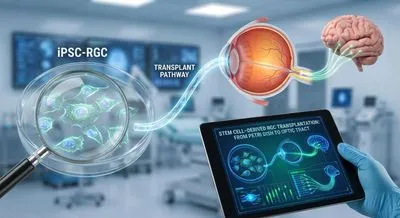
Stem Cell–Derived RGC Transplantation: From Petri Dish to Optic Tract
RGCs are not a uniform cell type. Dozens of RGC subtypes exist (e.g. motion-sensitive direction-selective cells, on/off center cells, intrinsically...
Deep research and expert guides on maintaining your visual health.
RGCs are not a uniform cell type. Dozens of RGC subtypes exist (e.g. motion-sensitive direction-selective cells, on/off center cells, intrinsically...
Blind spots often develop gradually without symptoms. Start a free trial and take a quick visual field test to spot changes early.
Find Out NowiPSC stands for induced pluripotent stem cell, a cell created by reprogramming an ordinary adult cell back into a stem-like state. These cells regain the ability to become many different kinds of cells in the body, such as nerve cells, heart cells, or retinal cells. Scientists make them by turning on a set of genes or using molecules that reset the cell’s identity without using embryos. Because they come from adult tissues like skin or blood, they avoid many of the ethical concerns tied to embryonic stem cells. iPSC are very useful for studying disease because they can be made from a patient’s own cells to model that person’s condition in the lab. Researchers can use them to test drugs, study how diseases develop, and explore ways to replace damaged tissue. They hold promise for personalized therapies where a patient could receive cells made from their own body, reducing the chance of immune rejection. However, making reliable, safe cell products is still challenging because reprogramming can introduce genetic changes and some iPSC-derived cells may form unwanted growths. Scientists are working to improve reprogramming methods, control cell differentiation better, and ensure long-term safety before widespread clinical use. Even with hurdles, iPSC technology has transformed biology by giving researchers a powerful, flexible tool to study human cells and imagine new treatments.