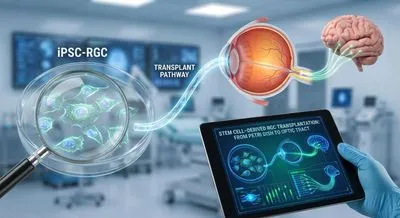
Stamcelleafledt RGC-transplantation: Fra petriskål til synsnervebane
Introduktion Glaukom er en førende årsag til irreversibel blindhed verden over, fordi de retinale ganglieceller (RGC'er), der forbinder øjet med hjern...
Dziļi pētījumi un ekspertu rokasgrāmatas par jūsu redzes veselības uzturēšanu.
Introduktion Glaukom er en førende årsag til irreversibel blindhed verden over, fordi de retinale ganglieceller (RGC'er), der forbinder øjet med hjern...
Introduktion Glaukom är en ledande orsak till irreversibel blindhet över hela världen, eftersom de retinala gangliecellerna (RGC) som förbinder ögat m...
Introduksjon Glaukom er en ledende årsak til irreversibel blindhet på verdensbasis, fordi de retinale ganglioncellene (RGC-er) som forbinder øyet med...
서론 녹내장은 눈과 뇌를 연결하는 망막 신경절 세포(RGC)가 죽고 재생되지 않아 전 세계적으로 되돌릴 수 없는 실명의 주요 원인입니다 (pmc.ncbi.nlm.nih.gov). RGC가 없으면 망막의 시각 신호가 뇌의 중심부(예: 외측 슬상핵 및 상구)에 도달할 수...
Introduzione Il glaucoma è una delle principali cause di cecità irreversibile a livello mondiale perché le cellule gangliari retiniche (CGR), che coll...
Εισαγωγή Το γλαύκωμα είναι η κύρια αιτία μη αναστρέψιμης τύφλωσης παγκοσμίως, επειδή τα αμφιβληστροειδικά γαγγλιακά κύτταρα (RGCs) που συνδέουν το μάτ...
Bevezetés A glaukóma az visszafordíthatatlan vakság vezető oka világszerte, mivel a szemet az aggyal összekötő retinális ganglionsejtek (RGC-k) elpusz...
บทนำ ต้อหินเป็นสาเหตุสำคัญของการตาบอดถาวรทั่วโลก เนื่องจากเซลล์ปมประสาทจอตา (RGCs) ซึ่งเชื่อมต่อตากับสมองตายและไม่สามารถสร้างใหม่ได้ (pmc.ncbi.nlm.nih...
Wprowadzenie Jaskra jest główną przyczyną nieodwracalnej ślepoty na całym świecie, ponieważ komórki zwojowe siatkówki (RGC), które łączą oko z mózgiem...
Introducere Glaucomul este o cauză principală a orbirii ireversibile la nivel mondial, deoarece celulele ganglionare retiniene (CGR) care conectează o...
Úvod Glaukom je celosvětově hlavní příčinou nevratné slepoty, protože gangliové buňky sítnice (RGC), které spojují oko s mozkem, odumírají a nemohou s...
Giới thiệu Bệnh tăng nhãn áp là nguyên nhân hàng đầu gây mù lòa không hồi phục trên toàn thế giới vì các tế bào hạch võng mạc (RGC) kết nối mắt với nã...
Pendahuluan Glaukoma adalah penyebab utama kebutaan ireversibel di seluruh dunia karena sel ganglion retina (RGC) yang menghubungkan mata ke otak mati...
Introdução O glaucoma é uma das principais causas de cegueira irreversível em todo o mundo porque as células gânglionares da retina (CGRs), que conect...
Introductie Glaucoom is wereldwijd een belangrijke oorzaak van onomkeerbare blindheid, omdat de retinale ganglioncellen (RGC's) die het oog met de her...
Sissejuhatus Glaukoom on maailmas peamine pöördumatu pimeduse põhjustaja, sest silma ajuga ühendavad võrkkesta ganglionirakud (RGC-d) surevad ega suud...
Giriş Glokom, gözü beyne bağlayan retinal ganglion hücrelerinin (RGC'ler) ölmesi ve yenilenememesi nedeniyle dünya çapında geri dönüşü olmayan körlüğü...
Introduction Le glaucome est une cause majeure de cécité irréversible dans le monde entier, car les cellules ganglionnaires de la rétine (CGR) qui con...
Sāciet bezmaksas redzes lauka testu mazāk nekā 5 minūtēs.
Sākt testu tagadiPSC stands for induced pluripotent stem cell, a cell created by reprogramming an ordinary adult cell back into a stem-like state. These cells regain the ability to become many different kinds of cells in the body, such as nerve cells, heart cells, or retinal cells. Scientists make them by turning on a set of genes or using molecules that reset the cell’s identity without using embryos. Because they come from adult tissues like skin or blood, they avoid many of the ethical concerns tied to embryonic stem cells. iPSC are very useful for studying disease because they can be made from a patient’s own cells to model that person’s condition in the lab. Researchers can use them to test drugs, study how diseases develop, and explore ways to replace damaged tissue. They hold promise for personalized therapies where a patient could receive cells made from their own body, reducing the chance of immune rejection. However, making reliable, safe cell products is still challenging because reprogramming can introduce genetic changes and some iPSC-derived cells may form unwanted growths. Scientists are working to improve reprogramming methods, control cell differentiation better, and ensure long-term safety before widespread clinical use. Even with hurdles, iPSC technology has transformed biology by giving researchers a powerful, flexible tool to study human cells and imagine new treatments.