
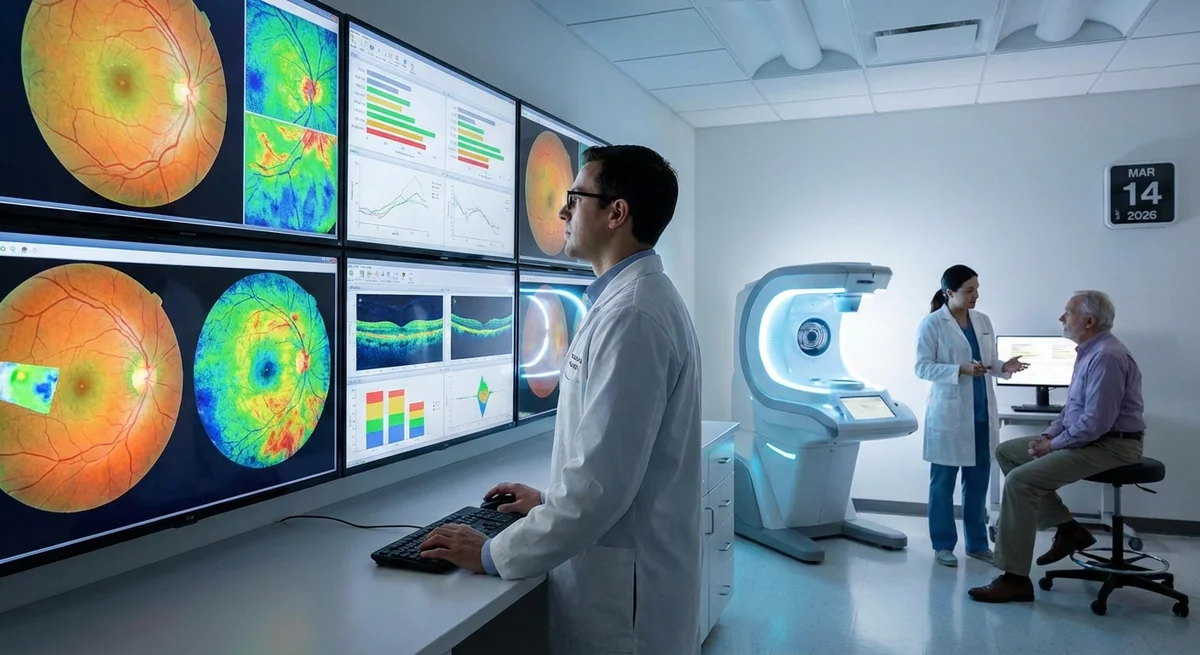
Could Better Scan Databases Help Catch Glaucoma Earlier? What a New March 2026 Study Found
Glaucoma is a sneaky eye disease that can steal vision if not caught early. To spot it sooner, eye doctors use special scans. One common scan is Optical Coherence Tomography (OCT) – think of it like an ultrasound, but it uses light instead of sound to take very detailed cross-sectional pictures of your retina (pmc.ncbi.nlm.nih.gov). OCT scans can reveal thinning of the nerve fiber layer in the eye years before you actually notice vision loss (pmc.ncbi.nlm.nih.gov). This makes OCT a powerful tool for early glaucoma detection.
Doctors don’t judge an OCT scan in isolation. Instead, the scan machine compares your eye measurements to a built-in reference database of healthy eyes. In simple terms, a reference database is a group of “normal” eye scans from people without glaucoma. When your eye is scanned, the machine checks: “Does this look like most healthy eyes, or is it thinner than normal?” (pmc.ncbi.nlm.nih.gov). If your measurement falls far outside the normal range (often shown in yellow or red on the report), the machine “flags” it as suspicious. These flags can alert your doctor to possible problems.
Recently, a new study (March 2, 2026) looked at how the size of that database affects these flags. The researchers created a “real-world” database of about 4,900 healthy eyes collected from optometry clinics and compared it to the usual smaller commercial database of about 400 eyes (www.reviewofoptometry.com). They found that, even though the average measurements were very similar between the two groups, the larger database made the “normal” range more precise (www.reviewofoptometry.com) (www.reviewofoptometry.com). In practice, this meant some eyes got flagged differently. In other words, a scan result that was labeled “outside normal” by the small database might fall inside the normal range with the bigger database – and vice versa.
The key reason is random variation. With only a few hundred eyes in the old database, the cutoff lines for “abnormal” have wider uncertainty. Adding thousands more healthy eyes “tightened” those cutoff lines (www.reviewofoptometry.com). The study authors noted that a larger normal database “should improve our ability to screen” for glaucoma (pmc.ncbi.nlm.nih.gov) (www.reviewofoptometry.com). In other words, more data helps the machine distinguish truly abnormal scans from healthy variation.
Why a scan can be helpful but not perfect
An OCT scan is very helpful because it shows the tiny layers of tissue at the back of your eye in great detail. Changes in those layers often appear years before vision problems. That’s why OCT can flag glaucoma earlier than some other tests (pmc.ncbi.nlm.nih.gov).
However, no scan or test is 100% perfect by itself (pmc.ncbi.nlm.nih.gov). OCT scans can be fooled by factors unrelated to glaucoma. For example, people who are very nearsighted (myopic) often have naturally thinner nerve fiber layers. One recent study found that myopic eyes can mimic glaucoma damage on an OCT scan – even when there’s no actual disease (pmc.ncbi.nlm.nih.gov). Other issues like cataracts, dry eyes, or even slight head tilt can affect the image. Also, OCT machines belong to different manufacturers and use different reference data, so results can vary slightly from one device to another.
Because of these factors, eye doctors never diagnose glaucoma with one scan alone (pmc.ncbi.nlm.nih.gov). The diagnosis usually combines multiple pieces of information: your eye pressure, optic nerve exam, visual field tests, and OCT results. In fact, glaucoma specialists emphasize that “there is no litmus test for glaucoma” – meaning no single test definitively proves it. They need agreement across several tests to reach a confident diagnosis (pmc.ncbi.nlm.nih.gov). This means a flagged OCT scan is a helpful clue, but doctors always look at the whole picture.
Could this reduce false alarms or missed cases?
A bigger reference database could help reduce false alarms (healthy eyes flagged as abnormal) and missed cases (glaucoma eyes flagged as normal). With a larger normal database, the study found that the cutoff values are more accurate and stable (www.reviewofoptometry.com) (www.reviewofoptometry.com). Imagine a healthy eye that’s just a bit thinner than average. In the small database, it might fall below the cutoff and raise an alarm. In a larger database, the cutoff line might shift so that eye is recognized as still within normal limits. This means fewer healthy eyes get wrongly labeled as suspicious.
Conversely, if an eye truly has early glaucoma changes, a more precise normal range might help catch it. In the study, some glaucoma eyes that slipped under the radar with the smaller database were flagged by the larger one. In fact, using the real-world data of nearly 5,000 eyes gave doctors “more accurate cut-off values of healthy eyes” (www.reviewofoptometry.com). Having tighter confidence bands around these cutoffs also helped identify the lowest 5% and 1% of normal measurements more reliably (www.reviewofoptometry.com). In practice, that could mean catching real disease earlier.
Overall, experts say the larger database “enhances...reliability” of the scan results and refines identification of outliers in the normal distribution (www.reviewofoptometry.com). In plain terms: bigger healthy-eye data makes the test smarter. It helps avoid unnecessary worry when your eye is actually fine, and it helps prevent missing early glaucoma in borderline cases.
What patients should remember when a scan report says borderline or abnormal
If your OCT report comes back borderline or outside normal limits, it’s a signal to pay attention – but not a final verdict. It means your eye’s measurements were close to or beyond the usual healthy range for the specific reference data used by that machine.
Because there’s no one-size-fits-all for OCT scans, it helps to ask questions. How was the test done? Is the machine comparing you to a younger group by mistake, or to an older one? Do you have any factors like nearsightedness that the report considers? In short, talk with your eye doctor about what the numbers mean in the context of your overall exam.
Often, doctors will repeat suspicious scans or do additional tests. For example, they may perform a visual field test (pushing a button when you see little lights) or take a closer look at the optic nerve in person. These comparisons across different tests help confirm whether glaucoma is really present or not (pmc.ncbi.nlm.nih.gov).
Remember that an “abnormal” or “yellow/red flag” on one scan doesn’t automatically mean glaucoma. Think of it like a yellow traffic light – it’s a warning to slow down and investigate more, not to slam on the brakes with panic. The March 2026 study reminds us that as technology improves (for example, by using bigger normal databases), the tests may become even more reliable. But the doctor’s judgment and a combination of tests remain key.
In summary, OCT scans are very useful for screening, but they have limitations. Recent research suggests that using larger, more diverse databases of healthy eyes can make these scans more accurate (pmc.ncbi.nlm.nih.gov) (www.reviewofoptometry.com). Until such databases become standard in clinics, remember: a borderline result means maybe pay more attention or get a second opinion, but it’s not a stamp of disease on its own. Always follow up with your eye care professional and continue regular check-ups to keep an eye on changes over time.