
A New Way to Read Eye Scans in Glaucoma: Can 3D Nerve Fiber Shape Improve Detection?
To check the RNFL, doctors commonly use optical coherence tomography (OCT), a non-invasive imaging test that takes cross-sectional “slice” pictures...
Deep research and expert guides on maintaining your visual health.
To check the RNFL, doctors commonly use optical coherence tomography (OCT), a non-invasive imaging test that takes cross-sectional “slice” pictures...
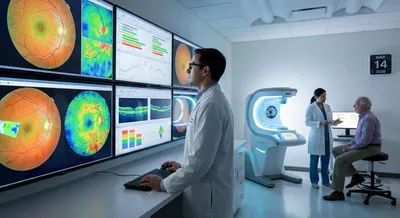
Doctors don’t judge an OCT scan in isolation. Instead, the scan machine compares your eye measurements to a built-in reference database of healthy...
Screen your peripheral vision from home — no downloads, no waiting rooms. Sign up for a free trial and test in under 5 minutes.
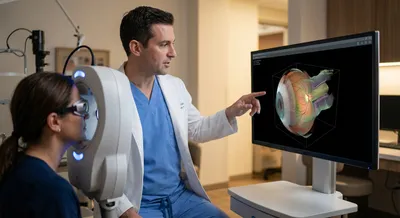
An eye scan is a medical picture of the internal parts of the eye taken with special machines. It can show structures like the retina, optic nerve, cornea, and the layers of tissue that carry visual information. Doctors use different kinds of scans depending on what they need to see; some give a flat, wide view while others reveal thin slices or layers. Most eye scans are quick, noninvasive, and painless, and they can be done during a routine eye exam. The images help eye doctors spot changes that are too small to see with a regular exam, such as early tissue thinning, swelling, or fluid buildup. Because many eye diseases start without obvious symptoms, scans are important for catching problems early when treatment is is most effective. Scans are also used to track how a condition changes over time and to judge whether a treatment is working. For patients, an eye scan can mean earlier diagnosis, better monitoring, and a greater chance of preserving vision.