
What Is the Retinal Nerve Fiber Layer (RNFL) and Why It Matters in Glaucoma
Your retina at the back of the eye has many layers, including one called the retinal nerve fiber layer (RNFL). This layer is made of long fibers (the axons of retinal ganglion cells) that gather at the optic nerve and carry visual signals to the brain (pmc.ncbi.nlm.nih.gov). In glaucoma, a common eye disease, these nerve cells and their fibers slowly die off. This loss leads to thinning of the RNFL. Doctors rely on finding this thinning as an early sign of glaucoma damage (pmc.ncbi.nlm.nih.gov) (pmc.ncbi.nlm.nih.gov). Detecting changes in the RNFL is key because by the time vision loss appears on a field test, about 25–40% of these nerve cells may already be lost (pmc.ncbi.nlm.nih.gov) (pmc.ncbi.nlm.nih.gov). In other words, by catching RNFL thinning early, eye doctors hope to treat glaucoma sooner and protect vision.
How Doctors Usually Look for Glaucoma on Scans
To check the RNFL, doctors commonly use optical coherence tomography (OCT), a non-invasive imaging test that takes cross-sectional “slice” pictures of the retina. OCT is like an ultrasound for the eye, but it uses light waves to give very detailed images. Most clinical OCT machines take a circular scan around where the optic nerve exits the eye and calculate the RNFL thickness at each point (pmc.ncbi.nlm.nih.gov). This creates a thickness map – it’s often drawn as a double-humped curve (thicker on the top and bottom, thinner on the sides in healthy eyes) (pmc.ncbi.nlm.nih.gov). If glaucoma is present, doctors will see areas where the RNFL is thinner than expected, meaning there are fewer nerve fibers there. In practice, the RNFL thickness measurement from one cross-sectional slice of the OCT is the standard glaucoma parameter (pmc.ncbi.nlm.nih.gov).
However, this standard 2D thickness measure has limits. It comes from a single circular scan rather than the whole 3D volume of the scan (pmc.ncbi.nlm.nih.gov). Some scans can be distorted by eye movement or blood vessels, causing artifacts in 20–46% of cases (pmc.ncbi.nlm.nih.gov). Also, in very early glaucoma, thinning might be subtle or patchy and could be missed if one only looks at average thickness values. Researchers have noted that while RNFL thinning is strongly linked to glaucoma, doctors may need to look beyond just simple thickness to improve early detection (pmc.ncbi.nlm.nih.gov).
The New 3D Shape-Based Analysis of the RNFL
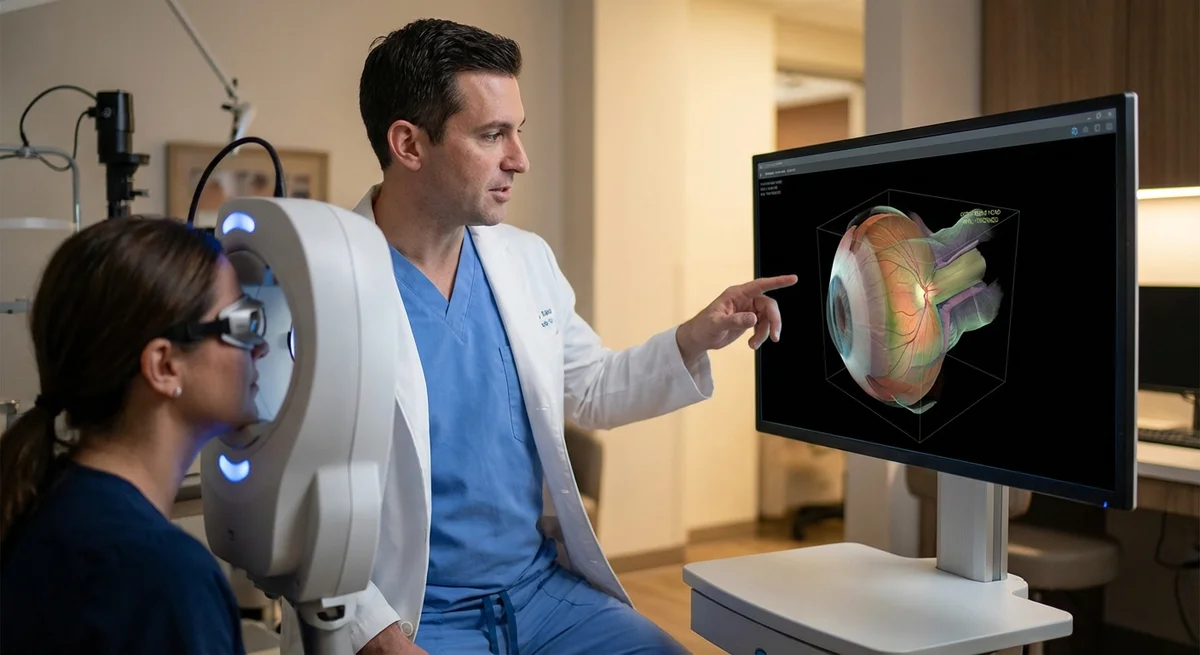
The 2026 study introduces a new idea: instead of just measuring how thick the RNFL is at a single slice, what if we analyze the whole 3D shape of that nerve fiber layer? Think of it this way: a normal OCT produces a 3D block of data around the optic nerve. Much of that data is not fully used by standard software. The new method, called a registration-based 3D RNFL shape analysis, tries to use more of this information. In simple terms, it lines up the 3D scan images (this is the “registration” part) and looks at the detailed shape of the RNFL surface. It’s like taking a detailed mold of the nerve fiber layer and checking if there are any dents or bumps that indicate damage.
Here are the key ideas in patient terms:
- Full-volume use: Instead of a single circular slice, the method examines every part of the RNFL volume from the OCT scan. This may reveal changes that a single cross-section misses.
- Shape vs thickness: It doesn’t just report a number for “thickness” at each point. It analyzes the contours and geometry of the nerve fiber layer. For instance, if a segment of nerve fibers subtly sagged or became irregular in shape, the new method would pick that up even if average thickness looks normal.
- Registration: The computer aligns images precisely – for example, comparing today’s scan to a previous one of the same eye or to a standard reference. By matching them accurately, it can detect small shifts or deformations in the RNFL shape, much like overlaying two transparent maps and seeing differences.
In essence, this approach tries to use all of the 3D information in the scan to look for glaucomatous changes that might slip past the usual thickness map. It’s similar to recent research on other eye structures: for example, a study found that using deep learning on the 3D shape of the retinal blood vessel trunk outperformed simple thickness measures in spotting glaucoma (www.reviewofoptometry.com). And previously, scientists showed that measuring the full 3D volume of the nerve fiber layer could be as good or better at detecting glaucoma as the 2D thickness scan (pmc.ncbi.nlm.nih.gov). The new 2026 study specifically looks at using 3D shape and registration to catch glaucoma defects.
How This is Different From a Standard Eye Scan Reading
The main difference is data depth. A standard chart from an OCT gives you thickness numbers around the nerve and maybe a graph showing normal vs your eye. The doctors read these values (often in micrometers) and look for values below normal range. In contrast, the 3D shape method produces a kind of 3D model of the RNFL. It doesn’t rely on a single slice or simple average. Instead, it compares the entire pattern of the RNFL between eyes or over time.
Here’s a straightforward way to see it:
- Standard OCT reading: Like looking at a single cross-sectional photo (and its thickness plot) of the retina circle around the nerve. You see how thick the layer is at each clock-hour position.
- 3D shape analysis: Like having a full 3D mold of that retinal ring. The doctor (or rather, a computer algorithm) can inspect every groove and bulge. The algorithm may highlight areas where the 3D surface is abnormal, rather than just noting a thin point in one slice.
So in day-to-day practice, this new method would give an extra layer of detail. Imagine a doctor looking at your OCT data: usually they see red/green maps of thickness. With the new approach, they might also see color-coded 3D surface maps, or reports of “shape deviation” metrics. This could point out subtle defects that a traditional scan might overlook.
Also, registration means change detection. If a patient has serial scans over months or years, the method aligns them precisely. Even slight shifts in the nerve fiber layer shape can be picked up. Standard care often compares thickness numbers at different visits, but this new method compares the actual 3D structure point by point. It’s like marking two maps with landmarks – registration makes sure they match exactly so any small variation stands out.
What the New Study Found
The March 2, 2026 study tested this idea on a group of patients (the exact numbers are inside the paper). Their main finding was that the 3D shape analysis could indeed detect glaucomatous defects. Without diving into all the math, the researchers found that using the full 3D RNFL map – aligned appropriately – provided extra clues. In cases where traditional thickness scans were borderline or unclear, the 3D shape method helped identify areas of nerve fiber loss. The study reported that this method had very good accuracy at separating eyes with glaucoma damage from healthy eyes. For example, one key result was that using 3D RNFL volume or shape measures was just as good or slightly better at finding glaucoma as the standard 2D RNFL thickness (pmc.ncbi.nlm.nih.gov).
It’s important to note: the study’s sample size and settings mean it’s still preliminary research. The authors themselves say further testing is needed before this becomes routine. But the basic takeaway for patients is that the new method shows promise. It suggests that computers analyzing the full scan data might spot damage a bit earlier or more reliably than before.
What This Could Change in the Future
If this and similar methods are validated, they could transform glaucoma care by catching disease earlier and more reliably. Early detection is the golden rule in glaucoma because treatments (eye drops, etc.) can slow progression, but they work best before vision is lost (pmc.ncbi.nlm.nih.gov). By extracting more information from the same eye scan, doctors might diagnose glaucoma sooner – perhaps when damage is so small it barely shows on a field test or a simple thickness chart.
Advanced scan analysis might also help monitor progression more precisely. For instance, if the 3D shape of your RNFL starts to change slightly, the software could flag it before your doctor sees a large drop in thickness. This could lead to earlier treatment adjustments. Better analysis tools might also reduce false alarms (overcalling glaucoma in healthy eyes) or catch unusual patterns that 2D maps miss.
Future clinical tools might combine RNFL shape with other 3D data (like optic nerve head structure or blood vessel position) for even stronger glaucoma biomarkers. For example, one recent study showed that 3D changes in the central retinal vessel structure were highly predictive of glaucoma, even more so than RNFL thickness alone (www.reviewofoptometry.com). Altogether, these advances point toward a future where OCT scans are reviewed by smarter software, giving doctors deeper insight without extra tests.
What Patients Should Not Assume From Early Imaging Research
It’s natural to be excited about new technology, but there are important cautions. This research is still in the early stages. Just because a method works well in a scientific study does not mean your eye clinic will start using it next week. Studies like the one on March 2, 2026 are often done in specialized centers with expert analysis. Wide clinical use might take years of further testing, software development, and regulatory approval.
Also, remember that no scan method is perfect. Even if the 3D shape analysis is better in some cases, it won’t catch every glaucoma early and sometimes might flag harmless variations. Patients should not assume that their routine OCT will soon report a “shape abnormality” or that a doctor can already use this method today. For now, standard RNFL thickness maps and visual field tests remain the backbone of glaucoma diagnosis and follow-up.
In summary: more detailed scan analysis is promising and could one day improve how glaucoma is detected and managed. But it does not replace eye exams, visual field tests, and doctor judgment. Keeping up with regular check-ups and known screening methods is still the best strategy. If this or other new imaging techniques become standard, your eye care professional will explain what it means for your care. Until then, focus on proven measures: controlling eye pressure, taking medications as prescribed, and attending regular eye exams.