
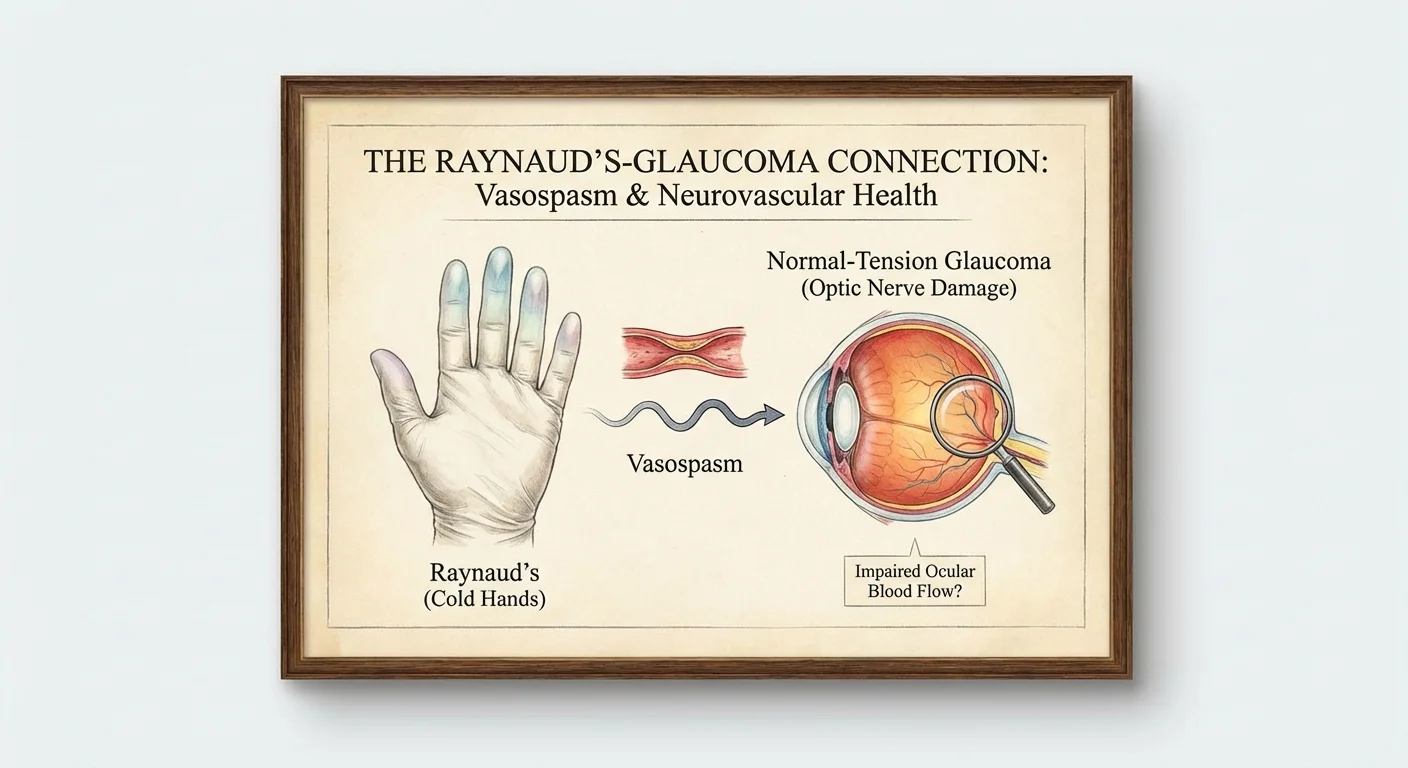
Vasospasm, Cold Hands, and Normal-Tension Glaucoma: The Raynaud’s Connection
Glaucoma is usually linked to high eye pressure, but in normal-tension glaucoma (NTG) the optic nerve is damaged even when eye pressure is normal. Researchers have long suspected that blood flow problems play a role in NTG. In fact, many NTG patients have symptoms of vascular dysregulation (abnormal control of blood vessels), such as Raynaud’s phenomenon, migraines, or low blood pressure (pmc.ncbi.nlm.nih.gov) (pmc.ncbi.nlm.nih.gov).
Raynaud’s phenomenon is a condition where cold or stress causes the small arteries in the fingers and toes to spasm and shut down blood flow (turning the skin white then blue) (pmc.ncbi.nlm.nih.gov). This exaggerated vasoconstriction is a clear example of vascular dysregulation. Interestingly, studies show that people with NTG are more likely to have cold hands (Raynaud’s) than those without glaucoma (pmc.ncbi.nlm.nih.gov) (pmc.ncbi.nlm.nih.gov). In one study of 246 NTG patients and over 1,100 controls, symptoms like cold hands or feet were significantly more common in the NTG group (pmc.ncbi.nlm.nih.gov). Likewise, a review on NTG noted that “Raynaud’s phenomenon, migraine, [and] nocturnal systemic hypotension” are among the main associated factors for NTG (pmc.ncbi.nlm.nih.gov).
These findings suggest that the optic nerve damage in NTG may come from inadequate blood supply rather than pressure. When blood vessels in the body (and eye) over-react to cold or stress, the optic nerve can suffer from repeated mild ischemia (low oxygen) and ‘reperfusion injury’ (damage when blood returns) (pmc.ncbi.nlm.nih.gov) (pmc.ncbi.nlm.nih.gov). In short, NTG may in part be a vascular glaucoma, and Raynaud’s is one visible sign of that vascular trouble.
How Cold Tests Reveal Vascular Problems
To study this connection, researchers use cold provocation tests and blood-flow measurements. A common test is the cold pressor test: a patient immerses a hand in ice water for about a minute, and doctors measure how much the finger temperature drops. In healthy people, the drop is modest; in someone with Raynaud’s or vasospasm it is large.
For example, a 2021 study had 113 NTG patients (with well-controlled low eye pressure) dip a hand in ice water and then measured finger temperature (pmc.ncbi.nlm.nih.gov) (pmc.ncbi.nlm.nih.gov). NTG patients showed a significantly larger temperature drop than normal controls (about 31.8% vs. 27.0% after one minute, P=0.042) (pmc.ncbi.nlm.nih.gov). Moreover, within the NTG group, those with greater finger cooling progressed faster: they lost visual field (vision) more rapidly than those with milder cooling (pmc.ncbi.nlm.nih.gov). In other words, “an excessive drop in finger temperature after ice water was significantly associated with faster visual field progression” in NTG (pmc.ncbi.nlm.nih.gov). This suggests that strong peripheral vasospasm predicts worse glaucoma, presumably because it reflects similar constriction in the eye’s blood vessels.
Another study directly imaged the eye’s blood flow during a cold test (pmc.ncbi.nlm.nih.gov). Using laser flowmetry on the optic nerve head (ONH) and video capillaroscopy on fingernails, Takahashi et al. compared 14 NTG patients to 15 healthy controls (pmc.ncbi.nlm.nih.gov). They found that in NTG the optic nerve head vessels and finger capillaries showed abnormally large constrictions after cold stress, while facial vessels actually dilated (widened) more than normal (pmc.ncbi.nlm.nih.gov). In plain terms, NTG patients’ eye blood flow and finger blood flow drop much more in response to cold than in healthy people. This abnormal vasoreactivity (vessel response) is a hallmark of vascular dysregulation (pmc.ncbi.nlm.nih.gov) (pmc.ncbi.nlm.nih.gov).
Many older studies have likewise found nailfold capillary abnormalities in NTG and glaucoma patients (pmc.ncbi.nlm.nih.gov). For instance, combining cold tests with magnified observation of the tiny blood vessels at the base of a fingernail (nailfold capillaroscopy) often shows that glaucoma patients’ capillaries constrict excessively (pmc.ncbi.nlm.nih.gov). One research background notes that “studies have reported excessive nailfold capillary constriction” during cold tests in glaucoma patients, and even links this constriction to faster field loss (pmc.ncbi.nlm.nih.gov). In summary, cold-provocation tests and microcirculation measures consistently show that NTG patients have overly reactive vessels – just like in Raynaud’s.
Vascular Dysregulation Increases Glaucoma Risk
Why does this matter? The optic nerve is sensitive to blood flow. If the vessels feeding it are prone to spasm, the nerve can suffer repeated mild ischemic hits. Over time, this can cause optic nerve fibers to die and vision to worsen. This is especially significant in NTG, where pressure is not high to explain the damage.
Beyond the cold tests, large surveys support the Raynaud-NTG link. As noted, the Flammer syndrome questionnaire found NTG patients report cold extremities, migraines, and other vascular dysregulation symptoms far more often than people without glaucoma (pmc.ncbi.nlm.nih.gov). A 2017 study concluded that “There is an association between normal tension glaucoma and Flammer syndrome” (the term Flammer syndrome is often used to describe such vascular dysregulation) (pmc.ncbi.nlm.nih.gov). The authors suggested that if this link holds up, then treating the vascular issues might help slow NTG progression (pmc.ncbi.nlm.nih.gov).
Specific risk factors also tie in. Patients with NTG often have episodic low blood pressure at night (which lowers eye perfusion) and other circulatory issues (pmc.ncbi.nlm.nih.gov). Studies mention that low systemic blood pressure and blood-pressure fluctuations can increase NTG risk (pmc.ncbi.nlm.nih.gov). In case reports, doctors even note a patient who used timolol eye drops (a beta-blocker) developed Raynaud’s symptoms, showing that drugs which constrict vessels can trigger vasospasms (pubmed.ncbi.nlm.nih.gov).
Critically, data show that the degree of vascular dysregulation relates to disease progression. The cold-pressor study (pmc.ncbi.nlm.nih.gov) is a prime example: greater peripheral vasospasm meant faster field loss. Other work hints at similar patterns: abnormal nailfold patterns in NTG patients were associated with more optic disc hemorrhages and worse glaucoma findings (pubmed.ncbi.nlm.nih.gov). In short, if an NTG patient also has Raynaud’s-like signs, they may be at higher risk of glaucoma worsening. Monitoring such patients more closely for progression makes sense.
Coping Strategies: Stay Warm and Manage Stress
Given this link, one obvious recommendation is warmth. Keeping your hands (and body) warm helps prevent the vasospasm that triggers Raynaud’s attacks (pmc.ncbi.nlm.nih.gov) (pmc.ncbi.nlm.nih.gov). For example, people with Raynaud’s are advised to wear gloves and warm clothing in cold weather, use heated hand-warmers, and avoid sudden temperature drops (pmc.ncbi.nlm.nih.gov). Smoking should be avoided too (it can injure vessel linings), and one should steer clear of drugs that tighten vessels (pmc.ncbi.nlm.nih.gov). Indeed, in Raynaud’s care the first step is purely protective: “conservative measures, including keeping warm and avoiding drugs with vasoconstrictive effects” (pmc.ncbi.nlm.nih.gov). This applies equally to anyone with NTG and cold hands. By staying warm, you reduce episodes where blood flow to the hand (and potentially the eye) is cut off.
Managing stress is another key tip. Emotional anxiety can trigger roughly one-third of Raynaud’s episodes (pmc.ncbi.nlm.nih.gov). Most of us do not think of stress as causing physical blood vessel spasms, but it can. Patients with Raynaud’s often have higher anxiety or depression, and these can worsen attacks (pmc.ncbi.nlm.nih.gov). Relaxation exercises, breathing techniques, or mind-body therapies can help. In one study with patients who had disease-related Raynaud’s, an eight-week course of daily guided-imagery meditation significantly reduced the severity of their attacks and improved quality of life (pmc.ncbi.nlm.nih.gov). Even biofeedback training (learning to consciously warm your hands) can be helpful for some people. In practical terms, finding ways to calm down – whether through yoga, meditation apps, or hobbies – may reduce Raynaud’s flares and thereby might indirectly protect your optic nerve from recurrent underperfusion episodes.
Other general health measures also help maintain good circulation. Keeping blood pressure stable (especially avoiding drops at night) is wise; your doctor may monitor 24-hour blood pressure if NTG is present. Regular moderate exercise can improve overall vascular health (though in severe Raynaud’s one should avoid extreme cold during workouts). Staying well-hydrated, and treating any anemia or hormonal issues (like thyroid problems) that affect vessels, can also support better blood flow.
In summary, counseling usually focuses on mitigating triggers. Key points to discuss with patients are:
- Layer up in cold weather (gloves, warm socks, a scarf).
- Avoid tight gloves or watches that could cut circulation.
- Quit smoking if applicable.
- Limit caffeine or decongestants, which can constrict vessels.
- Identify stressors and use relaxation techniques daily.
- Report any new dizziness or fainting, since very low blood pressure can worsen NTG.
These measures are low-cost, low-risk, and may slow glaucoma damage by keeping blood vessels open.
Calcium-Channel Blockers: A Cautious Look
When lifestyle steps aren’t enough, doctors sometimes consider medications. In Raynaud’s disease (primary Raynaud’s), oral calcium-channel blockers (CCBs) like nifedipine are the most common drugs used to relax blood vessels (pmc.ncbi.nlm.nih.gov). However, even for Raynaud’s the benefits are limited. A Cochrane review found CCBs minimally effective: they reduced the frequency of attacks by only about 1.7 per week on average, and had little effect on attack severity (pmc.ncbi.nlm.nih.gov). People may get some relief, but headaches, flushing and swelling are common side-effects (pmc.ncbi.nlm.nih.gov). Thus, CCBs are described as first-line drugs only if warm-ups alone fail (pmc.ncbi.nlm.nih.gov) (pmc.ncbi.nlm.nih.gov).
What about NTG? The idea is that by dilating vessels, CCBs could improve optic nerve perfusion. Some small trials have tested this. For instance, in Japan a longer-term study (3 years) of nilvadipine (a CCB that can affect the eye) suggested it improved blood flow to the optic nerve and slowed damage (pmc.ncbi.nlm.nih.gov). In fact, older ophthalmology reviews note that some NTG patients treated with nilvadipine had “significant reduction in the rate of disc and field damage” (pmc.ncbi.nlm.nih.gov).
However, these studies are limited in size and not all are consistent. More recent evidence has not shown a clear benefit of CCBs for NTG. In a large population study (UK Biobank, 2023), researchers actually found that people on systemic CCBs had higher odds of glaucoma and thinner nerve layers, without any lowering of eye pressure (pmc.ncbi.nlm.nih.gov). The authors concluded this might represent an adverse effect: CCBs were associated with 39% higher odds of glaucoma and thinner retinal nerve layers (pmc.ncbi.nlm.nih.gov). This does not prove CCBs cause glaucoma, but it certainly fails to support them as an obvious fix.
In practice, most eye doctors remain cautious. Topical beta-blockers (like timolol eye drops) are known to occasionally trigger Raynaud’s in susceptible people (pubmed.ncbi.nlm.nih.gov). Oral CCBs can lower blood pressure and cause side effects (dizziness, fast heart rate), so doctors weigh the options carefully. At present, calcium blockers are not part of routine NTG treatment guidelines except in special cases. They might be tried if a patient truly has severe vasospasm unresponsive to other measures – and even then, expectations are modest. If a patient is already on CCB for hypertension, there is no clear reason to stop it based on current evidence, but Dr. should be aware of these findings and monitor eye status closely (pmc.ncbi.nlm.nih.gov).
Counseling and Risk Assessment
Putting this together, here is how a clinician might counsel a patient and stratify risk:
-
Ask about systemic symptoms. In a patient with NTG, the doctor should ask if they experience cold hands/feet, migraines, frequent neck pain, or dizziness on standing. Positive answers suggest vascular dysregulation. (Likewise, someone with diagnosed Raynaud’s should be screened for NTG if they have any visual complaints.)
-
Identify modifiable factors. Ensure systemic blood pressure isn’t too low (especially at night), and manage it if needed. Control other vascular risks – e.g. avoid strong blood pressure medications at night, since over-dipping can starve the optic nerve.
-
Monitor more closely if risk is high. If the patient has multiple vasospastic signs (cold extremities, history of migraine, low blood pressure), they may be at higher risk of fast progression. This may justify more frequent visual field tests or optic nerve imaging than usual, even if pressures are on target.
-
Emphasize lifestyle changes. For any NTG patient with cold sensitivity, reinforce the thermal protection measures and stress management discussed above. Explain that these aren’t cures but could slow down damage by keeping blood flow steady.
-
Consider consulting specialists. In refractory cases, collaboration with a rheumatologist or internist can help. They may perform nailfold capillaroscopy or other tests to quantify vasospasm. In some centers, 24-hour BP monitoring is done. Specialists may also guide on possible off-label treatments, if any, beyond calcium blockers (like PDE5 inhibitors, etc. – though evidence there is even sparser).
-
Supportive care. Address patient concerns: cold hands are uncomfortable and worrying. Provide clear guidance on how environmental changes can help both Raynaud’s and eye health. Encourage patient self-monitoring of finger color/temperature changes.
Risk stratification: We can broadly tag NTG patients into “low vs. high vascular risk”. Those with NTG and clear Raynaud’s symptoms are in a higher-risk category. They should be told: “You have an optic nerve condition that is partly influenced by blood flow. Your history of cold-induced finger color changes suggests your blood vessels are extra sensitive. That means we need to be especially vigilant about protecting your eyes and controlling all risk factors.” On the other hand, an NTG patient without any Raynaud’s, migraines, or hypotension can be followed in the standard way, focusing mainly on keeping eye pressure conservative.
Throughout counseling, we stress that IOP lowering is still important. Often NTG patients are treated with eye drops to reduce pressure by 25–30%. But in addition, they should do everything possible to maximize eye perfusion. Balanced blood pressure (not too high or low), avoidance of vasoconstrictors, and warm blood supply can complement IOP therapy.
Conclusion
In summary, there is a growing recognition that vascular dysregulation – manifesting as Raynaud’s phenomenon, cold extremities, and other circulation issues – can make the optic nerve vulnerable at normal eye pressure. Cold-provocation tests and blood-flow measurements show NTG patients have exaggerated vasospasm (pmc.ncbi.nlm.nih.gov) (pmc.ncbi.nlm.nih.gov). When NTG patients exhibit these signs, they appear more likely to worsen faster.
Patients with NTG should be counseled not only on eye drops, but also on protecting their circulation. Keeping warm, staying relaxed, and avoiding vessel-tightening behaviors are practical steps. Drugs like calcium-channel blockers may help in rare cases of severe vasospasm, but their benefits for eye health are unproven and debated (pmc.ncbi.nlm.nih.gov) (pmc.ncbi.nlm.nih.gov).
Ultimately, a patient with NTG and cold hands should be informed that their systemic condition affects their eye risk. Regular eye exams, careful blood pressure control, and healthy habits geared toward good circulation offer the best strategy. By combining pressure reduction with attention to blood flow, we give the optic nerve the best chance of staying healthy.