
Glaucoma affects more than the eye
Glaucoma is best known as a disease of the optic nerve and retina, but modern brain scans show it also involves the brain’s vision centers. Studies using MRI have found that people with glaucoma often have smaller brain structures and weaker connections in visual areas compared to healthy people (www.frontiersin.org) (www.frontiersin.org). For example, a review in Frontiers in Neuroscience (2018) found thinner cortex in visual brain regions (lower volume in V1 and other visual areas) and abnormal blood-oxygen signals on fMRI in glaucoma patients (www.frontiersin.org). These findings suggest that damage in the eye can travel “backwards” along the visual pathway, a process known as trans-synaptic degeneration. In other words, when retinal ganglion cells die in glaucoma, connected neurons in the lateral geniculate nucleus (LGN) and visual cortex can shrink or lose function too (www.frontiersin.org) (www.repository.cam.ac.uk).
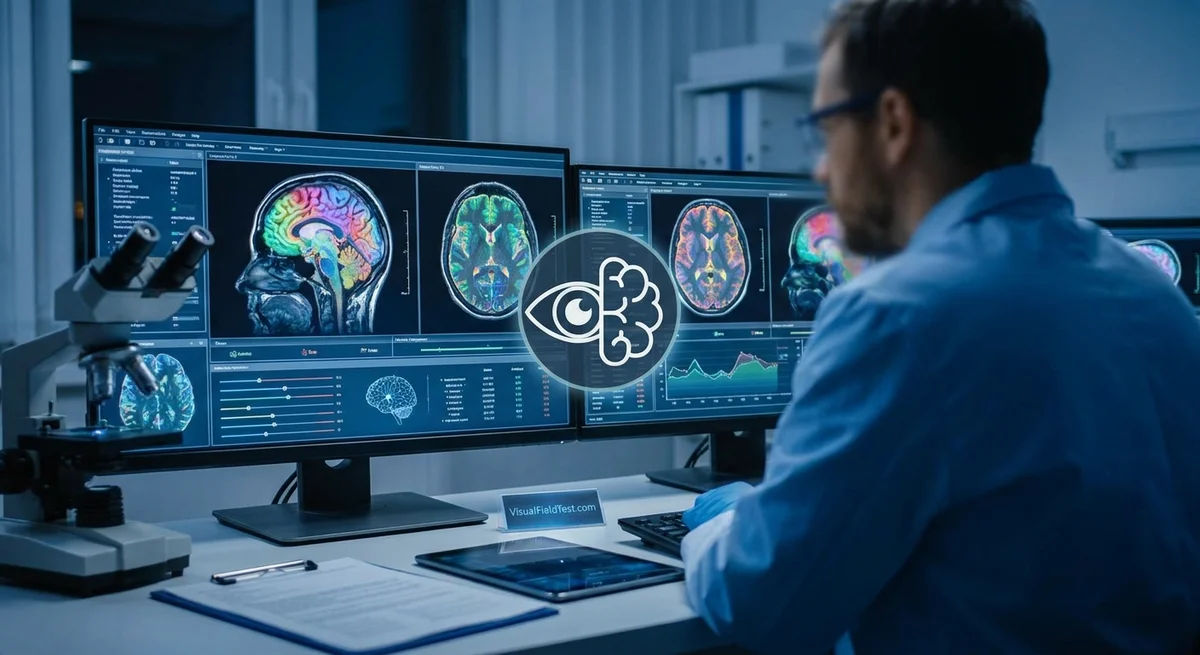
Doctors and researchers use advanced MRI techniques to track these changes. One method is diffusion tensor imaging (DTI), which traces the brain’s white-matter fiber tracts. DTI has revealed rarefaction (thinning) of the optic radiations (the fibers from the LGN to visual cortex) in glaucoma patients, reflecting loss of nerve fibers (www.repository.cam.ac.uk). Graph-theory analysis of DTI data even shows wide-range network changes: glaucoma patients have altered connectivity not just in visual areas but also in regions for movement and emotion (www.repository.cam.ac.uk). In functional MRI (fMRI) scans, which measure brain activity, glaucoma patients often show reduced activation in the primary visual cortex (V1) when viewing images, and weaker functional connections between visual areas (www.frontiersin.org) (www.repository.cam.ac.uk). In short, the brain imaging paints a consistent picture: glaucoma is associated with degeneration of the central visual pathway and disruption of normal network activity.
MRI studies also measure cortical thickness – the thickness of the gray-matter surface. Several studies report that glaucoma patients have a thinner visual cortex. For instance, one MRI study found that people with open-angle glaucoma had significantly lower V1 thickness and smaller LGN volumes compared to controls (pmc.ncbi.nlm.nih.gov). These structural losses correlated with vision: in that study, thinner V1 and smaller LGN were tied to worse visual field scores (larger cup-to-disc ratio) (pmc.ncbi.nlm.nih.gov). Interestingly, brain changes are not limited to vision areas; some patients show thinning in non-visual regions like the frontal pole and amygdala (pmc.ncbi.nlm.nih.gov), which may relate to the stress or cognitive aspects of living with glaucoma. All together, these results confirm that eye damage in glaucoma leads to measurable brain atrophy and thinning, especially in visual pathways (www.frontiersin.org) (pmc.ncbi.nlm.nih.gov).
Brain plasticity and reorganization
The brain is not completely helpless in glaucoma – there is evidence of neuroplasticity (reorganization) that can help preserve function. When retinal cells die, nearby neurons or other pathways may adapt. Research in animals and patients shows that some retinal ganglion cells can recover function if treated early, and that the brain can adjust its wiring after long-term vision loss (pmc.ncbi.nlm.nih.gov) (www.frontiersin.org). For example, one study of mice found young animals could regain full retinal nerve function days after a pressure-induced injury, whereas older mice took much longer (pmc.ncbi.nlm.nih.gov). In humans, vision tests often improve after lowering eye pressure in mild glaucoma, suggesting surviving neurons ramp up activity (pmc.ncbi.nlm.nih.gov). On a brain level, functional MRI and connectivity studies hint that undamaged parts of the visual network may increase their connectivity to compensate for lost input (www.frontiersin.org) (www.frontiersin.org).
Specialized analyses (“AI analysis” or advanced computational modeling) are helping to spot subtle reorganization. For example, DTI-based network models found that glaucoma patients show higher clustering (stronger local connectivity) in certain occipital regions, perhaps reflecting an attempt to reroute visual information (www.repository.cam.ac.uk). Overall, imaging suggests the adult visual cortex retains some flexibility: it can partially reorganize blood flow and synaptic connections after injury (www.frontiersin.org) (www.frontiersin.org). However, this plasticity has limits. If the retinal loss is too severe or the disease is advanced, many neurons are gone and the cortex thinning becomes irreversible (www.frontiersin.org) (pmc.ncbi.nlm.nih.gov).
MRI biomarkers of resilience
Researchers are now eager to find which brain changes predict better or worse outcomes. The hope is to identify biomarkers — MRI features that indicate who is resilient (maintains vision) versus who might benefit most from therapy. For instance, if a patient’s visual cortex is still relatively thick and its connections largely intact on DTI/MRI, they may have a reserve that could support recovery with treatment. Conversely, early signs of LGN shrinkage or optic radiation damage might signal rapid progression.
Some candidate biomarkers have emerged from studies. One approach is to correlate brain metrics with vision tests. The network/connectivity study mentioned above found that thinner retinal nerve fiber layer (from OCT eye scans) was linked to abnormal connectivity in the amygdala and temporal lobe on MRI (www.repository.cam.ac.uk). This suggests combining retinal imaging and brain scans could flag patients whose brains are “keeping up” with the damage. Another study showed a tight correlation: eyes with worse visual field loss had thinner V1 cortex and smaller LGN on MRI (pmc.ncbi.nlm.nih.gov). In practice, a patient with preserved V1 thickness or high-fidelity DTI pathways might be more likely to maintain vision if treated. These ideas are still being tested, but the principle is that MRI measures of visual pathway integrity could one day help predict individual outcomes (pmc.ncbi.nlm.nih.gov) (www.repository.cam.ac.uk).
Fusion of eye and brain imaging
To get the best picture of glaucoma, experts advocate multimodal imaging – combining eye tests and brain scans. For example, optical coherence tomography (OCT) can precisely measure the retina’s nerve layers, while MRI assesses the brain. One recent study explicitly linked these: it found associations between OCT measures (like macular ganglion cell layer thickness) and brain connectivity. In that work, weaker connectivity in certain brain nodes went along with thinner retinal layers (www.repository.cam.ac.uk). This kind of fusion could improve disease staging (knowing how advanced it is) and help select patients for neuroprotective treatments or rehabilitation. In future clinical trials, doctors might require both OCT and brain MRI to choose patients whose brains have enough intact wiring to benefit from therapy (www.repository.cam.ac.uk) (www.frontiersin.org).
Another practical example: combining visual field tests (functional eye exam) with MRI-based biomarkers. If a patient shows stable visual fields but MRI reveals worsening LGN atrophy, that might prompt earlier intervention. Conversely, some patients with significant field loss might still have relatively strong brain networks and be good candidates for neuroenhancement techniques. By bringing together ocular data (OCT, field tests) and neuroimaging, clinicians aim for a fuller assessment than either can provide alone.
Future directions: longitudinal studies and rehabilitation
Most MRI studies so far are “snapshots” of patients at one time. The next big step is longitudinal research – following the same patients over months or years. Such studies would track how brain imaging markers change over time, especially after interventions. For instance, if a glaucoma patient undergoes a visual training program or starts a neuroprotective drug, we could see whether their MRI markers (like V1 thickness or connectivity) show positive changes. Researchers suggest linking plasticity markers to rehab outcomes: do patients who show early signs of brain reorganization on fMRI end up gaining more vision with therapy?
Some clues are emerging. A 2023 trial used virtual-reality visual training in glaucoma patients. After three months, the patients showed a slight increase in the thickness of the macular ganglion cell layer (measured by OCT) and improved sensitivity in the trained visual field area (journals.sagepub.com). This provides proof-of-concept that training can induce structural and functional recovery. The next question is whether MRI could predict or monitor such gains. For example, one could imagine an fMRI before and after visual training: patients whose brain response in V1 improves might also have better vision outcomes.
Another angle is lifestyle: preliminary evidence (mostly from animal studies) suggests exercise and diet can boost retinal recovery (pmc.ncbi.nlm.nih.gov). It would be valuable to see if these general measures reflect in brain scans (e.g. preserved visual cortex thickness in exercising patients).
In short, doctors and scientists see a path forward: use advanced imaging over time to identify early brain plasticity signals, and link them to vision test results. This could validate targets for rehabilitation and guide personalized therapy. Ultimately, the goal is a feedback loop: measure MRI biomarkers, apply a treatment or training, re-measure MRI and vision, and optimize recovery strategies based on what the brain imaging shows.
Conclusion
Growing evidence shows that glaucoma is a neurodegenerative disease affecting the entire visual pathway, not just the eye. State-of-the-art MRI methods (DTI, fMRI, cortical thickness mapping) reveal retrograde degeneration from the eye back to the brain and hints of compensatory plasticity in visual cortex (www.frontiersin.org) (www.frontiersin.org). Identifying which MRI changes predict better outcomes (“resilience biomarkers”) is an active research goal. Combining eye and brain imaging may improve disease staging and help match patients to new treatments. Crucially, long-term studies will test whether imaging markers of brain plasticity actually translate into better vision after therapy. This research promises to guide future rehabilitation approaches – from drugs to visual training – so patients with glaucoma can keep seeing better for longer.