
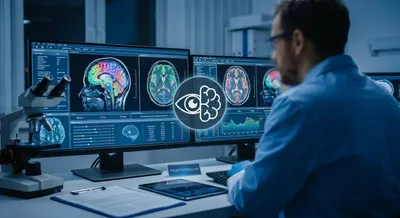
Brain Imaging Biomarkers and Plasticity in Glaucoma
Doctors and researchers use advanced MRI techniques to track these changes. One method is diffusion tensor imaging (DTI), which traces the brain’s...
Deep research and expert guides on maintaining your visual health.
Doctors and researchers use advanced MRI techniques to track these changes. One method is diffusion tensor imaging (DTI), which traces the brain’s...
Track peripheral vision changes between eye doctor visits. Start your free trial and get results in under 5 minutes.
Diffusion tensor imaging, often called DTI, is a type of MRI that maps how water molecules move in tissue. In the brain, water tends to move along nerve fibers, so DTI can reveal the orientation and health of those wiring pathways. The method produces measures like fractional anisotropy, which indicates how directional the water movement is, and mean diffusivity, which reflects overall freedom of movement. By looking at these measures, researchers and doctors can infer whether white matter pathways are intact, damaged, or reorganizing. DTI is useful for studying development, aging, multiple sclerosis, traumatic injury, and many other conditions that affect connectivity. It also lets scientists build maps of brain networks and follow changes after treatment or rehabilitation. The technique is noninvasive, but it has limits: it can struggle where fibers cross, and the images are sensitive to motion and technical factors. Because of these challenges, careful data collection and analysis are needed to draw reliable conclusions. When used properly, DTI gives unique insight into the brain’s wiring that other scans cannot provide.