
Sleep Posture Hacks: Head Elevation and Side-Sleeping Effects on Eye Pressure
High intraocular pressure (IOP) – the fluid pressure inside the eye – is a key factor in glaucoma and other eye diseases. Notably, IOP can change with sleep position. Studies show that simply lying down tends to raise IOP compared to sitting (pmc.ncbi.nlm.nih.gov). For example, one experiment found the average IOP was significantly higher when healthy subjects lay flat than when they sat up (pmc.ncbi.nlm.nih.gov). Over the course of the night, side-lying or stomach-lying positions can further affect pressure. In this article we explain how sleeping at a 20–30° head-up angle can lower nighttime eye pressure, why the “down-side” eye often has higher pressure when you sleep on your side, and how practical aids (wedges, adjustable beds, pillow stacks) compare. We also discuss comfort and adherence issues, caution about tight eye masks, and give a simple step-by-step plan for trying new sleep postures and checking the effect (for example with a home tonometer if you have one).
Side-Sleeping and the Dependent Eye
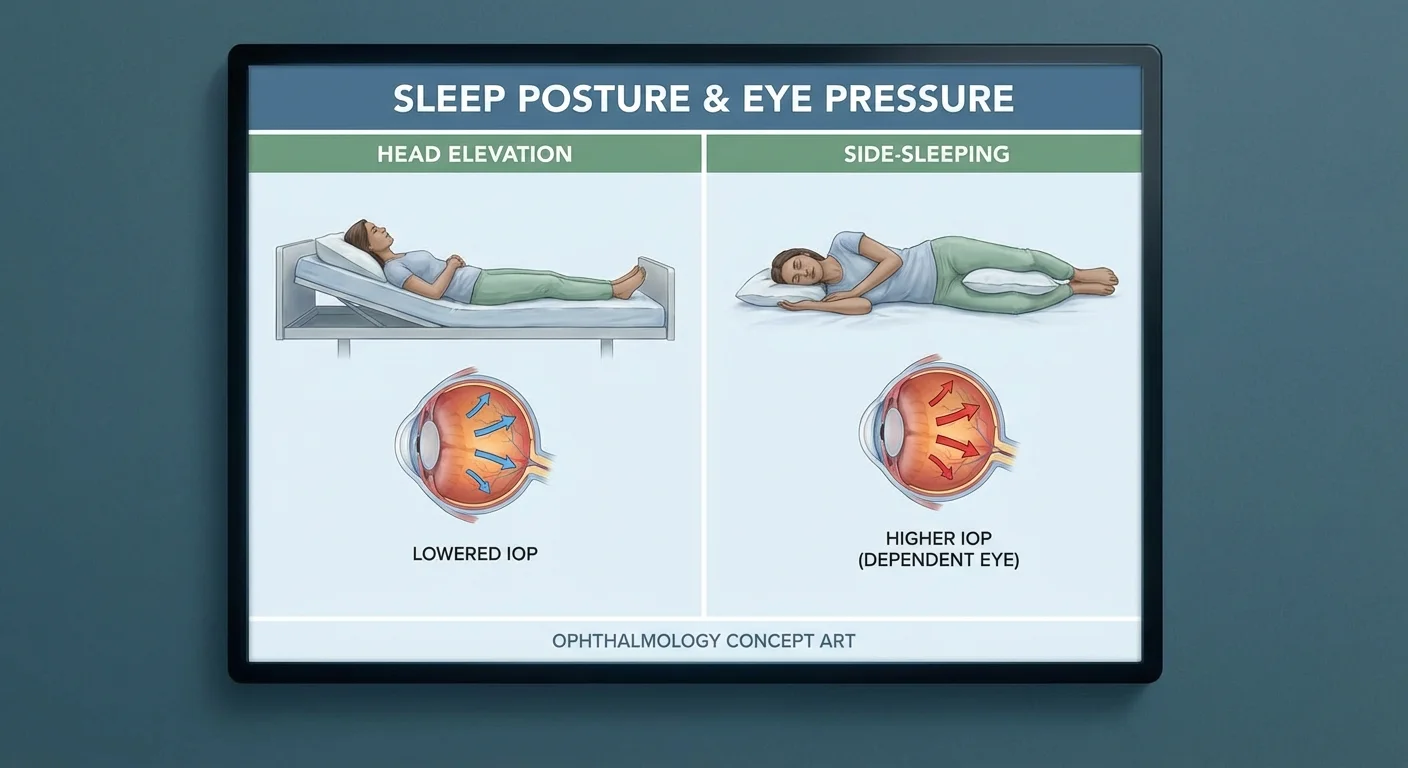
When you lie on your side, gravity and blood flow tend to increase pressure in the dependent eye – the one on the pillow side. In other words, your lower eye usually has higher IOP than your upper eye. Multiple studies confirm this dependent-eye effect. For instance, experiments with healthy volunteers and glaucoma patients show that the eye you lie on (the dependent eye) experiences a significantly greater IOP rise than the higher eye (pmc.ncbi.nlm.nih.gov). Even in people with one worse (more damaged) eye, that worse eye tended to have higher pressure if it happened to be on the pillow side (pmc.ncbi.nlm.nih.gov). Another study of glaucoma patients who habitually slept on one side found that the down-side eye’s IOP climbed about +1.6 mmHg after 30 minutes in that position (pubmed.ncbi.nlm.nih.gov). (In eyes that were deteriorating on that side, the increase was even larger, around +2.5 mmHg (pubmed.ncbi.nlm.nih.gov).) Over time such repeated pressure spikes on one eye could contribute to worsening glaucoma in that eye.
The takeaway: if you sleep on your side, the eye on that side will typically show higher pressure overnight. Experts often recommend that glaucoma patients try to avoid lying on the “bad” eye side. Sleeping on the back (with head raised) keeps both eyes level and may help limit these asymmetric pressure bursts (pmc.ncbi.nlm.nih.gov).
Why flat lying raises IOP too
It’s worth noting that even flat supine sleep (lying on the back or stomach) raises IOP compared to sitting up. In the same head-elevation study mentioned above, investigators found standing/sitting IOP was lower than flat-lying IOP in all subjects (pmc.ncbi.nlm.nih.gov). This happens partly because lying down increases blood pressure in the head and heart, and this in turn raises eye pressure. The lay-flat effect is why simply elevating the head can lower IOP somewhat – as we will see next.
Head Elevation and IOP Reduction
Sleeping on an incline (head up) has been shown to lower IOP a modest amount. A clinical experiment with patients sleeping in a lab found that a 20° head-up tilt (achieved with a wedge pillow) reduced average nighttime IOP by about 1.5 mmHg (around 9–10%) compared to lying fully flat (europe.ophthalmologytimes.com). In that study, 25 of 30 patients (over 80%) had lower mean IOP at 20°, and 36.7% had reductions of over 10% (europe.ophthalmologytimes.com). In real numbers the average drop was about 1.56 mmHg for glaucoma patients (from ~15–16 down to ~14 mmHg) and 1.47 mmHg in non-glaucoma people (europe.ophthalmologytimes.com). In plain terms, elevating the head by 20°–30° lowered nighttime eye pressure by roughly one or two points on average, which can be a valuable additional reduction for someone whose target reduction goal is 20–30% of baseline.
A separate trial in healthy volunteers compared two ways of getting a 30° head-up tilt. When subjects elevated their entire upper body by raising the bed head 30°, their IOP fell significantly compared to flat (pmc.ncbi.nlm.nih.gov). But simply stacking ordinary pillows to get the same 30° angle did not significantly lower IOP (pmc.ncbi.nlm.nih.gov). (In that study the p-value was only 0.06–0.09 for the pillow stack method (pmc.ncbi.nlm.nih.gov).) In other words, a sturdy elevation (bed frame lift or firm wedge) was effective, whereas a soft pillow pile collapsed too much to maintain the same result. Another study in real glaucoma patients confirmed these findings: raising the bed head by 30° lowered the eye pressure by about 2.0 mmHg on average, while using multiple pillows did not give a reliable drop (pubmed.ncbi.nlm.nih.gov). In fact, over a third of patients actually had a pressure increase when they tried the pillow stack.
These data tell us that a true inclined sleep position (20–30°) can help lower eye pressure at night. The safest way to get and keep that angle is generally with a wedge pillow or adjustable bed rather than loose pillows.
Elevating Head: Pillows, Wedges, or Beds?
Once you decide to raise the head of your bed, how to do it in practice? Here are the common methods:
-
Wedge Pillow: This is a single ramp-shaped pillow (usually foam) that props your head and upper torso. A wedge pillow is portable and comes in fixed angles. Many glaucoma patients find it relatively easy to use. The downside can be comfort: if the wedge is too high or too firm, it may push your head forward or cause neck strain. Users should pick a wedge of a moderate angle and pair it with a flatter pillow for neck support. Once in place, a wedge pillow provides a stable incline (unlike soft pillows that collapse) and should maintain the intended 20–30° angle (pmc.ncbi.nlm.nih.gov).
-
Adjustable Bed: This is a motorized bed frame that can tilt the head section up. Hospitals use these often, and some people have them at home. An adjustable bed lets you dial in the exact angle you want, and many find it comfortable because their whole upper body is supported. It’s effective at keeping both your head and torso up. The drawback is practical: adjustable beds are expensive and bulky. They also tilt the mattress, not just your pillow, which can shift sleeping partners or require different sheets. (However, they do give a precisely controlled elevation, which is ideal for pressure reduction (pmc.ncbi.nlm.nih.gov).)
-
Stacked Pillows: A simple DIY method is to pile two or more pillows under your head/shoulders. This costs nothing extra, but has pitfalls. In practice, stacked pillows often compress or slip during the night, so the angle may fluctuate. As noted earlier, studies found that even if you stack pillows to reach ~30°, the eyes may not see as much benefit as a mechanical incline (pmc.ncbi.nlm.nih.gov). Some people find pillow stacks less comfortable or secure, and they may wake up mid-sleep needing to restack them. In short, pillow stacks sometimes work somewhat, but they are the least reliable method for lowering IOP.
Patient Comfort and Adherence: Ultimately, any method only helps if you can stick with it. There are no formal trials of adherence in glaucoma patients, but lessons can be drawn from related fields. For example, in hospitals where nurses monitor head-of-bed tilt for medical reasons, patients often cannot maintain full elevation constantly without reminders (pubmed.ncbi.nlm.nih.gov). At home, comfort becomes key. Some patients love the gentle incline of a wedge and report better sleep after tweaking their setup, while others abandon the idea because they wake with a stiff neck or coughing (due to the incline). Adjustable beds might be great but only if your budget and bedroom space allow. Pillow stacks are easy to try but may feel flimsy.
In practice, patients often experiment to find what works: using a thinner wedge, adding a neck roll, or arranging pillows under the back so you don’t slide down. It helps to gradually increase elevation (say from 30cm to 40cm wedge) rather than jumping to a steep angle. Keep in mind that your partner or spouse might visit different positions at night, so setting firm boundaries (e.g. sleep on your side nearest the wall) can also help keep you on a stable incline.
Sleep Masks and Eyelid Pressure
Many people use eye masks or shields for sleep (to block light). However, any tight mask or goggles that press on the eyes or eyelids could raise IOP through external pressure. In fact, researchers have shown that simply turning the head into a pillow (simulated sleep) can increase IOP by 20–28 mmHg due to eyelid compression alone (pmc.ncbi.nlm.nih.gov). That’s enormous – roughly doubling the internal pressure in some cases – until the pressure is relieved. Similarly, tight swimming goggles are known to elevate eye pressure (pmc.ncbi.nlm.nih.gov).
So, be careful with snug eye gear at night. Thick, rigid sleep goggles or headbands that push on your eyes should be avoided. If you need darkness, choose a loose-fitting mask that just covers but does not squeeze. There is also an idea of using a protective sleep shield (a hollow 3D mask or orbital rim support) to keep the material off the eyelids; one study found that wearing such a shield reduced strain on the eye during side-lying (pubmed.ncbi.nlm.nih.gov). In short: don’t let your eczema mask become a pressure cuff on your eye. A gentle, soft mask that barely touches your face is safest.
Step-by-Step: Trying Sleep Posture Changes
If you (or your doctor) want to try adjusting sleep posture to help lower eye pressure, here’s a simple roadmap:
-
Talk to Your Eye Doctor: Before making big changes, let your ophthalmologist or optometrist know. Ask if they think sleep posture could help your specific case. They might have records of your IOP swings or visual field progress, and can advise if posture changes make sense for you.
-
Baseline Measurement: If possible, have a daytime IOP measured before and after a night of elevated sleep. If you have a home tonometer (see below), try measuring your IOP in your usual bed position for a week to see your normal range. (If not, jot down how your vision or comfort feels, and use your doctor’s office readings.)
-
Get an Incline Support: Choose a wedge pillow or adjustable platform to raise your head. Aim for about 20–30 degrees tilt. (A 7–12 inch wedge pillow typically gives ~20–30° depending on your height.) Place it so your head, neck, and shoulders rest on the incline. If you don’t have a wedge, start by propping multiple pillows securely.
-
Try Sleeping Positions:
- Back (supine) sleeping: See how you feel lying on your back at the incline. This evenly distributes pressure and often maximizes the IOP drop.
- Side sleeping: If you must sleep on your side, make sure to keep the higher eye on the pillow. That means avoid lying on the eye with more optic nerve damage. You can also use a flat towel or small support under your rolling shoulder so your face isn’t pressed hard into the bed.
- Alternate sides: If you habitually sleep on one side, try alternating sides between nights or every few hours. This prevents one eye from being down all night.
-
Monitor Comfort: How does the new position feel? Do you wake with neck strain, nasal congestion, or controlled snoring issues? Adjust the angle or add a neck roll as needed. It may take a week or two to adapt. Keep a sleep diary for a few nights noting comfort, quality of sleep, and any morning blurriness or headaches.
-
Measure Your IOP (if you can): If you have access to a home tonometer (see below), take readings each evening and morning in your new position. Look for any downward trend compared to before. If you don’t have a device, you can schedule a 24-hour IOP monitoring block in a sleep lab or clinic. Otherwise, ask your doctor to measure IOP at varied times (midnight, 2am, etc.) if needed.
-
Pause and Adjust Mask or Gear: Ensure any eye patch or mask is loose or lifted off the eyelids. Double-check that your pillow isn’t pushing on your eye area at all. If pressure on eyelids was noticeable, try using a hollow shield or simply a very soft headband.
-
Follow Up: After a few weeks, report back to your doctor. Share any home IOP logs or just describe changes in morning vision or exam findings. Together you can decide if continuing the new sleep habit is beneficial.
Home Monitoring with Tonometry
Many people wonder if they can “test” these changes at home. Nowadays there are devices like the iCare HOME rebound tonometer (FDA-approved) that let patients measure IOP themselves. Such home tonometers can record patterns outside office hours (pmc.ncbi.nlm.nih.gov). One study showed that about 72–82% of patients could learn to use iCare HOME correctly with some training (pmc.ncbi.nlm.nih.gov). If you rent or buy one, you would typically take several readings per day (even supine, since iCare works in any position) and then download the data to show your doctor.
Keep in mind that home tonometer readings may differ somewhat from office Goldmann measurements (pmc.ncbi.nlm.nih.gov), but they are still very useful for trends. Using a home tonometer, you could literally sleep in your new position and see if your nighttime IOP numbers look lower than on your old pillows. (Your doctor may lend you one for a few days of testing.) If home tonometry is not available, focus on regularly scheduled check-ups and telling the doctor you’ve changed sleep habits, so they can interpret the results in context.
Conclusion
Small changes in sleep posture can have a measurable effect on eye pressure. Sleeping with your head elevated (20–30°) usually lowers IOP by around 1–2 mmHg or roughly 10% (europe.ophthalmologytimes.com), and sleeping flat or face-down raises it. Likewise, if you lie on your side, the downward eye tends to see higher pressure spikes (pmc.ncbi.nlm.nih.gov) (pubmed.ncbi.nlm.nih.gov). Using a firm wedge pillow or adjustable bed tilt is generally more reliable than balancing loose pillows (pmc.ncbi.nlm.nih.gov). Comfort and consistency are important: pick the method you can actually sleep with each night. Also, avoid any tight sleep masks pressing on your eyes, as external pressure can negate these benefits. By carefully adjusting your sleep setup and, if possible, tracking your own IOP at home, you can add this strategy to your glaucoma care. Always discuss such changes with your eye doctor, as they can help you interpret your eye pressure readings and tailor advice to your condition.