
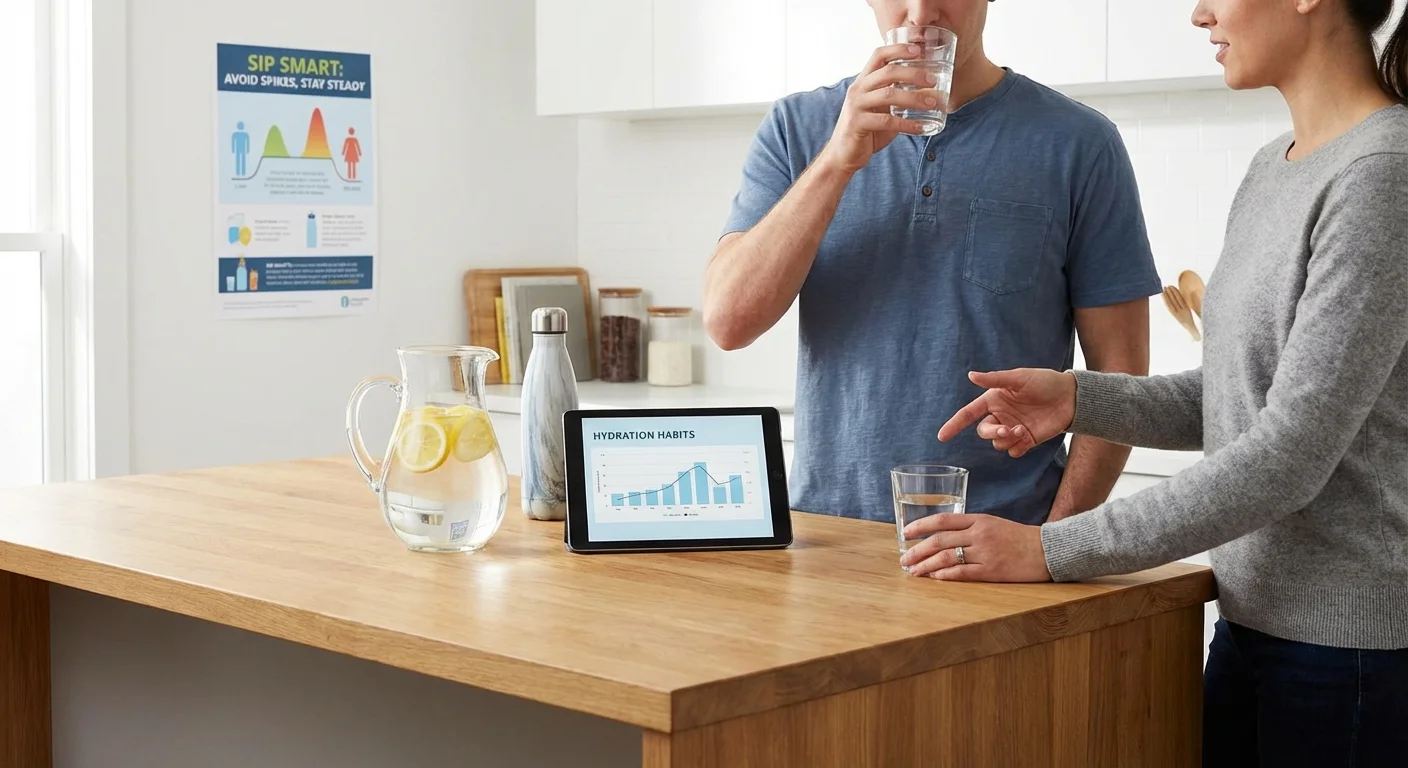
Hydration Habits: Water-Drinking Spikes and How to Sip Safely
Staying properly hydrated is crucial for overall health – but surprisingly, the way we drink water can affect our eyes. In ophthalmology, a water-drinking test (WDT) has long been used to provoke and study intraocular pressure (IOP) changes in glaucoma patients. In this test, patients drink a large volume of water quickly (often ~1 liter in about 5 minutes) and doctors measure the eye pressure over the next hour. This “stress-test” for the eye reveals that chugging water causes a transient IOP spike. In fact, studies show IOP climbs within 15 minutes of rapid water intake and stays elevated for about 30–45 minutes (scholars.mssm.edu) (pubmed.ncbi.nlm.nih.gov). For example, Brucculeri et al. found that healthy young adults given ~1 L of water experienced a significant IOP rise by 15 minutes, lasting approximately 45 minutes (scholars.mssm.edu). Similarly, a glaucoma patient who drank a large water “bolus” for a medical procedure had a sudden pressure jump (5–8 mmHg above baseline) and symptoms of headache and blurred vision (pmc.ncbi.nlm.nih.gov). This shows that even in healthy eyes, gulping a large volume quickly can temporarily overfill the eye’s fluid system.
The reason has to do with eye fluid dynamics. Our eyes continuously produce a clear fluid (aqueous humor) that drains through a meshwork in the front of the eye. When you drink a lot of water at once, the body’s fluid balance shifts. Early theories suggested water might create an osmotic gradient, but research indicates that’s not the case (scholars.mssm.edu) (pubmed.ncbi.nlm.nih.gov). Instead, the excess blood volume from quick drinking seems to briefly overwhelm the eye’s drainage, so the outgoing fluid flow lags behind, and pressure inside the eye rises. In practical terms, a big drink is like adding extra water to a balloon faster than it can safely leak out – the pressure inside goes up for a short time.
Why Large Drinks Raise Eye Pressure
- Temporary IOP spike: Drinking ~1 L of water in a few minutes can raise IOP by several mmHg. In one study of glaucoma patients, IOP jumped on average from about 12 mmHg up to ~16 mmHg (a 4 mmHg rise) 30 minutes after a 1-liter challenge (esmed.org). These pressure hikes are transient – normalizing in under an hour – but they reveal how quickly Drastic drinking can pressurize the eye.
- Dose matters: Even smaller amounts cause rises. Glaucoma research shows that both 500 mL and 1000 mL water challenges significantly increase IOP for up to 45 minutes after drinking (pubmed.ncbi.nlm.nih.gov). In other words, it’s not just “megajuice” – even half a liter downed very quickly will push eye pressure upward.
- Not due to water moving into the eye: The spike isn’t direct water filling the eye. Classic experiments found no change in blood osmolarity or hematocrit after drinking, ruling out simple “dilution” effects (pubmed.ncbi.nlm.nih.gov). Instead, the body’s fluid redistribution must transiently hamper the eye’s drainage. (So the fix isn’t osmotic – it’s about pacing fluid outflow.)
- Symptoms of overhydration: If you do gulp water quickly, you might feel it. One report described a patient who drank a large water bolus and soon had a headache and eye discomfort; his exam showed significantly increased IOP (pmc.ncbi.nlm.nih.gov). In an extreme case, a person who drank 5 liters in a few hours (on a doctor’s advice during a fever) suffered sudden bilateral angle-closure glaucoma with eye pain, nausea and vision loss – their IOP soared above 50 mmHg (pmc.ncbi.nlm.nih.gov). These are dramatic examples, but they underline the warning: “too much too fast” can truly hurt.
Daily Hydration Tips: Sip and Space Your Water
The big takeaway is that how you drink matters. Instead of gulping water in one go, spread your fluid intake evenly across the day. This helps keep you hydrated without shocking your eyes. Key strategies include:
- Sip, don’t chug. Take small sips frequently rather than drinking an entire bottle at once. For example, spread the equivalent of one large glass (250 mL) over several minutes. This gives your body (and eyes) time to adapt.
- Space fluids through the day. Aim for regular hydration spaced by the hour. If you need to meet a daily goal (say 8 cups/2 liters), set alarms or carry a bottle and drink a little every 30–60 minutes. Consistent sipping prevents big volume loads.
- Mind mealtimes and medication. If you’re told to hydrate with medications (like some diuretics that require water), do so gradually. Don’t take the full glass at once unless urgently needed.
- Beware high-risk times: Eye pressure follows a circadian rhythm. In many people, IOP tends to be highest in the early morning and lowest in the late evening (pmc.ncbi.nlm.nih.gov). Other studies find pressures can climb during sleep as well (pubmed.ncbi.nlm.nih.gov). To be safe, avoid excessive drinking right at bedtime or late at night when eye pressure can naturally rise. Instead, do most of your drinking earlier in the day.
- Use smaller containers. Portion water into bottles or cups so you naturally drink smaller amounts at a time. Refill as needed rather than opening a giant jug.
- Include electrolytes after heavy sweating. In hot weather or intense exercise, dehydration is a concern. Drink steadily, and consider beverages with salts if you’ve sweated a lot. Even then, follow the same “sip and space” rule: rehydrate gradually instead of downing an entire sports drink in one gulp. (Studies show that when people dehydrated in the heat, their IOP actually fell slightly – they got about 2–3 mmHg lower – probably because the eye loses fluid too (pmc.ncbi.nlm.nih.gov). The key is to restore fluids steadily, not overload.)
Timing Around Exercise and Hot Weather
After a workout or on a hot day, thirst can be strong. Naturally you’ll need to drink more to replace lost fluids and prevent dehydration. Just don’t overdo it all at once. For example, if you finish a run and are sweating heavily, drink a moderate amount (250–500 mL) at a time, walking around or resting, rather than gasping and downing a liter immediately. Sip cool fluids slowly as you recover. If you drink too fast (especially if you’re already a glaucoma patient or suspect), you risk an IOP surge on top of the stress from exercise. Rating your hydration by color-scaled pee or body weight (instead of gulping a bottle) is safer for both your eyes and your overall system.
Patient Handout: Safe Sipping Strategies & Warning Signs
How to sip safely:
- Small sips frequently. Keep a water bottle with you and take a sip every few minutes rather than long chugs.
- Carry water all day. If you carry a small bottle (300 mL), refill it 3–4 times instead of carrying one huge jug.
- Use reminders. Set a timer to remind yourself to drink a little water each hour.
- Balance fluids. If you drink caffeinated or alcoholic beverages (which dehydrate), compensate with extra water sips.
- Before bedtime: moderate amounts. If evening thirst hits, drink a small glass, not the whole jug.
Warning signs (ask for help if these happen after drinking):
- Persistent headache or a “pressure” feeling behind the eyes.
- Eye pain or redness following a heavy drink.
- Sudden blurred vision or seeing halos around lights (could signal a pressure spike).
- Nausea or feeling sick along with any of the above.
If any of these occur—especially if you know you are “at risk” for glaucoma or have been told you have high eye pressure—contact your eye doctor. In the unusual event of severe vision changes or eye pain (as seen in case reports), urgent care may be needed (pmc.ncbi.nlm.nih.gov) (pmc.ncbi.nlm.nih.gov).
Keeping hydrated is important for health, but you can do it safely. By spacing out fluids and drinking steadily, you help avoid transient eye-pressure spikes. Small, steady sips through the day (and extra care during hot weather or after exercise) can keep both your body and eyes happy.
Stay hydrated, but do it smart: sip often, pace yourself, and listen to your body. Drinking water safely is an easy habit to protect your vision as well as your health (scholars.mssm.edu) (pmc.ncbi.nlm.nih.gov).
References: Major findings come from ophthalmology research showing IOP changes after water intake (scholars.mssm.edu) (esmed.org) (pubmed.ncbi.nlm.nih.gov). Case reports of eye pressure spikes after rapid water loading provide real-world examples (pmc.ncbi.nlm.nih.gov) (pmc.ncbi.nlm.nih.gov). Circadian studies inform us about daily IOP rhythms (pmc.ncbi.nlm.nih.gov) (pubmed.ncbi.nlm.nih.gov), and hydration studies in exercise highlight how dehydration/lack of fluids can actually lower IOP, underscoring the need for balanced rehydration (pmc.ncbi.nlm.nih.gov). All advice here is based on peer-reviewed ophthalmology sources.