
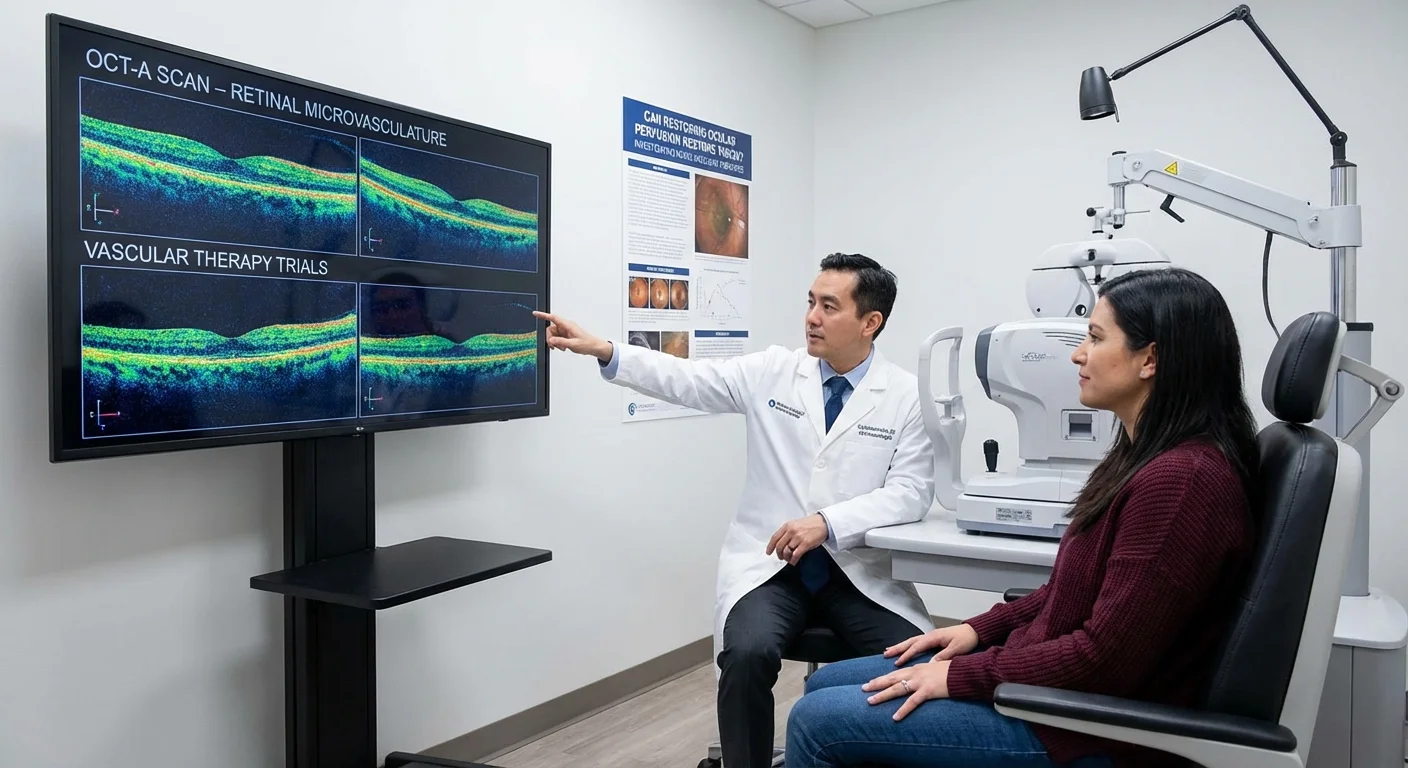
Can Restoring Ocular Perfusion Restore Vision? OCT-A and Vascular Therapies
Glaucoma is a disease where the optic nerve gradually loses nerve fibers, leading to vision loss. In most cases, lowering eye pressure (intraocular pressure or IOP) is the proven way to slow or stop progression. However, researchers have long wondered whether improving blood flow to the eye (ocular perfusion) could also help preserve or even restore vision. New imaging tools like optical coherence tomography angiography (OCT-A) can noninvasively measure tiny blood vessels in the optic nerve head and retina. This article reviews what is known about OCT-A vascular measurements and visual function in glaucoma, and whether treatments aimed at enhancing perfusion (such as Rho-kinase inhibitors or blood pressure adjustments) might recover vision. We will also consider how future studies could tease apart the effects of blood flow versus pressure, and suggest OCT-A–based endpoints to predict if vision recovery is possible.
Vascular Metrics and Visual Function in Glaucoma
OCT-Angiography and Vessel Density
OCT-Angiography (OCT-A) captures images of blood flow by detecting moving red blood cells in the eye’s capillaries. Two key metrics are often reported: vessel density (the percentage area occupied by vessels) and flow index. In glaucoma, multiple studies have found that eyes with glaucoma have lower OCT-A vessel density than healthy eyes. For example, a large study showed that normal eyes had significantly higher peripapillary (around the optic nerve) vessel density than glaucoma eyes. In that study, average vessel density in healthy eyes was about 55%, versus 42% in advanced glaucoma eyes (pmc.ncbi.nlm.nih.gov). Notably, this vessel density loss closely matched the degree of visual field loss: each 1% drop in vessel density corresponded to about a 0.6 dB worsening in visual field mean deviation (pmc.ncbi.nlm.nih.gov). In fact, the association between vessel density and vision loss was stronger than the association between traditional structural measurements (like nerve fiber thickness) and vision (pmc.ncbi.nlm.nih.gov).
Macular vessel density (in the central retina) has also been linked to vision in glaucoma. A study of glaucoma patients found that lower macular capillary density was associated with poorer central visual sensitivity on a 10-2 visual field test (pmc.ncbi.nlm.nih.gov). In advanced glaucoma, larger areas of the foveal avascular zone (FAZ) – meaning more loss of central capillaries – were linked to worse visual acuity (clarity of vision) (pubmed.ncbi.nlm.nih.gov). In moderate glaucoma, eyes with lower macular vessel density had worse distance vision. In short, reduced blood flow metrics on OCT-A – both around the optic nerve and in the macula – tend to go hand-in-hand with worse visual function (pmc.ncbi.nlm.nih.gov) (pmc.ncbi.nlm.nih.gov) (pubmed.ncbi.nlm.nih.gov).
Why might blood flow measures reflect vision? One idea is that reduced capillary perfusion may indicate that nerves are starved of oxygen and nutrients. Lower perfusion might occur even before nerve fibers are fully lost, so OCT-A could detect early dysfunction. In fact, experts note that a reduction in capillary perfusion is a sign of vascular dysfunction and might precede permanent nerve fiber loss (pmc.ncbi.nlm.nih.gov). Thus, OCT-A vessel density can serve as an early warning, potentially showing damage in not-yet-destroyed nerve fibers (pmc.ncbi.nlm.nih.gov). This suggests that vascular changes measured by OCT-A do relate to functional outcomes in glaucoma, even though they are not part of routine testing yet.
Do Perfusion-Boosting Therapies Improve Vision?
Even if low blood flow is associated with worse glaucoma, the key question is whether actively improving blood flow can recover vision or slow loss. Here we look at the evidence for three strategies: Rho kinase (ROCK) inhibitors, optimizing systemic blood pressure, and managing nocturnal hypotension.
Rho Kinase (ROCK) Inhibitors
ROCK inhibitors (like netarsudil or ripasudil) are eye drops developed to lower IOP by increasing fluid outflow. Interestingly, preclinical studies also suggest they can increase blood flow in the optic nerve head. In animal experiments, topical ROCK inhibitors produced dilation of optic nerve blood vessels: both blood flow velocity and volume through the nerve head went up after treatment (pmc.ncbi.nlm.nih.gov). The theory is that these drugs relax vascular muscle, letting more blood flow.
However, translating this to human vision is uncertain. Clinical trials of ROCK inhibitors have focused on IOP lowering, and none have clearly shown that these drugs improve visual field or acuity by themselves. In practice, any vision effect from ROCK inhibitors is probably mostly due to the IOP reduction. We do not have strong evidence that administering a ROCK inhibitor results in measurable vision improvement purely by better perfusion. Thus, while ROCK inhibitors could boost ocular perfusion (as seen in labs (pmc.ncbi.nlm.nih.gov)), we lack proof that this leads to functional gains in glaucoma patients. More research is needed to test if ROCK-related blood flow changes correlate with nerve recovery.
Systemic Blood Pressure Control
Blood pressure (BP) indirectly affects eye perfusion. Ocular perfusion pressure (OPP) is roughly the difference between blood pressure and IOP. Low OPP can reduce blood flow to the optic nerve. High systemic blood pressure (hypertension) itself does not directly improve glaucoma; in fact, high BP may damage vessels over time. Glaucoma in patients with hypertension still requires IOP control.
On the other hand, excessively low blood pressure can be a problem. Several studies have shown that low blood pressure, especially at night, is linked to glaucoma worsening. In one prospective study of normal-tension glaucoma, patients with deeper or longer drops in nighttime BP were more likely to lose visual field over a year (pmc.ncbi.nlm.nih.gov). Another analysis found that a nocturnal fall in mean arterial pressure was one of the strongest predictors of glaucoma progression (pmc.ncbi.nlm.nih.gov). These findings imply that if BP falls too much, the optic nerve may not get enough blood.
However, manipulating BP to treat glaucoma is tricky. There is no clinical trial evidence that deliberately raising blood pressure or preventing nocturnal dips improves vision or slows glaucoma. In fact, experts warn that boosting blood vessels at night could cause other health problems. One commentary noted that while doctors may consider adjusting medications to avoid extreme nocturnal BP “dips,” there is no proof this helps glaucoma, and raising nighttime BP could harm the heart (pmc.ncbi.nlm.nih.gov). In short, we know low perfusion pressure is a risk, but we lack data showing that fixing BP solves glaucoma damage. Most eye doctors will manage hypertension as usual (to protect overall health) but avoid overly aggressive BP lowering at night in glaucoma patients. They do not have a specific BP or perfusion therapy approved for glaucoma.
Nocturnal Hypotension Management
Closely related to blood pressure is the issue of nocturnal hypotension – the phenomenon of blood pressure dropping during sleep. In some people, BP naturally dips by 20–30% at night (called “dippers”), but in a few it drops even more. Studies have linked excessive nighttime BP drops with glaucoma worsening. For example, glaucoma patients with more than a 10% nocturnal BP decline had faster visual field loss (pmc.ncbi.nlm.nih.gov). The problem is, we cannot easily “treat” this drop. Some doctors check a patient’s overnight BP (with a 24-hour monitor) if glaucoma is progressing despite controlled IOP. If the drop is very large, they might review the patient’s medications (for example, moving antihypertensive pills to earlier in the day, or adjusting dosages) in hopes of lessening the dip.
But again, no study has tested whether these adjustments actually improve vision. The evidence so far is just observational: low nighttime BP seems bad for glaucoma. It makes sense to avoid extreme hypotension (for overall health too), but whether doing so can reverse any glaucoma damage is unknown. Right now, managing nocturnal BP is more of a precautionary discussion with doctors than a proven therapy.
In summary, while certain drugs and measures can raise ocular blood flow in theory, we do not yet have proofs that they lead to actual vision gains in glaucoma patients. Improved perfusion may help protect remaining nerve cells, but studies have not shown clear functional improvement attributable solely to increased blood flow.
Teasing Apart Perfusion vs. Pressure: Study Designs
One challenge is that most ways to improve perfusion also change IOP or vice versa. For example, glaucoma surgery or drops usually lower IOP, which automatically raises perfusion pressure (since eye pressure is lower). Studies have found that after trabeculectomy or shunt surgery, patients often show higher vessel density on OCT-A (reflecting better perfusion) within months (pmc.ncbi.nlm.nih.gov) (pmc.ncbi.nlm.nih.gov). These changes tend to occur in areas where nerve tissue is still present . However, because surgery also dramatically lowers IOP, it’s hard to know whether any slowing of vision loss is due to pressure drop or the increased blood flow.
Likewise, some glaucoma trials use different medications to try to isolate effects. For example, a crossover study gave patients one drop that stabilizes blood pressure (dorzolamide) versus another drop (timolol) that can lower blood pressure more in the evening. The dorzolamide group showed smaller fluctuations in both intraocular pressure and systemic blood pressure during the day (pmc.ncbi.nlm.nih.gov). This design shows how one could hold IOP roughly constant while altering systemic perfusion. But even in such trials, the link to actual vision changes was not measured.
Future studies could be designed more explicitly to separate these factors. One idea is a 2×2 factorial trial where one factor is IOP lowering (e.g. surgery or prostaglandin drops) and the other is a perfusion intervention (e.g. a vasodilator drop or timed blood pressure control). Patients would be randomized to all combinations, and visual field outcomes compared. Another approach is using the fellow eye as a control: for instance, giving a perfusion-targeted drug to one eye and a neutral placebo to the other, while both eyes have similar IOP control. Researchers could then measure changes in OCT-A flow and visual function in each eye separately.
Animal studies or short-term “challenge” tests can also help isolate factors. For instance, some experiments intentionally raise blood pressure (with drugs) in an animal with fixed IOP to see if retinal cells function improves. Others measure retinal thickness and perfusion before and after artificially inducing blood flow changes. In humans, prospective trials could monitor ambulatory blood pressure and rigorously record visual fields over time, to see if any intervention that raises average perfusion pressure (without further lowering IOP) slows damage.
At present, the best clues come from correlational studies: e.g. Park et al. found that eyes showing bigger OCT-A perfusion gains after surgery tended to have slower visual field decline (pmc.ncbi.nlm.nih.gov). However, because IOP also fell, high-quality trials are needed to prove causation. Designing those trials will require careful pairing of interventions, control of confounders, and choosing sensitive outcome measures.
Potential Vascular Endpoints for Reversibility
If blood flow therapies could potentially “wake up” dysfunctional neurons, how would we predict who can improve? OCT-A might offer predictive endpoints. One promising idea is that residual vessel density in areas with still-intact nerve fiber layer could mark recoverability. For example, after surgery, regions of the optic nerve with only mild nerve fiber thinning and moderate perfusion loss were those that showed reperfusion on OCT-A (pmc.ncbi.nlm.nih.gov). These partly-viable areas might harbor cells that could regain function once blood flow is restored. In contrast, regions with severe nerve loss had little recovery even if perfusion improved. Thus, mapping peripapillary vessel density alongside nerve fiber thickness might reveal pockets of “sleeping” nerve fibers.
Similarly, increases in deep optic nerve head capillary density have been linked to better outcomes. In one study, patients whose deep ONH vessel density improved after surgery had much less visual field progression than those whose deep flow did not recover (pmc.ncbi.nlm.nih.gov). This suggests that monitoring deep capillary plexus flow could be a functional biomarker.
For the macula, the foveal avascular zone (FAZ) is also of interest. A decrease in FAZ area (meaning more capillaries or less non-perfused area) was seen when IOP was lowered (pmc.ncbi.nlm.nih.gov). While FAZ size is mainly studied in retinal diseases, it might serve as a vascular endpoint in glaucoma trials targeting perfusion. If lowering IOP or giving a vasodilator shrinks the FAZ or increases macular capillary density, this could indicate improved central perfusion, which might help central vision. One surgical study noted that FAZ and deep plexus measurements were sensitive to IOP reduction (pmc.ncbi.nlm.nih.gov), implying their potential use as endpoints.
In summary, possible vascular endpoints could include: peripapillary capillary density in preserved nerve zones, deep optic nerve head vessel density, macular vessel density (especially in the deep plexus), and FAZ area. Higher perfusion in these measures – or significant increases after treatment – might predict which eyes have “recoverable” neurons. These OCT-A metrics, possibly combined with structural measures (like retinal ganglion cell thickness), may help clinical trials select patients likeliest to benefit from perfusion therapies.
Conclusion
Glaucoma is primarily managed by lowering eye pressure, but there is clear evidence that poor blood flow is associated with worse glaucoma. OCT-Angiography has shown that reduced vessel density at the optic nerve and macula aligns with worse vision (pmc.ncbi.nlm.nih.gov) (pmc.ncbi.nlm.nih.gov). However, whether restoring perfusion can actually improve vision remains unproven. Animal and lab studies suggest possible benefits (for instance, Rho-kinase inhibitors dilate ocular vessels (pmc.ncbi.nlm.nih.gov)), but clinical vision gains from purely vascular treatments are not yet established. Managing systemic blood pressure carefully is important, yet there is no trial evidence that raising BP or preventing nocturnal dips reverses visual field loss (pmc.ncbi.nlm.nih.gov).
Future research should try to separate vascular effects from IOP effects. This might involve trials where IOP is held constant while applying a blood flow intervention, or using the fellow eye as an internal control. The goal would be to see if increased perfusion alone slows progression or even restores function. Meanwhile, OCT-A offers tools to assess which patients might recover. For example, eyes with moderate vessel loss but relatively preserved nerve tissue may have a chance to improve once flow is enhanced (pmc.ncbi.nlm.nih.gov) (pmc.ncbi.nlm.nih.gov). Trials could use vessel density changes as an early endpoint, to predict if vision-saving effects will follow.
For now, patients should understand that maintaining eye pressure control is still the main strategy. Vascular factors are an active area of research, but we cannot yet promise vision recovery by “boosting blood flow.” In practice, doctors may monitor blood pressure patterns (especially nocturnal dips) and choose glaucoma medications that do not overly compromise perfusion, but evidence-based ways to recover lost vision through perfusion changes are still emerging. OCT-A has strengthened the link between blood flow and glaucomatous vision loss, and ongoing studies will clarify if improving flow can one day translate into real functional gains.