
Introduction
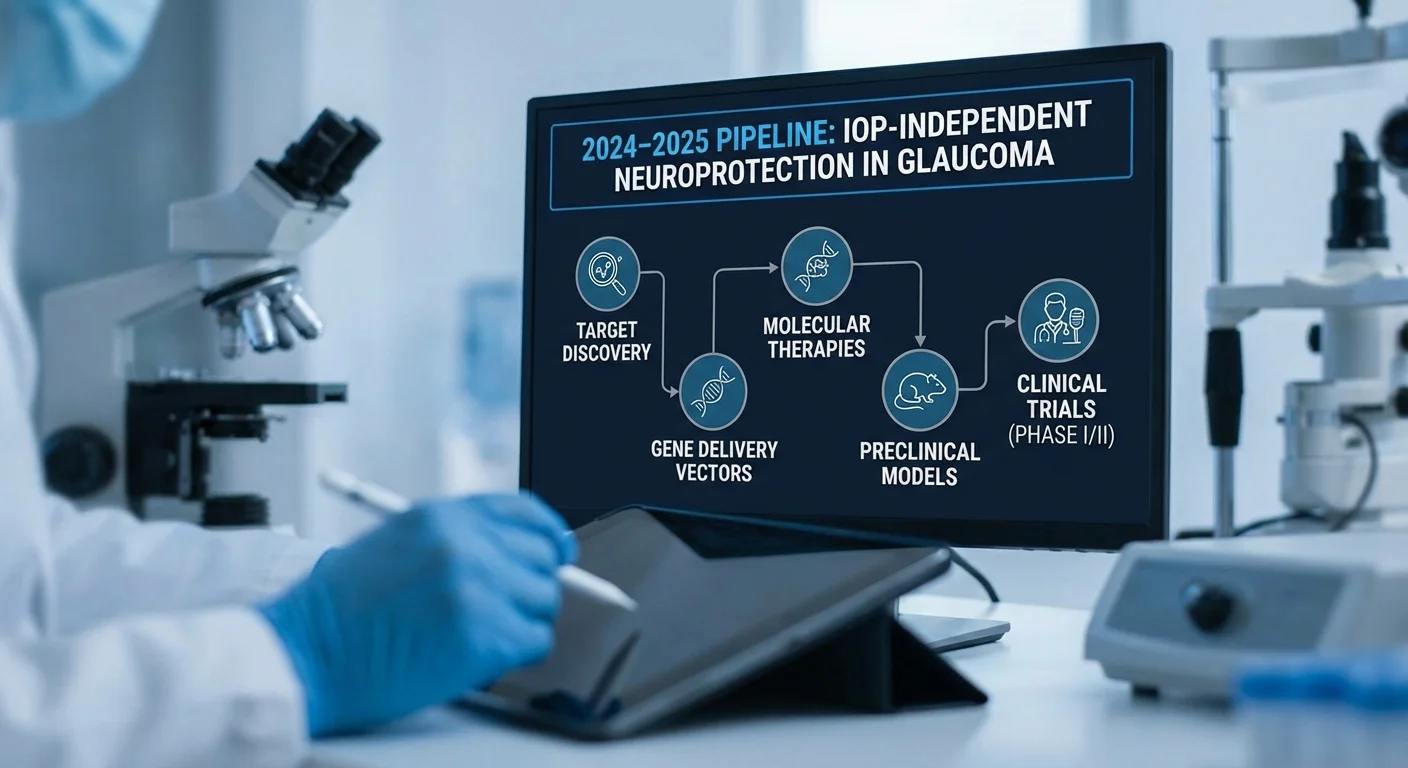
Glaucoma is a common eye disease that damages retinal ganglion cells (RGCs) – the nerve cells that carry visual signals from the eye to the brain – leading to irreversible vision loss. Most treatments focus on lowering eye pressure (intraocular pressure or IOP), which indeed slows damage in many patients (pmc.ncbi.nlm.nih.gov). However, a large fraction of glaucoma patients lose vision even when their IOP is normal or well-controlled. This has sparked great interest in IOP-independent neuroprotection – therapies aimed directly at keeping RGCs alive by targeting other stressors. Long-term RGC damage in glaucoma has been linked not only to pressure, but also to poor blood flow, excess excitation by brain chemicals (excitotoxicity), and oxidative stress (damaging molecules in cells) (pmc.ncbi.nlm.nih.gov). New treatments in development are striving to protect RGCs through several strategies: stabilizing cell mitochondria (the RGC “power plants”), supplying neurotrophic factors (growth signals), dialing down inflammation, and calming overactive immune cells (microglia). Below we review key late-stage candidates in these categories, explain their mechanisms and trial progress, and discuss how modern trial designs and biomarkers may finally yield success after past disappointments.
Mitochondrial Stabilizers
RGCs have very high energy needs. Mitochondria within RGCs produce ATP (energy) but can also generate harmful free radicals. Drugs or nutrients that stabilize mitochondria and boost healthy metabolism are a major focus. For example, nicotinamide (vitamin B3) is a precursor for NAD^+, a co-factor that fuels energy production. In glaucoma models, high-dose nicotinamide greatly protected RGCs (pmc.ncbi.nlm.nih.gov) (pmc.ncbi.nlm.nih.gov). This led to a large human trial: starting in 2022 the UK‐led study aims to enroll ~500 patients for 4 years to test whether nicotinamide delays vision loss (www.ucl.ac.uk). This trial will also measure mitochondrial “power” in blood cells and other biomarkers (www.ucl.ac.uk). Early small trials of high-dose nicotinamide already hinted that some patients improved vision (www.ucl.ac.uk). Despite its promise, nicotinamide can cause flushing or nausea at very high doses, so trial safety is being watched closely. Citicoline (CDP-choline) is another mitochondrial enhancer. It helps build cell membranes and supports energy metabolism. Clinical studies (mostly outside the US) report that citicoline supplements (oral drops or pills) can slow glaucoma progression or improve visual function (pmc.ncbi.nlm.nih.gov). Indeed, long-term studies have shown treated patients had less field loss and better quality-of-life, independent of IOP (pmc.ncbi.nlm.nih.gov). Citicoline is well tolerated, and eye-drop forms are already registered for glaucoma in Europe. (In contrast to past failures, experts expect official approvals in more countries ahead (pmc.ncbi.nlm.nih.gov).)
Other mitochondrial approaches are in early/preclinical stages. For example, the NDI1 gene therapy (AAV-NDI1) directly boosts mitochondrial respiration. In glaucoma mice, a single monthly eye injection of AAV-NDI1 protected RGCs and improved their electrical responses (www.mdpi.com). This approach uses a virus to deliver a powerful yeast-derived enzyme that works in RGC mitochondria. The company behind it (Vzarii Therapeutics) plans to move toward human trials, but this is likely several years away. Meanwhile, common supplements like coenzyme Q10 (CoQ10) or pyruvate are also believed to scavenge free radicals and support mitochondria. Early studies suggest they may help RGC function, but definitive clinical trials are still pending.
Neurotrophic Support
Neurotrophic factors are naturally occurring proteins that “feed” neurons and keep them alive. In glaucoma, transport of these factors from the brain to the eye is impaired. Delivering neurotrophic signals directly to the eye is another strategy. For example, a recombinant nerve growth factor (rhNGF) eye drop has been tested. In a recent phase 1b trial, 60 glaucoma patients received high-dose rhNGF drops (or placebo) for 8 weeks (pmc.ncbi.nlm.nih.gov). The primary goal was safety and tolerability. The good news: no patient had serious adverse events from the drops, and there were no pressure spikes or dangerous vision changes (pmc.ncbi.nlm.nih.gov). Side effects were mild (mostly eye or brow ache), and only about 7% of treated patients stopped drops due to discomfort (pmc.ncbi.nlm.nih.gov). On the efficacy side, treated eyes showed slight, non-significant trends toward better visual fields and nerve layer thickness than placebo, but no statistical benefit was seen in this small short trial (pmc.ncbi.nlm.nih.gov). The authors noted that longer studies with more patients will be needed to reveal any clear benefit (pmc.ncbi.nlm.nih.gov). Nevertheless, these results mark an important step: a growth factor eyedrop was safe and hinted at effect, setting the stage for a true neuroprotection trial.
Gene therapies are also under study to deliver neurotrophic signals. One innovative approach engineered a permanently active version of the BDNF receptor (TrkB) to bypass low BDNF in diseased eyes (www.asgct.org) (www.asgct.org). In mice, intravitreal AAV carrying this modified receptor (F-iTrkB) helped preserve RGCs and even stimulate some axon regrowth (www.asgct.org). These gene therapies are very experimental and still in animal models, but they illustrate how delivering neurotrophic support directly inside the eye could one day aid RGC survival and nerve repair. Other growth factors like CNTF (ciliary neurotrophic factor) have been tried: an implanted cell capsule releasing CNTF showed safety in early trials, though efficacy in glaucoma specifically has not yet been established (pmc.ncbi.nlm.nih.gov).
Anti-Inflammatory and Microglial Modulation
Chronic inflammation appears to contribute to glaucoma. In particular, the retina’s immune cells (microglia) can become overactive and prune synapses on RGCs, accelerating cell loss. One leading therapy in this area is ANX007, a fragment of an antibody that targets complement protein C1q. C1q is part of the body’s innate immune “tagging” system: it normally marks weak synapses to be removed by microglia, but in glaucoma excess C1q is found on retinal synapses, and experimental models show that removing C1q genetically protects RGCs (pmc.ncbi.nlm.nih.gov). ANX007 is injected into the vitreous (inside the eye) to block C1q’s action.
A recent Phase 1 trial tested ANX007 in 26 glaucoma patients (pmc.ncbi.nlm.nih.gov) (pmc.ncbi.nlm.nih.gov). Single and repeat-dose injections (at two dose levels) were given. The results were encouraging: there were no serious adverse events, and no significant spike in eye pressure due to the injections (pmc.ncbi.nlm.nih.gov). Importantly, analysis showed that aqueous (eye fluid) levels of C1q dropped to undetectable within 4 weeks after injection, indicating full target engagement (pmc.ncbi.nlm.nih.gov). In short, ANX007 was well tolerated and effectively saturated its target, supporting further studies. A Phase II trial is now planned to see if monthly injections of ANX007 can slow glaucoma progression.
Other anti-inflammatory approaches have been explored. For example, broad anti-TNF treatments (like infliximab) were tested in optic nerve inflammation models, and smaller drugs like minocycline (an antibiotic that calms microglia) showed mixed results in rodents (pmc.ncbi.nlm.nih.gov). So far no powerful microglia inhibitor has advanced far in human glaucoma trials. However, the complement inhibitors are a concrete example of translating the microglia concept into a drug.
Why Past Trials Failed – and What’s Changing
Given the urgent need, several neuroprotective trials were attempted decades ago – most notably with memantine and with high-dose brimonidine – but they had negative or inconclusive results. Memantine, an Alzheimer’s drug that blocks overactive NMDA receptors, held great promise in animal tests. In fact, two massive 4-year trials enrolled 2,298 glaucoma patients on memantine pills (pmc.ncbi.nlm.nih.gov). Disappointingly, the drug did not slow vision loss versus placebo (pmc.ncbi.nlm.nih.gov). These failures dampened enthusiasm for neuroprotection for a time. Experts note several reasons: glaucoma progresses slowly and variably, making it hard to detect small benefits in typical trial timeframes. Also, the outcome measures used (standard visual fields and disc exams) can be noisy and may miss subtle neuroprotection.
Today’s trials are more sophisticated. Investigators are using multiple structural and functional endpoints beyond just pressure and fields. For example, many studies now include OCT measurement of retinal nerve fiber thickness, pattern electroretinograms (PERG) or photopic negative responses (electrical tests of RGC function), and other biomarkers to catch early changes (pmc.ncbi.nlm.nih.gov) (pmc.ncbi.nlm.nih.gov). One exciting technology is DARC (Detection of Apoptosing Retinal Cells): it uses a fluorescent marker (annexin A5) to image dying RGCs in living patients (pmc.ncbi.nlm.nih.gov). Although not yet in routine use, trials are exploring DARC as an early signal of drug effect. In short, by combining advanced imaging and electrophysiology, new trials hope to see neuroprotective effects sooner and in smaller patient groups.
Realistic Timelines to Approval
Given the current pipeline, outright approval of an IOP-independent neuroprotective drug by 2025 is unlikely. Many candidates are just reaching the middle or late trial stages. For instance, the nicotinamide (vitamin B3) trial started in 2022 and will run 4 years (www.ucl.ac.uk), so results won’t be known until the mid-2020s. Only if those results are strongly positive would regulatory filings follow, likely pushing approval into the late 2020s. Supplements like citicoline and CoQ10 are already used off-label by some, but they lack formal FDA approval for glaucoma; their widespread registration in Europe (pmc.ncbi.nlm.nih.gov) suggests the US might adopt them in future guidelines. Biologic therapies like NGF or complement antibodies face longer paths: rhNGF eye drops will need larger Phase II/III trials after the positive safety signals (pmc.ncbi.nlm.nih.gov), and ANX007 must prove it actually slows glaucoma (Phase II) before possible FDA review. Gene therapies (e.g. AAV-NDI1 or F-iTrkB) will likely take a decade or more to be tested in humans.
In summary, researchers are cautiously optimistic. The pipeline now targets multiple glaucoma pathways with smarter trial designs and better imaging/biomarkers. If early endpoints like OCT thinning or RGC function improve in coming trials, we might see dedicated neuroprotective treatments become reality. Until then, patients should continue proven IOP-lowering treatments, while clinicians and patients may discuss off-label use of safe supplements (like B3 vitamins or citicoline) on a case-by-case basis. The renewed pace of innovation offers hope that in the next 5–10 years new therapies will emerge to guard vision beyond pressure control (pmc.ncbi.nlm.nih.gov) (pmc.ncbi.nlm.nih.gov).
Conclusion: Protecting the optic nerve in glaucoma without changing eye pressure has long been a “holy grail” (pmc.ncbi.nlm.nih.gov). The recent glaucoma pipeline includes promising approaches – from mitochondrial boosters (vitamin B3, citicoline) to growth factors (NGF-like drops) to immune modulators (complement inhibitors) – that aim to directly support RGC survival. Early trials emphasize safety and biomarker endpoints, learning from past setbacks. Although no IOP-independent cure is on the immediate horizon, persistent research and smart trial design (with new imaging tools) may finally bring FDA‐approved neuroprotective treatments into clinical care within this decade.