
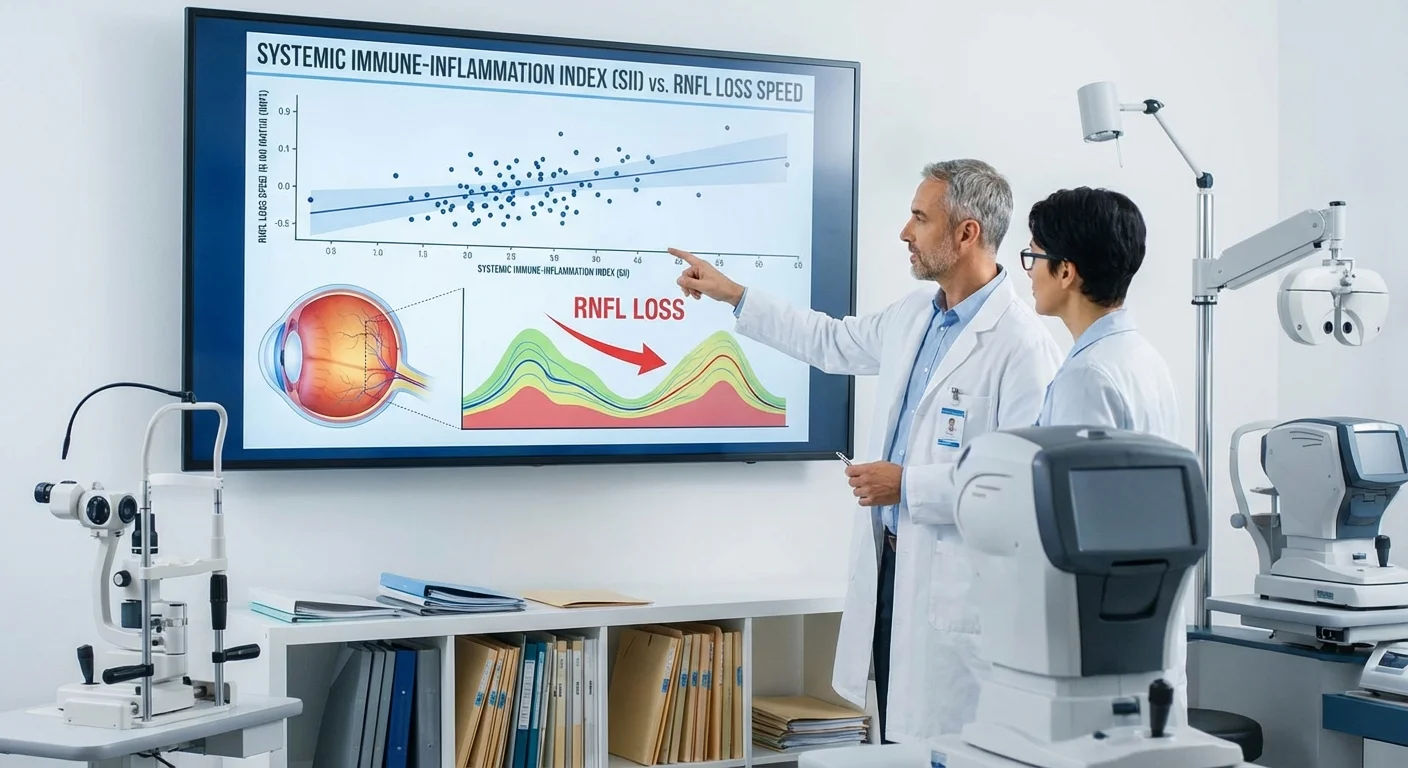
Introduction: Glaucoma is an eye disease that slowly damages the retinal nerve fiber layer (RNFL) – the bundle of nerve fibers carrying vision signals from the eye to the brain. Doctors monitor RNFL thickness (and nearby ganglion cell complex (GCC) thickness) over time using imaging scans. Thinning of RNFL or GCC is a warning sign of glaucoma progression. Traditionally, eye pressure and imaging guide treatment. But emerging research suggests even a routine blood test might help predict how fast the optic nerve will thin. (pubmed.ncbi.nlm.nih.gov) (pmc.ncbi.nlm.nih.gov). A new marker called the Systemic Immune-Inflammation Index (SII) – based on your Complete Blood Count (CBC) – shows promise as an “integrative” inflammation indicator for eye health.
What Is the Systemic Immune-Inflammation Index (SII)?
The Systemic Immune-Inflammation Index (SII) is a number calculated from a standard blood test. It uses three common measures: platelet count, neutrophil count, and lymphocyte count. The formula is:
SII = (Platelet count × Neutrophil count) / Lymphocyte count (pmc.ncbi.nlm.nih.gov).
In other words, multiply your blood platelet number by your neutrophil number, then divide by your lymphocyte number (pmc.ncbi.nlm.nih.gov). All of these values come from the CBC (Complete Blood Count), a test that virtually any doctor can order or that many patients can order directly (see below).
- Platelets are tiny blood cells that help clot blood.
- Neutrophils are a type of white blood cell that rises during infection or inflammation.
- Lymphocytes are another white cell type (including T-cells and B-cells) that fight specific germs.
A higher SII generally means more inflammation (high neutrophils or platelets, or low lymphocytes) across the body. (Originally SII was studied in cancer and heart disease, but now ophthalmology researchers are exploring it (pmc.ncbi.nlm.nih.gov) (pmc.ncbi.nlm.nih.gov).)
Because SII comes straight from routine CBC numbers, it’s an accessible marker. Any adult can get a CBC at most labs (often called “CBC with differential”) and see their platelets, neutrophils, and lymphocytes reported, typically with reference ranges. Then anyone can plug those numbers into the SII formula. Keep in mind the lab’s unit (often thousands of cells per microliter) and use the absolute counts (not percentages) for neutrophils and lymphocytes. For example, if Platelets=250 (×10^3/µL), Neutrophils=4.5 (×10^3/µL), Lymphocytes=1.8 (×10^3/µL), then SII = 250×4.5 / 1.8 ≈ 625. There is no single “normal SII” yet, but researchers have found that glaucoma patients often have much higher SII values than healthy people (pubmed.ncbi.nlm.nih.gov).
SII and Eye Diseases
Research is increasingly linking high SII to eye problems. In glaucoma, one study of 240 open-angle glaucoma patients versus 300 controls found significantly higher SII in the glaucoma group (pubmed.ncbi.nlm.nih.gov). In fact, patients with more severe glaucoma had even higher SII. The authors concluded that elevated SII “might serve as a readily available inflammatory predictor” in glaucoma (pubmed.ncbi.nlm.nih.gov). Large population surveys also back this up. For example, an analysis of U.S. NHANES survey data showed that as SII levels rise, the prevalence of glaucoma increases in a linear fashion (pmc.ncbi.nlm.nih.gov) (pmc.ncbi.nlm.nih.gov).
Interestingly, high SII appears linked to other age-related eye diseases too. The same NHANES analyses found SII rose with both glaucoma and cataract risk (pmc.ncbi.nlm.nih.gov) (pmc.ncbi.nlm.nih.gov). A recent study reported that SII may predict cataract development; the authors suggested it could be a useful biomarker for cataract risk (pmc.ncbi.nlm.nih.gov). (This makes sense: both glaucoma and cataract tend to involve chronic, low-level inflammation as we age.) In simpler terms, systemic inflammation measured by SII is associated with worse outcomes in multiple eye conditions (pmc.ncbi.nlm.nih.gov) (pmc.ncbi.nlm.nih.gov).
For patients, this means: if your blood tests show persistently high SII, it might reflect an inflammatory state that could affect your eyes. However, SII is just one piece of the puzzle. Eye doctors still rely on eye exams and OCT scans; SII could complement those by flagging who might need closer monitoring.
Predicting Nerve Fiber Loss with SII
Glaucoma management often involves estimating how fast the RNFL is thinning each year. Could SII help predict that speed? This is an area of active research. One long-term study in South Korea looked at many routine blood counts and found that some blood values were indeed linked to the rate of RNFL thinning over ten years (pmc.ncbi.nlm.nih.gov). Although that study didn’t calculate SII specifically, it shows that systemic blood markers can predict optic nerve changes (pmc.ncbi.nlm.nih.gov).
Building on this idea, researchers propose time-updated models using SII. In practical terms, instead of a single SII number at diagnosis, one could track a patient’s SII over time (for example, during yearly check-ups). Each year’s SII result would feed into a statistical model predicting RNFL or GCC thickness loss over the next year. This is similar to how doctors update risk predictions for other chronic diseases: for example, keeping track of yearly blood pressure to better forecast stroke risk. In glaucoma research, a time-updated SII model would use the latest SII, along with eye data, to refine the predicted annual thinning rate.
Important factors: To make such models reliable, studies must account for things that transiently affect SII. For example, if a patient has a cold or bacterial infection, neutrophils jump up and lymphocytes drop, spiking SII. This spike reflects the illness, not the glaucoma, so researchers would exclude SII tests taken during acute illness. They must also account for seasonality: blood cell counts vary by season. Large studies have shown neutrophil counts tend to be higher in winter and lower in summer, while lymphocytes peak in spring and dip in fall (pmc.ncbi.nlm.nih.gov). This natural fluctuation will affect SII. Finally, different labs and equipment can give slightly different count values – so a patient’s SII should ideally be tracked by the same lab or with an understanding of the lab’s normal ranges. In short, one would want steady-state SII measurements (no acute flu, done at similar times of year, using the same lab method) to plug into these predictive models.
Cataract Surgery as a “Competing Risk”
One special issue in eye studies is cataract surgery. Many glaucoma patients eventually develop cataracts. Post-cataract surgery, it becomes harder to follow RNFL in the same way (the eye’s internal environment changed). In research, needing cataract surgery is treated as a “competing risk” – an event that removes the eye from typical observation. In other words, if a patient has lens surgery, that event essentially interrupts the natural glaucoma track. In statistical models, a competing-risk analysis will account for cataract surgery as an alternate outcome. This way, the effect of SII on RNFL loss isn’t biased by the eye being operated on.
Note the connection: since higher SII also predicts cataract risk (pmc.ncbi.nlm.nih.gov), a glaucoma patient with high SII might be more likely to need cataract surgery sooner. This reinforces why cataract events must be included in the analysis. In practice, if you’re tracking your eye health and blood tests, it’s worth noting when cataract surgery happens. Doctors might then adjust risk estimates accordingly.
Normal-Tension Glaucoma (NTG) and SII
Normal-tension glaucoma is a form of glaucoma where eye pressure is not elevated, yet nerve damage still occurs. It has led experts to look for non-pressure-related risk factors, including systemic inflammation. Could SII predict progression in NTG?
The jury is still out. NTG is sometimes linked to immune or vascular issues, but studies are mixed. For example, one hypothesis paper suggested using simple blood ratios (like neutrophil-to-lymphocyte ratio) to screen for NTG risk (pubmed.ncbi.nlm.nih.gov). However, a recent case-control study found no significant difference in autoimmune diseases between NTG patients and similar people without glaucoma (pmc.ncbi.nlm.nih.gov). That study suggests autoimmune history alone may not distinguish NTG.
What about blood markers? Some older studies noted that NTG patients tended to have higher CRP or other inflammation markers than people without glaucoma, implying an inflammatory component. But no large study has yet measured SII specifically in NTG patients. Given that SII was higher in general glaucoma and POAG (pubmed.ncbi.nlm.nih.gov), it’s plausible high SII could flag risk in NTG too. However, until more research is done, we can’t say for sure. For now, SII is only a potential piece of the NTG puzzle. Doctors might consider it along with other risk factors (like blood pressure swings and family history), but there’s no established guideline for SII in NTG yet.
Practical Testing and Interpretation
Ordering the test: To use SII, you just need a Complete Blood Count (CBC with differential) from a lab. In many places, you can get this ordered at a clinic or even by direct-access lab services (online lab companies) without seeing a doctor. Providers like QuestDirect or Walk-in Lab (where available) allow patients to purchase a CBC, have blood drawn at a local lab, and receive results directly. The CBC report will list Neutrophils (abs. count), Lymphocytes (abs. count), and Platelets.
Interpreting results: Each lab gives its normal range. You want the absolute counts (often in units like 10^3/µL). To calculate SII: plug into SII = Platelets × Neutrophils / Lymphocytes (pmc.ncbi.nlm.nih.gov). If your lymphocyte count is in the same units as neutrophils, the units cancel (platelets often in thousands, neutrophils and lymphocytes in thousands). Use a calculator.
- If your neutrophils or platelets are elevated or lymphocytes low, SII goes up, signifying more systemic inflammation.
- If your SII is much above several hundred, it might be considered high. (In one glaucoma study, an SII above ~947 was a key cutoff predicting glaucoma (pubmed.ncbi.nlm.nih.gov).)
- Importantly, do not panic over one value. Doctors would look at trends. A single high SII could just mean you had a cold. Multiple, steady high readings would be more concerning.
Other accessible tests: Besides CBC, patients can also ask for general inflammation markers if interested. A C-reactive protein (CRP) test or erythrocyte sedimentation rate (ESR) can indicate inflammation level, although they’re not part of SII. Some labs allow ordering CRP directly. Urine tests aren’t directly related to SII, but routine urinalysis can be done for overall health (to rule out infections or kidney issues).
Key to interpretation: Always compare your results to reference ranges and discuss with a doctor. Some labs also compute ratios (like NLR or PLR), but SII calculation is simple math once you have the CBC numbers. If you’re using online lab results, be sure to use the absolute (not percentage) counts. If the lab uses different units (per liter vs per microliter), convert so the formula works correctly.
Conclusion
In summary, SII from a routine CBC is emerging as a useful marker of systemic inflammation that relates to eye health. High SII has been linked with glaucoma presence and severity (pubmed.ncbi.nlm.nih.gov), and even with cataract risk (pmc.ncbi.nlm.nih.gov). By tracking SII over time alongside eye exams, it may become possible to predict who will lose optic nerve fibers faster. Researchers also take care to exclude tests during illness, adjust for seasonal blood count swings (pmc.ncbi.nlm.nih.gov), and treat cataract surgery as a separate risk when modeling eye disease. Whether SII can help specifically with normal-tension glaucoma progression remains under study.
For patients interested in this approach, the first step is easy: get a complete blood count (CBC) at a lab. Keep good records of your neutrophil, lymphocyte, and platelet counts. Share these with your doctor. A rising SII score – especially one consistently above the typical range – would be a sign to scrutinize your eye health more closely, as it hints at higher inflammation that could affect glaucoma.
As always, SII is just one tool. Eye doctors will continue to rely on eye pressure, visual field tests, and OCT imaging to monitor glaucoma. But understanding SII gives an extra window into your body’s inflammatory state. It’s a promising idea: that a simple blood test could help predict vision loss risk. Ongoing studies will clarify how best to use SII – but it’s something patients and doctors can start paying attention to today.