
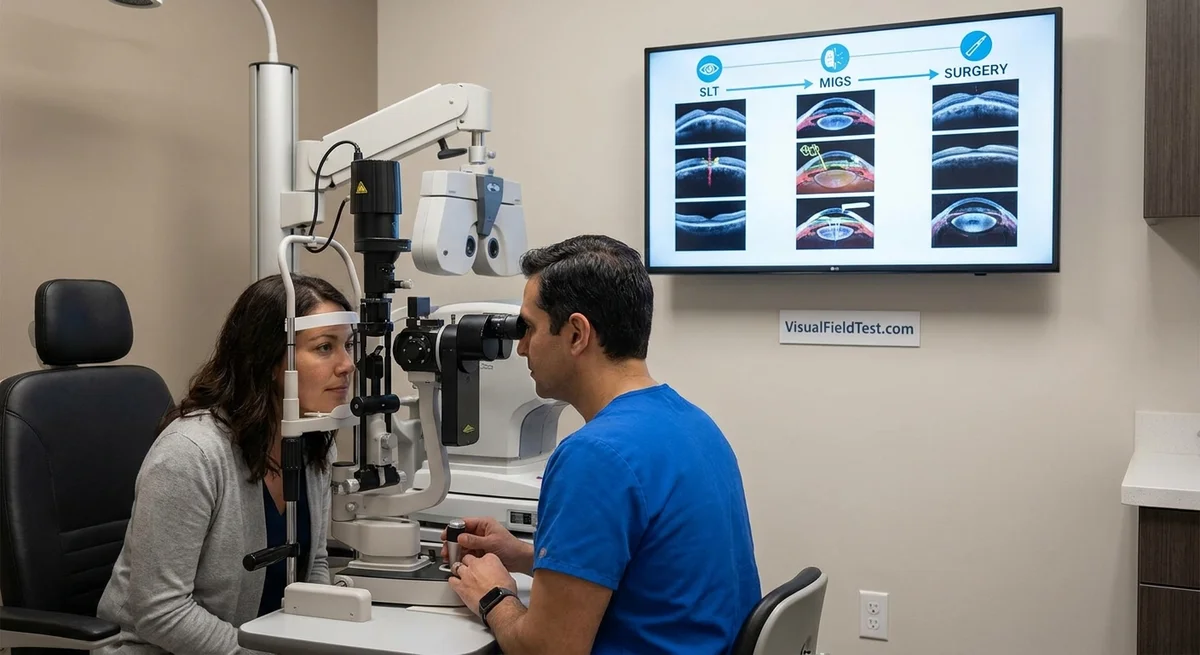
Selective Laser Trabeculoplasty (SLT) in Modern Glaucoma Care
Glaucoma treatment has evolved beyond just daily eye drops or major surgery. Selective laser trabeculoplasty (SLT) is a gentle office laser procedure that helps lower eye pressure by improving fluid drainage through the eye’s natural pathway. In recent years, SLT’s role has grown – sometimes used as an initial therapy, other times added later – especially alongside newer minimally invasive glaucoma surgeries (MIGS). Patient-friendly studies now suggest SLT can safely reduce or delay the need for medications and surgery. For example, a large trial (the LiGHT study) found that when open-angle glaucoma patients started treatment with SLT instead of drops, 74% of them remained off all medications three years later and none needed incisional surgery (www.sciencedirect.com). Leading eye care organizations (like NICE in the UK and the American Glaucoma Society) now list SLT as an option for first-line treatment, recognizing its benefit in early glaucoma care (eyewiki.aao.org).
SLT as Primary or Adjunct Therapy
SLT is often recommended either before starting drops or after medications alone can’t reach the target pressure. Being “selective,” the laser targets pigment cells in the drainage meshwork without scarring it, so it leaves the drainage pathway intact. As a result, SLT can be repeated if needed (glaucoma.org). Per the Glaucoma Research Foundation, a single SLT session typically lowers pressure for about 2–3 years (often longer), and then can be repeated (glaucoma.org). Many patients on multiple eye drops can do very well with SLT: it often allows them to reduce or stop medications.
In contrast, MIGS procedures (such as tiny stents or implants like the iStent or Hydrus) are newer surgical methods done in the operating room, often together with cataract surgery. MIGS also aim to drop pressure or cut down medications, and are especially used in mild-to-moderate glaucoma. For example, one study found that combining a Hydrus microstent with cataract surgery gave the same IOP drop as SLT alone, but allowed many more patients to go medication-free (47% versus only 4% with SLT) (pmc.ncbi.nlm.nih.gov). However, that MIGS group did have a few more short-term issues (temporary blurred vision or IOP spikes) that weren’t seen in the SLT group (pmc.ncbi.nlm.nih.gov). In practice, doctors may choose MIGS when slightly lower pressures are needed than SLT can usually achieve, or when a patient is already getting cataract surgery. MIGS generally have a good safety profile and modest pressure drops (www.eyerounds.org), filling a gap between simple drops/laser and major glaucoma surgery.
SLT can also be used after a MIGS or vice versa. Notably, SLT still helps even if a stent is already in place. One study showed that glaucoma patients who had an iStent implant and then received SLT got about the same eye-pressure reduction as others – but importantly, the previous stent group ended up on fewer medications afterwards (pmc.ncbi.nlm.nih.gov). (This suggests SLT adds benefit in terms of med reduction even after MIGS.) In all cases, SLT is a quick outpatient procedure and may be tried first in suitable patients because it has minimal downsides. If it does not achieve the needed pressure, doctors can then consider stepping up to MIGS or traditional surgery.
Durability and Retreatment
SLT’s effects wear off over time. In general, about half to three-quarters of eyes have successful pressure control at one year, but many lose enough effect by 3–5 years that retreatment is needed. A review of studies reported SLT success rates ranging roughly 45–87% at 1 year, falling to only ~25% by five years (eyewiki.aao.org). In practice, nearly 44–45% of eyes in a 3-year study eventually needed a second SLT treatment (eyewiki.aao.org). Fortunately, SLT is repeatable because it does not scar the meshwork. A repeated SLT (often covering 360° of the angle) can regain pressure control and typically gives another 1–2 years of effect (eyewiki.aao.org). However, each time tends to give a slightly smaller drop, so the benefit diminishes with more repeats (eyewiki.aao.org).
Several factors predict how well SLT will work for a patient. The baseline eye pressure is the strongest predictor: patients with higher starting pressures tend to get bigger pressure drops and higher success rates, simply because there’s more to reduce (pmc.ncbi.nlm.nih.gov). In fact, eyes with very low pressure to start (such as normal-tension glaucoma) may see little benefit at all (pmc.ncbi.nlm.nih.gov). Other features like pigment in the drainage angle or pseudoexfoliation may slightly alter response, but results are quite individual (pmc.ncbi.nlm.nih.gov). Age, race, or severity do not strongly predict outcomes beyond their effect on baseline IOP. In short, entering SLT with a pressure well above target usually means a better absolute drop, while eyes already very low may need more aggressive treatment.
When monitoring SLT, doctors watch for pressure creep. If target pressure is lost or disease progresses (for example, worsening visual field loss), it’s time to step up therapy. Modern guidelines emphasize not waiting for a very high pressure before acting: any sign of glaucoma worsening warrants additional treatment, whether that is repeating SLT, adding MIGS, or moving to incisional surgery (eyewiki.aao.org). Importantly, data show that patients started on SLT often avoid surgeries longer: in the LiGHT trial, none of the SLT-first patients needed glaucoma surgery by year 3 (versus several who started on drops) (www.sciencedirect.com).
Safety and Side Effects
SLT is exceptionally safe for patients. It is done in the clinic under topical anesthesia and causes minimal discomfort. The most common side effects are mild and short-lived. Nearly all patients have some mild eye inflammation (seen as a few cells in the front chamber) for a day or two after the laser, which usually helps the pressure drop before it resolves (glaucoma.org). Many patients also take a few anti-inflammatory drops for a week. Some people might notice a bit of redness or eye irritation right after. A known effect is a transient pressure spike: in roughly 20–30% of eyes, the IOP temporarily rises by about 5 mmHg or more in the first few hours (especially if a lot of angle pigment is present) (pmc.ncbi.nlm.nih.gov). This spike usually takes a day to 48 hours to go away, and doctors often give a preventive drop (like brimonidine or acetazolamide) to blunt it. Rarely, a spike can be higher and take a few days to settle.
Serious complications from SLT are very rare. There have been isolated reports of extended inflammation or even cystoid macular swelling, especially in patients with other eye problems, but these are exceptional cases. By contrast, incisional surgeries (trabeculectomy or tube shunts) carry risks like infection, chronic hypotony, or bleb complications. MIGS are generally safer than classic surgery, but they still involve incisions inside the eye and have their own issues (transient blood or fluid in the eye, needling revisions of stents, etc.). In one head-to-head comparison, a Hydrus MIGS implant and SLT gave similar IOP-lowering, but the MIGS eyes had a few more side effects (temporary blurred vision or early pressure spikes) that did not happen with SLT (pmc.ncbi.nlm.nih.gov).
In summary, SLT’s advantages are its simplicity and safety: it carries none of the risks of a later trabeculectomy (no bleb to worry about) and can be done as often as needed. Its limitations are that it typically cannot achieve very low “target” pressures (often only into the mid-teens) and it may need repeating. MIGS falls in between: it is more invasive, so has somewhat more risk, but it can sometimes reach a bit lower pressure and substantially reduce medications (pmc.ncbi.nlm.nih.gov). The choice between them depends on how much pressure lowering is needed and patient preferences.
Sequencing SLT and MIGS: Proposed Treatment Pathways
The best order of treatments depends on disease severity, resource goals, and patient wishes. Here are evidence-based approaches to lining them up:
-
Early (mild) glaucoma: Consider SLT first to delay drops. A patient with newly diagnosed mild open-angle glaucoma and a target pressure in the mid-teens can often do well with one SLT treatment (glaucoma.org). If the patient is already undergoing cataract surgery, a surgeon might instead or additionally place a MIGS stent during the same operation (for example, an iStent or Hydrus). If SLT is used and later pressure rises, re-treat SLT once or twice more before moving on. If additional lowering is needed, MIGS procedures or adding a single medication may be the next step. Several guidelines now endorse using laser early exactly for these patients.
-
Moderate glaucoma or patients on multiple drops: Many surgeons consider MIGS (with cataract if indicated) at this stage, especially if target IOP is not reached by medicines and lens changes allow. For example, an eye needing to go from 18 to 15 mmHg might handle SLT, but an eye needing 12–13 mmHg may require a stent or micro-shunt. SLT can still be done either before or after MIGS to shave off a few more points or reduce meds. Indeed, even after an unsuccessful MIGS, applying SLT later can add some benefit (pmc.ncbi.nlm.nih.gov). If MIGS itself is insufficient, the patient may ultimately need a full trabeculectomy or tube shunt, especially if disease is progressing.
-
Advanced glaucoma: Here the target pressure is very low (often mid-teens or below). Neither SLT nor most MIGS will reliably hit those levels. In such cases, many doctors proceed directly to trabeculectomy or tube. SLT may be used earlier as a temporizing step or if the patient absolutely cannot have surgery, but one should be prepared for possible twin interventions (laser first, then surgery). For very advanced fields, doctors may bypass SLT/MIGS and go to trabeculectomy sooner to ensure adequate control.
-
Patient goals and context: Some patients strongly prefer to avoid daily drops or are bothered by medication side effects. SLT and many MIGS can greatly reduce drop burden. For a patient with life-long glaucoma ahead of them, delaying drops even by a few years can improve quality of life (eyewiki.aao.org) (www.sciencedirect.com). Others may be anxious about surgery risks; these patients might opt for SLT or MIGS as long as possible. Conversely, a patient who tolerates drops well but has very aggressive glaucoma might choose to skip SLT and go straight to a more definitive procedure. Resources and access also matter: an eye surgeon might choose SLT as a cost-effective first step in a system, knowing it delays expensive surgery and reduces medication costs (eyewiki.aao.org).
In practice, a customized care plan could look like this:
- Mild glaucoma, patient on 0–1 drops: Do SLT as first step (glaucoma.org). If pressure target isn’t reached after 1–2 lasers, add a drop or two. If moderate cataract is present, consider combined cataract+MIGS instead.
- Moderate glaucoma, on 2+ drops: If the patient is having cataract surgery, add a MIGS stent; if not, SLT is still an option for incremental lowering. If target pressure still isn’t met, plan for a trabeculectomy or a more potent intervention.
- Glaucoma in one eye with the only seeing eye or with normal-tension: SLT may yield less drop in normal-pressure eyes (pmc.ncbi.nlm.nih.gov), so set expectations or lean toward earlier surgery. For a patient who cannot risk incisional surgery (e.g. severe comorbidities), SLT/MIGS become even more valuable.
- Pseudoexfoliation or pigmentary glaucoma: These often respond well to SLT (and produce higher spikes). In such cases, dosing SLT conservatively or doing it in steps may be wise to prevent spikes.
Overall, SLT is now seen as a versatile tool in the glaucoma toolbox (glaucoma.org) (www.sciencedirect.com). It can be used as a gentle first move, an add-on when drops alone are not enough, or a way to postpone or even prevent more invasive surgery. MIGS procedures play alongside SLT, offering a middle ground of safety and efficacy (www.eyerounds.org) (pmc.ncbi.nlm.nih.gov). By considering disease stage, patient needs, and surgeon expertise, clinicians can sequence SLT and MIGS (and later trabeculectomy) in a logical, evidence-based way that maximizes benefit and safety for each individual.