
Introduction
Our eyes depend on a steady blood flow and pressure balance to stay healthy. During sleep, changes in blood pressure, breathing, and even eye pressure can affect vision. In particular, a drop in blood pressure at night (nocturnal hypotension) and episodes of stopped breathing (sleep apnea) may reduce ocular perfusion pressure – the difference between blood pressure and eye pressure – and stress the optic nerve. Researchers are now using 24-hour monitoring of blood pressure, oxygen levels, and eye pressure to see how these factors line up with subtle changes in vision. This article explains how nighttime blood pressure dips and sleep apnea can influence eye health, how we can measure them, and what can be done to protect the eyes.
Nighttime Blood Pressure Dips and Eye Health
Most people experience a normal “dip” in blood pressure during sleep – typically a 10–20% fall compared to daytime levels. However, some individuals, especially those on blood pressure medications, experience a larger drop. When blood pressure falls too far, the ocular perfusion pressure (OPP) can become too low. The OPP is essentially the driving pressure pushing blood into the eye (roughly blood pressure minus eye pressure). If OPP drops too much, the optic nerve may not get enough blood. In fact, experts believe that the balance between intraocular pressure (IOP) and blood pressure is key to optic nerve health (edoc.unibas.ch).
Studies confirm the danger of extreme nighttime dips. For example, glaucoma patients whose blood pressure fell far below daytime levels at night tended to have more progression of vision loss. In one long-term study of normal-tension glaucoma patients, the duration and magnitude of nocturnal blood pressure below daytime pressure predicted the rate of visual field loss (www.sciencedirect.com). In practical terms, this means if your nighttime blood pressure stays significantly (e.g. 10 mmHg or more) below your daytime average for many hours, your risk of glaucoma worsening is higher. Another study found that glaucoma patients who had unusual large dips in night blood pressure (so-called over-dippers) showed larger swings in ocular perfusion pressure and worse visual field test results (pubmed.ncbi.nlm.nih.gov).
Importantly, body position and sleep also matter. Normally, when you lie down, intraocular pressure (IOP) tends to rise (by 10–20%) because eye fluid drains more slowly (glaucoma.org). So at night you may have higher IOP and lower blood pressure at the same time – a “double whammy” that can lower OPP. In simple terms, the nighttime balance of pressures can leave the optic nerve vulnerable if blood pressure drops too much or eye pressure rises too much.
Sleep Apnea and Oxygen Supply
Obstructive sleep apnea (OSA) is a condition where the upper airway repeatedly collapses during sleep, causing breathing to stop briefly and oxygen levels to fall. During an apnea event, the body may experience low oxygen (hypoxia) and sudden surges in blood pressure when breathing resumes. Over time, untreated sleep apnea has many health effects, including on the eyes. Research shows that patients with glaucoma have a higher chance of having sleep apnea. For instance, one study found 20% of glaucoma patients screened positive for sleep apnea (higher than in similar people without glaucoma) (edoc.unibas.ch). A large meta-analysis reported that sleep apnea is significantly associated with the presence of glaucoma (pmc.ncbi.nlm.nih.gov). In other words, glaucoma patients are more likely to have sleep apnea than people in general.
Why does apnea matter for the eye? Repeated drops in oxygen during the night can stress the optic nerve’s blood supply. Although the full connection is still under study, doctors caution that untreated apnea could worsen glaucoma. For now, anyone with glaucoma — especially if they have symptoms like loud snoring or daytime fatigue — should consider evaluation for sleep apnea.
Measuring Pressures at Home (Continuous Monitoring)
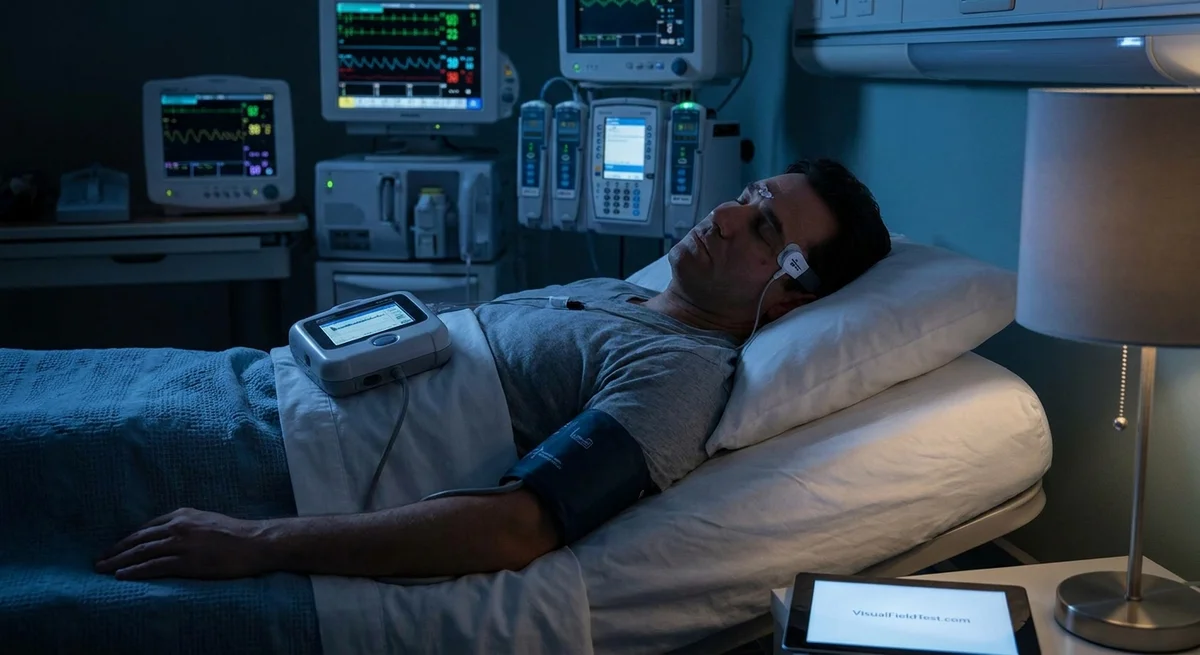
To understand these nighttime effects, doctors can use ambulatory monitoring devices at home:
-
Ambulatory Blood Pressure Monitors: These are portable cuffs worn on the arm that record blood pressure every 15–30 minutes for 24–48 hours. They capture day/night patterns. In studies, glaucoma patients have worn ambulatory monitors to catch nighttime dips and relate them to vision changes (www.sciencedirect.com).
-
Pulse Oximeters: These finger-worn or bedside devices continuously track blood oxygen saturation and pulse rate. They can detect the low-oxygen episodes caused by apneas. By logging drops in oxygen, a pulse oximeter gives a measure of apneic burden.
-
Continuous Eye Pressure Sensors: New technology can track IOP trends over 24 hours. For example, the SENSIMED Triggerfish is a soft contact lens with a built-in strain gauge. Worn overnight, it records tiny changes in the eye’s shape caused by IOP fluctuations (www.nice.org.uk). (The data come out as a pattern of millivolt signals, not mmHg, but they clearly show when eye pressure peaks.) Using these tools together, researchers can recreate minute-by-minute ocular perfusion pressure (blood pressure minus eye pressure) through the night, and see if dips align with low oxygen events.
These advanced monitors are mainly used in research today, but they illustrate what can be done. In a recent study of untreated glaucoma, doctors actually checked IOP and blood pressure every few hours around the clock, then calculated mean ocular perfusion pressure (MOPP) and categorized patients based on how much their nighttime blood pressure fell (pubmed.ncbi.nlm.nih.gov).
Impact on Vision and Visual Fields
Why do we care about mapping these night changes? Ultimately, it’s about preserving vision. Decreases in OPP can reduce flow to the optic nerve head, potentially starving it of nutrients. Over time, this contributes to glaucomatous optic nerve damage and loss of peripheral vision. The key measure we have for glaucoma damage is the visual field test, which shows how well a person sees over the entire field of vision.
Studies link larger nocturnal dips with worse visual field outcomes. For example, in the ambulatory study mentioned above, glaucoma patients with progressing vision loss had significantly lower nighttime blood pressure and larger dips than those with stable disease (researchers.mq.edu.au). In the modern NTG study, the researchers found that patients who spent more time at very low blood pressure (<10 mmHg below daytime) had more rapid visual field decline (www.sciencedirect.com). In other words, the deeper and longer your pressure stays reduced at night, the more likely small vision losses will occur over time.
Eye doctors have noticed that even if daytime eye pressure is well-controlled, some patients’ fields worsen. Continuous monitoring helps explain this puzzle: if blood pressure drops during sleep, the optic nerve may be at risk even when eye pressure is “normal.”
Treatment: CPAP and Medication Timing
If nocturnal drops or apnea are problems, what can be done? Two ideas are: treating sleep apnea and adjusting blood pressure medication timing.
-
Treating Sleep Apnea: The main therapy for OSA is CPAP (Continuous Positive Airway Pressure), which keeps the airway open at night. CPAP restores normal breathing and oxygen levels. Interestingly, one study found that starting CPAP in sleep apnea patients slightly raised eye pressure overnight and lowered ocular perfusion pressure (pubmed.ncbi.nlm.nih.gov). The mechanism isn’t fully clear. However, CPAP’s benefits for general health outweigh this, and many eye specialists recommend that glaucoma patients with sleep apnea use CPAP, while carefully monitoring eye pressure and fields. In summary, treating apnea may improve oxygen delivery to the optic nerve, but doctors keep an eye (pun intended) on any IOP changes.
-
Adjusting Blood Pressure Meds: Doctors used to worry that taking blood pressure drugs at night might cause excessive dips. Some physicians now suggest taking antihypertensive medication in the morning rather than right before bed, to avoid deep night-time hypotension. On the other hand, large trials have shown no significant difference in major outcomes whether blood pressure pills are taken in the morning or evening (www.acc.org). One summary of the TIME trial concluded that patients can take hypertension medication in the morning or evening by preference (www.acc.org) (www.acc.org). For someone with glaucoma, a doctor might still tailor the timing: for example, taking long-acting blood pressure pills in the morning could blunt the night dip. This should be decided case-by-case.
In all cases, patients should never stop or change medication without a doctor’s guidance. But if you have glaucoma and are on blood pressure medications, it’s reasonable to bring up the question of timing with your eye doctor and primary care doctor.
Who Is Most at Risk?
Not every person needs round-the-clock monitoring or interventions. But certain “phenotypes” (patient profiles) seem more vulnerable to nocturnal issues:
-
Normal-Tension Glaucoma: Patients who develop glaucoma despite “normal” IOP often have other vascular risk factors. In studies, normal-tension glaucoma patients frequently showed large nocturnal blood pressure dips (www.sciencedirect.com). If your glaucoma worsens even when your eye pressure is controlled, nocturnal hypotension could be a culprit.
-
Progressive Glaucoma: Anyone whose visual fields keep deteriorating despite treatment should be evaluated for systemic factors. As studies show, these patients often have bigger BP drops at night (researchers.mq.edu.au).
-
Multiple Vascular Risks: People with conditions like migraines, Raynaud’s phenomenon (cold hands), or anemia may have components of blood flow dysregulation. Others with metabolic syndrome (diabetes, obesity, high cholesterol) might have hypertension and sleep apnea together. The interplay is complex, but a history of sleep problems (snoring, pauses, gasping) or very low night-time BP readings should raise a flag.
In short, tell your eye doctor about any symptoms of poor night-time oxygen (snoring, daytime tiredness), and ask if an overnight blood pressure test is warranted. Keeping a simple home blood pressure log (morning vs bedtime readings) can help. Anyone older or on multiple BP-lowering drugs should be aware of possible over-dipping at night.
Conclusion
Our sleep may be restful for the brain, but our eyes continue to rely on good blood flow through the night. Excessive drops in blood pressure or repeated low-oxygen events (sleep apnea) can lower ocular perfusion pressure and threaten the optic nerve. Using ambulatory devices, researchers have shown that these night-time factors can indeed align with worse vision test results (www.sciencedirect.com) (pubmed.ncbi.nlm.nih.gov). The good news is that with awareness, steps can be taken: treating sleep apnea, adjusting medication timing, and close monitoring can help stabilize ocular perfusion and protect vision. Patients and doctors should work together – if you have glaucoma and are a “ night-time dipper” or have sleep apnea, let your doctors know. Adjustments like moving blood pressure pills to the morning or using CPAP at night may save vision in the long run.
Sources: Numerous peer-reviewed studies and expert analyses support these findings (www.sciencedirect.com) (pubmed.ncbi.nlm.nih.gov) (pmc.ncbi.nlm.nih.gov) (edoc.unibas.ch) (www.nice.org.uk) (www.acc.org) (www.acc.org) (edoc.unibas.ch), including a large glaucoma cohort study and a meta-analysis of sleep apnea. These findings underline the importance of integrated care between eye specialists and primary doctors for patients with glaucoma.