
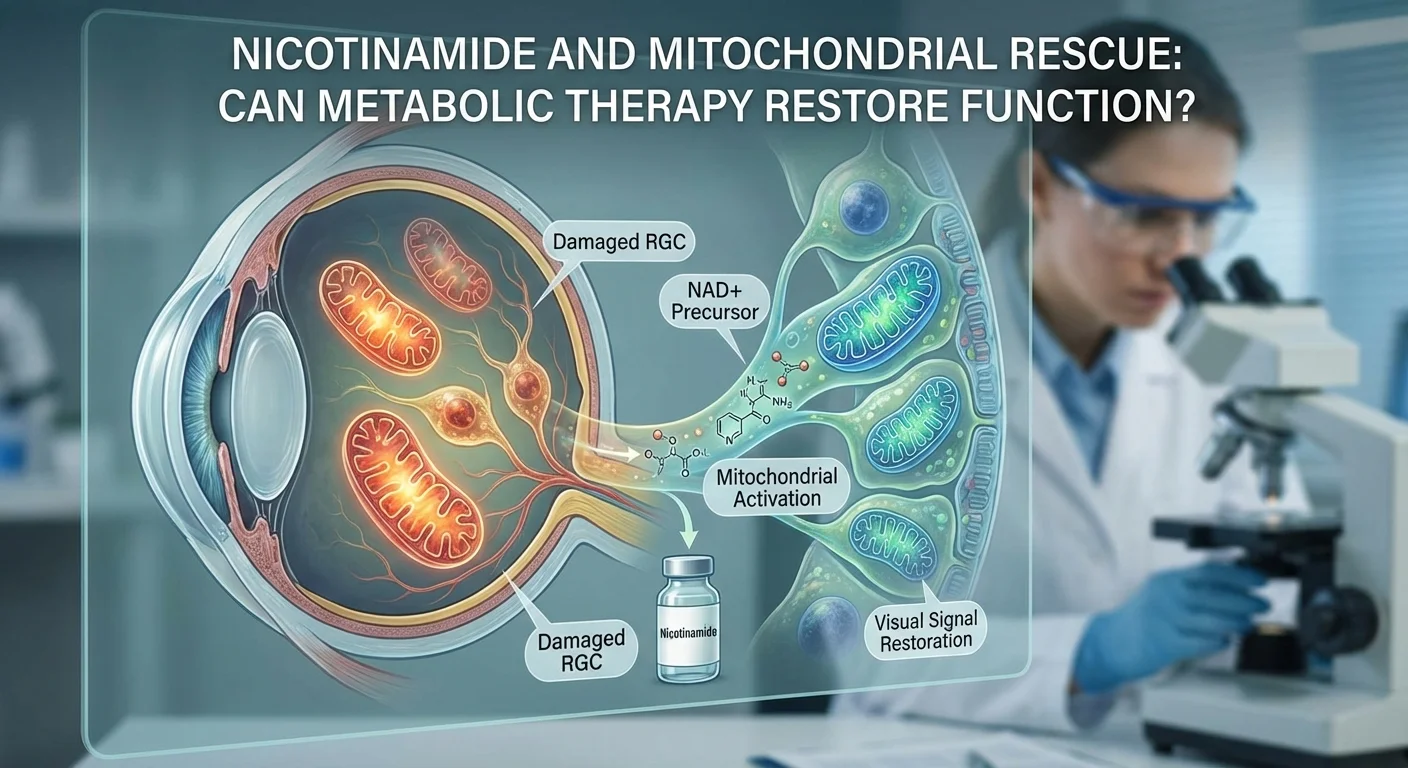
Nicotinamide and Mitochondrial Rescue: Can Metabolic Therapy Restore Function?
Glaucoma is a leading cause of irreversible vision loss, often progressing even when intraocular pressure (IOP) is controlled. A growing body of evidence highlights that retinal ganglion cells (RGCs) are particularly vulnerable to metabolic stress, notably from chronic depletion of nicotinamide adenine dinucleotide (NAD+), a coenzyme essential for mitochondrial energy production (pmc.ncbi.nlm.nih.gov). Nicotinamide (NAM), a form of vitamin B3 and an NAD+ precursor, has therefore emerged as a promising neuroprotective therapy. In animal models and early human studies, NAM supplementation has shown significant preservation of RGC integrity and function (pmc.ncbi.nlm.nih.gov) (pmc.ncbi.nlm.nih.gov). This article reviews recent randomized clinical trials of high-dose NAM (with or without pyruvate) and discusses how NAD+ repletion might “rescue” stressed but viable RGCs. It also covers dosing considerations, safety, heterogeneity of responses, patient selection, and ongoing research.
Metabolic Basis of Glaucoma and NAD+ Repletion
RGCs have extremely high metabolic demands and rely on robust mitochondrial function. In glaucoma, aging and chronic stress trigger progressive NAD+ depletion in RGCs. NAD+ is a key cofactor in oxidative phosphorylation and in pathways (like sirtuins and DNA repair) that support cell survival (pmc.ncbi.nlm.nih.gov) (pmc.ncbi.nlm.nih.gov). When NAD+ levels fall, RGCs experience bioenergetic failure, elevated oxidative stress, and susceptibility to apoptosis. Nicotinamide supplementation can replenish NAD+ via the NAD+ salvage pathway. This helps maintain mitochondrial ATP production and activates survival enzymes (e.g. SIRT1) while preventing over-activation of PARP1 (a DNA repair enzyme that can otherwise deplete NAD+) (pmc.ncbi.nlm.nih.gov) (pmc.ncbi.nlm.nih.gov).
In short, restoring NAD+ may revive “silent” RGCs. For example, electroretinographic studies show that NAM-treated glaucoma patients have larger photopic negative response (PhNR) amplitudes – an objective measure of inner retinal (RGC) function – compared to placebo (pmc.ncbi.nlm.nih.gov). These studies suggest NAM protects against early mitochondrial dysfunction and can boost RGC activity even after onset of disease. In animal glaucoma models, high-dose nicotinamide robustly preserved RGC morphology and prevented vision loss (pmc.ncbi.nlm.nih.gov). Together, these findings support the idea that stressed but not-yet-dead RGCs can be metabolically “rejuvenated” by NAD+ repletion.
Clinical Trial Evidence for Nicotinamide
Several recent randomized trials have tested high-dose nicotinamide (with or without pyruvate) in glaucoma patients. Key outcomes include electrophysiology (pattern or photopic ERG) and visual function tests (visual field).
-
Nicotinamide supplements alone (high-dose): A crossover trial in Australia randomized 57 patients with treated primary open-angle glaucoma to receive high-dose NAM (1.5 g/day for 6 weeks, then 3.0 g/day for 6 weeks) versus placebo, then crossed over (www.researchgate.net). In this study, inner retinal function improved significantly on NAM. The PhNR amplitude (Vmax) increased by ~14.8% on NAM (vs 5.2% on placebo, p=0.02), and the PhNR/b-wave ratio increased ~12.6% on NAM (p=0.002) (www.researchgate.net). Notably, 23% of patients on NAM showed PhNR improvements beyond natural variability, compared to only 9% on placebo (www.researchgate.net). There was also a trend for better visual fields: 27% of eyes improved ≥1 dB in mean deviation on NAM versus only 4% on placebo (p=0.02) (www.researchgate.net). Compliance was excellent (>94%) and NAM was well tolerated. These results indicate that NAM alone can improve objective measures of RGC function over a few months, even without lowering IOP (www.researchgate.net).
-
Nicotinamide plus pyruvate: In a Phase 2 trial (JAMA Ophthalmology 2021), 57 glaucoma patients were randomized to receive nicotinamide (1.5 g/day for 6 weeks, then 3.0 g/day for 6 weeks) together with calcium pyruvate, versus placebo (pmc.ncbi.nlm.nih.gov). This study evaluated standard automated perimetry (SAP) over ~2 months of treatment. The NAM+pyruvate group had significantly more improving visual field locations than the placebo group. In fact, treated eyes showed a threefold higher odds of pointwise sensitivity improvement (pmc.ncbi.nlm.nih.gov). Safety was good. Importantly, improvements tended to occur in areas of mild or moderate field loss, not in severely damaged or dead areas (pmc.ncbi.nlm.nih.gov). This suggests that metabolic therapy revived RGCs that were “stressed but not dead”, yielding better perimetric and ERG measures (pmc.ncbi.nlm.nih.gov). Consistent with the NAM-only trial, this study implies a short-term functional gain from NAD+ replenishment, though structural measures (like OCT RNFL thickness) were unchanged.
In summary, both trials showed functional improvement in glaucoma patients on NAM. The Australian crossover (NAM vs placebo) found statistically significant gains in PhNR and trends in visual field MD (www.researchgate.net). The JAMA trial (NAM+pyruvate) demonstrated more improving field points with treatment (pmc.ncbi.nlm.nih.gov) (pmc.ncbi.nlm.nih.gov). The effects were generally modest and observed over weeks; larger trials over longer durations are needed to assess durability.
Mechanism: “Rescuing” Viable RGCs
How can NAM produce these gains? The key concept is dormant or stressed RGCs. In glaucoma, some RGCs have impaired metabolic activity but remain alive. By boosting NAD+, NAM can jump-start mitochondrial ATP production in these cells, improving their firing and synaptic function (pmc.ncbi.nlm.nih.gov) (pmc.ncbi.nlm.nih.gov). The JAMA paper observed that visual gains occurred mainly in test locations with mild-moderate sensitivity loss, often at edges of scotomas (pmc.ncbi.nlm.nih.gov). In contrast, severely damaged regions (where RGCs are likely irreversibly lost) did not improve. In other words, NAM seems to recruit partially degenerated RGCs back to function. Moreover, combining NAM with pyruvate (an energy substrate) may enhance multi-faceted metabolic support.
At the molecular level, increased NAD+ can activate neuroprotective pathways. For example, sirtuin-1 (SIRT1) requires NAD+ to deacetylate mitochondrial enzymes and support stress resistance, while poly-ADP-ribose polymerase-1 (PARP-1) consumes NAD+ when overactive during DNA damage. By bolstering NAD+ pools, NAM can keep SIRT1 active and limit PARP-mediated cell death. Several animal studies have confirmed that NAM supplementation stabilizes mitochondrial health, preserves RGC dendrites, and maintains optic nerve integrity (pmc.ncbi.nlm.nih.gov) (pmc.ncbi.nlm.nih.gov). One review notes that NAM “boosts NAD+ levels, protects against early mitochondrial dysfunction, and enhances photopic negative response amplitudes” in experimental glaucoma (pmc.ncbi.nlm.nih.gov). Thus NAD+ repletion provides a plausible mechanism for the clinically observed improvements.
Dosing and Safety Considerations
The clinical studies have generally used high oral doses of nicotinamide (1.5–3.0 g/day). In the trials above, patients escalated from 1500 to 3000 mg daily. These dosages are well above the typical dietary intake but are still within ranges tested in other fields (e.g. Alzheimer’s research). Pharmacokinetic data show that NAM is extensively metabolized on first pass, so only a fraction reaches retinal tissue (pmc.ncbi.nlm.nih.gov). Thus the high doses are intended to overcome this limitation. It remains unclear if even higher doses would be more effective or tolerable; animal studies often use far larger weight-based doses, raising feasibility concerns for humans (pmc.ncbi.nlm.nih.gov).
So far, short-term tolerability appears good. The trials reported only mild gastrointestinal discomfort as the most common side effect. For example, one review found that doses up to 3 g/day for 6–12 weeks were well tolerated, with no severe adverse events or liver enzyme elevations (pmc.ncbi.nlm.nih.gov). In the crossover trial, adherence was excellent and NAM was “well tolerated with minimal side effects” (www.researchgate.net). Similarly, the JAMA study reported no serious safety issues. The IJMS review confirms that even combined NAM+pyruvate was well tolerated at high doses, with only minor GI symptoms and no serious events (pmc.ncbi.nlm.nih.gov).
Only a few discontinuations have been reported. In a small open trial of NAM for glaucoma, 3 of 87 patients (about 3%) stopped due to side effects (primarily gastrointestinal) (pmc.ncbi.nlm.nih.gov). Overall, NAM’s favorable safety profile (low cost, oral route) is encouraging (pmc.ncbi.nlm.nih.gov). However, long-term safety remains an open question. Most studies have lasted weeks to a few months. Nicotinamide is not completely inert – very high doses over years could, in theory, affect liver function, methylation status, or other systems. One review noted that while NAM was “well tolerated in the short term,” evidence on chronic use is limited (pmc.ncbi.nlm.nih.gov) (pmc.ncbi.nlm.nih.gov). Ongoing trials will monitor hepatic enzymes and other labs to ensure safety. The world’s largest NAM trial (Nicotinamide Diabetes Intervention Trial) used 3 g/day for 3 years without major issues, but translation to glaucoma patients awaits study.
Patient Selection and Heterogeneity of Response
Not all glaucoma patients are expected to respond equally. The available data suggest the greatest benefit in early-to-moderate disease, before RNFL loss becomes terminal. In the trials, visual/ERG improvements were seen in sectors with moderate deficits, whereas fields that were already at or below the measurement “floor” did not gain function (pmc.ncbi.nlm.nih.gov) (pmc.ncbi.nlm.nih.gov). This implies that eyes with very thin RNFL (the “floor effect” in advanced glaucoma) may have too few living RGCs left to salvage. Conversely, patients with mild to moderate field loss still harbor many viable but stressed RGCs, making them ideal candidates.
For example, the JAMA study found that improving visual field points on NAM/pyruvate were “those with mild to moderate sensitivity loss,” consistent with rescuing partially dysfunctional cells (pmc.ncbi.nlm.nih.gov). The Biomedicines review echoed this, noting that loci with intermediate sensitivity saw the most gains (pmc.ncbi.nlm.nih.gov). Conversely, no patient showed structural improvement (RNFL thickness) in the short term, suggesting NAM does not regrow axons but revives function (pmc.ncbi.nlm.nih.gov). Thus patients with early glaucoma and adequate RNFL might benefit most.
Other factors might influence response. For instance, glaucoma is heterogeneous (high-pressure vs normal-pressure, different genetic backgrounds, comorbidities). One trial (Gustavsson 2023) indicated that patients with severe disease actually had a larger vascular perfusion increase on NAM (pmc.ncbi.nlm.nih.gov), hinting that severe glaucoma might benefit vasculopathically even if their RGC response is limited. However, electrophysiology and fields likely improve only if enough RGCs survive. In summary, patient selection is still being studied, but a reasonable hypothesis is that earlier-stage, metabolically stressed eyes are most likely to show functional rescue (pmc.ncbi.nlm.nih.gov) (pmc.ncbi.nlm.nih.gov).
Ongoing Trials
Several large trials are currently underway to rigorously assess nicotinamide therapy in glaucoma:
- A University College London Phase 3 trial (NCT05405868) is testing up to 3.0 g/day NAM in 27-month treatment of open-angle glaucoma patients (pmc.ncbi.nlm.nih.gov). Its primary outcome is the change in mean visual field sensitivity over time (pmc.ncbi.nlm.nih.gov).
- The Umeå University Glaucoma Nicotinamide Trial (NCT05275738) plans 2 years of 3.0 g/day NAM versus placebo, focusing on visual field progression rates (pmc.ncbi.nlm.nih.gov).
- An Australian-led trial (NCT04784234) is evaluating “GlaucoCetin” dietary supplement (which contains NAM among other agents) with endpoints including electrophysiology and contrast sensitivity (pmc.ncbi.nlm.nih.gov).
- Columbia University is running a NAM+pyruvate RCT (NCT05695027) over 20 months, with outcomes including central visual field and OCT RNFL thickness (pmc.ncbi.nlm.nih.gov).
These studies will address key gaps: durability of effect (progression over years), structural correlates (OCT changes), and real-world feasibility. They will also recruit larger and more diverse cohorts, potentially illuminating which subgroups (severity, glaucoma type, baseline NAD+ levels) benefit most.
Unanswered Questions
Despite promising early data, many questions remain. It is not yet established whether NAM merely produces short-term functional gains or actually slows long-term neurodegeneration. Do improvements persist after stopping supplementation, or is continuous treatment needed? The optimal dose and schedule (e.g. whether to pulse or cycle) are unknown. Patient-specific factors (e.g. systemic NAD+ metabolism, diet, genetics) that predict response have not been defined. And it is unclear how NAM therapy should integrate with other neuroprotective strategies.
Importantly, structural outcomes have so far been disappointing: none of the trials reported an increase in RNFL or ganglion cell complex thickness. This suggests NAD+ repletion may buy functional time but not replace lost cells. Whether sustained treatment can at least preserve RNFL slope is a key open question. Future work will need to follow eyes over years.
Nevertheless, the existing trials have demonstrated that metabolic therapy is feasible and safe enough to proceed. The hope is that these NAD+-targeting approaches will complement traditional IOP-lowering and eventually become part of personalized glaucoma care.
Conclusion
High-dose nicotinamide shows biological plausibility and early clinical promise for “metabolic rescue” of RGCs in glaucoma. Randomized trials report short-term improvements in electrophysiology and visual fields, especially in regions of mild-to-moderate damage (www.researchgate.net) (pmc.ncbi.nlm.nih.gov). Nicotinamide’s mechanism – replenishing NAD+ to restore mitochondrial function – provides a compelling rationale for rescuing stressed RGCs before cell death (pmc.ncbi.nlm.nih.gov) (pmc.ncbi.nlm.nih.gov). Key considerations include using doses up to ~3 g/day (well tolerated over weeks) and monitoring for gastrointestinal effects (pmc.ncbi.nlm.nih.gov) (pmc.ncbi.nlm.nih.gov). As larger multicenter trials read out over the coming years, we will learn whether this metabolic therapy can durably slow glaucoma progression and which patients are most likely to benefit.