
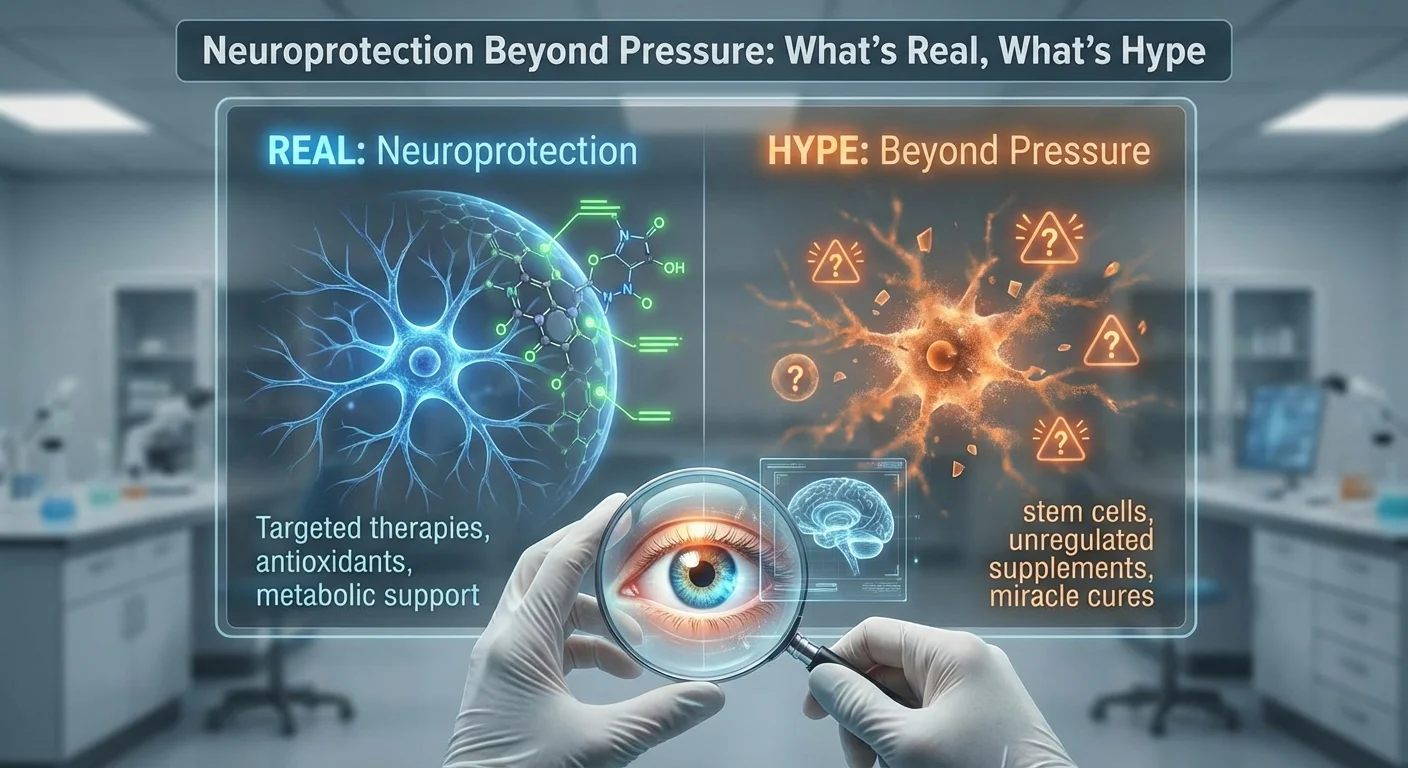
Neuroprotection Beyond Pressure: What’s Real, What’s Hype
Glaucoma causes vision loss by damaging the optic nerve, often linked to high intraocular pressure (IOP) in the eye. Lowering IOP with drops or surgery is currently the only proven way to slow glaucoma’s progression (pmc.ncbi.nlm.nih.gov). However, many patients still lose vision despite good pressure control, so doctors are studying pressure-independent strategies to directly protect the retinal nerve cells (neuroprotection). This article reviews the latest research on these strategies and separates solid science from overhyped claims.
A recent review reminds us that after decades of work, “only a handful of neuroprotective therapies have succeeded clinically” (pmc.ncbi.nlm.nih.gov). In other words, very few treatments beyond pressure-lowering have demonstrated clear benefit in patients. For now, all patients should understand that the best evidence still supports aggressive pressure control, while other approaches remain experimental (pmc.ncbi.nlm.nih.gov) (pmc.ncbi.nlm.nih.gov).
Alpha-2 Adrenergic Agonists (Brimonidine and Similar Drugs)
One class of glaucoma medication with proposed neuroprotective effects is the alpha-2 adrenergic agonists. The most common example is brimonidine, an eye drop that lowers pressure but also signals through alpha-2 receptors in the retina. In animal studies, brimonidine showed promise as a nerve protector. For example, a 2021 experiment in mice found that topical brimonidine reduced inflammatory stress and preserved retinal ganglion cell (RGC) function after injury (pmc.ncbi.nlm.nih.gov). In that study, electrical signals from the retina were higher and fewer nerve cells died in treated eyes.
Despite these encouraging lab results, clinical trials in humans have not confirmed a clear benefit. A 2020 systematic review of all brimonidine trials found only a few small studies, showing mixed results and high uncertainty (pubmed.ncbi.nlm.nih.gov). Another analysis concluded overall evidence is “inconclusive” (pmc.ncbi.nlm.nih.gov). In one randomized trial, patients on brimonidine did not significantly fade less in vision field loss compared to standard treatment, and authors cautioned that bias may account for any apparent advantage (pmc.ncbi.nlm.nih.gov) (pubmed.ncbi.nlm.nih.gov). In short, brimonidine remains a useful IOP-lowering drug, but its neuroprotective powers in people have yet to be proven (pmc.ncbi.nlm.nih.gov) (pubmed.ncbi.nlm.nih.gov).
NMDA Blockade (Memantine Trials)
Another idea was to use NMDA-receptor antagonists to block excitotoxicity (overstimulation by glutamate). Memantine is an Alzheimer’s drug with that action. Two large Phase-3 trials (over 2,200 patients with open-angle glaucoma) tested oral memantine (10 mg or 20 mg daily) against placebo for four years (pubmed.ncbi.nlm.nih.gov) (pmc.ncbi.nlm.nih.gov). Disappointingly, memantine did not slow glaucoma progression. The rate of visual field loss was essentially the same in memantine and placebo groups (pubmed.ncbi.nlm.nih.gov) (pmc.ncbi.nlm.nih.gov). In pooled analysis, memantine showed no significant protective effect on visual field or optic nerve damage (pubmed.ncbi.nlm.nih.gov) (pmc.ncbi.nlm.nih.gov). In fact, those trials “did not reveal a significant benefit” of memantine (pubmed.ncbi.nlm.nih.gov) and failed to meet their primary endpoint (pmc.ncbi.nlm.nih.gov). In plain terms, memantine did not work as a glaucoma neuroprotectant, so it is not used for this purpose.
Rho-Kinase Pathway Inhibitors
Rho-kinases (ROCK) are enzymes that regulate cell shape and contraction. In the eye, ROCK inhibitors (such as ripasudil, netarsudil) are a new type of pressure-lowering drop. They make fluid drain more easily by relaxing the eye’s drainage channels. Researchers have also found Rho-kinase blockers may directly protect nerve cells. In animal studies, topical ROCK inhibitors reduced RGC death after pressure injury. For instance, a recent mouse study showed that daily ripasudil drops lowered harmful ROCK activity and resulted in “fewer RGCs and axons [dying]” compared to untreated eyes (pmc.ncbi.nlm.nih.gov). Other experiments found that ROCK inhibitors like Y-27632 and fasudil helped retinal nerves grow new connections despite scarring in vitro and even promoted axon regeneration in an optic nerve injury model (pmc.ncbi.nlm.nih.gov).
These findings suggest ROCK inhibitors could be neuroprotective, but they remain unproven in patients. In practice, RIPASUDIL and NETARSUDIL are prescribed for IOP lowering only. No human trial has yet shown they improve vision outcomes independent of pressure. Thus, ROCK inhibitors are an exciting research target, but their nerve-saving effects are currently hype pending clinical proof.
Mitochondrial and Metabolic Support
Mitochondria are the “powerhouses” of cells, producing the energy nerve cells need. Evidence shows mitochondrial dysfunction contributes to glaucoma damage. For example, reducing levels of NAD⁺ (an energy-carrying molecule) in retinal nerves is linked to greater vulnerability (pmc.ncbi.nlm.nih.gov). Researchers are therefore testing ways to boost cell energy and antioxidants. One strategy is nicotinamide (vitamin B₃), a precursor to NAD⁺. In laboratory glaucoma models, high-dose vitamin B₃ dramatically protected retinal nerves. Encouragingly, a recent small clinical trial gave patients large oral doses of nicotinamide (1.5–3.0 g daily) and measured eye function. The result: treated eyes showed significant improvement on an electrical test of retinal function (the photopic negative response) compared to placebo (pubmed.ncbi.nlm.nih.gov). About 23% of patients on nicotinamide showed clear improvement beyond measurement variability, versus only 9% on placebo (pubmed.ncbi.nlm.nih.gov). There was even a trend for stabilized visual field scores on nicotinamide. This suggests that supporting NAD⁺ metabolism can improve retinal cell performance (pubmed.ncbi.nlm.nih.gov). Larger trials are now underway.
Antioxidants that support mitochondria are also of interest. Coenzyme Q10 (CoQ10) is a natural antioxidant involved in energy production. In animal studies, CoQ10 has protected retinal cells. For example, delivering CoQ10 to the eye delayed retinal ganglion cell apoptosis (programmed death) and reduced harmful glutamate levels in a rat model (pmc.ncbi.nlm.nih.gov). Feeding mice CoQ10 in their diet reduced oxidative stress and excitotoxic damage, leading to about 30% more surviving RGCs after injury (pmc.ncbi.nlm.nih.gov). Even topical drops with CoQ10 plus vitamin E preserved retinal responses in injured eyes. These results hint that supplements like CoQ10 might help, but human data are very limited.
In summary, metabolic therapies (vitamins, supplements, etc.) show promise in labs, and some early human studies (like nicotinamide) are positive. However, none have yet demonstrated long-term vision saving in real patients. These treatments are experimental. Patients should discuss such supplements with their doctor and not view them as proven cures.
Inflammation and Immune Targets
Inflammation is now recognized as a factor in glaucoma. The retina contains immune cells (microglia) and supporting cells (astrocytes) that become reactive under stress. In glaucoma research models, elevated IOP or injury triggers microglia to release inflammatory chemicals (cytokines) that can kill retinal neurons (pmc.ncbi.nlm.nih.gov) (pmc.ncbi.nlm.nih.gov). For example, in one mouse glaucoma model the antibiotic minocycline (known to calm microglia) protected RGCs by suppressing this inflammation (pmc.ncbi.nlm.nih.gov). A review notes that glial cell activation and oxidative stress are consistently seen in glaucoma, suggesting that therapies to modulate immune responses might help protect the optic nerve (pmc.ncbi.nlm.nih.gov).
These findings open new avenues (anti-inflammatory eye drops, immune-modulating drugs, even vaccines), but so far there is no approved glaucoma treatment targeting inflammation. Currently this research is preliminary. Patients should understand that unlike a condition like uveitis, standard glaucoma care does not include immune suppression. Any claims of breakthrough “anti-inflammatory” glaucoma cures should be viewed with caution.
Surrogate Markers vs. Real Patient Endpoints
When evaluating new therapies, researchers often rely on surrogate markers (like IOP or imaging measurements) instead of hard clinical endpoints (actual vision outcomes). A surrogate marker is an indirect sign — for example, retinal nerve fiber thickness on OCT or blood flow measures — that is thought to correlate with disease progression (pmc.ncbi.nlm.nih.gov). Using surrogates can make trials faster.
However, a surrogate must be validated to reliably predict meaningful patient benefit. A review in the British Journal of Ophthalmology emphasizes that the primary endpoint of a glaucoma trial should be something the patient cares about (like preservation of visual field or quality of life) (pmc.ncbi.nlm.nih.gov). For example, every trial has measured visual field loss directly as the most relevant outcome. By contrast, just lowering IOP or slightly thickening a nerve layer scan is only useful if it translates to less vision loss. If a new drug only improves a scan but patients still lose sight, the scan change was a false signal.
In practical terms, patients and doctors should focus on real vision outcomes. If a study is touted as “neuroprotective” but only shows improvement in some imaging or biomarker, ask whether it also reduced vision loss in years of follow-up. As one expert cautionarily notes, using unvalidated surrogates “may lead to incorrect conclusions” about a treatment’s value (pmc.ncbi.nlm.nih.gov).
Patient Takeaways and Research Outlook
What patients should know: Right now, the best-proven approach to preserve vision in glaucoma is rigorous pressure control (pmc.ncbi.nlm.nih.gov). All new treatments beyond that are still being tested. No eye drop, pill, or supplement is FDA-approved solely for neuroprotection. Patients should be cautious about claims of miraculous cures. For example, the idea that an Alzheimer’s drug (memantine) or a generic supplement will save your vision is not supported by strong evidence. Maintain regular use of your prescribed eye drops or surgeries to keep IOP low. Discuss with your doctor before starting any supplements or alternative therapies. Some (like vitamins B3 or CoQ10) have theoretical benefits and low risk, but we don’t yet know if they help you personally. Key points to remember:
- Pressure control is proven. Consistently using your glaucoma medications or treatments to keep IOP at target is critical (pmc.ncbi.nlm.nih.gov).
- No neuroprotective “magic bullets” exist yet. Therapies like brimonidine, nicotinamide, CoQ10, etc. are investigational. A 2022 review notes that enhancing neuron survival remains largely in the research phase (pmc.ncbi.nlm.nih.gov).
- Focus on vision, not hype. If you read news about a new “neuroprotective” eye drop, check whether it actually helped people keep their sight, or just changed a lab measurement. Only patient outcomes matter.
- Healthy lifestyle helps. Good overall health (exercise, no smoking, manage blood pressure and diabetes) supports eye health. Lighting and nutrition are also important for the whole retina. Consider nutrients like lutein, antioxidants, and Omega-3s, which have proven general eye benefits, but know they are not substitutes for glaucoma treatment.
For clinicians and caregivers: Keep abreast of ongoing trials. Current research directions to watch include: higher-dose nicotinamide (vitamin B₃) or its precursors (nicotinamide riboside), which have shown dose-dependent protection in models; new ROCK inhibitors with better penetration or combination therapies; biomarkers of metabolic stress; and advanced imaging/AI methods to detect early damage. Trials of immune-modulating drugs (e.g. anti-complement or anti-cytokine agents) may emerge. Importantly, any study that shows a benefit in a surrogate will need to be followed by patient-outcome trials. Clinicians should help patients maintain realistic expectations: progress is being made, but there are no overnight fixes. Encourage willing patients to participate in clinical trials, since well-controlled studies are essential to prove or disprove these new ideas.
Conclusion
In summary, while laboratory science has identified many intriguing ways to protect retinal nerves, the only treatment proven to work in glaucoma remains lowering intraocular pressure (pmc.ncbi.nlm.nih.gov). All other “neuroprotective” strategies, from alpha-2 agonists to memantine and beyond, currently have either unproven or disappointing results in patients (pmc.ncbi.nlm.nih.gov) (pubmed.ncbi.nlm.nih.gov). New targets – such as Rho-kinase inhibition, mitochondrial support, and inflammation control – are exciting research avenues, but their clinical value is unconfirmed. Patients and families should continue evidence-based therapy and watch for new developments cautiously.
Clinicians should balance hope and skepticism: these emerging therapies might one day augment glaucoma care, but so far they remain under investigation. As one expert review notes, after extended study only a “handful” of neuroprotective treatments have even worked in human neurodegenerative diseases (pmc.ncbi.nlm.nih.gov). The community eagerly awaits results from larger, well-designed trials (especially those focusing on real vision outcomes like visual fields and quality of life). From a patient’s viewpoint, the message is clear: control pressure, maintain health, and stay informed but not swayed by hype.
The bottom line: Keep using your proven glaucoma treatments and stay in close follow-up with your eye doctor. Report any side effects with curiosity but remember that new “breakthrough” claims require careful validation. Science is learning more every year, but as of today, pressure reduction is your best bet against vision loss (pmc.ncbi.nlm.nih.gov) (pmc.ncbi.nlm.nih.gov).