
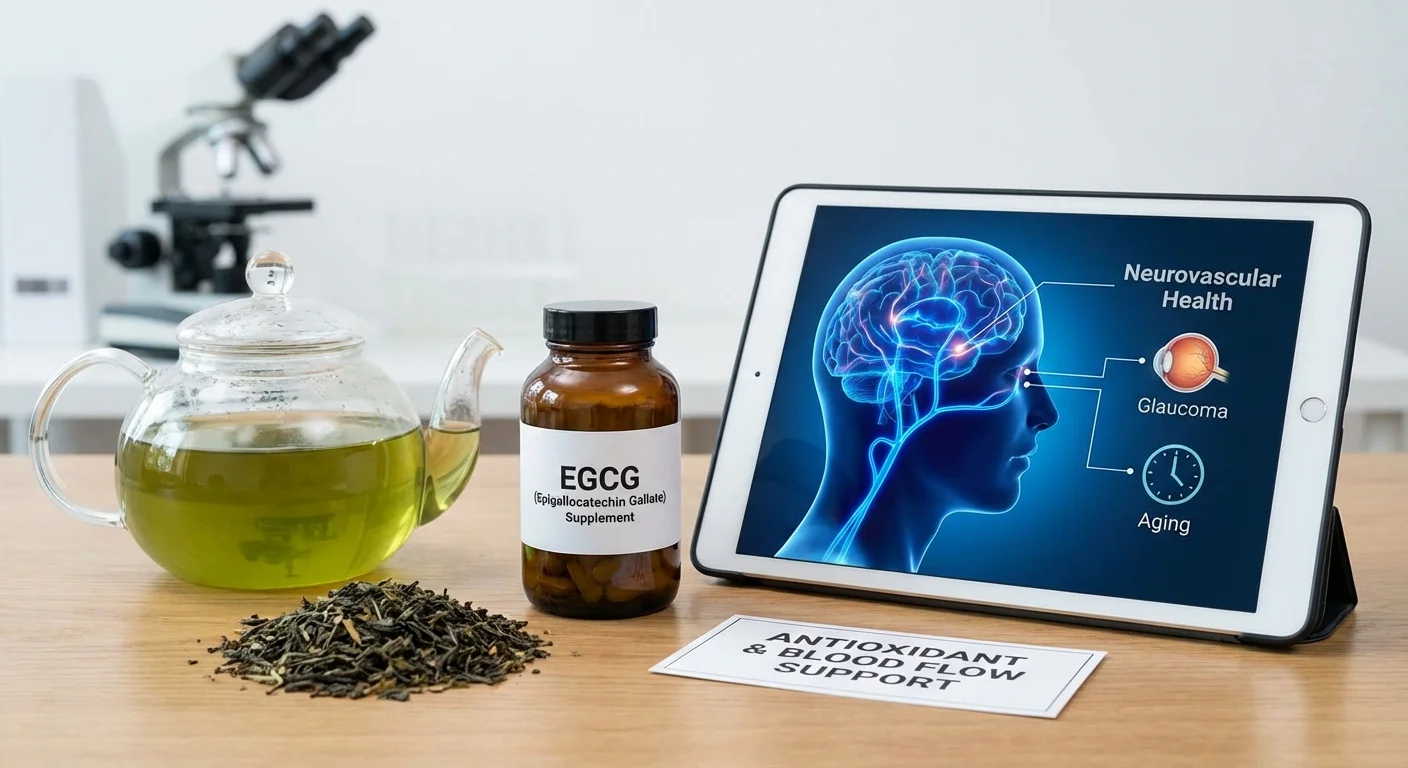
EGCG and Neurovascular Health in Glaucoma and Aging
Green tea cultures have long prized their tea’s catechins—particularly epigallocatechin-3-gallate (EGCG)—for promoting health. Modern research suggests EGCG’s potent antioxidant, anti-inflammatory and vasodilatory effects might benefit the neurovascular system in glaucoma and aging. In glaucoma, retinal ganglion cells (RGCs) degenerate under stress, and intraocular pressure (IOP) rises due to trabecular meshwork (TM) dysfunction. We review animal and cell studies of EGCG on RGC survival, TM extracellular matrix (MMPs) and blood flow, then summarize limited human data on vision and ocular structure. We connect these to EGCG’s known effects on cardiovascular and cognitive aging, and discuss its bioavailability, caffeine content, and safety.
Retinal Ganglion Cell Protection (Preclinical)
Preclinical studies consistently show EGCG helps RGC survival after injury or elevated IOP. In a mouse glaucoma model (microbead-induced high IOP), oral EGCG (50 mg/kg·d) preserved RGC density: treated mice had significantly more fluorogold-labeled RGCs versus untreated controls (pubmed.ncbi.nlm.nih.gov). In rats with acute IOP elevation, EGCG treatment markedly reduced optic nerve damage and inflammatory cytokines. For example, in one study EGCG lowered IL-6, TNF-α and other inflammatory signals, and inhibited NF-κB activation, thereby attenuating glaucoma symptoms and RGC injury (pmc.ncbi.nlm.nih.gov). These neuroprotective effects likely derive from EGCG’s ability to quench free radicals and block stress pathways (e.g. activating Nrf2/HO-1 in ischemia models (pmc.ncbi.nlm.nih.gov)). In cell culture, EGCG blocked oxidative and ultraviolet stress in RGC lines. Thus, multiple lines of evidence indicate that EGCG can mitigate RGC degeneration in animal glaucoma or optic nerve injury models (often via anti-oxidant and anti-inflammatory mechanisms) (pubmed.ncbi.nlm.nih.gov) (pmc.ncbi.nlm.nih.gov).
Trabecular Meshwork and Aqueous Outflow
MMPs (matrix metalloproteinases) regulate the extracellular matrix of the TM and thus aqueous outflow and IOP. Adequate MMP activity “elevates aqueous outflow, reducing IOP,” whereas reduced MMPs increase outflow resistance (pmc.ncbi.nlm.nih.gov). EGCG and other catechins are known MMP modulators. For instance, catechin treatment can suppress MMP-9 expression in humans (e.g. lowering MMP-9 in hypertension) (pmc.ncbi.nlm.nih.gov). In ocular models, EGCG has anti-fibrotic and cell-protective effects on TM cells. Zhou et al. found 40 μM EGCG dramatically improved human and porcine TM cell survival under ER stress: EGCG curtailed stress markers (ATF4, HSPA5, DDIT3) by ~50-70% and rescued cell viability (pmc.ncbi.nlm.nih.gov) (pmc.ncbi.nlm.nih.gov). By reducing TM cell dysfunction, EGCG pretreatment may help maintain normal outflow. Similarly, EGCG strongly inhibited TGF-β1–induced fibrotic changes in human Tenon’s fibroblasts: treated cells showed dramatically lower α-smooth muscle actin and collagen expression (pubmed.ncbi.nlm.nih.gov). This suggests EGCG can blunt ECM deposition, which in TM would preserve lumen. In sum, preclinical data imply EGCG’s anti-oxidant/anti-fibrotic actions protect TM cells and could facilitate aqueous clearance, complementing its IOP-lowering potential (pmc.ncbi.nlm.nih.gov) (pmc.ncbi.nlm.nih.gov).
Ocular Perfusion and Vascular Effects
EGCG has vasoactive properties that may boost ocular perfusion. Mechanistically, EGCG activates endothelial nitric oxide synthase (eNOS) and increases nitric oxide (NO) production via PI3K/Akt pathways (pmc.ncbi.nlm.nih.gov). This causes vasodilation and improved microcirculation. In the retina, enhanced NO-mediated blood flow supplies oxygen and nutrients to neurons. As a review notes, EGCG “activating eNOS… enhancing NO production” leads to better blood perfusion “particularly to neural tissues such as the retina (pmc.ncbi.nlm.nih.gov).” Such improved perfusion could counteract microvascular compromise seen in glaucoma and aging. In animal models, EGCG not only strengthened blood-retinal barrier integrity but normalized choroidal perfusion by downregulating VEGF under stress (pmc.ncbi.nlm.nih.gov). Therefore, EGCG’s systemic endothelial benefits (lowering endothelin-1, raising cGMP, reducing oxidative endothelial damage) likely translate to the eye, preserving ocular perfusion pressure and retinal circulation (pmc.ncbi.nlm.nih.gov).
Human Evidence: Visual Function and Structure
Very few human trials have tested EGCG/green tea in glaucoma. One small crossover study (18 patients) found oral EGCG (capsules totaling ~200–800 mg/day over 3 months) improved inner retinal function. Pattern electroretinogram (PERG) amplitudes rose significantly after EGCG supplementation compared to placebo (pubmed.ncbi.nlm.nih.gov), suggesting enhanced RGC responsiveness. However, standard visual field tests (perimetry) did not change, and effects were modest. Importantly, the study concluded that while EGCG might favorably influence retinal function, “the observed effect is small” and long-term benefits remain unproven (pubmed.ncbi.nlm.nih.gov). Another human study (43 healthy volunteers) showed that acute green tea or 400 mg EGCG significantly reduced IOP by ~1.9–2.6 mmHg within 1–2 hours (pmc.ncbi.nlm.nih.gov). This aligns with the TM findings above (EGCG may relax outflow pathways). No serious adverse events were reported.
Overall, human data are promising but sparse and limited to short-term endpoints. There is no evidence yet that EGCG preserves RNFL thickness, optic nerve structure or long-term visual fields in patients. Trials to date have been small and underpowered, focusing on functional surrogates (PERG, IOP). Larger trials with visual and structural outcomes are needed. Current findings must be viewed cautiously: benefits on PERG or transient IOP improve metabolic health but do not establish clinical glaucoma protection (pubmed.ncbi.nlm.nih.gov) (pmc.ncbi.nlm.nih.gov).
Systemic Cardiometabolic and Cognitive Aging
EGCG’s ocular benefits mirror its systemic effects, which are well-documented in aging cardiovascular and cognitive health. In humans, EGCG supplementation (300 mg/day) improves lipid and blood pressure profiles. For example, obese adults taking EGCG for 8 weeks had significantly lower fasting triglycerides and both systolic and diastolic blood pressure (pmc.ncbi.nlm.nih.gov). In rats and small trials, EGCG enhances endothelial function and insulin sensitivity, and protects against vascular injury (pmc.ncbi.nlm.nih.gov) (pmc.ncbi.nlm.nih.gov). These cardiometabolic actions share pathways with glaucoma: better blood flow and lower hypertension ease stress on the optic nerve.
On cognitive aging, epidemiology supports a green tea benefit. A large study in 50–70-year-olds found regular green tea drinkers scored higher on memory and executive tests, with reduced Alzheimer’s biomarkers (β-amyloid, pTau) in blood (pmc.ncbi.nlm.nih.gov). EGCG specifically has been shown in animal models to inhibit Aβ aggregation and tau pathology (pmc.ncbi.nlm.nih.gov). Thus, EGCG’s Alzheimer disease–related activities may translate to preserving visual processing centers. In sum, the cardiometabolic and neuroprotective actions of EGCG outside the eye provide contextual optimism: if EGCG preserves blood vessels and neurons systemically, comparable processes in the retina/optic nerve may benefit with age and in glaucoma.
Bioavailability and Formulation
A major challenge for EGCG therapy is its low oral bioavailability. After drinking tea, only a small fraction of EGCG reaches circulation due to poor absorption and rapid metabolism (pmc.ncbi.nlm.nih.gov). Studies show fasting dramatically increases plasma EGCG: constant-dose ingestion on an empty stomach yielded ~3.5-fold higher peak EGCG than with food (pmc.ncbi.nlm.nih.gov). In fact, co-ingestion with a meal can delay absorption and reduce EGCG levels by ~70%, whereas co-administration with carbohydrates unexpectedly boosts EGCG’s area-under-curve by ~140% (pmc.ncbi.nlm.nih.gov). Thus, taking catechins between meals or with certain foods (fruit sugars) can enhance uptake.
Various delivery strategies are under investigation. Liposomal or nanoparticle formulations can protect EGCG through the gut, and EGCG prodrugs (per-acetylated EGCG) are being developed to improve stability and tissue delivery (pmc.ncbi.nlm.nih.gov). Even simple measures like adding ascorbic acid (vitamin C) or phospholipids can prolong EGCG half-life. As of now, standard EGCG capsules achieve low micromolar plasma levels; achieving effective retinal concentrations may require high doses or novel formulations (pmc.ncbi.nlm.nih.gov) (pmc.ncbi.nlm.nih.gov).
Caffeine and Safety Considerations
Natural green tea contains caffeine (~30–40 mg per cup), which can be a concern in glaucoma. High caffeine intake (e.g. strong coffee) has sometimes been reported to raise IOP by 1–2 mmHg briefly (pmc.ncbi.nlm.nih.gov), though controlled studies of pure caffeine showed no consistent IOP change (pmc.ncbi.nlm.nih.gov). Importantly, many EGCG supplements are virtually caffeine-free: for instance, one 137 mg EGCG capsule contained <4 mg caffeine (pmc.ncbi.nlm.nih.gov). Thus, taking pure EGCG or decaffeinated green tea minimizes any stimulant effects. Patients sensitive to caffeine (e.g. with severe tremor or arrhythmia) might prefer caffeine-free extracts.
In terms of toxicity, EGCG is generally safe at dietary levels. Typical green tea consumption provides 90–300 mg EGCG daily, and even high tea drinkers rarely exceed ~800 mg/day (pmc.ncbi.nlm.nih.gov). The European Food Safety Authority notes that supplements above 800 mg EGCG per day (especially on an empty stomach) have been linked to mild liver enzyme elevations (pmc.ncbi.nlm.nih.gov). In one analysis, daily EGCG ≥800 mg caused statistically higher ALT/AST in some subjects, whereas lower doses (≤300 mg) showed no liver toxicity (pmc.ncbi.nlm.nih.gov). Thus, staying under ~500 mg/day is prudent. At normal doses, EGCG’s main side effects are mild (stomach upset, headache). Rare case reports of hepatotoxicity were mostly with high-dose extracts. In summary, EGCG at usual supplemental doses appears safe, but patients with liver disease or on hepatotoxic drugs should use caution and monitor liver function (pmc.ncbi.nlm.nih.gov).
Conclusion
In sum, EGCG and green tea catechins exhibit multiple properties relevant to neurovascular health in glaucoma and aging. Preclinical evidence robustly supports EGCG’s protective effects on retinal ganglion cells, trabecular meshwork cells (and their matrix), and ocular blood flow. Human data are limited but suggest possible benefits for retinal function and IOP control. Systemically, EGCG also improves vascular and metabolic factors and may guard cognitive function, aligning with a holistic approach to healthy aging. Major hurdles remain: EGCG’s poor bioavailability and the paucity of large clinical trials. Nonetheless, given its favorable safety profile at moderate doses, EGCG (in green tea or extract form) is a promising adjunctive strategy. Future research should rigorously test whether these preclinical findings translate into real-world slowing of glaucoma progression or age-related vision loss.