
Introduction
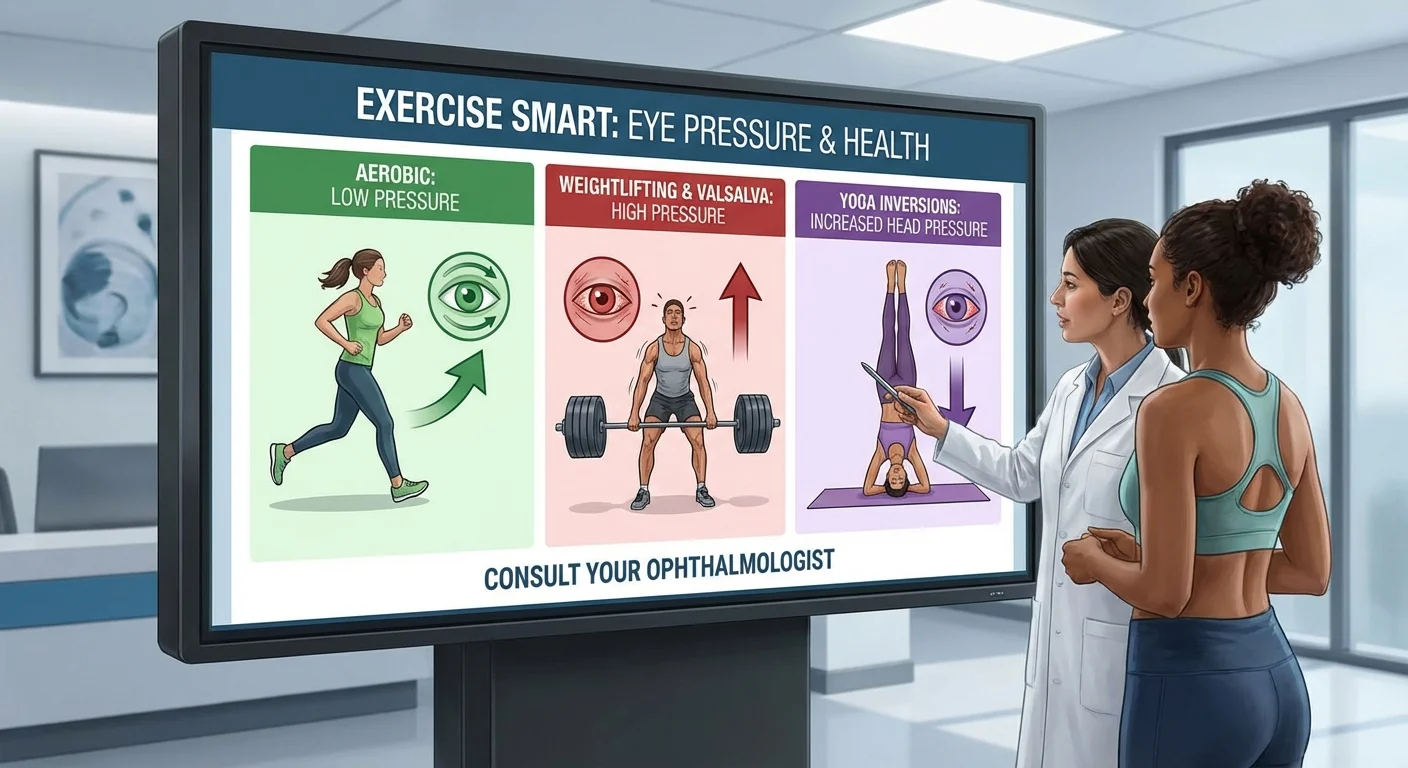
Lifestyle exercise is great for overall health – including eye health. In fact, moderate aerobic exercise (like walking, jogging, or cycling) tends to lower intraocular pressure (IOP), while intense straining (especially with breath-holding) can push IOP way up. For people at risk of glaucoma or optic nerve damage, it’s important to get heart-pumping cardiovascular benefits without dangerous eye-pressure spikes. Here we compare steady cardio versus heavy lifting (weightlifting) and breath-holding (Valsalva maneuver), and explain how smart modifications (breathing out on exertion, lighter resistance) can keep IOP in check. We also discuss which yoga and Pilates poses raise eye pressure, and suggest safer alternatives so you can protect your optic nerves while staying fit.
Aerobic Exercise Is Good for Eye Pressure
Regular cardio workouts generally lower IOP. Many studies show that after a bout of dynamic exercise, eye pressure falls. For example, a BMC Ophthalmology study found a statistically significant decrease in IOP during jogging (bmcophthalmol.biomedcentral.com). Longer or more intense activity can drop it even more – one report found IOP fell by about 2.25 mmHg after running a marathon, and by 4.1 mmHg (about 26%) after a 110 km march (pmc.ncbi.nlm.nih.gov). Even a brisk walk produces a significant pressure drop (pmc.ncbi.nlm.nih.gov). Over time, a regular exercise program can keep baseline IOP lower (though it will return up if you stop training) (pmc.ncbi.nlm.nih.gov).
These drops occur because exercise shunts blood flow to muscles, alters body-fluid balance, and may accelerate eye fluid drainage. (Minor dehydration during hard workouts can also slightly reduce fluid production (pmc.ncbi.nlm.nih.gov).) The upshot is that aerobic exercise is safe and often beneficial for people with glaucoma risk. It boosts optic nerve blood flow and may even lower glaucoma risk: one large survey found people who walked or did moderate activity had markedly lower glaucoma incidence (pmc.ncbi.nlm.nih.gov). In plain terms, daily moderate workouts (like 30 minutes of brisk walking, cycling, swimming, or similar) are recommended: they strengthen the heart and actually help keep eye pressure down (bmcophthalmol.biomedcentral.com) (pmc.ncbi.nlm.nih.gov).
Heavy Lifting and IOP Spikes
By contrast, resistance training – especially heavy, isometric lifts – can cause short-lived IOP spikes. Lifting very heavy weights tends to raise blood pressure and venous pressure in the head, which squeezes the eye. Studies have recorded sharp jumps in IOP during heavy lifts. For example, doing a bench press can raise IOP significantly, and holding the breath (the Valsalva maneuver) makes it worse (pmc.ncbi.nlm.nih.gov). In concrete numbers, one study found IOP jumped about 23% above baseline when breath-holding was used, versus only 12% without it (pmc.ncbi.nlm.nih.gov). In maximal static efforts, average IOP rose by 115% above normal – one subject even spiked as high as 46 mmHg (normally in the high 20s) during an all-out lift (pmc.ncbi.nlm.nih.gov). A sustained squat (thighs at right angles) caused about a 37% mean increase in IOP (pmc.ncbi.nlm.nih.gov). Essentially, any time you push hard against a heavy weight and especially hold your breath to “brace,” eye pressure can double or more.
These spikes matter because sudden high IOP can strain the optic nerve and blood vessels in the eye. In fact, heavy straining has been linked to eye problems (like retina hemorrhages or detachment) in rare cases (pmc.ncbi.nlm.nih.gov). The bottom line: strenuous lifts can be risky for a vulnerable eye unless you modify them.
Breathing Tips: Exhale on Exertion
To avoid these dangerous spikes, use proper breathing during lifts. A fundamental tip is to exhale during the exertion phase (the push or lift) and inhale during the easier phase (the lowering or release). For example, when doing a squat or bench press, breathe out as you lift the weight. This simple change significantly reduces IOP spikes: in one experiment, the average IOP rise was only ~2.2 mmHg (12% above baseline) when breathing normally, compared to ~4.3 mmHg (23% higher) when a Valsalva was simulated (pmc.ncbi.nlm.nih.gov). In other words, avoid holding your breath against a closed throat. That means never grunt, yell, or strain with a closed airway during a lift.
Additional practical tips for safer resistance training:
- Moderate weights and reps. Choose a weight you can lift for 8–12 reps without locking out completely or straining to the max. Avoid single “all-out” sets to failure when possible.
- Take frequent breaks. Do multiple shorter sets rather than one heavy set. Between sets, sit or stand up and breathe normally for a moment.
- Use machines or bands. Exercises on machines or using resistance bands often allow smoother motion and less breath strain than free heavy bars.
- Focus on form, not ego. It’s better for your eyes (and muscles) to lift lighter with perfect form and breathing than to struggle with heavier weight.
In summary, strength training is fine as long as you let the air back out and avoid prolonged straining. By breathing correctly and using moderate loads, you preserve the benefits of muscle and bone health without endangering your optic nerve (pmc.ncbi.nlm.nih.gov).
Yoga and Pilates: Poses to Avoid
Many yoga and Pilates moves involve bending or inverting the body, which can increase eye pressure. Any pose where your head goes below your heart or you hold breath can spike IOP. Scientific measurements confirm this. A study measuring IOP in common yoga poses found every head-down position caused a rapid rise in eye pressure (pmc.ncbi.nlm.nih.gov). The worst was Downward-Facing Dog (Adho Mukha Svanasana): IOP jumped from about 17 mmHg (resting) to nearly 28–29 mmHg on average – a boost of over 50% (pmc.ncbi.nlm.nih.gov). A standing forward fold (Uttanasana) raised IOP similarly, as did the plow pose (Halasana) and legs-up-the-wall (Viparita Karani) – although Viparita Karani caused a smaller rise (to ~21 mmHg) (pmc.ncbi.nlm.nih.gov). Importantly, the spikes happened within 1–2 minutes of holding the pose. (Reassuringly, IOP also dropped back to baseline within a couple of minutes after returning upright (pmc.ncbi.nlm.nih.gov).)
In plain terms, poses that bend your body fully over or invert it head-down should be used with care: examples include headstands, shoulder stands, plow pose, downward dog, and deep forward folds. Also beware isometric holds (like wall-sitting) that strain core and thigh muscles while leaning forward – these too raise IOP by compressing the chest and face.
Safer Alternatives: Instead of skipping fitness, switch to gentler versions:
- For Downward Dog, try Cat-Cow or Tabletop Pose, which keep the back straight and head above heart.
- In place of a full forward fold, do a standing half-fold (bend knees and hinge at hips only partially) or sit on a chair.
- Skip headstand (Sirsasana) or shoulder stand, which nearly double IOP when held (pmc.ncbi.nlm.nih.gov). Instead, do seated twists or standing side stretches with your spine long.
- Swap the Plow Pose for a simple Supine Twist on the floor, keeping one leg extended to the ceiling while the other stays bent on the mat.
- In Pilates, avoid exercises that flip you upside-down. For example, instead of a full “roll-over” (both legs extended overhead) or “neck pull”, focus on core exercises with the head supported (like partial crunches) or bridge pose (which keeps weight on shoulders, not head).
Interestingly, not all “head-below-heart” exercises are equally risky. One study of 30-second yoga asanas found that certain poses (Meruasana, Viparita Karani, Sarvangasana) actually showed a post-exercise drop in IOP when measured afterward (pmc.ncbi.nlm.nih.gov). However, these were brief holds and measured after returning upright – the key takeaway is that sudden leg-raising moves (like Viparita Karani) seem less dangerous than true inversions. Nonetheless, for safety, use caution with any new inverted poses.
By choosing yoga and Pilates moves that keep the head level or above the heart, you can still strengthen your body and improve flexibility without burdening your optic nerve. Always move slowly, breathe calmly, and come up from any forward bend in stages.
Putting It Together: Safe Exercise Routines
You can preserve cardio fitness while protecting your eyes by following a few smart guidelines:
- Focus on steady cardio: Aim for 30–45 minutes of moderate aerobic activity most days (brisk walking, stationary cycling, swimming, dance classes, light jogging, or using an elliptical machine). These elevate heart rate without the intense pressure spikes caused by maximal exertion or breath-holding (bmcophthalmol.biomedcentral.com) (pmc.ncbi.nlm.nih.gov). Even interval training is fine if you control breathing – short bursts sprints or cycling workloads, each followed by gentle recovery.
- Moderate your resistance: When doing strength or circuit workouts, use weights or resistance bands you can lift with good control. For example, do 2–3 sets of 8–12 reps for each exercise. Keep exhale-on-lift, and take a 60–90 second rest between sets. This gives you a great muscle workout (important for bone health and metabolism) without time to hold a heavy strain.
- Hydrate appropriately: Drink water before, during, and after your workout to stay hydrated. Moderate dehydration during hard exercise can lower IOP slightly (pmc.ncbi.nlm.nih.gov), but it’s healthier to sip water regularly. Being hydrated helps maintain healthy blood flow to the optic nerve.
- Limit breath-holding exercises: Skip any gym moves that tempt you to hold your breath (e.g. heavy squats, overhead presses at max weight) and those requiring you to bear down (like trying a new one-rep max). Instead, hold light or moderate weights, or use weight machines which naturally guide breath timing.
- Warm up and cool down: Begin each session with gentle movement (marching in place, arm swings, neck rolls) to stabilize your cardiovascular system. End each session slowly (walking, gentle shoulder/arm stretches). This prevents sudden drops or rises in blood pressure that could briefly affect eye pressure.
- Use proper form and supervision: If you have glaucoma or high IOP, it can help to work initially with a trainer or therapist familiar with these issues. They can cue you on breathing and posture. Good form in every exercise both protects your body and prevents you instinctively holding your breath or straining too much.
By following these routines and substitutions, you keep your cardiovascular system strong while minimizing any harm to the eyes. The goal is to protect the optic nerve: remember that short bursts of raised IOP (we see above) are less risky than chronically high IOP, but we still want to avoid unnecessary spikes. In practice, this means breathing out on every exertion, using moderate resistance, and avoiding long inversions, all while enjoying plenty of heart-healthy activity (pmc.ncbi.nlm.nih.gov) (pmc.ncbi.nlm.nih.gov).
Conclusion
Regular exercise is extremely beneficial for general and eye health. Aerobic workouts (walking, swimming, biking, etc.) consistently lower IOP and improve blood flow to the optic nerve (bmcophthalmol.biomedcentral.com) (pmc.ncbi.nlm.nih.gov). On the other hand, heavy weightlifting with breath-holding can cause brief surges in eye pressure (pmc.ncbi.nlm.nih.gov) (pmc.ncbi.nlm.nih.gov). The good news is that simple modifications – such as exhaling on exertion, using lighter weights, and not locking or straining maximally – largely eliminate those spikes. Similarly, yoga and Pilates flows can be eye-safe if you skip very inverted or overextended poses. Choose exercises that keep your head above your heart and move gently out of forward bends. In this way, you preserve all the cardiovascular and fitness benefits of exercise without compromising your optic nerve. By smartly crafting your workout – plenty of moderate cardio, controlled strength training, and cautious flexibility routines – you stay fit and help protect your vision. (bmcophthalmol.biomedcentral.com) (pmc.ncbi.nlm.nih.gov)