
A New Glaucoma Implant Study: Can It Protect Vision, and Can It Bring Lost Vision Back?
Glaucoma is a common eye disease that slowly damages the optic nerve (the bundle of nerve fibers that carry visual signals from the eye to the brain), leading to irreversible vision loss (www.brightfocus.org). Most current glaucoma treatments work by lowering the fluid pressure inside the eye. However, even when pressure is controlled, some patients still lose vision over time. Doctors describe this damage as a neurodegenerative process – the nerve cells in the eye’s retina (called retinal ganglion cells) are dying off. Right now, no approved treatments directly protect those nerve cells (pmc.ncbi.nlm.nih.gov). That’s why researchers are excited about a new experimental implant called NT-501 (also known as Encelto). This tiny device continuously releases a nerve-growth protein (ciliary neurotrophic factor, or CNTF) inside the eye, with the goal of neuroprotection – preserving the remaining vision by keeping the retinal nerve cells alive and healthy.
What is the NT-501 (Encelto) CNTF implant?
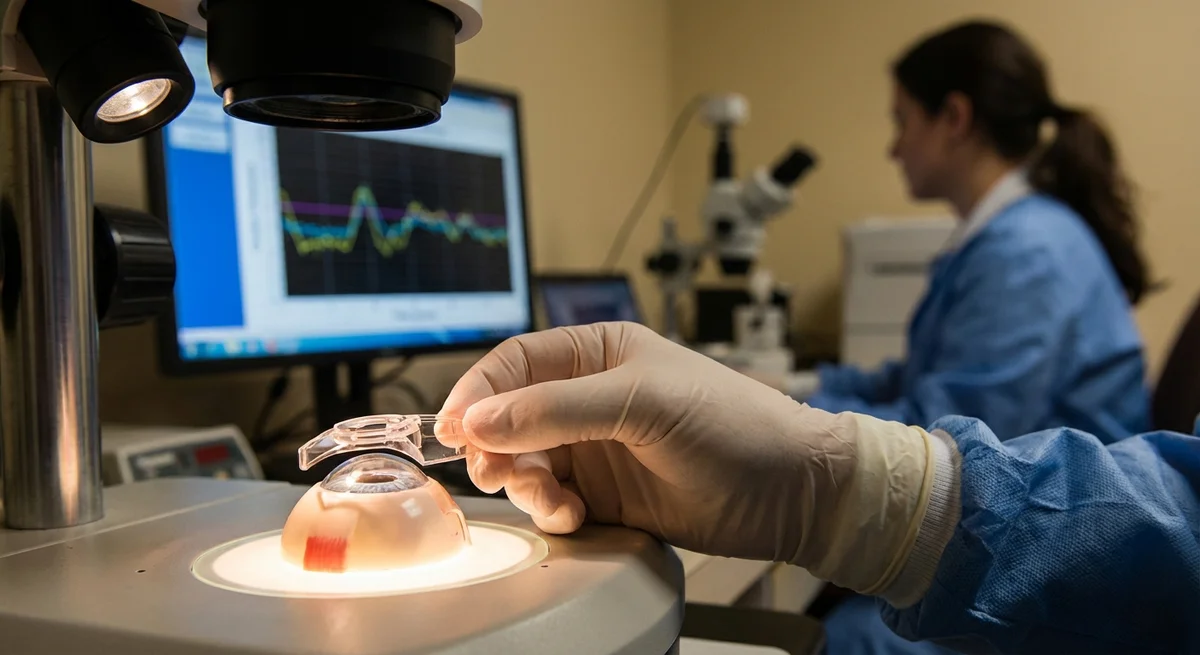
The NT-501 implant is a small capsule (about 1×6 mm) that a surgeon places inside the eye (in the gel-like vitreous near the retina) during a minor procedure (www.reviewofophthalmology.com) (www.brightfocus.org). Inside the capsule are living cells that have been genetically engineered to produce human CNTF, a protein that acts like a “fertilizer” for nerve cells. CNTF belongs to a family of growth factors known to help retinal neurons survive and grow (pmc.ncbi.nlm.nih.gov). Over many months (up to a couple of years), the implant slowly pumps CNTF into the eye. In effect, the implant is like a tiny medicine-pump that continuously bathes the nerve cells in protective growth factor (www.reviewofophthalmology.com) (www.brightfocus.org).
Neurotech Pharmaceuticals (the maker) calls this encapsulated cell therapy Encelto. Notably, the same implant was FDA-approved in 2025 for a different eye disease (macular telangiectasia type 2) (www.reviewofophthalmology.com), which shows it can be safely placed in the eye. For glaucoma, doctors hope the constant light dose of CNTF will protect the retinal nerve cells from the stress of glaucoma.
What does “neuroprotection” mean?
“Neuroprotection” literally means protecting nerve cells. In glaucoma, neuroprotection refers to any treatment that slows or stops the death of the retinal nerve cells, helping to preserve the patient’s existing vision. To explain it simply: if an eye drops from seeing 20/40 to 20/70 every year without treatment, a neuroprotective therapy might slow that decline so the patient stays closer to 20/40 for much longer. In a recent article, Dr. Jeffrey Goldberg (the glaucoma researcher leading these studies) noted that maintaining vision by stopping degeneration is exactly what neuroprotection is meant to do (www.brightfocus.org). (He contrasts this with improving vision beyond the original level – which he called “neuroenhancement” – a higher bar that would mean actually recovering lost vision (www.brightfocus.org).) In short, a neuroprotective treatment protects what you already see, slowing further loss.
What did the studies find so far?
Early (Phase I) results – small safety trial
Researchers first tested this implant in a small safety study. In that Phase I trial, 11 patients with open-angle glaucoma were enrolled (www.brightfocus.org). Each patient had one eye receive the NT-501 implant and the other eye left untreated (serving as a control). The goal was to watch for any side effects and see if there were any hints of benefit. The results were encouraging on safety: all implants were well-tolerated. No one developed severe complications or needed to have the device removed (www.brightfocus.org). The only problems were mild and related to surgery (for example some temporary eye irritation), which all went away by a few months.
Interestingly, even these early results suggested a possible protective effect. Over 18 months of follow-up, the eyes with the CNTF implant tended to do better than the untreated eyes on some vision measures (www.brightfocus.org). For example, visual field testing (which maps the patient’s side vision) and other tests showed a small improvement in the implanted eyes, whereas the control eyes declined slightly (www.brightfocus.org). The implanted eyes also showed a thicker layer of nerve fibers (measured by eye scans) than the untreated eyes, suggesting the CNTF may have kept those nerves healthier. In simple terms, the NT-501 eyes seemed to lose vision more slowly (or even stay about the same) compared to the untreated eyes, which lost more function. Because of these positive safety and preliminary findings, researchers moved on to a larger Phase II trial.
Follow-up (Phase II) results – two-year trial
A larger, randomized Phase II clinical trial was then conducted and presented in late 2024 (www.clinicaltrialsarena.com). In that study, glaucoma patients were randomly assigned to get the CNTF implant (one or two per eye) or a sham (fake) procedure, and were followed for two years. The main goal was again safety, but researchers also measured eye pressure, vision tests, and retinal scans.
The Phase II results (presented at a conference) showed the implant was again very safe (www.clinicaltrialsarena.com). There were no serious side effects linked to the implant, and patients generally felt the same as those who had the sham procedure. Importantly, eye pressure (the usual glaucoma risk) stayed stable in all groups – meaning the implant did not affect eye pressure (www.clinicaltrialsarena.com).
In terms of eye health, the treated eyes again showed a notable effect on retinal structure. Specifically, after 24 months the eyes with CNTF implants had a significantly thicker retinal nerve fiber layer (the layer containing the visual nerve fibers) than the sham-treated eyes (www.clinicaltrialsarena.com). A similar pattern was seen in the ganglion cell complex (the area containing the nerve cells): the implant groups had more layer thickness than the sham group (www.clinicaltrialsarena.com). In fact, researchers noted that most of this extra thickness occurred in areas of the retina that had been thinnest to begin with – the areas usually most affected by glaucoma (www.clinicaltrialsarena.com). These structural improvements suggest the CNTF was having a real biological effect on the retinal nerve cells, consistent with the idea of neuroprotection.
However, when it came to actual vision test results, the study found the eyes were mostly the same across groups. Visual field test scores (patients’ ability to see in different parts of the visual field) remained stable in all groups from start to finish, with no significant difference between the implant and control eyes (www.clinicaltrialsarena.com). In other words, both treated and sham eyes largely held their existing vision ≥; none showed clear restoration of vision. Visual acuity (sharpness of sight) also showed no meaningful change. Put simply, the implant eyes did not show better vision outcomes than the control eyes over two years – but crucially, they also did not do worse, despite having had more advanced damage at the start.
What do these findings mean?
Taken together, the study results give a mixed but cautiously positive picture. Safety: so far, the NT-501/Encelto implant appears to be safe in glaucoma patients (www.brightfocus.org) (www.clinicaltrialsarena.com), with no serious adverse effects reported. Neuroprotection: the structural data (thicker nerve layers in treated eyes vs. controls (www.clinicaltrialsarena.com)) suggests there is a protective effect on the retinal nerve cells. Essentially, the implant seems to help keep those cells from continuing to thin out. The fact that treated eyes remained stable (rather than dropping in vision tests as we often fear) is also encouraging.
Vision preservation: As of the latest data, the implant has not restored lost vision, but it might be protecting the vision patients still have. In the smaller Phase I trial, treated eyes actually showed slight functional improvement compared to untreated eyes (www.brightfocus.org). In the larger Phase II trial, treated eyes ended up with healthier nerve layers than sham eyes (www.clinicaltrialsarena.com). However, no trial has yet shown a clear gain in vision (no “vision restoration”) from this implant. After two years, visual field scores were about the same with or without CNTF (www.clinicaltrialsarena.com). So at present, experts view the main effect as neuroprotection (slowing damage) rather than vision recovery.
The researchers are continuing to study this approach (for example, by testing two implants in each eye) to see if an even stronger effect on vision can be achieved. But importantly, no evidence has emerged that the implant can bring back vision that’s already lost. It may at best help prevent further loss.
What this could mean for glaucoma patients right now
- Still experimental. This CNTF implant is not yet an approved glaucoma treatment. It is only available through clinical trials. Patients cannot get this implant as a standard therapy at this time.
- Safety so far. The studies report the implant is safe and well tolerated (www.brightfocus.org) (www.clinicaltrialsarena.com). Common mild issues were related to the surgery (transient irritation or a small pupil change), but no lasting harm was reported.
- Doesn’t change current care today. For now, glaucoma patients should continue their usual treatments (eye drops, surgeries, etc.) as prescribed. If you hear news about CNTF implants, discuss it with your eye doctor, but do not stop proven therapies. Right now this implant is a research procedure, not a replacement for pressure-lowering treatments.
- No miracle cure. Patients should understand that current data do not show any ability to recover lost vision. The goal of this implant is to protect remaining vision. In practice this means it could possibly keep your vision from getting worse as quickly, but it won’t restore vision you’ve already lost.
- Hope for the future. These early results are promising enough that researchers are continuing the studies. If larger trials confirm the benefits, this method could one day add to glaucoma care. But that is likely several years away. Even if it works perfectly, it would probably become an additional option rather than a standalone cure. (For example, it might be used in combination with pressure-lowering treatments.)
- No immediate action needed. If you’re a patient or caregiver, the main takeaway is that science is exploring new ways to help the glaucoma-damaged nerve cells. It doesn’t affect your life today. Stay informed and ask your doctor if and when clinical trials might be an option for you.
What questions are still unanswered
- Long-term benefit: We don’t yet know if the thicker nerve layers seen in treated eyes will translate into better vision many years down the road. Two-year results (Phase II) are only an early look. Researchers need longer follow-up to see if this actually slows the pace of vision loss.
- Best approach: It’s still unclear how many implants are needed (the Phase II trial is even testing two implants per eye). We don’t yet know the optimal dose of CNTF for glaucoma. Future studies may compare one vs. two devices, or look at adding CNTF to different kinds of patients.
- Patient selection: We don’t know which glaucoma patients might benefit the most. Will this work better in early disease vs. very advanced disease? In fast-progressing glaucoma vs. slow? In normal-tension glaucoma (where pressure is not high)? These questions are still under study.
- Vision improvement: So far there is no proof it can regrow or restore lost vision. It remains uncertain whether higher doses or longer therapy might one day produce any reversal of damage. (Experts remain skeptical, but keep it as an open question.) For now we assume it primarily protects what’s left.
- Other outcomes: The current trials focus on safety and certain eye exam measures. It’s still uncertain whether patients will feel a noticeable difference in daily life. For example, will quality-of-life tests or real-world driving/reading tests improve? Those questions require larger trials and different measurements.
- Availability and approval: Even if the implant consistently shows benefit, it will need to go through large Phase III trials and regulatory review before becoming a routine option. It’s still unknown how long that will take and what the final indication might be.
- Costs and comparisons: In the future, how will this implant compare in cost and convenience versus other new glaucoma treatments? We don’t know until bigger trials and (possibly) submissions for approval happen.
In summary, the NT-501 (Encelto) CNTF implant offers a promising new idea for glaucoma treatment – a way to feed nerve cells a survival factor. Early studies show it’s safe and may help preserve retinal nerve health (www.brightfocus.org) (www.clinicaltrialsarena.com). However, its real-world benefit is still unproven. We cannot say it will bring vision back at this time. Ongoing research will tell us more. For now, patients should be cautiously optimistic but not assume this changes their current glaucoma care.