
A Cataract Lens That Also Treats Glaucoma? Understanding the New BIM-IOL Study
Many people with glaucoma or ocular hypertension also develop cataracts as they age. Glaucoma is a disease where eye pressure can damage vision over time. Cataracts are a clouding of the natural eye lens that makes vision blurry. In cataract surgery, the cloudy lens is removed and replaced with a clear intraocular lens (IOL). A new technology called the BIM-IOL System combines these two treatments: it is a cataract lens that can continuously release a glaucoma medicine inside the eye.
In March 2026, SpyGlass Pharma reported early results from a trial of their BIM-IOL System. This news is exciting but should be read carefully. The company provided a topline update (a summary of initial results) from a 12-month phase 1/2 clinical trial. This means the detailed data are not yet fully published in a medical journal. Studies have shown that press announcements often come out months before the full results are reviewed by experts (pmc.ncbi.nlm.nih.gov). For now, we can say the BIM-IOL lens seems promising for lowering eye pressure and reducing the need for daily eye drops – but more research is needed to confirm these findings.
What is the BIM-IOL System?
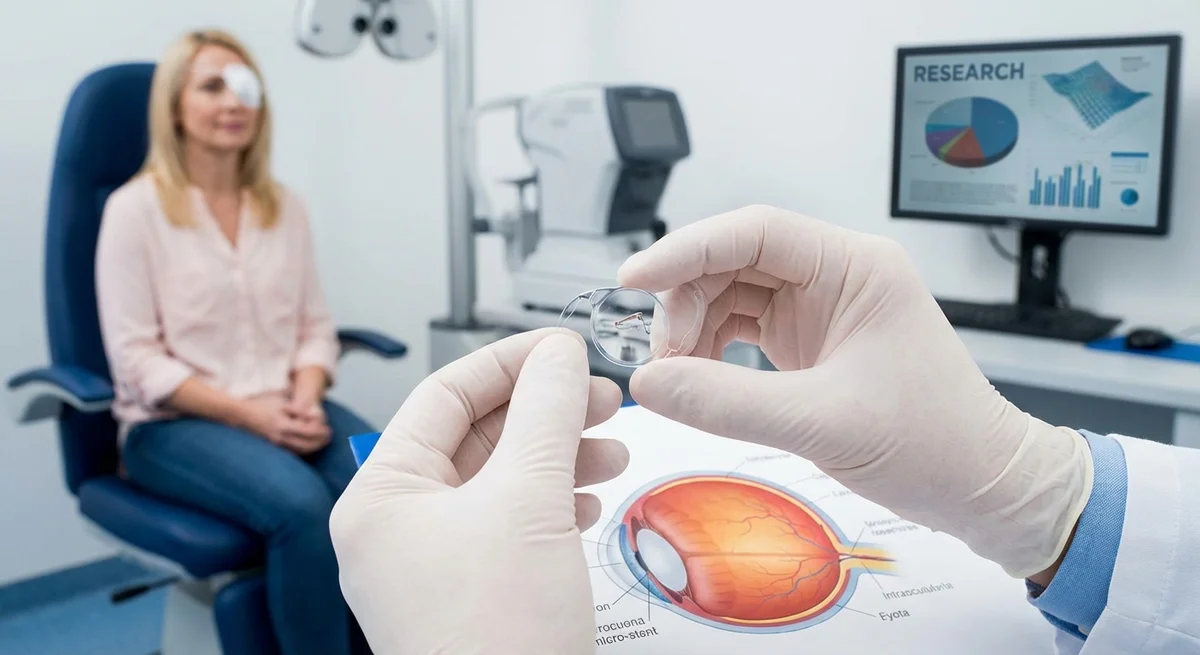
The BIM-IOL (Bimatoprost drug pad-IOL) System is an innovative type of cataract lens that also delivers glaucoma medication. The name comes from bimatoprost (BIM, a common glaucoma drug) and IOL (intraocular lens). Here’s how it works in simple terms:
- During standard cataract surgery, the surgeon replaces the cloudy lens with a clear IOL. The BIM-IOL System looks like a normal lens but has two tiny drug pads attached to it.
- These drug pads are made of a material that does not dissolve (non-bioerodible). They hold the glaucoma medication bimatoprost and slowly release it directly into the fluid inside the eye.
- This means the medicine is delivered continuously over time, rather than using daily eye drops. In theory, one surgery could provide glaucoma treatment for years without the patient needing to put in any drops (www.pharmanow.live).
- Importantly, the BIM-IOL is implanted in the same way as any other IOL. No extra surgical steps are needed beyond standard cataract surgery. This makes it easy for all cataract surgeons to use (no special glaucoma training like MIGS is required).
By packaging the medicine into the lens itself, the BIM-IOL System combines two procedures into one. It can give you a new clear lens for your cataract and a built-in dose of eye pressure medicine. This is very different from regular glaucoma eye drops, which a person must remember and be able to put in every day.
How is it different from regular eye drops?
Most glaucoma patients use daily eye drops to lower eye pressure. These drops (like bimatoprost, latanoprost, etc.) help fluid drain from the eye so pressure stays lower. But many people have trouble with drops: they may forget them, have trouble squeezing the bottle, or get side effects (red/grain spray, eye irritation). Not getting drops regularly can allow pressure to rise, risking more optic nerve damage.
The BIM-IOL System is different in key ways:
- No daily drops required. Once implanted, the lens continuously releases medication inside the eye. In the recent trial, almost all patients with the BIM-IOL lens stopped using any drops by the one-year mark (www.biospace.com). In other words, the lens provided enough medicine that the daily routine of drops was no longer needed.
- Continuous delivery. Eye drops wash away quickly. A lens implant effectively acts as a slow-release reservoir. It can keep levels steady for months or years, so pressure is managed continuously without gaps.
- Convenience and adherence. This can help people who struggle with daily drops. For example, someone with arthritis may find drops hard to manage. With the BIM-IOL, they would get the medicine automatically from the lens, solving the worry of forgetting a dose.
- Surgery setting. The medication is placed inside the eye during surgery, bypassing barriers like tear film on the eye surface. This targeted delivery can be more efficient than drops on the front of the eye.
- Combining treatments. Because it’s done during cataract surgery, patients get two benefits in one procedure: a new cataract lens and glaucoma treatment. It may reduce the number of separate doctor visits or procedures needed.
March 2026 Trial Results
SpyGlass Pharma shared initial results of their Phase 1/2 clinical trial (12-month follow-up) on March 9, 2026 (www.biospace.com). Here is what they reported:
- Participants: 104 patients with open-angle glaucoma or ocular hypertension who needed cataract surgery. About two-thirds got the BIM-IOL lens (at one of two dose levels of medicine) and one-third got a regular cataract lens plus timolol eye drops (the control group).
- Lowering eye pressure: On average, patients with the BIM-IOL lens had large drops in pressure. For instance, one dose group saw a 34% average drop and the other saw 42% drop in pressure at the 12-month visit (measured in the morning) (www.biospace.com). This was similar to the 35% drop seen in the control group (who got timolol drops). So on average, pressure reduction was comparable to standard care.
- Reducing eye drop use: Remarkably, nearly all BIM-IOL patients did not need any extra glaucoma drops after surgery. Specifically, 98% of patients in the higher-dose lens group and 96% in the lower-dose group were completely free of topical medications at one year (www.biospace.com). This suggests the lens itself controlled the pressure almost entirely.
- Vision outcomes: All patients with the BIM-IOL lens achieved good vision (after cataract removal). In fact, 100% reached 20/32 or better best corrected vision (normal high-quality vision), with the average being about 20/20 (www.biospace.com). In other words, the new lens gave very good vision, matching the performance of standard cataract lenses.
- Safety: No serious eye safety problems were linked to the BIM-IOL itself. Side effects were similar to what happens with routine cataract surgery, and there were no serious ocular adverse events (www.biospace.com). This suggests the lens was about as safe as a normal implant in the short term.
In summary, the company reported that the BIM-IOL achieved sustained pressure lowering and excellent vision, while eliminating the need for daily drops in nearly all patients (www.biospace.com). They emphasized this could be “life changing” because it avoids the burden of eye drops (www.biospace.com).
However, remember this is a company announcement of topline results. The full details have not yet been released or published in detail. We should interpret these findings carefully (pmc.ncbi.nlm.nih.gov). Other experts have noted that press releases often come out well before full scientific review (pmc.ncbi.nlm.nih.gov). The results are encouraging, but final peer-reviewed data will give a complete picture of how well this system really works.
Based on this update, here are some important takeaways for patients:
What sounds promising
- Much less or no drops: The trial shows nearly all patients with the BIM-IOL lens were able to stop all glaucoma drops after surgery (www.biospace.com). This could greatly help those who forget or have difficulty using drops every day.
- Steady pressure control: Eye pressure fell substantially in the BIM-IOL group (about one-third to two-fifths lower on average) (www.biospace.com), similar to standard treatment. The continuous medication delivery seems effective at keeping pressure low.
- Excellent vision: Vision after surgery was excellent. Every patient had at least fairly good vision (20/32 or better, which is close to 20/20) (www.biospace.com). This means the lens itself works as well as a plain lens for seeing well.
- Combining treatments: This system treats both cataracts and glaucoma in one procedure (www.pharmanow.live). That could mean fewer surgeries overall and convenience.
- Accessible to surgeons: Because the lens is put in via normal cataract surgery, any eye surgeon who does cataracts could use it (www.biospace.com). You wouldn’t need a special glaucoma surgery; it just adds a new type of lens to a routine operation.
- Less reliance on patient memory: A big challenge in glaucoma is that patients often forget or struggle with drops. The BIM-IOL bypasses that problem by delivering the medicine automatically (www.sec.gov). (For example, one analysis notes that this approach could eliminate the need for daily medications and no longer depends on patients remembering to do drops (www.sec.gov).)
All of these points suggest that, if later studies confirm the results, the BIM-IOL could make life easier for patients by combining clear vision and pressure control in one step.
What patients should stay cautious about
- Early data: The trial results are preliminary. They come from a Phase 1/2 study run by the company. The full data have not been published yet. Researchers often issue press releases months before the final peer-reviewed study is available (pmc.ncbi.nlm.nih.gov). We should wait for the complete published report or conference presentations.
- Small study and limited setting: Only 104 patients were in this study. It was designed as an early safety and effectiveness test. Larger Phase 3 trials are underway. We don’t yet know if these results will hold up in bigger, longer studies.
- Approved yet: The BIM-IOL System is still experimental. It is NOT yet approved by regulators. It cannot be used outside of a clinical trial until regulatory approval is gained, likely after Phase 3 confirms safety and benefit.
- Not for everyone: This is only being tested in open-angle glaucoma or ocular hypertension patients who are also getting cataract surgery (www.biospace.com) (www.ophthalmologytimes.com). It doesn’t apply to all glaucoma types (e.g. angle-closure glaucoma wasn’t studied). Also, you have to be at the point of having a cataract removed. If your natural lens is clear, this lens would require you to have cataract surgery sooner than planned.
- Not a cure or vision restoration: The BIM-IOL helps control eye pressure, but it does not cure glaucoma or restore vision already lost from glaucoma damage. It can prevent future damage by keeping pressure low, and it will give you clear vision from the cataract removal, but it can’t fix what nerves have already been lost. In short, it supports vision by treating cataract and managing pressure, but doesn’t reverse glaucoma damage.
- Potential side effects: So far no serious new eye problems were seen up to 1 year (www.biospace.com). But long-term safety (multiple years) is not yet known. Any implanted device could have risks (infection, inflammation, or device issues) that take time to appear. Future results will tell us more.
- Dependence on one drug: This lens currently delivers bimatoprost only, one type of glaucoma drug. If a patient needs different drugs or very low target pressures, this lens average effect might not be enough on its own. Some patients might still need additional treatments if pressure isn’t fully controlled.
- Unknown cost and coverage: If eventually approved, it may be expensive. We don’t yet know about insurance coverage. (The company expects Medicare Part B might cover the medicine portion, but that’s to be confirmed.) Patients often pay for cataract surgery, but usually a standard IOL is covered. An implant that includes a drug might change billing.
- Removability: The company says the device is engineered to be removable and replaceable (www.sec.gov), but in reality once implanted during cataract surgery, you wouldn’t easily swap it out unless you had another surgery. This aspect is still theoretical and being studied. So if any problem arises, you currently would need surgery to address it.
In short, patients should be cautious because these are early company-reported results (pmc.ncbi.nlm.nih.gov). It’s great news, but only after full peer review and larger studies can we know if BIM-IOL truly lives up to the promise for the average patient.
Who might be a candidate now?
Based on the trial, the BIM-IOL would be offered only to patients who need cataract surgery and have open-angle glaucoma or ocular hypertension. In the study, they looked at people with mild-to-moderate glaucoma who were already planning cataract removal (www.ophthalmologytimes.com). This implant might help those who:
- Have open-angle glaucoma or ocular hypertension and also have a cataract that needs surgery. (It is not intended for other glaucoma forms, or for people without a cataract.)
- Are struggling to manage multiple eye drops and want a more convenient option.
- Have mild or moderate disease levels (since more severe cases often need very low pressure which might require more aggressive treatment).
- Are otherwise healthy enough for cataract surgery (age or overall health concerns aside).
It would not be suitable for:
- Patients who have no cataract; you can’t get the lens unless you have surgery to remove your existing lens.
- Those with other glaucoma types not tested (like narrow-angle) or who need different medications.
- People who absolutely must stay on a specific set of eye drops for other eye conditions (e.g. certain inflammations or infections).
- People who are not comfortable with an experimental device (until it is fully approved).
Doctors will carefully consider individual cases once (and if) the product is approved. For now, this is only in research settings for specific patients.
What needs to happen next before this becomes routine care
Before the BIM-IOL System can be offered widely, these steps are needed:
- Complete Phase 3 trials: Larger trials (like the two Phase 3 studies that began in early 2026) must finish enrollment and follow patients for effects. These trials will confirm if the pressure control and vision benefits seen early are real and consistent.
- Peer-reviewed publication: The detailed results need to be written up and published in a medical journal. That way independent experts can review the methods and data. (As one analysis pointed out, press announcements often come well before such publications (pmc.ncbi.nlm.nih.gov).)
- Regulatory approval: The FDA (or other agencies) will need to review all trial data. The company plans to apply through a specific regulatory pathway (505(b)(2) in the U.S.) which could speed review, but approval is not guaranteed. If approved, the lens could then be legally marketed.
- Long-term monitoring: We need to see data on what happens after 2-3 years. Does the drug pad still work? Does eye pressure stay low? Are there late side effects? Post-approval studies might track this.
- Insurance coverage plans: Doctors, hospitals, and insurers (like Medicare) have to decide how to bill for an IOL that contains a drug. The company expects to set up a code for reimbursement. Patients will want clarity on out-of-pocket costs.
- Training and guidelines: Eye surgeons will learn how best to use the new lens and select patients. Medical organizations may create guidelines on when to use it.
- Patient education: Finally, patients and families will need understandable information from doctors on the benefits and risks once it’s closer to approval.
Conclusion
The new BIM-IOL lens promises a two-in-one solution for people having cataract surgery and also needing lower eye pressure. The idea of a single implant that can clear your vision and also treat glaucoma automatically is exciting, especially for anyone tired of daily drops. The early results (March 2026, 12-month data) are encouraging: they suggest strong pressure-lowering and a dramatic drop in the need for daily medications (www.biospace.com). But we must keep in mind that these are company-reported interim results. The findings need confirmation by the medical community.
No hype: This isn’t a magic cure. It doesn’t replace overall glaucoma care (you’ll still need follow-up). It won’t regain vision already lost to glaucoma. It simply adds a helpful tool for the right patients. The question “Could this help me?” depends on your individual situation and timing of cataract surgery.
Next steps: Be patient. Watch for announcements from medical conferences or journals where doctors present full data. Talk to your ophthalmologist about upcoming clinical trials if you think this is an option. And definitely stay on your current glaucoma treatment until and unless a doctor gives you a green light after reviewing all the data.
What happens next before routine use: Larger trials must finish and be reviewed, regulatory decisions must be made, and longer-term safety confirmed. Only then can this become a standard care option. Until that happens, the BIM-IOL System remains a promising experimental approach.
Overall, the news is hopeful but early. It highlights ongoing innovation to make glaucoma care easier. We will keep an eye (no pun intended) on further updates so that patients can make informed choices in the future.