
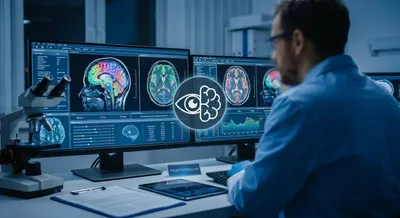
Brain Imaging Biomarkers and Plasticity in Glaucoma
Doctors and researchers use advanced MRI techniques to track these changes. One method is diffusion tensor imaging (DTI), which traces the brain’s...
Deep research and expert guides on maintaining your visual health.
Doctors and researchers use advanced MRI techniques to track these changes. One method is diffusion tensor imaging (DTI), which traces the brain’s...
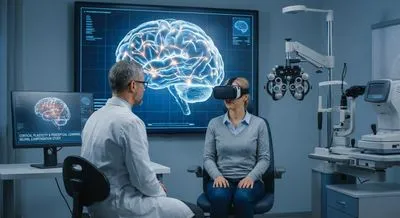
Interestingly, many glaucoma patients have little awareness of their blind spots. This perceptual filling-in – where the brain “fills” missing...
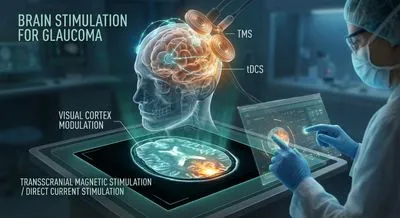
Vision outcomes: Measured outcomes have included visual field indices (e.g. detection accuracy or mean defect in perimetry) and sometimes contrast...
Track peripheral vision changes between eye doctor visits. Start your free trial and get results in under 5 minutes.
The visual cortex is the part of the brain, located at the back of the head, that processes information coming from the eyes. It receives signals routed through the eyes and a relay station in the brain and begins interpreting basic features like edges, colors, motion, and depth. The first area in this region sorts simple visual properties such as orientation and contrast, and nearby areas build on that information to recognize shapes, faces, and movement. This region is organized so that nearby points on the retina map to nearby neurons, creating a point-for-point representation of the visual field. Because it performs the early steps of seeing, damage to the visual cortex can cause specific losses in vision, like blind spots or problems recognizing objects. The visual cortex is not just a passive receiver; it adapts with experience and can reorganize to some extent when the input changes, such as after injury or training. That adaptability underlies rehabilitation techniques and perceptual learning, where practice can improve visual skills or partially restore function. Scientists also target this region with noninvasive stimulation and other therapies because changing its activity can influence perception and recovery. Understanding how the visual cortex works helps explain everyday abilities like reading, navigating the environment, and recognizing faces. In short, the visual cortex matters because it is the brain’s central processor for sight, and its function shapes how we see and interact with the world.