
Introduction
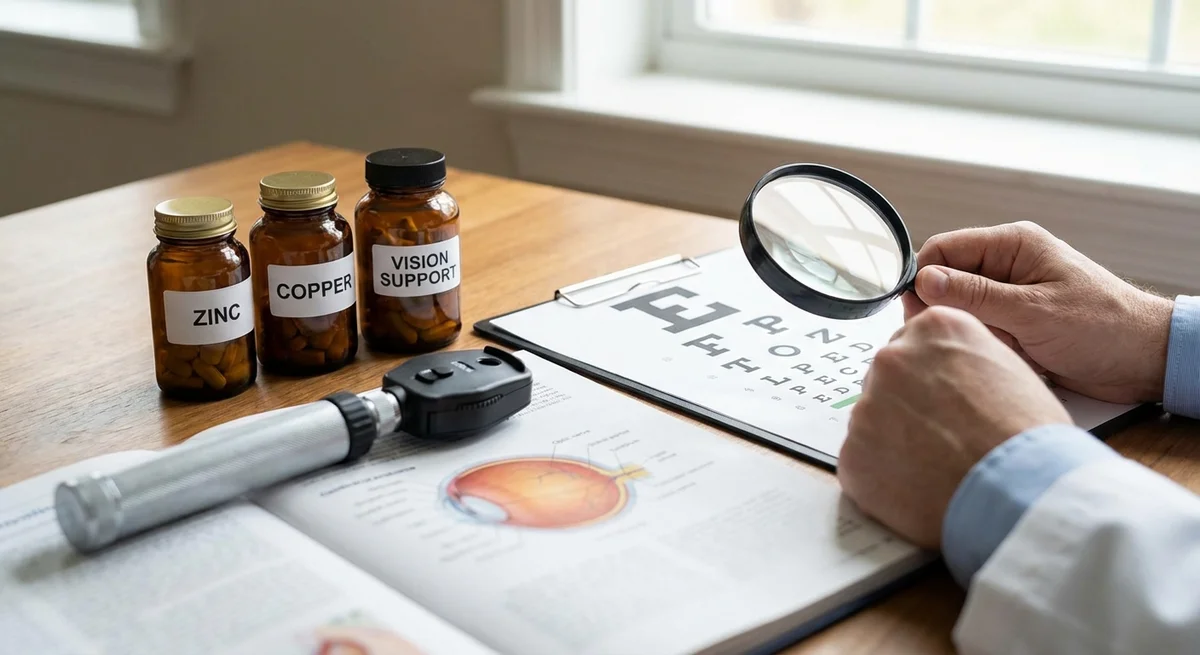
Many people take zinc supplements believing they help the immune system or heart health. Too much zinc, however, can upset the balance of copper in the body. In rare cases, high-dose zinc over months or years causes copper deficiency, which damages the optic nerve (the bundle of fibers that carries vision signals from the eye to the brain). The result is vision loss that can look a lot like worsening glaucoma – even when eye pressure is well controlled. This article explains how zinc affects copper, how copper deficiency can hurt your optic nerve, and how that can be mistaken for glaucoma progression. We’ll highlight key clues that the problem is nutritional rather than glaucoma, and suggest safe supplement practices. At the end, a practical checklist is offered to guide doctors when a glaucoma patient’s sight falls off despite normal eye pressure.
Zinc, Copper, and the Eye
Zinc and copper are essential minerals needed for many body functions, including healthy vision. Both travel through your digestive system and bloodstream, but they compete for absorption. When you take a lot of zinc, it triggers production of a protein (metallothionein) in intestinal cells that grabs copper and holds it in the gut, so less copper enters your body (pmc.ncbi.nlm.nih.gov). In effect, excess zinc “starves” your body of copper. Over time, this can lead to low blood copper (hypocupremia).
Copper is crucial for nerve health. In particular, it helps maintain the myelin sheath around nerves and is part of important enzymes. Copper deficiency can cause many neurologic problems – for example, numb hands and legs, trouble walking, and optic neuropathy (damage to the optic nerve) (pmc.ncbi.nlm.nih.gov) (pmc.ncbi.nlm.nih.gov). Recognizing this is important because copper-related optic nerve damage can be treated. In fact, cases have been reported of patients who were legally blind (20/400 vision) partly regain good sight (to 20/25) after getting copper supplements (pmc.ncbi.nlm.nih.gov).
It’s worth noting that many people regularly exceed safe zinc intakes. The National Institutes of Health advise that healthy adults only need about 8–11 mg of zinc per day, and the safe upper limit is 40 mg/day (ods.od.nih.gov). Yet some immune boosters, eye health formulas, and multivitamins provide 25–80 mg of zinc daily without increased copper. A survey found about 5–8% of U.S. adults taking zinc supplements exceed that 40 mg limit (pmc.ncbi.nlm.nih.gov). Without extra copper, long-term high zinc use can therefore create copper deficiency – so doctors should be aware of this hidden risk (pmc.ncbi.nlm.nih.gov) (pmc.ncbi.nlm.nih.gov).
Copper Deficiency Optic Neuropathy: Symptoms and Signs
When the optic nerve is damaged by copper deficiency, vision loss usually comes on slowly and in both eyes at once. Patients often note that colors look faded and that there is a dark spot or patch in their center of vision (pmc.ncbi.nlm.nih.gov). One review explains that nutritional optic neuropathies typically cause a central (cee-cocentral) scotoma – a blind spot that affects the central field, with the far side vision remaining mostly fine (pmc.ncbi.nlm.nih.gov). In other words, side vision tends to be preserved while central sight (reading, recognizing faces) is hurt.
Because both eyes are affected similarly, there usually is no relative afferent pupillary defect (RAPD) – the doctors’ test where shining light into one dark eye triggers little or no pupil reaction because the other eye already is weak. In copper deficiency, this test is usually normal (since both optic nerves are similarly damaged) (pmc.ncbi.nlm.nih.gov).
Early on, the optic nerves may look nearly normal on exam, or only slightly pale on the side toward the temple (eyewiki.org). (In true glaucoma, by contrast, the optic nerve often develops a deep “cupped” excavation of the disc.) Over time, copper-deficient nerves can show a temporal pallor (paler on the side toward the temple) and thinning of nerve fiber layers subserving the center vision (eyewiki.org). By the late stage, both the fibers and the disc can look quite thin (optic atrophy).
A key point is that copper deficiency often strikes straight through the optic nerve’s center (the papillo-macular bundle) that carries central sight. A 2020 review noted the central loss and color impairment, and also pointed out that peripheral fields are mostly spared in nutritional optic neuropathy (pmc.ncbi.nlm.nih.gov). In contrast, glaucoma usually starts by damaging peripheral (side) vision first (pmc.ncbi.nlm.nih.gov). One classic paper explained that glaucoma was “traditionally thought to affect peripheral visual function in the early stages and to spare central visual function until late in the disease process” (pmc.ncbi.nlm.nih.gov). In plain language: glaucoma tends to leave the center of gaze intact until the disease is advanced, whereas copper deficiency typically blurs central (straight-ahead) vision early on (pmc.ncbi.nlm.nih.gov) (pmc.ncbi.nlm.nih.gov).
When Copper Deficiency Mimics “Worsening Glaucoma”
Doctors treating glaucoma rely on measurements like intraocular pressure (IOP), optic nerve appearance, and visual fields (visual field tests) to track disease. Copper deficiency neuropathy can produce findings that overlap with glaucoma: bilateral visual field loss, some optic nerve cupping or pallor, and gradual worsening of sight. For example, a recent case report of a 67-year-old woman with copper-deficiency optic neuropathy noted features that could look like glaucoma. Her eye pressure was low-normal, but her visual fields showed a nasal step (loss on one side of the field) and a cecocentral scotoma in each eye – findings commonly seen with glaucoma (pmc.ncbi.nlm.nih.gov).
Other case reports also document how copper-deficiency optic neuropathy can be mistaken for glaucoma. The optic disc may show an enlarged cupping in some eyes (sometimes symmetric in both eyes) and mild pallor. Patients have been referred for “progressive glaucoma” only to discover their zinc supplement was the culprit. In one example, doctors saw optic disc pallor but normal nerve fiber layers on testing – a hint that something other than glaucoma might be at play (pmc.ncbi.nlm.nih.gov).
Key Differences and Clues
Despite similarities, certain clues help distinguish copper-deficiency optic neuropathy from true glaucoma progression:
-
Eye Pressure (IOP): Glaucoma is associated with high pressure (or at least requires pressure control). In copper deficiency, eye pressure is typically normal. If vision worsens while pressure is well-controlled, consider another cause.
-
Visual Field Pattern: Glaucoma classically affects side vision first with arcuate scotomas, whereas copper-deficiency nerves lose center vision. A dominant central or cecocentral scotoma (blind spot in the middle of vision) with intact peripheral field strongly suggests nutritional/neurologic optic neuropathy (pmc.ncbi.nlm.nih.gov).
-
Color Vision: Copper deficiency often causes red-green color impairment. In contrast, patients with glaucoma usually have normal color vision in the early and moderate stages. If a glaucoma patient suddenly has much worse color vision, look for another cause.
-
Pupillary Reflexes: With copper deficiency, both eyes are similarly weak so there is usually no relative afferent pupillary defect (no big difference when light is shone between eyes) (pmc.ncbi.nlm.nih.gov). In glaucoma, an afferent pupillary defect can occur if one eye is significantly worse than the other.
-
Optic Disc Appearance: Nutritional optic neuropathies often produce temporal pallor of the nerve head (the side toward the ear looks pale) before the cup enlarges. Glaucoma typically causes thinning of the neuroretinal rim and cupping (enlarged cup-to-disc ratio) especially on the top or bottom, and often obeys the “ISNT-rule” (thickest rim on Inferior, then Superior, then Nasal, then Temporal). If pallor dominates or if the cupping is out of proportion or the ISNT rule is violated, suspect non-glaucomatous damage.
-
Optical Coherence Tomography (OCT): In copper deficiency you may see early thinning of the macular ganglion cell layer (inner retinal layer serving central vision) before the surrounding nerve fiber layer thins markedly (pmc.ncbi.nlm.nih.gov). In glaucoma, initial thinning often appears in the retinal nerve fiber layer in characteristic arcuate patterns. This test is usually done by doctors; patients can ask about any unusual patterns in retinal imaging.
-
Systemic Signs: Copper deficiency often causes symptoms beyond the eyes. Look for anemia, fatigue, or neurological symptoms (numbness, clumsy gait, memory or balance issues). A history of gastrointestinal surgery (e.g. gastric bypass) or malnutrition also raises the risk of this deficiency (pmc.ncbi.nlm.nih.gov) (pmc.ncbi.nlm.nih.gov).
-
Supplement and Diet History: Crucially, ask about zinc. If a patient is taking high-dose zinc supplements (for colds, immune boost, or age-related eye formulas like AREDS for macular degeneration) without equal copper, that is a red flag. For example, reported cases include people taking 50–80 mg elemental zinc daily (pmc.ncbi.nlm.nih.gov) (pmc.ncbi.nlm.nih.gov). Having dentures, skin creams, or laxatives with zinc can also contribute.
In short, if an older person’s vision is worsening despite normal eye pressure, especially with central vision loss or color loss, the doctor should ask about diet and supplements and consider copper deficiency (pmc.ncbi.nlm.nih.gov) (pmc.ncbi.nlm.nih.gov). Studies advise that “copper deficiency should be considered in cases of atypical optic neuropathy” (pmc.ncbi.nlm.nih.gov).
Safe Zinc Use and Copper Monitoring
To prevent zinc-induced copper deficiency, stick to recommended dosages. The recommended daily allowance (RDA) is about 8–11 mg of zinc for adults, and the tolerable upper intake level (UL) is 40 mg per day (ods.od.nih.gov) (pmc.ncbi.nlm.nih.gov). This means you generally should not exceed 40 mg of zinc daily on a regular basis unless a doctor prescribes it and monitors you (ods.od.nih.gov) (pmc.ncbi.nlm.nih.gov). For comparison, many standard multivitamins contain 5–15 mg of zinc (which is safe), but some specialized formulas (e.g. high-dose colds or macular degeneration formulas) may contain 30–80 mg. Those high-zinc supplements always need extra copper added.
Many eye vitamins (like the AREDS/AREDS2 formulations for macular degeneration) contain 80 mg zinc plus 2–5 mg copper to prevent deficiency. If you ever take supplemental zinc beyond 25 mg a day, make sure it either includes at least ~2 mg of copper, or that your overall copper intake is adequate through diet or separate supplements. Good copper sources are nuts, seeds, shellfish and whole grains.
If you or your doctor are concerned that high zinc use might be affecting copper levels, blood tests can check it. Serum copper and ceruloplasmin (a copper-carrying protein) are common measures (though they fluctuate with illness and other factors) (ods.od.nih.gov). If copper is confirmed low, treatment is straightforward: stop excess zinc and give copper supplements (copper gluconate is often used). Doctors may give several milligrams of copper daily for months (pmc.ncbi.nlm.nih.gov). Visual improvement can take many months of treatment, but many patients do recover significant vision if treated early (pmc.ncbi.nlm.nih.gov) (pmc.ncbi.nlm.nih.gov).
Conclusion
In summary, although rare, zinc-induced copper deficiency optic neuropathy is an important mimicker of glaucoma progression. In patients with known glaucoma who are losing vision despite well-controlled eye pressure, consider nutritional causes – especially if exams show central field loss, color defects, or disc pallor. Asking about supplement use can provide the crucial clue. Unlike glaucoma (which hurts peripheral vision first and usually leaves colors alone), copper deficiency often blurs central vision and color. Checking blood copper levels and reviewing supplement doses can uncover the problem. The good news is that, once identified, copper deficiency can be treated and further vision loss stopped or even partly reversed (pmc.ncbi.nlm.nih.gov) (pmc.ncbi.nlm.nih.gov).
Always consult your eye doctor or primary physician before starting or stopping supplements. If you do take zinc, follow dosage guidelines and ensure you get enough copper. Early recognition of a nutritional optic neuropathy can preserve sight, whereas missing it can allow needless progression of vision loss.
Clinician’s Checklist: “Glaucoma” Getting Worse despite Good IOP
- Re-check eye pressure & adherence: Confirm that intraocular pressure (IOP) truly has been controlled and that glaucoma drops or treatments are used correctly.
- Examine the optic nerves carefully: Look for pallor (paleness) of the nerve head, especially temporally, rather than just rim thinning/cupping. Note any violation of the ISNT rule.
- Assess visual fields: Compare current fields to old ones. Central or cecocentral scotomas (blind spots near fixation) suggest nutritional optic neuropathy, while classic nasal steps or arcuate defects suggest glaucoma. Look for symmetry between eyes.
- Test central function and color: Check sight at fixation (both eyes) and perform color vision testing. Disproportionate loss of central acuity or color vision is a red flag. In glaucoma, central acuity/color vision is usually spared early.
- Check for RAPD: Test pupils. In bilateral symmetric loss, there should be no definite RAPD. A hidden RAPD or asymmetry in a “glaucoma” patient may point to another cause.
- Review systemic history: Ask about any neurological symptoms (tingling, trouble walking), anemia, or GI surgeries/malabsorption. These increase the likelihood of a nutritional cause.
- Review supplements and diet: Specifically ask if the patient takes doses of zinc >25–40 mg daily (for any reason: immune health, arthritis, AMD, etc). Also consider denture creams or any topical zinc sources. Check if any multi-vitamin contains zinc without matching copper.
- Order blood tests if needed: If suspicion is high, check serum copper (and ceruloplasmin) levels, along with vitamin B12 and folate. Remember that serum copper can be affected by inflammation, but very low levels (in the teens of µg/dL) strongly suggest deficiency (pmc.ncbi.nlm.nih.gov) (pmc.ncbi.nlm.nih.gov).
- Consider imaging/studies: If neurological signs are present or the cause is unclear, neuroimaging (MRI) can rule out compressive or demyelinating conditions.
- Stop zinc/supplement trial: If copper deficiency is likely, advise the patient to stop zinc supplements. Starting oral copper (e.g. copper gluconate, a few mg daily) is often done empirically if levels are very low (pmc.ncbi.nlm.nih.gov).
- Follow-up: Repeat visual fields and optic nerve exams after correcting the deficiency. Improvement in field and vision after months favors copper deficiency over glaucoma. Monitoring with OCT can show recovery or stabilization of ganglion cell layers (pmc.ncbi.nlm.nih.gov).
By keeping this checklist in mind, clinicians can “think outside the cup” when glaucoma patients unexpectedly worsen. A simple question about over-the-counter zinc and checking copper can sometimes reveal a treatable cause and save a patient’s sight.