
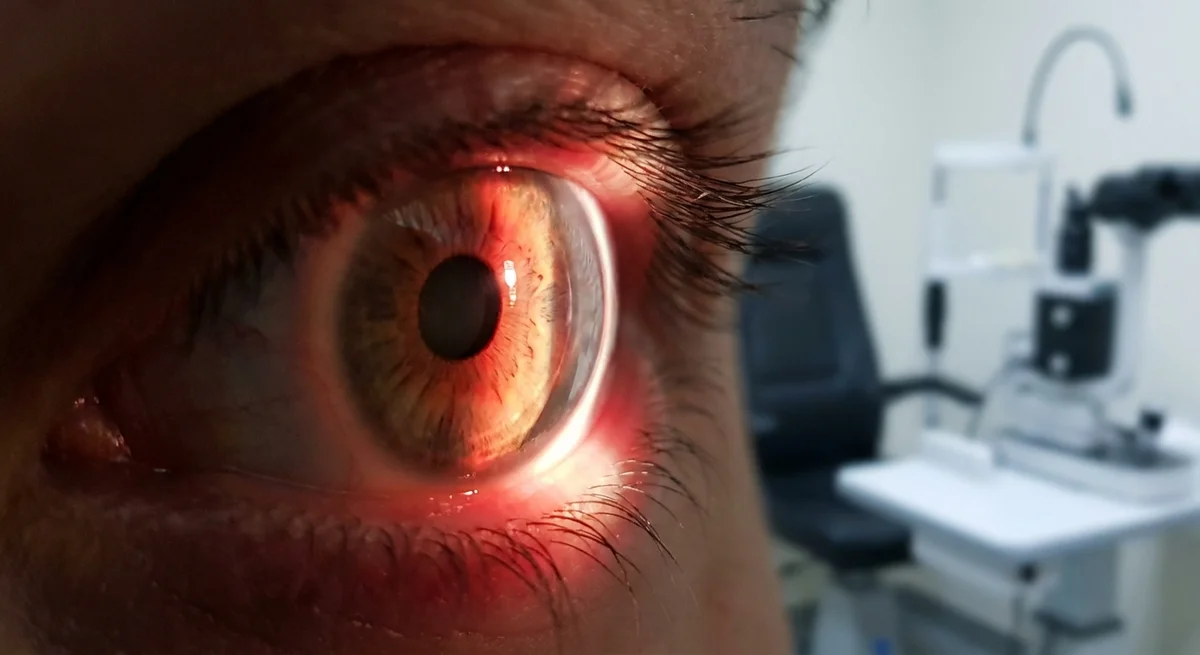
What Is Narrow-Angle Glaucoma?
Primary glaucoma is usually thought of as “open-angle” glaucoma, where the eye’s drainage system (the trabecular meshwork in the angle between the cornea and iris) remains open. Narrow-angle glaucoma – also called angle-closure glaucoma – is different. In these eyes the front part of the eye is crowded: the iris (the colored part) sits too close to the drainage angle, blocking fluid outflow. Tiny pores in the drainage tissue can become partially or fully sealed by the iris. This stops aqueous humor from draining normally and causes eye pressure (intraocular pressure, or IOP) to rise quickly (pmc.ncbi.nlm.nih.gov) (www.optometrists.org). In open-angle glaucoma, pressure usually rises slowly over years and damages nerves little by little. In contrast, narrow angles can abruptly trap fluid, driving IOP sky-high in hours – a spike that can destroy optic nerve fibers very quickly if untreated (pmc.ncbi.nlm.nih.gov) (pmc.ncbi.nlm.nih.gov).
High pressure in the eye leads to irreversible vision loss if not relieved. In fact, studies show angle-closure glaucoma causes blindness far more often than open-angle disease (pmc.ncbi.nlm.nih.gov). Although rare compared to open-angle glaucoma, angle-closure attacks can be catastrophic. It is one of the few true eye emergencies, because vision can be lost in a matter of hours without treatment (pmc.ncbi.nlm.nih.gov) (pmc.ncbi.nlm.nih.gov).
Anatomy: Closed Angle vs. Open Angle
To understand narrow angles, imagine the anterior chamber of the eye (space between cornea and iris) as a bowl. In open-angle glaucoma this bowl is deep enough that fluid (the aqueous humor) easily flows through the angle at the periphery. In narrow-angle glaucoma, the inner wall of the bowl (iris) bows forward toward the outer wall (cornea). This flattens and narrows the angle through which fluid drains (www.optometrists.org) (pmc.ncbi.nlm.nih.gov).
A helpful way ophthalmologists define angle-closure is by how much the iris touches the trabecular meshwork. If more than half of the meshwork is blocked by iris contact, the angle is considered “closed” (pmc.ncbi.nlm.nih.gov). In practice, doctors use gonioscopy – a special contact lens with mirrors – to shine light into the angle and see how open it is (eyewiki.org). With gonioscopy they can see if the iris is bumping into the drainage site. In short, angle-closure glaucoma means the drainage pathway is physically narrowed or sealed off by the iris, whereas open-angle glaucoma means the pathway remains open but becomes clogged or inefficient in other ways.
The Spectrum of Angle-Closure Disease
Narrow angles come in degrees. Some people are “angle-closure suspects” with anatomically narrow angles but no glaucoma damage yet. Others progress to chronic or acute closure.
-
Narrow Angles (Angle-Closure Suspect)
Some eyes simply have naturally shallow anterior chambers. These eyes are at risk: the iris is closer to the angle than normal, but fluid still drains (though a little slower). Many people with narrow angles never have symptoms or vision loss. We call them “suspects” or “pre-glaucoma.” They have narrow angles on exam, but pressure and nerve health remain normal. Such eyes need monitoring and often preventive treatment because they can progress to true angle-closure.
-
Chronic Angle-Closure Glaucoma (Subacute, Insidious)
Over time, a narrow angle can develop synechiae (iris adhesions) – patches where the iris sticks to the meshwork. This can block drainage bit by bit. Chronic angle-closure glaucoma often has no warning pain. Patients lose peripheral vision slowly, similar to open-angle glaucoma (pmc.ncbi.nlm.nih.gov). Unfortunately it is often caught late. Because it is less dramatic, chronic angle closure is commonly mistaken for ordinary open-angle glaucoma. But many experts note that small, farsighted (hyperopic) eyes are predisposed, and that Asian populations have especially high rates (pmc.ncbi.nlm.nih.gov) (www.optometrists.org). In fact, in some Asian and Inuit communities narrow angles are very common due to naturally shallower eyes (www.optometrists.org).
-
Acute Angle-Closure Crisis (Ophthalmic Emergency)
This is the classic “eye attack.” Suddenly the iris snaps forward and completely seals off the drainage angle, often precipitated by a trigger (see below). In an acute attack the eye cannot drain fluid at all. Pressure inside the eye can shoot up to very high levels (often >50–60 mmHg). The result is an intense, blinding emergency. Patients experience severe throbbing eye pain, headache, and nausea/vomiting (www.optometrists.org). The vision blurs dramatically and becomes “milky” as corneal cells swell from the pressure. People describe “halos” or rainbow rings around lights (www.optometrists.org). The pupil may be mid-dilated and unreactive. Because of the systemic symptoms, many patients end up in emergency rooms first, sometimes misdiagnosed as migraine, stroke or abdominal pain (pmc.ncbi.nlm.nih.gov). If not treated within hours, the optic nerve can suffer permanent damage.
Acute angle closure is one of the only true ocular emergencies: doctors stress that prompt relief of pressure usually leads to good recovery, but delays can mean irreversible blindness (pmc.ncbi.nlm.nih.gov) (pmc.ncbi.nlm.nih.gov). The crisis is frightening but, if handled quickly, has a better prognosis than chronic closure.
Risk Factors and Triggers
Certain eyes have the anatomy that predisposes to angle closure. Key risk factors include:
- Hyperopia (Farsightedness): Farsighted people have shorter eyes and naturally shallow anterior chambers. This pushes the iris forward. Studies show that hyperopic eyes are much more likely to develop narrow angles (www.optometrists.org) (pmc.ncbi.nlm.nih.gov).
- Age and Lens Growth: As we age, the lens inside the eye grows thicker. A thicker lens crowds the front of the eye, pushing the iris closer to the cornea and narrowing the angle. Thus angle-closure glaucoma usually appears after age 50 or 60 (www.optometrists.org).
- Gender: Women have narrower drainage angles on average (often due to smaller eyes), making them more susceptible. Large studies show women are roughly 2–4 times more likely than men to get angle-closure glaucoma (www.optometrists.org). (One large U.S. study found narrow-angle disease affected about 3× as many Caucasian women as men (www.optometrists.org).)
- Ethnicity/Ancestry: People of Asian or Inuit (Esquimo) descent have especially high rates of narrow angles. For example, East Asian populations may have up to ten times higher prevalence of angle closure compared to Europeans (www.optometrists.org) (pmc.ncbi.nlm.nih.gov). Inuit and other northern-indigenous groups similarly have shallower eye anatomies. Genetic factors in these populations produce shorter eyes, thicker lenses, and narrower angles.
- Family History: There is a hereditary component. A family history raises suspicion.
In addition, certain behaviors and medications can trigger an acute attack in a person with pre-existing narrow angles:
- Dim Lighting or Dark Rooms: In darkness, the pupil naturally dilates. When the pupil grows, the mid-peripheral iris bunches up and can plug the angle in a narrow eye. A simple dark movie theater or dark bedroom can precipitate closure.
- Drugs that Dilate the Pupil: Many common medicines have anticholinergic or sympathomimetic effects that dilate the pupil. For example, over-the-counter cold medications and some antihistamine tablets (which have anticholinergic properties) can trigger an attack (pmc.ncbi.nlm.nih.gov). Nasal decongestants, antidepressants, certain antipsychotics and anti-Parkinson drugs (which can dilate) are culprits (pmc.ncbi.nlm.nih.gov). Even eye drops given for other eye exams – or routine sunglasses that reduce light – can precipitate angle closure in a susceptible eye. In fact, research in patients with diabetes (who routinely have their pupils dilated for screening) found that about 0.04% suffered an acute attack after dilation – a small number, but enough to warrant caution (pmc.ncbi.nlm.nih.gov). The key is that any time the pupil enlarges, the iris bunches up and narrows the angle in these eyes.
- Other Triggers: Prolonged bed rest in darkness (e.g. recovering from surgery), certain migraine medications, and illicit drugs that dilate pupils can also act as triggers.
Understanding these triggers is crucial: patients with narrow angles are often warned to avoid painful pupil dilation or dark rooms.
Symptoms and Course
The symptoms depend on how acute the closure is:
-
Chronic Angle Closure: Typically no pain at first. There may be no noticeable symptoms until significant vision loss occurs. Some patients might notice gradual blurring or peripheral field defects very late. Occasionally there may be intermittent headaches or mild ache (often dismissed as migraines or sinus pain). Slowly developing halos or mild redness can sneak up undetected. Because chronic closure is sneaky, it is often discovered only when routine eye exams show nerve damage or a pressure rise.
-
Acute Angle-Closure Attack: This is dramatic. Patients report excruciating eye pain and headache so severe that they often describe it as the worst pain they've felt (pmc.ncbi.nlm.nih.gov). The eye is red, the vision is blurred (sometimes only hand motion), and one may see colorful halos around lights from corneal swelling (www.optometrists.org). Nausea and vomiting are extremely common; in many studies, more than half of acute patients feel sick, enough that they go to ER thinking it’s a migraine or stomach bug (pmc.ncbi.nlm.nih.gov). On exam the affected eye feels “rock hard” to the touch due to very high pressure. The pupil is often mid-dilated and fixed.
After an acute attack is relieved, the eye may still have permanent optic nerve damage and can remain permanently narrow. Importantly, even a single normal pressure reading does not rule out angle closure: the angle can close and open intermittently. That is why we emphasize examining the angle rather than relying on one pressure measurement.
Diagnosing Narrow Angles
Angle-closure can only be diagnosed by looking at the drainage angle. The gold standard is gonioscopy. The doctor numbs the eye, places a special mirrored contact lens on the cornea, and then uses a slit lamp microscope to directly visualize how open the angle is (eyewiki.org). Gonioscopy can classify the angle (open, narrow, or closed) and identify any iris-to-meshwork adhesions (synechiae).
Because gonioscopy requires skill, newer tests may be used too:
-
Anterior Segment Optical Coherence Tomography (AS-OCT): This is a camera that takes a cross-sectional image of the front eye without touching it. It can measure the angle width at multiple points quickly. AS-OCT is useful for screening (if available) and can document how much of the angle is open. However, it does not show blood or finer details as some lasers require.
-
Ultrasound Biomicroscopy (UBM): This high-frequency ultrasound can image deeper structures behind the iris. It is especially useful to diagnose “plateau iris,” a condition where the iris root configuration causes closure even after a laser hole. If the doctor suspects plateau iris, an UBM can confirm it and suggest additional laser treatment (iridoplasty).
-
Provocative Testing: In some cases, doctors may use tests that provoke pupil dilation (like dark-room testing or dilating drops under controlled conditions) to see if pressure spikes. This is done carefully because it can trigger an attack.
Often, doctors will do a peripheral anterior synechia check (looking for permanent iris adhesions) and measure the anterior chamber depth. A simple slit lamp exam can reveal shallow chambers by shadowing. But definitive angle-image techniques (like gonioscopy or AS-OCT) are needed for diagnosis.
Finally, if a patient has had an acute attack in one eye, the doctor will always check the fellow eye. Narrow angles are often bilateral, so prophylactic treatment (like laser iridotomy) of the other eye is commonly discussed.
Treatment Options
Because angle-closure is about anatomy, many treatments aim to open or bypass the narrow area. Treatment strategies include:
-
Lowering Pressure Medically: In an acute attack, the first step is to reduce IOP immediately with medications. This often includes oral carbonic anhydrase inhibitors (like acetazolamide), osmotic diuretics (like intravenous mannitol), and topical drops (beta-blockers, alpha agonists, etc.). These help lower pressure but do not solve the underlying blockage. Pilocarpine eye drops were historically used because they constrict the pupil, pulling the iris away from the angle (pmc.ncbi.nlm.nih.gov). However, pilocarpine can be painful and may not work in very high pressure cases (pmc.ncbi.nlm.nih.gov), and it has fallen out of favor during an acute attack (because it can also tighten the lens/iris apposition in some).
-
Laser Peripheral Iridotomy (LPI): This is the cornerstone prophylactic and first-line treatment. A laser (usually Nd:YAG or Argon) is used to create a tiny hole in the peripheral iris (pmc.ncbi.nlm.nih.gov). This hole provides an alternate pathway for fluid, equalizing pressure between the back and front of the iris. With the pressure balanced, the iris usually flattens and pulls away from the drainage meshwork. In effect, LPI eliminates the pupillary block that causes many angle closures. It is a quick outpatient procedure (often done in each eye that is at risk). LPI does not lower the existing pressure instantaneously, but it prevents future angle-closure attacks. Patients sometimes see temporary flashes or have minor inflammation afterward; a second laser session may be needed if the iris is very dark or thick. Even after LPI, patients require follow-up, because while it cuts the risk dramatically, it is not an absolute cure.
-
Laser Peripheral Iridoplasty: In some cases (especially plateau iris), a laser can be used on the peripheral iris itself (by putting burns around the outer iris) to contract it and pull it away from the angle. This is usually done if LPI alone does not open the angle sufficiently.
-
Lens Extraction (Cataract Surgery): Removing the crystalline lens (even if not cataractous) is increasingly viewed as the definitive treatment. By extracting the thick lens and replacing it with a thin artificial lens, the anterior chamber deepens and the angle widens appreciably. Clinical trials are now showing that early lens extraction can prevent progression in chronic angle-closure and significantly open the angle (pmc.ncbi.nlm.nih.gov). For many older patients, cataract surgery naturally removes the culprit lens. In others, an elective clear-lens extraction (glaucoma lens surgery) can be recommended. The advantage is a one-time long-term fix; the drawback is undergoing eye surgery.
-
Peripheral Iridectomy (Surgical): This is the non-laser version of LPI. In operating room, a small surgical punch or scissors is used to remove a piece of the iris. It achieves the same goal as an LPI hole. It is rarely first-line, but may be required if a laser cannot penetrate (very dark/brown iris) or if an acute attack is not resolving quickly.
-
Goniosynechialysis: In chronic cases where the iris has permanently stuck to the angle, surgeons can perform goniosynechialysis. This involves physically breaking those adhesions (using a micro-hook under a microscope) to reopen the angle. It is often done combined with cataract surgery.
-
Other Drainage Surgery: If glaucomatous damage is advanced, some patients may eventually need standard glaucoma surgeries (trabeculectomy, shunts, etc.) to control pressure. But these are less common than in open-angle cases, since early relief of angle closure usually prevents the worst damage.
Overall, the first step in any suspected acute attack is immediate pressure-lowering (medically) and prompt laser iridotomy once the cornea is clear enough. After a first eye attack, most specialists will perform an LPI in the fellow eye if it is narrow, to prevent an attack there.
Common Misconceptions and Take-Home Points
- “Narrow angles” is not the same as having glaucoma – yet. A person can have narrow angles on exam (anatomy risk) but still have normal eye pressure and healthy nerves. We call such cases “angle-closure suspect” or “primary angle-closure if no damage”. It only becomes glaucoma when optic nerve injury or visual field loss occurs.
- Normal pressure once does not mean you’re safe. Angle closure can be intermittent or develop suddenly. Someone can go to the clinic with normal IOP and still have a dangerously narrow angle. That’s why eye doctors check the angle configuration, not just measure pressure.
- Laser iridotomy is a preventive measure, not an absolute cure. Getting a hole in the iris vastly reduces the chance of an acute attack, but it doesn’t guarantee you will never need further treatment. Angle anatomy should still be monitored. Some patients need additional laser or surgery later if the situation changes.
- If one eye had an attack, the other eye is high-risk. Many patients think “I had it in my left eye, my right eye is fine.” In reality, anatomical narrowness is usually in both eyes. The fellow eye often gets a prophylactic iridotomy or at least close watching (pmc.ncbi.nlm.nih.gov).
- Early screening is effective. Unlike open-angle glaucoma which truly hides until late, narrow angles can be diagnosed before any damage. That means we can prevent an attack by routine eye exams that include angle assessment. Worldwide, delayed diagnosis causes unnecessary blindness from angle closure (pmc.ncbi.nlm.nih.gov). But if eye doctors look for it, angle closure is one of the most “preventable and treatable” forms of glaucoma.
In summary, narrow-angle (angle-closure) glaucoma is an anatomically distinct form of glaucoma where the iris blocks the eye’s drainage angle. It can quietly harm vision over years, or cause sudden high-pressure attacks that require immediate care. The jackpot of knowledge for patients is that it is very treatable – usually by opening the iris with a laser – and often preventable with timely detection. Anyone with the risk factors described (aging, farsightedness, family history, or Asian ancestry) should be sure to get a comprehensive eye exam with angle evaluation.
With awareness and modern treatments, angle-closure glaucoma need not lead to the disproportionate rate of blindness it still causes.
References: Clinical evidence and studies have documented the above findings (pmc.ncbi.nlm.nih.gov) (pmc.ncbi.nlm.nih.gov) (pmc.ncbi.nlm.nih.gov) (www.optometrists.org) (pmc.ncbi.nlm.nih.gov) among others.