
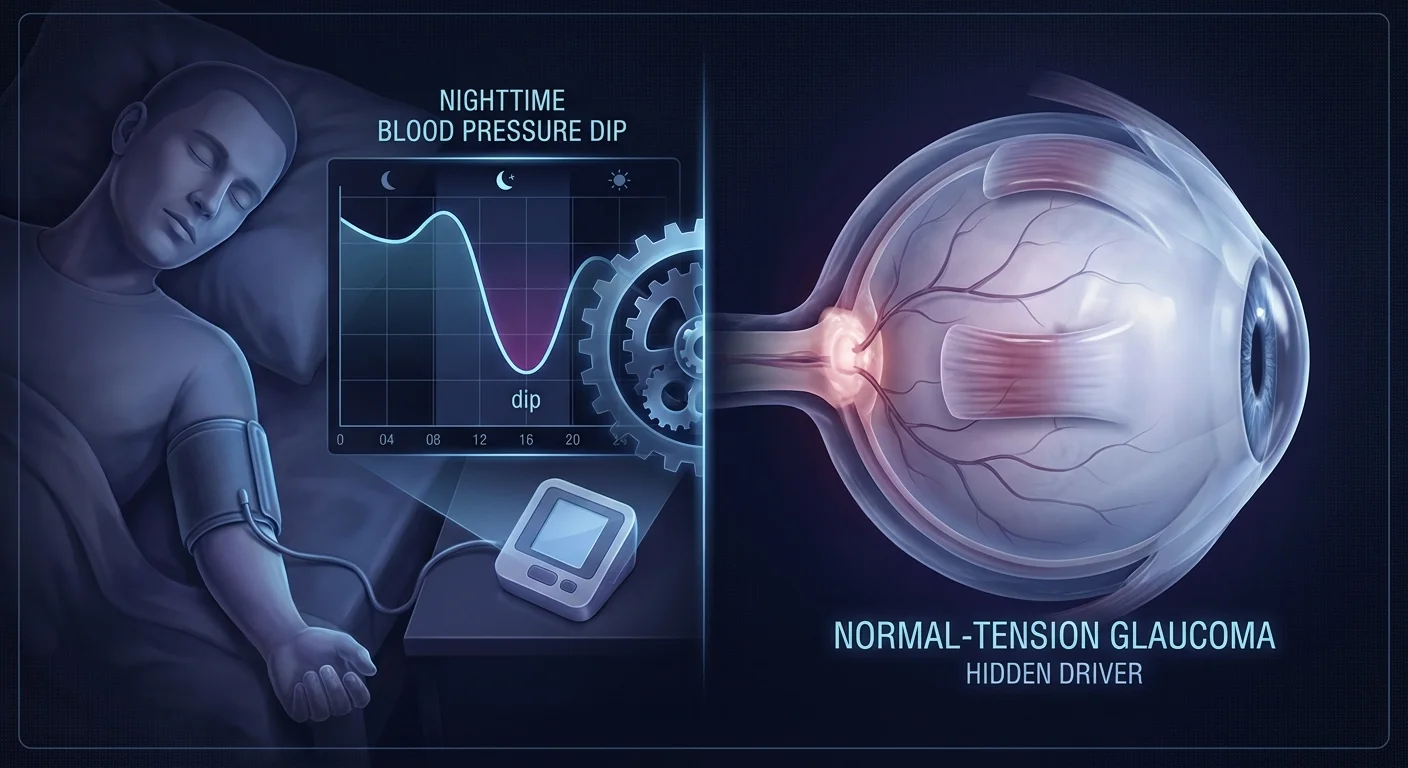
The Nighttime Blood Pressure Dip: A Hidden Driver in Normal-Tension Glaucoma
Normal-tension glaucoma (NTG) is a type of glaucoma where the optic nerve deteriorates even though eye pressure is normal. In NTG, experts believe blood flow to the optic nerve plays a key role. The ocular perfusion pressure (OPP) – roughly the difference between blood pressure in the eye’s vessels and the eye’s internal pressure – drives that blood flow. If blood pressure falls too low, OPP drops and the optic nerve may starve for oxygen (pmc.ncbi.nlm.nih.gov) (pmc.ncbi.nlm.nih.gov). Normally our blood pressure dips about 10–20% at night, which is healthy for the heart. But an excessive nocturnal dip (sometimes called “over-dipping”) can be harmful for the eye (pmc.ncbi.nlm.nih.gov) (pmc.ncbi.nlm.nih.gov). In simple terms, a very large overnight BP drop can deprive the optic nerve of blood and speed vision loss.
Ocular Perfusion Pressure: Why Low BP Can Hurt the Eye
OPP is like the eye’s blood “fuel”. When systemic blood pressure (the “pump”) falls or eye pressure (“back pressure”) rises, OPP drops. Decades of research show that chronically low OPP is linked to glaucoma. For example, large epidemiology studies found that people with low diastolic pressure relative to eye pressure had much higher glaucoma risk (pmc.ncbi.nlm.nih.gov). In one study, subjects whose night-time diastolic OPP was under 55 mmHg had over 3 times the risk of glaucoma (pmc.ncbi.nlm.nih.gov). The Early Manifest Glaucoma Trial similarly showed that NTG patients who had low baseline blood pressure and perfusion lost vision faster (pmc.ncbi.nlm.nih.gov). The bottom line: if the ocular blood supply pressure is low (because of low systemic BP), the optic nerve is vulnerable.
The Nighttime Blood Pressure Dip
At night, the body naturally relaxes and lowers blood pressure (typically by 10–20%). In NTG patients, an exaggerated dip can create trouble. If the nighttime fall exceeds about 20%, physicians call this “over-dipping.” In one study of 54 NTG patients, half (27/54) were classified as over-dippers (pmc.ncbi.nlm.nih.gov). These patients had very large nocturnal falls in mean arterial pressure. Such drops can cause large swings in OPP, potentially triggering tiny ischemic episodes in the optic nerve (pmc.ncbi.nlm.nih.gov).
Ophthalmologists now recognize extreme dips as a warning sign. A recent systematic review noted that “nocturnal hypotension and extreme nocturnal BP dipping are risk factors for the development and progression of open-angle glaucoma” (pmc.ncbi.nlm.nih.gov). In other words, letting the blood pressure plunge too low at night can directly damage the optic nerve. For example, one prospective NTG study found that patients whose nighttime blood pressure dropped about 10 mmHg below daytime levels had significantly faster visual field loss (pmc.ncbi.nlm.nih.gov). In NTG, each millimeter of mercury counts: a small extra drop at night can raise the chance of glaucoma progression substantially (pmc.ncbi.nlm.nih.gov).
Evidence from 24-Hour Blood Pressure Monitoring
To clearly see the problem, researchers use 24-hour ambulatory blood pressure monitors. These devices record BP repeatedly through day and night. Ambulatory monitoring has confirmed the link between night-time BP dips and NTG progression. For instance, Charlson et al. (2014) prospectively monitored NTG patients and showed that those with nocturnal hypotension lost significantly more vision in one year (pmc.ncbi.nlm.nih.gov). They found that both the magnitude and duration of the night-time drop predicted who would worsen (pmc.ncbi.nlm.nih.gov) (pmc.ncbi.nlm.nih.gov). In fact, Charlson’s team recommended that 24-hour BP monitoring “should become part of routine assessment” for NTG, especially if a patient is losing vision despite good eye-pressure control (pmc.ncbi.nlm.nih.gov).
Another study (Raman et al., 2018) quantified the risk: each 1 mmHg decrease in nocturnal diastolic ocular perfusion pressure (DOPP) raised the risk of progression by ~40% (pmc.ncbi.nlm.nih.gov). Eyes with very low nighttime DOPP (<35 mmHg) were over twice as likely to have field loss as those with higher DOPP (pmc.ncbi.nlm.nih.gov). This means that even a few mmHg of extra drop can double the risk. In short, low night-time BP predicts faster NTG progression.
Other studies back this up. One found that NTG patients (on average) have lower 24-hour and nighttime BP than people with high-pressure glaucoma or healthy subjects (pmc.ncbi.nlm.nih.gov) (pmc.ncbi.nlm.nih.gov). The authors cautioned that this persistent lower BP “may reduce [optic nerve] perfusion and may be responsible for” the vision loss in NTG (pmc.ncbi.nlm.nih.gov). In practice, any NTG patient with “unexplained” progression may be a culprit for nocturnal dips. As one review concluded, nocturnal hypotension alone or together with large BP swings can significantly raise the risk of optic nerve damage (pmc.ncbi.nlm.nih.gov) (pmc.ncbi.nlm.nih.gov).
Impact of Bedtime Blood Pressure Medications
A key factor in nocturnal dips is antihypertensive timing. Many heart-focused studies have shown that taking blood pressure pills at bedtime boosts the night-time BP fall – often desirable for cardiac protection. For example, Carter et al. (2013) noted that “bedtime dosing of antihypertensive agents reduces sleep blood pressure and improves the dipping pattern” (pmc.ncbi.nlm.nih.gov). In other words, if a patient takes their medication at night, their overnight BP will drop even more than if they took it in the morning. This strategy can lower stroke risk (pmc.ncbi.nlm.nih.gov), but in NTG it can exacerbate optic nerve under-perfusion.
Ophthalmologists must therefore balance heart benefits against eye risks. As Pickering (2008) pointed out, studies in optic nerve stroke (non-arteritic anterior ischemic optic neuropathy) found that patients taking nighttime BP meds often had dangerously low nocturnal pressures linked to vision loss (pmc.ncbi.nlm.nih.gov). His work (citing ABPM data) emphasized that nocturnal hypotension “may contribute” to optic nerve damage, especially in patients on antihypertensives (pmc.ncbi.nlm.nih.gov). In practice, this means a patient on potent nighttime vasodilators or diuretics could be an “over-dipper” by default.
Guidelines still debate the best approach. Large trials (Hygia, MAPEC) highlight cardiovascular benefits of bedtime dosing (pmc.ncbi.nlm.nih.gov), so we cannot simply advise everyone to avoid nighttime meds. Instead, NTG patients should be evaluated individually. If a patient’s fields are worsening and ABPM shows extreme dips, a medication schedule change should be considered – while still keeping overall BP in a safe range. As one review noted, if a patient has marked nocturnal hypotension, “change in pharmacological treatment might be considered” (pmc.ncbi.nlm.nih.gov). In short, flipping a dose from night to morning can sometimes protect the optic nerve without jeopardizing the heart.
Collaborating with Your Healthcare Team
Managing NTG and blood pressure together often requires teamwork. Here’s a practical workflow for doctors and patients:
-
Identify Risk Factors. Eye doctors should note if an NTG patient has low systemic BP, symptoms of hypotension (dizziness, fainting), or if their glaucoma is worsening out of proportion to IOP readings. Check if any antihypertensive is taken at night.
-
Order 24-Hour Monitoring. If concern is high, arrange ambulatory BP monitoring. This will categorize the patient as a dipper, non-dipper, or over-dipper. An over-dipper (large night drop) is a red flag for NTG progression.
-
Review Medications. If monitoring confirms nocturnal hypotension, the ophthalmologist should alert the patient’s primary care or cardiologist. Together they can adjust therapy. For example, an evening dose of a blood pressure pill might be moved to morning, or a medication swapped for one that lowers BP more gently. The goal is to maintain safe blood pressure overall, while avoiding large nighttime dips.
-
Follow Up and Recheck. After any change, repeat the BP monitoring to confirm that night-time pressures are stabilizing. Continue glaucoma checks (visual fields, optic nerve exams) to see if disease progression slows. If fields stabilize, the adjustment was likely beneficial.
In practice, even simple changes can help. If a patient is on a short-acting diuretic at bedtime, moving it to morning may smooth out the night drop. If on a long-acting blood vessel relaxer, a dose-shift might be tried. Communication is key: the eye doctor provides the ocular picture, and the PCP/Cardiologist ensures blood pressure remains well controlled overall. This co-management ensures both vision and cardiovascular health are safeguarded.
Clinician Checklist: Identifying Over-Dippers
Healthcare providers can use this checklist to spot patients at risk of excessive night-time BP dips:
-
Medication Review: Is the patient taking any antihypertensives at night (e.g., ACE inhibitors, ARBs, beta-blockers, diuretics)? Multiple night-time drugs raise suspicion.
-
Symptom Query: Ask about morning dizziness, headaches, or blurred vision on awakening. Does the patient ever wake feeling faint or disoriented? These suggest low overnight BP.
-
Measure BP Trends: Compare clinic BP with patient’s home readings. If possible, arrange or review a 24-hour BP study. Look for ≥10–20% night-time drop (“over-dipper” pattern) (pmc.ncbi.nlm.nih.gov).
-
Glaucoma Status: Note unexplained glaucoma progression. If RNFL or field loss worsens despite normal IOP, consider vascular factors. Also check for optic disc hemorrhages or notches that sometimes correlate with low perfusion.
-
Coordinate Care: If over-dipping is likely, flag it to the patient’s primary care or cardiologist. Recommend adjusting the medication schedule (e.g. moving doses to morning) and re-assessing BP pattern. Ensure clear communication so all doctors share the plan.
-
Education: Explain to the patient why we’re concerned about night-time BP. Encourage them to report any new symptoms (e.g. night sweats, vivid dreams, waking with palpitations) that might hint at low blood pressure events.
Patient Tips: Tracking Your Symptoms
Patients can also help monitor signs of nocturnal hypotension:
-
Check Vision on Waking: Pay attention to how your vision feels in the morning. Is there blurriness or dimness that improves later? Do you have headaches or feel dizzy when you first get up? Note these in a diary. Such morning symptoms can hint that your eyes got too little blood overnight.
-
Log Blood Pressure: If you have a home BP cuff, take readings at different times: lying down for a few minutes just after waking, then sitting upright after breakfast, in the afternoon, and at bedtime. Keep a simple log of date, time, and readings. Over a week, see if your BP is much lower at night than during the day.
-
Record Medication Times: Write down exactly when you take each blood pressure pill or diuretic. Include doses of diuretics (e.g. Lasix) which can lower pressure and hydration. This lets you and your doctors connect symptoms with medications.
-
Keep a Symptom Diary: Note any periods of blurred vision, faintness, or unusual fatigue. For example: “Day X – woke up at 7:00 am; vision blurry in left eye that cleared by 10:00.” Even simple entries help the doctor spot patterns. Also record if you wake at night with headache or heart racing.
-
Communicate Changes: Share these notes with your eye doctor and your primary doctor. If you notice your vision field (like your computer screen edge or reading words) getting worse, or if your morning readings show lows (e.g. BP falling below 100/60), tell both doctors. They may adjust medications or order a 24-hour monitor.
-
Regular Check-ups: Keep up with glaucoma exams (visual fields and eye imaging) so any change is caught early. Mention any new symptom immediately rather than waiting for the next appointment.
By tracking symptoms and BP readings, you provide valuable clues. For example, consistently low morning BP or vision fluctuations can indicate excessive nocturnal dips. Sharing this information helps your doctors fine-tune both heart and eye care to protect your vision.
Conclusion
In NTG, we can no longer focus solely on the eye; blood pressure matters too. Research shows that deep nighttime BP drops – whether from naturally low pressure or bedtime medications – can dramatically lower ocular perfusion and speed optic nerve damage (pmc.ncbi.nlm.nih.gov) (pmc.ncbi.nlm.nih.gov). For patients this means discussing your blood pressure patterns with your doctors. Measures like 24-hour BP monitoring and adjusting medication timing have been shown to slow NTG progression (pmc.ncbi.nlm.nih.gov) (pmc.ncbi.nlm.nih.gov). By working together – ophthalmologist, cardiologist, primary care doctor, and patient – we can catch hidden nocturnal hypotension. This teamwork helps keep blood pressure in a safe range and ensures the optic nerve stays well-perfused. Ultimately, watching the night-time dip may be critical to protecting vision in NTG.