
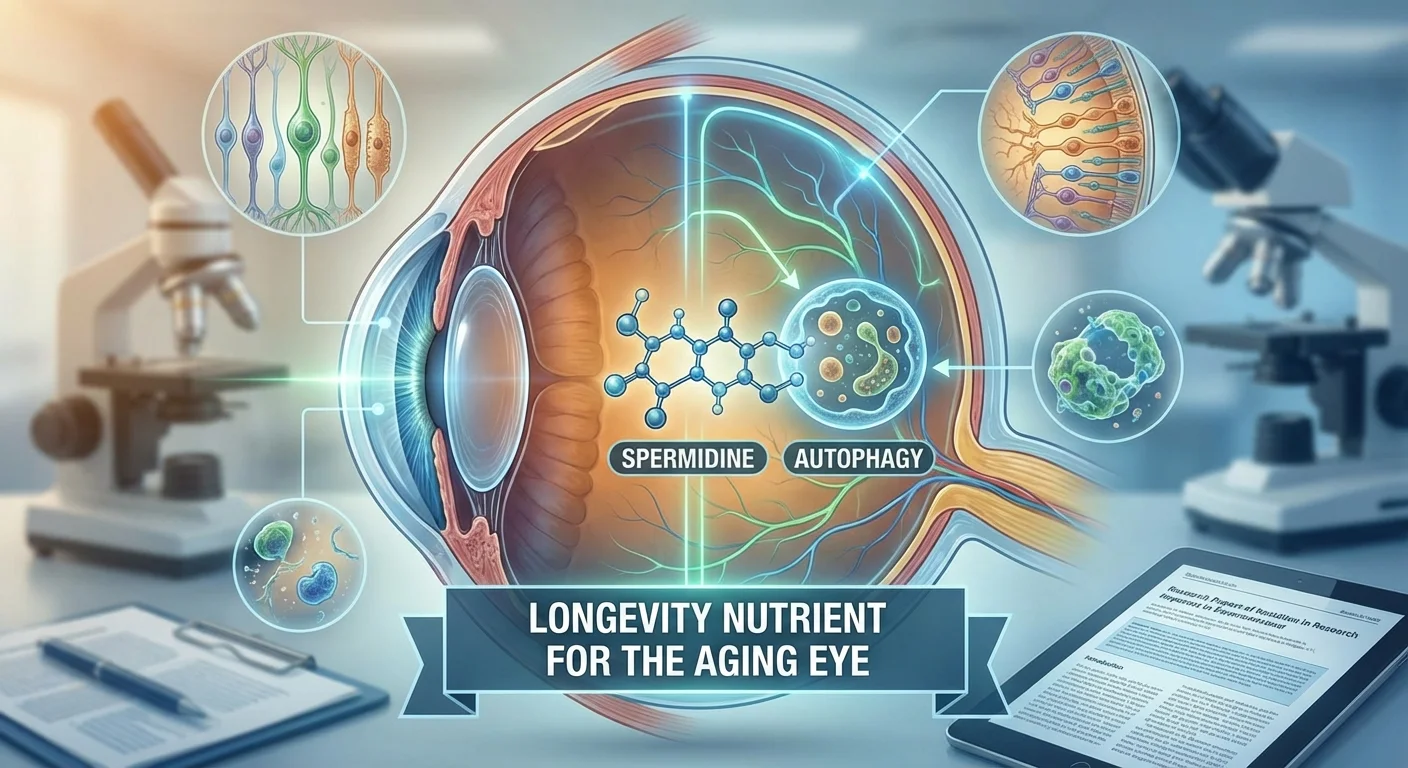
Spermidine: An Autophagy-Inducing Polyamine for Eye Health
Spermidine is a naturally occurring polyamine found in all cells and in many aging-friendly foods. It has recently attracted attention as an autophagy inducer and “longevity” nutrient. Autophagy is a cellular “cleanup” process that degrades damaged proteins and organelles (including mitochondria) to maintain cell health. In model organisms, spermidine robustly extends lifespan, likely by reactivating autophagy (pmc.ncbi.nlm.nih.gov) (pmc.ncbi.nlm.nih.gov). In cultured cells and animals, spermidine suppresses the histone acetyltransferase EP300, lowering protein acetylation and thereby accelerating autophagic flux (pmc.ncbi.nlm.nih.gov). At the same time, spermidine has a large safety margin; to date “no adverse effects of exogenous supply of spermidine have been reported” (pmc.ncbi.nlm.nih.gov), and dosing studies in humans (~1–3 mg/day) have increased intake by only ~10–20% over diet without toxicity (pmc.ncbi.nlm.nih.gov).
Autophagy and Mitochondrial Quality Control
By inducing autophagy, spermidine helps cells clear damaged components and maintain mitochondrial health. For example, chronic spermidine feeding in aged mice enhanced cardiac autophagy and mitophagy, improved mitochondrial respiration, and reduced markers of cellular aging (pmc.ncbi.nlm.nih.gov). These cardioprotective effects required intact autophagy machinery: mice lacking the autophagy gene Atg5 in heart cells did not benefit from spermidine (pmc.ncbi.nlm.nih.gov). Improved mitochondrial quality is also seen in neurons: spermidine restored bioenergetics in aged human neurons and in animal models by boosting mitochondrial respiration and ATP production (pmc.ncbi.nlm.nih.gov). Such mitophagy-promoting effects are relevant to long-lived neurons (like retinal ganglion cells) that depend on mitochondrial fitness.
Retinal Ganglion Cell Survival and Neuroprotection
Evidence is emerging that spermidine can protect retinal neurons. In a mouse optic nerve injury model (simulating neurodegeneration), daily oral spermidine dramatically reduced retinal ganglion cell (RGC) death and preserved retinal structure (pmc.ncbi.nlm.nih.gov). The study found that spermidine acts as a free-radical scavenger in this context: it inhibited retinal oxidative stress signaling (ASK1–p38 kinase pathway) and lowered expression of inflammatory mediators such as iNOS in microglia (pmc.ncbi.nlm.nih.gov) (pmc.ncbi.nlm.nih.gov). Spermidine-treated mice also showed less microglial accumulation in the retina and enhanced optic nerve regeneration (pmc.ncbi.nlm.nih.gov). In other words, spermidine not only prevented RGC apoptosis but even improved nerve regrowth after injury. These findings led the authors to conclude that “spermidine stimulates neuroprotection as well as neuroregeneration” (pmc.ncbi.nlm.nih.gov), suggesting potential benefit for diseases like glaucoma.
In a genetic mouse model of normal-tension glaucoma (EAAC1 knockout), spermidine in the drinking water also protected vision even though intraocular pressure was unchanged. Mice receiving 30 mM spermidine showed less retinal thinning and better visual function than untreated controls (pmc.ncbi.nlm.nih.gov). This protection was linked to antioxidant effects: spermidine reduced lipid-peroxidation (4-HNE) levels in the retina, indicating it counteracts oxidative stress (pubmed.ncbi.nlm.nih.gov). Thus, while spermidine does not lower IOP directly, it seems to boost optic nerve resilience by quenching reactive oxygen species and inflammation. In summary, in multiple retinal models spermidine has acted as an endogenous antioxidant/autophagy booster to preserve RGCs and visual function (pmc.ncbi.nlm.nih.gov) (pmc.ncbi.nlm.nih.gov).
Spermidine, Longevity and Cardiovascular Health
Population studies support spermidine’s role in longevity and cardiovascular wellness. In the Austrian Bruneck cohort, higher dietary spermidine intake was linked to substantially lower mortality: each standard-deviation increase in intake corresponded to a ~25% reduction in death risk (pubmed.ncbi.nlm.nih.gov). Similarly, a US analysis of NHANES data (2003–2014) found that participants in the highest spermidine intake quartile had roughly 30% lower rates of all-cause and cardiovascular mortality (HR≈0.70) compared to the lowest quartile (pmc.ncbi.nlm.nih.gov). Notably, these associations persisted after adjusting for diet and lifestyle. In a large UK Biobank study of ~180,000 adults, moderate polyamine intake (predominantly spermidine) was tied to an 18% lower risk of all-cause death and a 14% reduction in heart disease/stroke events during ~11 years of follow-up (pmc.ncbi.nlm.nih.gov). These epidemiologic findings echo spermidine’s cardioprotective effects in animals: supplemented mice showed lower blood pressure, less arterial stiffening and improved heart function (pmc.ncbi.nlm.nih.gov) (pmc.ncbi.nlm.nih.gov). Mendelian randomization analyses also suggest a causal link: genetically higher spermidine levels are associated with lower blood pressure and reduced stroke risk (pubmed.ncbi.nlm.nih.gov). Taken together, human data imply that a spermidine-rich diet – found in foods like whole grains, legumes, and aged cheese – correlates with greater longevity and cardiovascular health (pmc.ncbi.nlm.nih.gov) (pmc.ncbi.nlm.nih.gov).
Ocular Mechanisms: IOP and Neuroprotection
In the eye, no direct evidence has emerged that spermidine lowers intraocular pressure (IOP). In fact, in the normal-tension glaucoma model above, spermidine’s benefits occurred without any change in IOP, indicating its effects are IOP-independent. Instead, all available data point to neuroprotective and anti-inflammatory mechanisms. Spermidine’s known actions – autophagy upregulation, ROS scavenging, and anti-inflammatory signaling – all plausibly shield the optic nerve. For example, by removing damaged mitochondria via mitophagy, spermidine may prevent accumulation of neurotoxic stress in RGCs. Concurrently, its antioxidant properties (scavenging CR species and downregulating inducible NOS) protect against nitrative damage (pubmed.ncbi.nlm.nih.gov). Spermidine also reduces pro-inflammatory chemokines and microglial activation (pmc.ncbi.nlm.nih.gov), which are implicated in glaucomatous RGC loss. These combined effects – reduced oxidative stress, dampened neuroinflammation, and enhanced cellular cleanup – likely underpin the observed optic nerve resilience. In short, spermidine’s benefits for the eye seem to arise from supporting neuron health rather than from altering IOP or ocular fluids.
Dietary Sources, Supplementation, and Safety
Dietary spermidine comes from many plant and fermented foods. It is especially abundant in wheat germ, fermented soybeans (natto), and certain aged cheeses or fruits like durian (pmc.ncbi.nlm.nih.gov). Typical Western diets provide on the order of a few mg of spermidine per day. For context, one safety trial gave elderly subjects 1.2 mg spermidine daily (via 750 mg wheat-germ extracts), raising their intake ~10–20% above baseline (pmc.ncbi.nlm.nih.gov). This modest supplementation was well tolerated (3 capsules per day) and produced no significant side effects or changes in blood biomarkers (pmc.ncbi.nlm.nih.gov). Indeed, even much higher extrapolated doses (up to 3.4 mg/day for a 70 kg person, equivalent to a 41 mg/kg mouse dose) are predicted to be safe (pmc.ncbi.nlm.nih.gov). Spermidine’s safety profile is encouraging: preclinical and early human data report no serious adverse events attributable to supplementation (pmc.ncbi.nlm.nih.gov) (pmc.ncbi.nlm.nih.gov).
Of course, real-world intake comes from food, and eating more spermidine-rich foods (whole grains, legumes, mushrooms, nuts, and cheeses) is the simplest approach. Supplements containing spermidine-rich extracts (e.g. from wheat germ) also exist, but doses are small and long-term effects on eye health are still unproven. Importantly, spermidine’s potential benefits likely require consistent intake over many months or years, mimicking dietary patterns seen in longevity cohorts. Given its natural occurrence and low toxicity, moderate spermidine supplementation appears safe for most adults, but as with any supplement, it should be approached with caution and medical guidance.
Conclusion
Collectively, the evidence suggests that spermidine – via autophagy induction and mitochondrial quality control – enhances the survival of retinal neurons and supports vascular health. By promoting cellular “housekeeping”, spermidine may help counter age-related stress in retinal ganglion cells. Human studies link higher spermidine intake to longer life and less heart disease, implying broad systemic benefits (pmc.ncbi.nlm.nih.gov) (pmc.ncbi.nlm.nih.gov). In the aging eye, spermidine’s antioxidant and anti-inflammatory actions (rather than IOP effects) seem most relevant to protecting the optic nerve. While more clinical research is needed, incorporating spermidine-rich foods (or safe low-dose supplements) could be a promising strategy to bolster ocular resilience and healthy aging.