
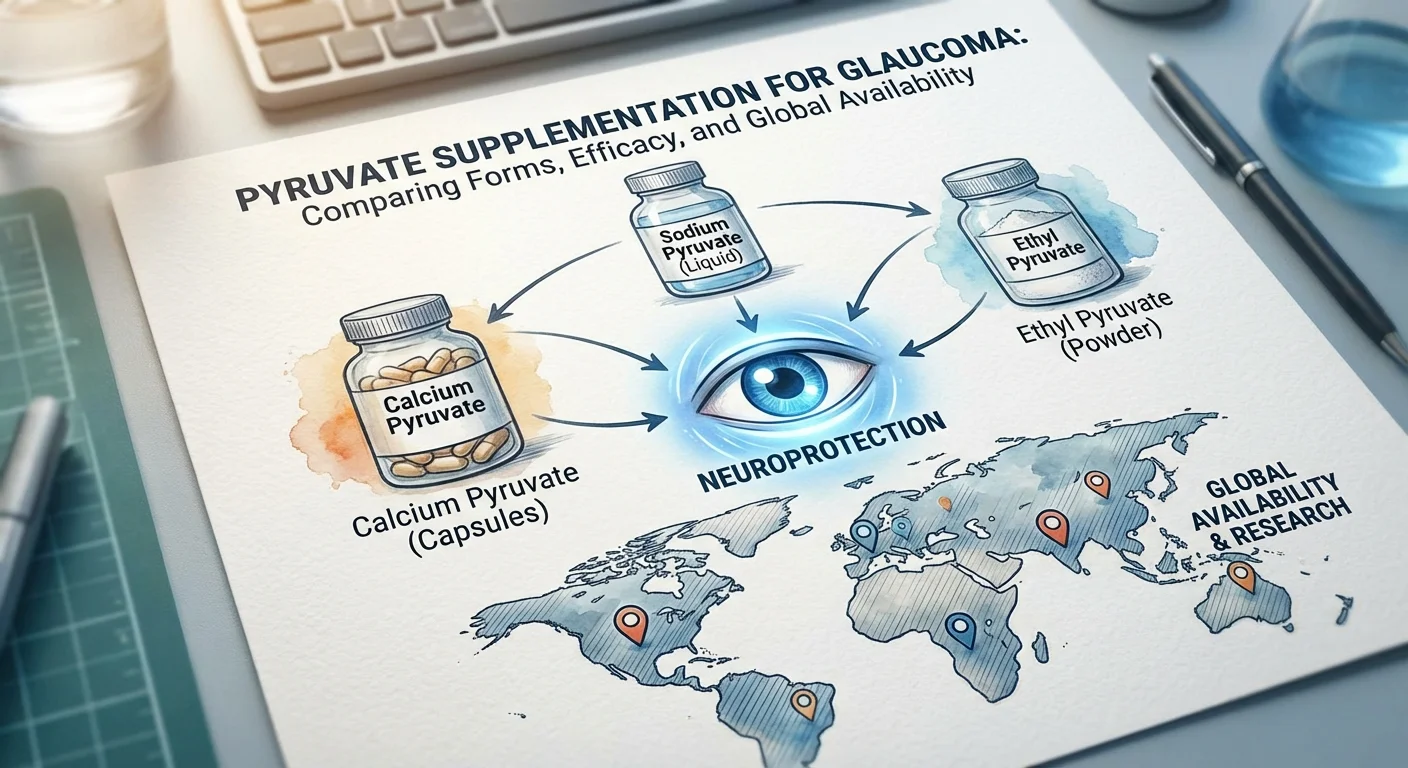
Pyruvate Supplementation for Glaucoma: Comparing Forms, Efficacy, and Global Availability
Glaucoma is a common eye disease that damages the optic nerve and leads to vision loss by killing off special retinal nerve cells called retinal ganglion cells. It is actually the leading cause of irreversible blindness worldwide (pubmed.ncbi.nlm.nih.gov). Normally, these eye nerves need a lot of energy to function. Recent research suggests that pyruvate – a natural energy molecule in our cells – might help protect the retina. In simple terms, pyruvate can act like a “fuel” for the nerves in your eye and also helps keep the tiny power plants inside those nerves (called mitochondria) running smoothly. This article explains how pyruvate helps the eye’s cells, what studies say about glaucoma, the added health perks of pyruvate, and how different pyruvate supplements compare (calcium pyruvate, creatine pyruvate, sodium pyruvate). We also look at how easy it is to find these supplements around the world.
How Pyruvate Fuels Eye Cells
Pyruvate is a three-carbon compound our bodies make when sugars are broken down for energy (ods.od.nih.gov). Think of it as a key fuel molecule: it can enter cells and head straight to the mitochondria (the cell’s “powerhouse” organelles) to be turned into usable energy (ATP). In mitochondria, pyruvate is converted into chemicals that keep the energy cycle (Krebs cycle) going. This process also helps regenerate a helper molecule called nicotinamide adenine dinucleotide (NAD⁺), which is crucial for energy production.
For retinal ganglion cells (the nerves that carry images from the eye to the brain), healthy mitochondria mean survival and good vision. In glaucoma, rising eye pressure and other stresses disrupt metabolism: studies in mice have shown that eye pressure causes retinal mitochondria to falter and pyruvate levels in the retina actually drop as the disease starts (pubmed.ncbi.nlm.nih.gov). When the cells lose pyruvate, their energy production stalls and they become vulnerable.
Importantly, pyruvate does more than just fuel cells. It has antioxidant and anti-inflammatory effects in cells. Lab research notes that pyruvate can neutralize harmful byproducts (free radicals) and lower stress in cells (pmc.ncbi.nlm.nih.gov). In other words, pyruvate not only powers up the cell but also helps protect it from damage (for example by reducing oxidative stress). This dual role – fueling mitochondria and guarding against cell stress – is why scientists are excited about its neuroprotective potential in glaucoma.
Pyruvate’s Neuroprotective Effects in Glaucoma
Multiple studies have now tested pyruvate in glaucoma models. In a landmark study, researchers induced glaucoma in rats and mice and monitored eye health (pubmed.ncbi.nlm.nih.gov). They saw two key things: first, that glaucoma caused a drop in retinal pyruvate and a backup of sugar metabolism in the eye (pubmed.ncbi.nlm.nih.gov). Second, and most importantly, when they gave the animals extra pyruvate by mouth every day, the retinal ganglion cells were much healthier. In those animals, optic nerve damage and cell loss were dramatically reduced compared to controls (pubmed.ncbi.nlm.nih.gov). In plain language, the pyruvate supplement acted like a rescue: it restored fuel levels in the retina and the nerve cells survived the glaucoma attack (pubmed.ncbi.nlm.nih.gov).
Even more encouraging are recent findings in humans. A 2025 study looked at blood chemistry and genetics in people at high risk for glaucoma. It found that individuals with higher levels of natural glycolysis metabolites (including pyruvate) had a surprisingly lower rate of glaucoma, despite bad genes (elifesciences.org). To test the idea, researchers then gave mice a diet with extra pyruvate. The treated mice not only kept their eye pressure lower, they also had much less optic nerve damage than untreated mice (elifesciences.org). In short, both lab and genetic studies indicate that pyruvate strengthens the retina’s resistance to glaucoma. One paper concluded that “oral pyruvate supplementation substantially protected against intraocular pressure elevation and conferred resilience against glaucoma” (elifesciences.org).
The takeaway: by boosting mitochondrial energy and reducing stress in retinal cells, pyruvate can support retinal ganglion cell survival under glaucoma-like conditions. It helps keep the cellular engines running when they would otherwise fail.
Pyruvate and Overall Health (Longevity)
Because pyruvate is a fundamental energy molecule, people are also looking at it for general health and longevity. The idea is that by supporting metabolism and clearing cellular stress, pyruvate might slow some aging processes. A recent scientific review points out that pyruvate can raise NAD⁺ levels and even clear out “old” senescent cells – actions that could theoretically help tissues stay youthful (pmc.ncbi.nlm.nih.gov). In fact, adding pyruvate to oral rehydration solutions has been proposed as a novel way to fight age-related damage (pmc.ncbi.nlm.nih.gov).
Some early lab experiments back this up. For example, a 2023 study in fruit flies found that adding sodium pyruvate to the diet extended the flies’ lifespan: female flies lived about 8% longer and slept better on pyruvate-rich feed (pubmed.ncbi.nlm.nih.gov). Those are simple creatures, but the study suggests pyruvate might tweak basic biology in favor of longevity. While we don’t yet know if taking pyruvate helps humans live longer, these results – plus its role in supporting NAD⁺ and energy balance – hint at possible anti-aging benefits.
In plain terms: by feeding our cells more of this natural fuel, pyruvate may help them repair and rejuvenate. It could act a bit like popular molecules (such as NAD⁺ boosters or mild “senolytic” drugs) that scientists study in aging research (pmc.ncbi.nlm.nih.gov) (pmc.ncbi.nlm.nih.gov). More research is needed, but the early signs are promising for general cellular health.
Comparing Pyruvate Supplement Forms
There are several common forms of pyruvate supplements, each attached to a different “carrier” compound. Here’s how they compare:
-
Calcium Pyruvate: This is pyruvate bound with calcium. Users get extra calcium with each dose, which can support strong bones and teeth. Some people take calcium pyruvate for weight loss or muscle energy, though evidence is limited. Most scientific reports say it has only minimal effect on fat loss, unless extreme diets are also used (ods.od.nih.gov). However, one plus is that “it provides calcium, a critical nutrient for bone health, and may help reduce inflammation” (www.healthline.com). In fact, Healthline notes that in conditions like inflammatory bowel disease (which can cause bone issues), calcium pyruvate helped reduce gut inflammation and improve bone markers in animal studies (www.healthline.com). So beyond its energy role, calcium pyruvate can help supply calcium and may ease inflammation. (One old rat study even suggested dietary calcium pyruvate helped prevent cataracts (www.healthline.com), but human evidence is lacking.)
-
Creatine Pyruvate: This combines pyruvate with creatine, a well-known supplement for muscle and strength. Creatine alone is used by athletes to boost short-term power and recovery. By linking creatine to pyruvate, manufacturers aim to give both benefits at once – extra muscle fuel plus pyruvate’s metabolism boost (caringsunshine.com). Reviews say this “dual-action formula supports energy, muscle function, and recovery” (caringsunshine.com). In practice, studies have shown some benefit. In one controlled trial, healthy athletes took 5 grams of creatine pyruvate daily for 4 weeks. They saw significant gains in high-intensity exercise power, and the study authors noted that creatine pyruvate “might benefit endurance, due to enhanced activity of the aerobic metabolism” (pmc.ncbi.nlm.nih.gov). In other words, this form may help you perform better during intense workouts and recover faster. It may also deliver creatine’s benefits to the brain, but that’s still being researched.
-
Sodium Pyruvate: This is the sodium salt of pyruvic acid. It’s often used in lab and medical settings (e.g. in IV fluids or sports drinks) rather than sold as a simple health supplement. The effects of sodium pyruvate are essentially the same as pyruvate itself, once ingested. Research on sodium pyruvate includes studies like the fruit fly experiment mentioned above (pubmed.ncbi.nlm.nih.gov). In practice, sodium pyruvate is sometimes used in oral rehydration drinks or supplements aimed at endurance and recovery. Because it’s just the salt form, its main “extra” component is sodium (which might help with hydration). Otherwise, any benefit comes from the pyruvate.
Each form has niche benefits. Calcium pyruvate adds bone-friendly calcium and some anti-inflammatory effect (www.healthline.com). Creatine pyruvate adds muscle fuel and performance perks (pmc.ncbi.nlm.nih.gov). Sodium pyruvate is easily absorbed and can support hydration. The choice depends on your needs: for eye or general health, the pyruvate itself is what matters.
Safety and Availability Around the World
Pyruvate supplements are generally sold as over-the-counter dietary supplements, not prescriptions. For example, in the U.S. and Europe you can find calcium pyruvate capsules or powders in health food stores and online. A National Institutes of Health report even lists calcium pyruvate among common supplement ingredients (ods.od.nih.gov). Since these are classified as supplements, they don’t undergo the same rigorous approval as drugs. Manufacturers must ensure safety, but the FDA does not review them before sale (ods.od.nih.gov).
That said, studies have tested fairly high doses of pyruvate and found it to be mostly safe in the short term. The NIH fact sheet notes that doses up to about 30 grams per day (much higher than most supplements provide) were used in clinical trials. In those trials, no serious side effects were seen – only minor digestive issues like gas, bloating, or mild diarrhea (ods.od.nih.gov). In other words, pyruvate is generally well-tolerated at common supplement doses. As always, very high intakes will raise the chance of stomach upset.
Globally, you can purchase pyruvate supplements in many countries. Calcium pyruvate pills and powders are on the shelves in North America and Europe. Creatine pyruvate products are sold in sports nutrition shops worldwide. In Asia and other regions, availability may vary, but many online retailers will ship pyruvate supplements internationally. There’s usually no requirement for a prescription – it’s treated like a vitamin or mineral.
To sum up the availability: pyruvate supplements (especially calcium pyruvate) are widely available as energy or weight-management aids (ods.od.nih.gov). Check local suppliers and labels. In some places, pyruvate might be paired with vitamins or other ingredients (for instance, some supplements combine it with carnitine or antioxidants). If you consider taking pyruvate, follow the dosage on the product and be aware of mild digestive side effects at high doses (ods.od.nih.gov).
Conclusion
In conclusion, pyruvate is a naturally produced energy molecule that has shown promise in protecting the eye’s retinal nerves in glaucoma. It does this by fueling cellular engines and reducing metabolic stress in those cells. Animal studies and early human research indicate that added pyruvate can help retinal ganglion cells survive high eye pressure (pubmed.ncbi.nlm.nih.gov) (elifesciences.org). Additionally, pyruvate may support overall metabolic health and aging processes (pmc.ncbi.nlm.nih.gov) (pubmed.ncbi.nlm.nih.gov). There are different forms of supplements (calcium, creatine, sodium) that come with slight extras like calcium for bones or creatine for muscle strength (www.healthline.com) (pmc.ncbi.nlm.nih.gov). All seem to deliver the same basic benefit of more pyruvate for your cells.
Importantly, pyruvate supplements appear to be safe at recommended doses. Regulatory agencies consider them dietary supplements, and studies using up to ~30 grams per day found no serious harm – only minor stomach upset in some people (ods.od.nih.gov). As with any supplement, you should talk to your doctor (especially if you have other health issues), but pyruvate is generally well tolerated.
Overall, pyruvate supplementation is an exciting option for glaucoma support. By easing energy shortages in retinal cells, it offers a neuroprotective strategy beyond the usual eye drops or surgery. While more clinical trials in patients are needed, current evidence and availability mean patients can explore pyruvate safely as part of their eye-care regimen.