
Introduction
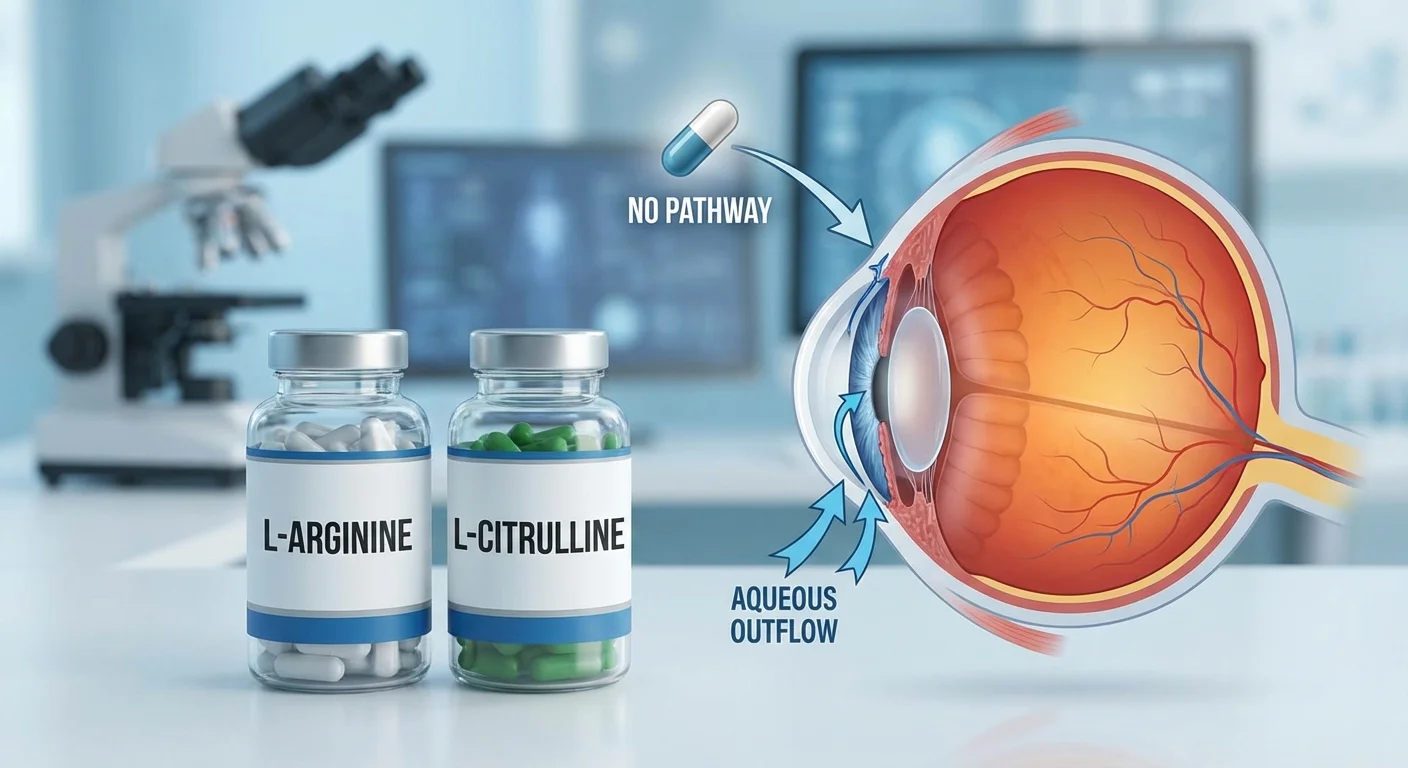
Glaucoma is one of the most common causes of irreversible vision loss worldwide. In glaucoma, intraocular pressure (IOP) becomes elevated because the clear eye fluid (aqueous humor) does not drain fast enough. Lowering IOP is the only proven way to slow disease progression (pmc.ncbi.nlm.nih.gov). Recent research suggests that nitric oxide (NO) – a natural signaling molecule – plays a key role in regulating fluid drainage and blood flow in the eye. Unlike most glaucoma medicines that reduce fluid production, NO helps the fluid escape by relaxing the eye’s drainage channels. This has led to new treatments (like NO-donating eye drops) and raises the question: can nutritional supplements that boost NO (such as the amino acids L-arginine and L-citrulline, or dietary nitrates from vegetables) help improve eye drainage and blood flow? In this article we explain how the NO pathway works in the eye, review what human studies have shown about NO-related supplements or foods, discuss possible side effects (like low blood pressure or headaches), and outline how future studies could measure their effects using imaging and ultrasound techniques.
The Nitric Oxide Pathway in the Eye
Nitric oxide is a gas produced inside blood vessel walls and eye tissues that causes smooth muscle relaxation. In the body, NO is formed from the amino acid L-arginine by enzymes called nitric oxide synthases (especially eNOS/NOS3) (pmc.ncbi.nlm.nih.gov). This NO then activates signaling that relaxes nearby blood vessels and tissues. The eye’s drainage system – the trabecular meshwork (TM) and Schlemm’s canal – has many endothelial and muscle cells. When these cells receive more NO, they relax and widen the tiny drainage channels, letting more fluid out and lowering IOP (pmc.ncbi.nlm.nih.gov). In simple words, NO makes the aqueous fluid route more leaky and flexible, so fluid drains easier.
At the same time, NO also affects blood flow in the eye. The retina and choroid (layers that supply the retina with oxygen) are fed by small arteries. NO dilates these arterioles, increasing blood flow to the retina and optic nerve (pubmed.ncbi.nlm.nih.gov). For example, one study gave healthy volunteers an IV infusion of L-arginine and found that retinal and choroidal blood flow rose by about 10–20% (pubmed.ncbi.nlm.nih.gov). This happened even as their blood pressure dropped slightly (see below). In animal studies, similar effects are seen: the retinal arterioles dilate under L-citrulline (a precursor of arginine) via NO-related pathways (pubmed.ncbi.nlm.nih.gov). In short, NO helps ensure good ocular perfusion by opening up eye blood vessels when needed.
The body also has a backup route to make NO from dietary nitrates (the “nitrate–nitrite–NO pathway”). Normally, under conditions like low oxygen or if the NOS enzymes are not working well (as can happen with aging or disease), beneficial bacteria in our mouth convert nitrates (found abundantly in green leafy vegetables and beetroot) into nitrite and then into NO in tissues (pmc.ncbi.nlm.nih.gov). This means you can either increase NO by taking L-arginine (the raw material for the usual pathway) or by eating nitrate-rich foods that seed an alternate NO production route. Both ultimately aim to boost NO levels in and around the eye.
Amino Acid Supplements (L-Arginine, L-Citrulline)
L-arginine and L-citrulline are amino acids commonly sold as dietary supplements for cardiovascular health. L-arginine is found in meat, fish, and nuts; L-citrulline is abundant in watermelon and is converted by the body into L-arginine. The idea is that taking these supplements could give the body more building blocks to make NO, thus enhancing its pressure- and flow-lowering actions in the eye.
Laboratory studies provide some support for this concept. For instance, an intravenous infusion of 10 grams of L-arginine in healthy volunteers caused a significant drop in IOP during the infusion (pubmed.ncbi.nlm.nih.gov). (IOP rose back quickly after stopping the infusion.) This IOP reduction was accompanied by a rise in nitrite levels in the eye fluid (aqueous humor), consistent with increased NO production (pubmed.ncbi.nlm.nih.gov). Importantly, the study noted no significant change in pupil size or focus, suggesting the effect was largely on outflow. Similarly, in a separate human trial, IV L-arginine boosted ocular blood flow: choroidal flow increased ~10–12% and retinal venous flow increased ~20%, even though mean arterial pressure fell slightly (pubmed.ncbi.nlm.nih.gov). In other words, giving L-arginine can open eye vessels and increase blood circulation. Animal experiments also show related effects. For example, in rabbits, adding L-arginine to eye drops with a glaucoma drug enhanced its IOP-lowering action (by further increasing outflow)【15†】.
These findings suggest that L-arginine (and by extension L-citrulline) can engage the NO system in the eye. In theory, L-citrulline – which is converted to L-arginine by the body – should behave similarly. In one rat study, L-citrulline dilated retinal arterioles through NO-dependent pathways without changing blood pressure (pubmed.ncbi.nlm.nih.gov). Thus, both amino acids have the potential to relax ocular vessels and drainage channels via NO.
However, there are qualifications: the human studies above used intravenous delivery of large doses (e.g. 10 g in 100 mL). It’s uncertain how much effect standard oral supplements would have. Oral L-arginine is partly broken down by the liver before reaching circulation (first-pass effect), whereas L-citrulline may raise body arginine levels more efficiently. Still, doses on the order of grams per day are typically needed to have systemic effects. Lower, dietary amounts might be less impactful. Also, individual response can vary due to factors like enzyme activity and baseline health.
Key point for readers: There is proof-of-concept that NO precursors like L-arginine can lower IOP and boost ocular blood flow in humans (pubmed.ncbi.nlm.nih.gov) (pubmed.ncbi.nlm.nih.gov). But most of this evidence comes from small IV studies, and we lack large trials of oral supplementation specifically for eye health. Anyone considering these supplements should discuss it with their doctor, especially because of possible side effects (below).
Human Studies on Eye Pressure, Blood Flow, and Vision
Large-scale human trials have not yet tested L-arginine or L-citrulline supplements for glaucoma or ocular blood flow. However, some population studies hint at related effects via diet. A notable example is the Nurses’ Health Study and Health Professionals Follow-up Study, which looked at dietary nitrate intake (mostly from vegetables) and glaucoma risk (pmc.ncbi.nlm.nih.gov). They found that people with the highest fifth of nitrate intake (~240 mg/day, roughly equivalent to 1–2 servings of green leafy vegetables) had about a 21% lower risk of developing primary open-angle glaucoma compared to those with the lowest intake (pmc.ncbi.nlm.nih.gov). The benefit was strongest for a subtype of glaucoma that affects central vision (paracentral visual field loss) (pmc.ncbi.nlm.nih.gov). Similarly, the Rotterdam Study (a large Dutch cohort) found that for every 10 mg/day increase in nitrate intake, the odds of glaucoma fell by about 5% (pmc.ncbi.nlm.nih.gov). These findings are observational, but they support the idea that NO-rich diets may protect against glaucoma.
Interestingly, the Rotterdam study noted that higher nitrate intake did not lower measured IOP (pmc.ncbi.nlm.nih.gov). This suggests the beneficial effects might be through improved optic nerve blood flow or other IOP-independent mechanisms (for example, healthier endothelial function in the eye (pmc.ncbi.nlm.nih.gov)). In other words, dietary nitrates might help keep the eye’s blood vessels healthier even if pressure doesn’t change much.
To date there is no published trial showing that taking L-arginine or L-citrulline supplements improves vision or visual fields. What we have are clues: improved ocular blood flow and lower risk of developing glaucoma. But we lack direct evidence on visual outcomes or advanced glaucoma. In contrast, we do know that medical NO-donating eye drops (like latanoprostene bunod) can lower IOP in patients (this is a different mechanism, releasing NO directly in the eye) (pmc.ncbi.nlm.nih.gov). Whatever the source (drug or diet), the goal is better outflow and perfusion.
In summary, clinical human data specific to L-arginine/citrulline supplements for eye health is very limited. There are encouraging signals (IOP drop in one study (pubmed.ncbi.nlm.nih.gov), better blood flow (pubmed.ncbi.nlm.nih.gov), and lower glaucoma rates with diets high in nitrates (pmc.ncbi.nlm.nih.gov) (pmc.ncbi.nlm.nih.gov)), but no definitive proof-of-concept trials. More research is needed to confirm benefits in patients and determine optimal dosing.
Systemic Effects and Safety (Hypotension, Migraines)
Since NO is a potent vasodilator throughout the body, boosting NO can have broad effects. The most important concerns are systemic hypotension (low blood pressure) and headaches/migraines. In the ocular blood-flow study (pubmed.ncbi.nlm.nih.gov), intravenous L-arginine did lower mean arterial pressure by about 6–8%. This is not surprising – dietary nitrate is known to reduce blood pressure. For example, a trial of daily beetroot juice (high in nitrate) in hypertensive patients showed a ~7–8 mmHg drop in systolic pressure after several weeks (pmc.ncbi.nlm.nih.gov). Usually this is seen as beneficial in cardiovascular health, but in glaucoma patients there is a trade-off: ocular perfusion pressure (the pressure driving blood flow to the eye) is roughly the arterial pressure minus the IOP. If blood pressure falls too much, it could theoretically reduce optic nerve perfusion, especially at night when pressures naturally dip. Therefore, any large BP drop from supplements might actually be counterproductive to eye health.
The other common side effect is headache. Nitrate-containing medications (like nitroglycerin) are notorious headache triggers. Indeed, about 80% of patients taking nitroglycerin complain of headaches, and up to 10% cannot tolerate nitrates due to severe migraine-type headaches (pmc.ncbi.nlm.nih.gov). In migraines possibly triggered by foods (e.g. cured meats, wine), excess dietary nitrate is often suspected. The connection is that NO and related molecules can activate pain-sensitive nerves. In a study of gut bacteria, people with migraines had higher levels of nitrate-reducing microbes, suggesting their bodies produce more NO from the same diet (pmc.ncbi.nlm.nih.gov).
Applying this to supplements: L-arginine or L-citrulline might cause headaches in sensitive individuals, although the evidence is not well studied. Dietary nitrate from vegetables is usually milder, but persons prone to migraines should be cautious. On the other hand, some research is even exploring L-arginine as a treatment for migraines (based on complex vascular theories)【9†】, so the relationship isn’t completely straightforward.
Other side effects of arginine/citrulline supplements in general include stomach upset or diarrhea, but these are usually mild. Overall, the risk of serious toxicity is low. However, because of the hypotensive and headache potential, any glaucoma patient considering NO-boosting supplements should monitor blood pressure and discuss with their doctor.
Dietary Nitrates vs. Direct NO Precursors
It is useful to compare the two main approaches to boosting NO: direct precursors (L-arginine, L-citrulline) vs dietary nitrates.
-
Entry point in NO pathway: L-arginine feeds into the enzymatic NO pathway (L-arginine + O₂ → NO via NOS). If the NO synthesis machinery is working well, more substrate can increase NO production. L-citrulline, converted to L-arginine in the body, effectively does the same. In contrast, dietary nitrate enters the alternative pathway: bacteria in saliva turn NO₃⁻ → NO₂⁻ → NO, which does not require NOS (pmc.ncbi.nlm.nih.gov). This is important because in some disease states (aging, diabetes, hypertension), the NOS enzyme system can be impaired. In those cases, nitrates might actually produce NO when arginine supplementation cannot.
-
Co-factors and efficiency: The NOS enzyme needs cofactors (B vitamins, etc.) and can be inhibited by oxidative stress. Excess L-arginine by itself may not translate linearly to more NO if, for example, asymmetric dimethylarginine (an inhibitor) is high or if there’s endothelial dysfunction. Nitrates bypass that limitation, but require a healthy oral microbiome. (Using antiseptic mouthwash or antibiotics can blunt nitrate conversion (pmc.ncbi.nlm.nih.gov).)
-
Dose and source: Typical effective doses differ. Oral L-arginine trials often use grams per day (2–9 g) to see blood pressure effects. L-citrulline doses (often 3–6 g/day) similarly raise arginine levels. In contrast, dietary nitrate studies often focus on ~100–300 mg/day from veggies or beet juice. For example, the Nurses’ study suggested ~240 mg/day (about 2 servings of leafy greens) in the high group (pmc.ncbi.nlm.nih.gov). These doses of vegetables are achievable in diet. However, getting 200+ mg of nitrate purely from supplements (like potassium nitrate pills) is not common practice and may carry other health considerations.
-
Safety and additional nutrients: Green leafy vegetables bring antioxidants, folate, etc., that are generally healthy. Their nitrate content is naturally regulated. On the other hand, isolated nitrate supplements (if used) could be less balanced. L-arginine and L-citrulline supplements also tend to be well-tolerated, but they do not come with vitamins. A mixed diet approach (eat your spinach!) is likely beneficial for many reasons beyond just NO, and as noted it has supportive epidemiological data (pmc.ncbi.nlm.nih.gov) (pmc.ncbi.nlm.nih.gov).
-
Effect on outcomes: The Rotterdam and Nurses’ studies suggest dietary nitrates correlate with lower glaucoma rates (pmc.ncbi.nlm.nih.gov) (pmc.ncbi.nlm.nih.gov). Whether taking a purely nutritional supplement of L-arginine would have the same effect is unknown. One might infer that L-arginine stimulates NO locally, while nitrates may improve general vascular health as well. In practice, one could pursue both: eat nitrate-rich foods (beets, spinach) and consider a balanced regime of L-arginine or L-citrulline, but always under medical advice if being used as a therapy.
In summary, dietary nitrates provide a gentle, natural way to increase NO, especially useful if NOS activity is low. L-arginine/citrulline supplements act more directly on the standard NO pathway. Both have shown effects on blood pressure and vascular health, but neither can currently be claimed as a cure or main treatment for glaucoma.
Measuring Ocular Hemodynamics (OCT-A, Doppler)
To objectively study how NO supplementation (or any therapy) affects the eye, standardized measurement protocols are needed. Two main tools are optical coherence tomography angiography (OCT-A) and color Doppler ultrasound.
-
OCT-Angiography (OCT-A): This is a non-invasive imaging technique that captures detailed maps of retinal and optic nerve head blood vessels. It works by detecting moving blood cells with light. In research, OCT-A can quantify parameters like vessel density in the superficial and deep retinal layers. For example, one published protocol had subjects undergo OCT-A scans at baseline and during mild physiologic stress (like holding their breath or hypoxia) to see how vessel density changes (pmc.ncbi.nlm.nih.gov). In that study, mild hypoxia (breathing low-oxygen air) caused a measurable increase in vessel density in both superficial and deep plexuses (pmc.ncbi.nlm.nih.gov), demonstrating the test’s ability to detect vasodilation. A standardized OCT-A protocol would specify: the device model, which retinal regions to scan (macula, peripapillary), eye tracking on/off, and exactly how vessel density is calculated (pmc.ncbi.nlm.nih.gov) (pmc.ncbi.nlm.nih.gov). Using such a protocol repeatedly allows comparisons over time or between treatment and control. Currently, OCT-A is widely available in clinics, and studies have shown good repeatability and reproducibility of measurements when protocols are followed.
-
Color Doppler Imaging (CDI): This ultrasound method measures blood flow velocity in the eye’s larger vessels, like the ophthalmic artery and central retinal artery. CDI provides waveform readouts of systolic and diastolic velocity. International guidelines exist for orbital ultrasound. For example, Doppler tests should be done with the eye closed and gel on the eyelid, using a set angle of insonation (often around 60°) so that flow velocities can be compared over time (pmc.ncbi.nlm.nih.gov) (pmc.ncbi.nlm.nih.gov). The Journal of Ultrasound in Ophthalmology published detailed guidance: they recommend careful patient positioning, selecting the correct probe frequency, and adjusting the Doppler angle for minimal error (pmc.ncbi.nlm.nih.gov) (pmc.ncbi.nlm.nih.gov). Researchers also call for standardization: a review article urged consistent methods (probe placement, calibration, nasal vs temporal approach, etc.) when using CDI for retrobulbar flow (pubmed.ncbi.nlm.nih.gov). In practice, a protocol might specify measuring peak systolic and end-diastolic velocities in the ophthalmic and central retinal arteries with the patient supine, eyes closed, scanning through the lid. Inter-test variability can be low if these steps are fixed.
By following standardized OCT-A and Doppler protocols, clinicians and researchers can reliably detect changes in ocular blood flow or vessel structure. For future studies of NO-pathway supplements, one would measure baseline ocular perfusion (retinal vessel density, blood flow velocities) and then repeat after a course of supplement or dietary intervention. Outcomes could include changes in mean ocular perfusion, vessel density metrics, or Doppler flow patterns. Using OCT-A together with Doppler might give a fuller picture: OCT-A shows the microvasculature response, while Doppler shows the bulk flow in major arteries and ocular perfusion pressure. These tools exist now, so setting a common protocol (for example, “OCT-A angiography of the macula performed 1 hour after supplement intake under resting conditions**) would help compare results across studies.
Conclusion
Nitric oxide is a key player in keeping eye pressure and blood flow in balance. In the trabecular meshwork and Schlemm’s canal, NO makes the drainage system more open, helping fluid out and lowering IOP (pmc.ncbi.nlm.nih.gov). It also dilates retinal and choroidal vessels, improving blood supply to the eye (pubmed.ncbi.nlm.nih.gov). This has inspired glaucoma therapies and raises interest in natural ways to boost NO.
L-arginine and L-citrulline are supplements that feed into the body’s NO-producing machinery. Small studies in humans show that IV L-arginine can reduce IOP (pubmed.ncbi.nlm.nih.gov) and increase ocular blood flow (pubmed.ncbi.nlm.nih.gov). Such results hint that oral supplements might help, but real evidence (especially on long-term visual outcomes) is lacking. Meanwhile, dietary nitrates from greens are a well-studied NO source: people who eat a lot of leafy vegetables or beets seem to have lower rates of glaucoma (pmc.ncbi.nlm.nih.gov) (pmc.ncbi.nlm.nih.gov). This suggests a healthy diet could support eye health, possibly via improved perfusion or vessel health, even if it does not directly change IOP.
At present, neither amino-acid supplements nor guaranteed doses of nitrates can be recommended as primary glaucoma treatments. Patients should not stop prescribed medications. However, eating a balanced diet rich in natural nitrate sources (spinach, lettuce, beets) is generally beneficial and may confer added NO-related benefits. If a doctor approves a trial of L-arginine or L-citrulline, it should be done cautiously: blood pressure and symptoms should be monitored, since lowering systemic pressure too much could, paradoxically, lower eye perfusion. People sensitive to headaches should also be aware that boosting NO sometimes triggers migraines (pmc.ncbi.nlm.nih.gov).
Looking ahead, better-designed studies are needed. These should use standardized imaging and Doppler protocols to measure exactly how the eye’s vessels and pressure respond to NO-boosting strategies. For example, a trial might use OCT-A scans and color Doppler before and after a 4-week course of a supplement. Such precise measurements would tell us whether these nutraceuticals truly improve ocular hemodynamics or are merely theoretical.
In summary, the NO signaling axis is very promising for eye health. Supplements like L-arginine and L-citrulline could, in theory, help improve aqueous outflow and blood flow based on basic science and small studies. Dietary nitrates have some supportive epidemiology. But these remain supportive measures, not substitutes for proven therapy. For now, patients are encouraged to follow a healthy diet, keep glaucoma well-managed with their doctor’s guidance, and stay informed about new research. Proper clinical trials with standardized measurements will ultimately clarify the role of NO-boosting supplements in protecting vision.