
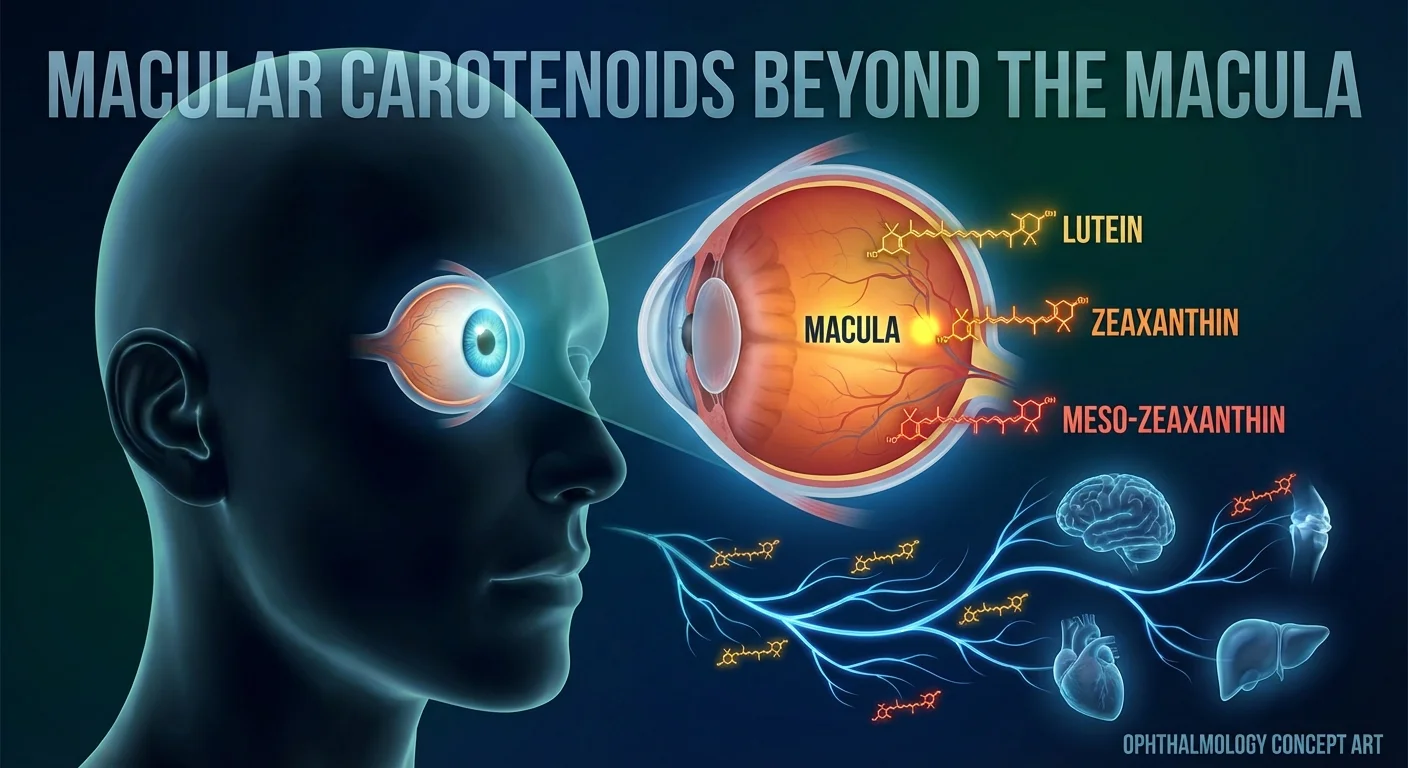
Macular Carotenoids (Lutein, Zeaxanthin, Meso-zeaxanthin) Beyond the Macula
Introduction: Lutein, zeaxanthin and meso-zeaxanthin are yellow-carotenoid pigments concentrated in the macula of the eye. Beyond filtering blue light in the retina, these macular carotenoids may affect visual and neural function more broadly – with potential relevance for glaucoma and aging. In glaucoma, early damage to retinal ganglion cells and their fibers impairs visual tasks like low-contrast and glare vision. Recent research has therefore explored whether boosting macular pigment (through diet or supplements) can improve contrast sensitivity, speed recovery from glare (photostress), and even neural processing efficiency. At the same time, lutein/zeaxanthin’s antioxidant and anti-inflammatory actions could protect retinal neurons and optic nerve tissue. We review the evidence linking these carotenoids to glaucoma-relevant vision metrics, to cellular stress in retina/nerve, and to broader benefits in aging – including cognition and cardiovascular health. Finally, we cover their absorption (bioavailability), dietary sources vs supplements, and safety profile.
Carotenoids and Visual Function
Macular carotenoids act as optical filters and antioxidants in the eye. By absorbing short-wavelength light and scavenging reactive oxygen species (ROS), they can improve visual performance. For example, higher macular pigment is known to improve contrast sensitivity and reduce glare in healthy eyes (pmc.ncbi.nlm.nih.gov). This occurs because dense pigment filters stray blue light, reducing intraocular scatter and enhancing the contrast of images on the retina. In one recent study, higher macular pigment density significantly improved contrast acuity and shortened recovery after a bright flash (photostress) (pubmed.ncbi.nlm.nih.gov). In a one-year trial of healthy adults, daily lutein (10 mg) plus zeaxanthin (2 mg) raised macular pigment and speeded recovery from glare: subjects cleared a bright light exposure faster and showed better color contrast compared to placebo (pubmed.ncbi.nlm.nih.gov). (In that study, reported glare disability also tracked pigment density, although supplementation did not produce a statistically significant change in glare threshold (pubmed.ncbi.nlm.nih.gov).)
In glaucoma specifically, patients often have reduced contrast sensitivity even before visual field loss is obvious. Macular lesions in glaucoma tend to spare central vision at first, but global visual quality suffers. It is plausible that enhancing macular pigment could help these patients tolerate glare or detect contrast better. Indeed, macular pigment’s filtering of blue light tends to improve contrast and diminish glare effects (pmc.ncbi.nlm.nih.gov). One glaucoma study noted that macular pigment improved “contrast sensitivity and glare disability” in healthy subjects, though its benefit in glaucoma (“glare disability in glaucoma”) may vary with lighting conditions (pmc.ncbi.nlm.nih.gov). Overall, data suggest that boosting lutein+zeaxanthin often leads to modest gains in real-world visual tasks. For example, in a large trial healthy subjects gained a significant advantage in color contrast tasks after one year of L/Z supplementation (pubmed.ncbi.nlm.nih.gov). These visual gains support the idea that improved glare recovery and contrast could be achieved in any visual system, including in glaucoma patients.
Beyond basic vision metrics, neural processing efficiency is another relevant endpoint. Visual information must be rapidly transmitted from the eye to the brain, and this process can slow with age or disease. Supplementation trials indicate that lutein and zeaxanthin can speed up certain neural responses. In a randomized study, young adults taking lutein+zeaxanthin showed faster visual processing: their critical flicker fusion thresholds improved, reaction times were shorter, and high-speed timing tasks were performed more accurately (pmc.ncbi.nlm.nih.gov). These findings suggest enhanced neural efficiency in visual-motor responses with higher carotenoid levels. By contrast (no pun intended), control subjects did not improve on those demanding timing measures. It is hypothesized that lutein/zeaxanthin may optimize synaptic connectivity or myelination in visual pathways, though precise mechanisms are still being studied (pmc.ncbi.nlm.nih.gov).
In sum, while direct trials in glaucoma patients are limited, the broader evidence is clear: higher macular pigment tends to improve contrast sensitivity and glare recovery, and supplementation can boost photostress recovery and visual processing speed (pubmed.ncbi.nlm.nih.gov) (pmc.ncbi.nlm.nih.gov) (pmc.ncbi.nlm.nih.gov). These improvements translate to better “real-world” vision, which is encouraging for aging eyes and disease states alike.
Retina and Optic Nerve: Oxidative Stress and Vascular Support
Glaucomatous damage involves stress on retinal ganglion cells (RGCs) and optic nerve fibers, partly driven by oxidative stress and blood flow deficits. Lutein and zeaxanthin’s antioxidant actions may therefore protect retinal neurons. In laboratory studies, lutein directly shields RGCs from damage: for instance, cultured RGC-5 cells exposed to hypoxic (low oxygen) or hydrogen-peroxide stress were rescued by lutein treatment (pmc.ncbi.nlm.nih.gov). In that study, lutein reduced intracellular accumulation of harmful H2O2 and superoxide radicals, preventing cell death (pmc.ncbi.nlm.nih.gov). Other carotenoids (like zeaxanthin and astaxanthin) have shown similar RGC-protective effects. Broadly, studies of retinal ischemia/reperfusion injury report that lutein curbs neuronal loss by quenching ROS and tamping down inflammation (pmc.ncbi.nlm.nih.gov). In animal models of retinal ischemia, lutein-treated eyes have smaller zones of degeneration and higher glutathione (a key antioxidant) levels than controls, indicating preservation of retinal neurons.
These findings imply that lutein/zeaxanthin can bolster the inner retina and optic nerve against oxidative insults – the same insults implicated in glaucoma. In practice, this could mean a slower progression of RGC loss or better functional resilience, though direct clinical proof is still emerging. Importantly, lutein and related carotenoids are known to cross the blood-retinal barrier and even reach the brain (pmc.ncbi.nlm.nih.gov) (pmc.ncbi.nlm.nih.gov), so their protective effects are not limited to the macula itself.
Vascular support is another mechanism. Healthy blood flow is crucial for optic nerve oxygenation and nutrient supply. Lutein has been found to assist vascular repair in eye models: in an oxygen-induced retinopathy model, lutein accelerated normal re-growth of retinal vessels and reduced leakage from damaged vessels (pmc.ncbi.nlm.nih.gov). While this model is of developing retinal vessels, it demonstrates lutein’s ability to promote physiological revascularization. In humans, epidemiological data also hint at vascular links: one study found that desirable retinal vessel traits (like wider arterioles and less tortuosity) were associated with higher serum lutein and zeaxanthin levels (pmc.ncbi.nlm.nih.gov). Because retinal vessel geometry often mirrors systemic vascular health, this suggests lutein intake may help maintain healthier microcirculation. The authors note that narrower or more tortuous retinal vessels — markers of poor microvascular health — were correlated with lower carotenoid levels (pmc.ncbi.nlm.nih.gov). Thus, high lutein/zeaxanthin status appears to be linked with a more favorable retinal vascular profile.
Taken together, the evidence indicates that macular carotenoids help retinal and optic nerve health by neutralizing oxidative stress and may support vascular integrity. In glaucoma, where oxidative damage and reduced perfusion contribute to ganglion cell death, these effects are potentially beneficial. Accordingly, boosting lutein/zeaxanthin could provide neuroprotection to glaucoma-relevant tissues.
Systemic Aging: Cognition and Cardiometabolic Health
Beyond the eye, lutein and its fellow xanthophylls are being studied for their broad health benefits in aging. One area of great interest is cognitive function. Lutein and zeaxanthin accumulate in the brain as well as in the retina, and observational studies have linked higher brain carotenoids with better cognitive performance. Randomized trials now suggest that supplementation can yield real gains. In one double-blind trial, community-dwelling older adults taking daily lutein+zeaxanthin showed improved cognition after one year. They significantly outperformed placebo on tests of complex attention and cognitive flexibility (executive function) (pmc.ncbi.nlm.nih.gov). There was also a trend toward better memory. In gender-specific analysis, supplemented men improved composite memory scores. The authors concluded that L/Z supplements improved cognitive performance in healthy older adults (pmc.ncbi.nlm.nih.gov). A separate trial in people with self-reported memory complaints found that L/Z boosted episodic (verbal) memory relative to placebo over six months (pmc.ncbi.nlm.nih.gov). Importantly, these neural gains mirrored rises in serum carotenoids and macular pigment, suggesting a systemic increase of L/Z in neural tissues. Summing up: lutein/zeaxanthin enriched diets or supplements have repeatedly shown positive effects on brain aging – enhancing attention, processing speed, and memory in elders (pmc.ncbi.nlm.nih.gov) (pmc.ncbi.nlm.nih.gov).
Cardiometabolic health is another critical aspect of aging where antioxidants like lutein may help. Oxidative stress and inflammation underlie atherosclerosis, metabolic syndrome and insulin resistance. Systematic reviews of nutritional studies have found that higher lutein intake or blood levels correlate with reduced cardiovascular risk. For example, a meta-analysis of dozens of studies reported that people with the highest lutein had about 10–20% lower risk of coronary heart disease and stroke than those with the lowest lutein (www.sciencedirect.com). This benefit likely comes in part from lutein’s ability to lower inflammation. The same analysis noted that lutein was associated with lower levels of C-reactive protein (CRP), a key marker of systemic inflammation (www.sciencedirect.com).
Even in metabolic disease, lutein appears protective. In a large study of Americans with metabolic syndrome, higher serum carotenoid levels were linked to lower all-cause mortality (pmc.ncbi.nlm.nih.gov). In fact, lutein/zeaxanthin emerged as one of the strongest predictors of survival. The study suggests that diets rich in these carotenoids (for example, green vegetables and eggs) could reduce mortality risk in at-risk adult populations (pmc.ncbi.nlm.nih.gov). This complements earlier findings that high carotenoid levels are associated with lower incidence of obesity-related conditions and better insulin sensitivity.
In short, macular carotenoids are not just eye pigments; they are systemic antioxidants. By quenching free radicals and dampening inflammation, they appear to support healthy aging in both brain and vascular systems. It is reasonable to think that these broad benefits of lutein/zeaxanthin – improved cognition and better cardiometabolic markers – derive from the same molecular actions that protect retinal neurons.
Bioavailability, Dietary Sources and Supplements
Lutein and zeaxanthin are fat-soluble carotenoids, so their absorption depends on dietary fat and formulation. In foods, these pigments are found in lipid-rich matrices (e.g. in egg yolk or the bilayer membranes of plants). As such, consuming them with a bit of fat (oil or egg yolk) markedly improves uptake. In contrast, taking a lutein pill on an empty stomach leads to poorer absorbance. Studies have quantified these effects: for example, one trial compared two supplement formulations and found that a starch-based (oil-matrix) lutein capsule yielded far higher blood levels than an alginate-based capsule (pmc.ncbi.nlm.nih.gov). This shows that supplement form strongly influences bioavailability. In practice, most commercial eye supplements encapsulate lutein/zeaxanthin in oil or micelles to maximize absorption.
Foods rich in macular carotenoids are mostly green or yellow plants (plus egg). Dark leafy vegetables stand out: kale, spinach, broccoli, peas and lettuce all contain substantial lutein/zeaxanthin (pmc.ncbi.nlm.nih.gov). Corn, pumpkin and eggs also contribute. Notably, egg yolk is a particularly bioavailable source because its fat content helps dissolve lutein (pmc.ncbi.nlm.nih.gov). In fact, chicken eggs have been called “better sources” of lutein/zeaxanthin than many fruits/vegetables due to this fat content (pmc.ncbi.nlm.nih.gov). Typical lutein content: boiled spinach or kale may contain ~11–18 mg per 100 g; egg yolks have a few mg per yolk depending on hen diet. A balanced diet with a cup of cooked spinach or kale and an egg can easily supply several milligrams daily.
Supplementation can provide higher doses than diet alone. For example, AREDS2 (a major eye health trial) used 10 mg lutein + 2 mg zeaxanthin daily. Clinical studies often use similar doses (10–20 mg lutein) with good effect (pubmed.ncbi.nlm.nih.gov) (pmc.ncbi.nlm.nih.gov). Real-world behavior studies show diet can influence macular pigment over months: one report found that adding spinach/kale to the diet for four weeks increased macular pigment optical density by about 4–5% (pmc.ncbi.nlm.nih.gov). This is a measurable gain, but much smaller than what supplements can achieve. Thus, both approaches raise tissue lutein: whole-food interventions slowly and holistically, supplements rapidly and predictably.
Safety and Tolerability
Lutein and zeaxanthin have excellent safety profiles. They are natural dietary components (e.g. in spinach and eggs) and have been given high consumption thresholds by regulators. The FDA recognizes lutein as Generally Regarded As Safe (GRAS) for use in foods. (pmc.ncbi.nlm.nih.gov) Typical diets in Western countries provide only about 1–2 mg per day (pmc.ncbi.nlm.nih.gov), whereas supplements often deliver 10 mg or more without issue. Clinical trials with up to 20 mg daily have reported no serious adverse effects attributable to lutein/zeaxanthin. In cognitive trials cited above, adverse events in the supplement group were no more common than placebo (pmc.ncbi.nlm.nih.gov). No changes in blood pressure or body weight were seen with months of L/Z intake (pmc.ncbi.nlm.nih.gov). The only minor effect sometimes reported is harmless yellow discoloration of the skin (carotenoderma) at very high intake, but this is reversible and not a sign of toxicity. Overall, researchers consider lutein and zeaxanthin extremely well-tolerated (pmc.ncbi.nlm.nih.gov) (pmc.ncbi.nlm.nih.gov).
Conclusion
In sum, macular carotenoids have promising roles beyond just the central retina. Boosting lutein and zeaxanthin intake – through diet or targeted supplementation – can enhance contrast sensitivity, speed glare recovery, and sharpen visual processing, effects which are relevant to glaucoma patients’ visual function (pubmed.ncbi.nlm.nih.gov) (pmc.ncbi.nlm.nih.gov) (pmc.ncbi.nlm.nih.gov). At a tissue level, these xanthophylls guard retinal neurons and optic nerve fibers against oxidative stress and support vascular health (pmc.ncbi.nlm.nih.gov) (pmc.ncbi.nlm.nih.gov) (pmc.ncbi.nlm.nih.gov). Systemically, they appear to favor healthier aging, improving cognitive performance in seniors and correlating with reduced cardiovascular/metabolic risk (pmc.ncbi.nlm.nih.gov) (www.sciencedirect.com) (pmc.ncbi.nlm.nih.gov). Lutein and zeaxanthin occur naturally in leafy greens, eggs and other foods, and are safe even at supplemental doses. The emerging picture is that carotenoids of the macula serve as protective “neuro-pigments” throughout the nervous and vascular systems, suggesting benefits for vision and health that extend well beyond the macula.