
Introduction
Low-carbohydrate diets (such as ketogenic diets) have become popular for weight loss and blood sugar control. These diets can significantly improve metabolic health by lowering insulin, blood sugar, and even blood pressure (pmc.ncbi.nlm.nih.gov) (pmc.ncbi.nlm.nih.gov). But for people with eye disease like glaucoma – especially the normal-tension type (NTG) – it is important to consider how major changes in diet and body chemistry might affect blood pressure patterns. In particular, doctors are paying attention to nocturnal hypotension (excessive night-time blood pressure drops) because the optic nerve is sensitive to low perfusion. Here we examine whether cutting carbs could alter the normal day-night blood pressure cycle and eye blood flow, and how to monitor these circadian changes safely. We will also weigh the potential benefits of better metabolic control against the risks of too-low blood pressure at night. Throughout, we rely on evidence from clinical studies and expert reviews (pmc.ncbi.nlm.nih.gov) (pmc.ncbi.nlm.nih.gov).
Low-Carbohydrate Diets and Blood Pressure
Low-carb diets (for example, very-low-calorie or “keto” diets) can improve metabolic markers. They often lead to weight loss, better blood sugar control, and reduced insulin levels (pmc.ncbi.nlm.nih.gov). Multiple studies have found that switching to a low-carbohydrate diet tends to lower blood pressure as well. For instance, in a trial of overweight adults with high blood sugar, a very-low-carb diet lowered systolic blood pressure by nearly 10 mmHg on average over four months – a greater drop than with a standard DASH-style diet (pmc.ncbi.nlm.nih.gov). This effect is likely partly due to losing water weight and salt (since low-carb diets can cause an initial diuresis) and partly due to overall improved cardiovascular health. In fact, one review notes that keto-style diets are specifically recommended by diabetes experts because they improve blood pressure as well as glycemic control (pmc.ncbi.nlm.nih.gov).
However, lowering blood pressure quickly can have side effects. When people start a ketogenic diet, many report what is colloquially called the “keto flu”: headaches, lightheadedness, and fatigue (www.frontiersin.org). These symptoms are thought to come from temporary fluid and electrolyte shifts (for example, losing more sodium and dropping blood pressure). In practice, this means that some people on a strict low-carb diet may feel dizzy or unusually tired, especially in the first weeks. For patients already on blood-pressure medications, this added effect can increase the chance of excessive hypotension (too-low blood pressure), especially at night. In summary, low-carb diets often improve blood pressure long-term (pmc.ncbi.nlm.nih.gov) (pmc.ncbi.nlm.nih.gov), but they can cause acute dips that should be monitored, especially in sensitive individuals.
Nighttime Blood Pressure Dips and Eye Health
Our blood pressure normally follows a day-night pattern: it dips during sleep and rises by morning. For most healthy people, night-time blood pressure falls by about 10–20% from daytime levels. This “nocturnal dip” is part of normal physiology. But exaggerated nocturnal dipping (for example, a drop much greater than 10–20%) can be risky for the eyes. The reason is ocular perfusion: the optic nerve and retina need a constant flow of blood. Ocular perfusion pressure (OPP) is roughly the difference between arterial blood pressure forcing blood into the eye and the pressure inside the eye (intraocular pressure, IOP) pushing back. At night, blood pressure goes down while IOP often rises, so OPP can fall to low levels.
Research has shown that excessive night-time hypotension is associated with glaucomatous damage. In fact, Hayreh and colleagues found that night-time drops in blood pressure can “reduce the optic nerve head blood flow below a critical level” and may play a role in glaucomatous optic nerve damage (www.sciencedirect.com). Studies in glaucoma patients support this: for example, a classic 1995 study (Graham et al.) performed 24-hour blood pressure monitoring on patients with open-angle and normal-tension glaucoma and found that those whose visual fields worsened had significantly larger night-time blood pressure drops than patients who remained stable (researchers.mq.edu.au). More recently, a comprehensive review concluded that in glaucoma patients the odds of visual field loss are much higher if night-time blood pressure dips are large (pmc.ncbi.nlm.nih.gov). In that review, patients whose systolic or diastolic blood pressure fell by more than 10% at night had roughly 3 times the odds of glaucoma progression over two years, compared to those without such dips (pmc.ncbi.nlm.nih.gov).
In short, nocturnal hypotension is a known risk factor for glaucoma progression. This is especially true in normal-tension glaucoma, where eye pressure is already in the normal range and fluctuations in blood flow are thought to drive damage. Choi and colleagues note that nightly blood pressure drops influence ocular perfusion pressure, and that large 24-hour OPP fluctuations are consistently linked to NTG development and worsening (pmc.ncbi.nlm.nih.gov). Denting the analogy of a garden hose, if the pressure to the eye drops at night while the “valve” (eye pressure) is relatively high, the optic nerve may be starved of blood. Patients with systemic hypertension who are over-treated with medications at night can have the same problem. Indeed, studies found that glaucoma patients on blood-pressure meds who experienced nocturnal hypotension had more advanced disease (pmc.ncbi.nlm.nih.gov).
Importantly, intraocular pressure itself varies with a circadian rhythm. Modern continuous IOP monitors have shown that most eyes reach their peak eye pressure outside of office hours. One implantable IOP sensor study found that 80% of observed peak IOP values actually occurred at night or early morning (www.sciencedirect.com). Thus, many people have high IOP coinciding with low blood pressure in the pre-dawn hours. A glaucoma expert summarizes this as a dangerous mismatch: “early in the morning, just before you wake up, is when your IOP is normally the highest – at the same time your blood pressure is usually the lowest, causing an imbalance in the blood supply to your eye” (www.reviewofophthalmology.com). Although healthy eyes can usually adapt to this fluctuation, the optic nerves of glaucoma patients (especially NTG) may not, making nocturnal hypotension a critical concern.
Capturing 24-Hour Patterns with Ambulatory Monitoring
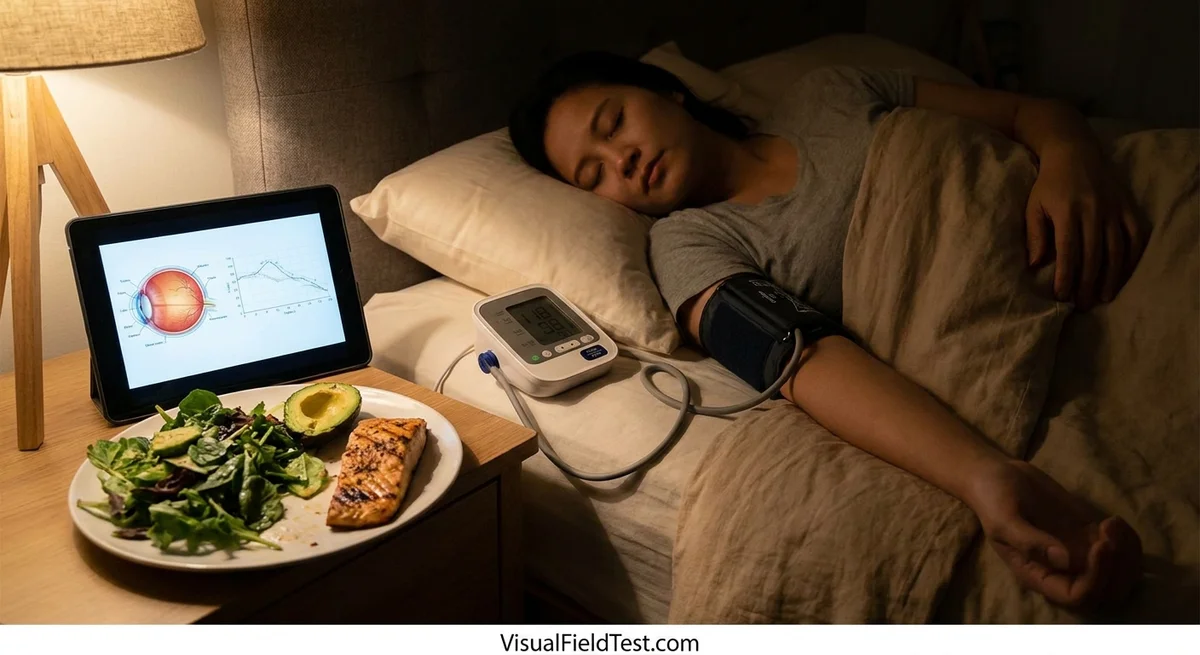
Given these circadian interactions, a key question is how to monitor both blood pressure and eye pressure around the clock. Clinically, this means using ambulatory blood pressure monitoring (ABPM) and something analogous for intraocular pressure. ABPM devices (wide belts or cuffs worn on the upper arm) are already used for 24-hour blood pressure profiles. They can record blood pressure every 15–30 minutes while a patient goes about normal activities and sleeps. For example, one glaucoma study used an automatic arm cuff to measure blood pressure every 30 minutes for 48 hours (www.reviewofophthalmology.com). In practice, wearing a blood pressure monitor overnight is well tolerated and has little risk. Analysis of ABPM data can reveal exactly how much someone’s BP dips when they sleep. Indeed, experts recommend 24-hour ABPM to assess glaucoma patients: it “can be performed to reveal the characteristics of circadian BP variability in subjects with glaucoma” (pmc.ncbi.nlm.nih.gov). In other words, using ABPM can identify if a patient is an extreme “dipper” (large nighttime fall) or “non-dipper,” both of which have different risks (pmc.ncbi.nlm.nih.gov) (pmc.ncbi.nlm.nih.gov).
For intraocular pressure, ambulatory monitoring is less common but emerging. Traditional IOP checks (Goldmann tonometry) only happen in the clinic and miss night-time peaks. New technologies allow more continuous IOP tracking. For example, an implantable IOP sensor (the EYEMATE-IO) placed during cataract surgery can report IOP measurements wirelessly on demand (www.sciencedirect.com). A review of this technology notes that it can obtain continual IOP readings. Contact-lens based sensors (not yet widely used clinically) are another approach. In research settings, combining ABPM with round-the-clock IOP recording has been done to calculate 24-hour ocular perfusion pressure. In principle, such combined monitoring would capture exactly how blood pressure and eye pressure interact over the day. While these methods are mainly research tools right now, they illustrate what is possible: by seeing both blood pressure and IOP curves together, one can see if OPP drops dangerously at night.
In summary, measuring circadian patterns may involve:
- Ambulatory Blood Pressure Monitoring: Wearable BP cuffs record blood pressure every 15–30 minutes over 24 hours, capturing daytime vs nighttime levels (pmc.ncbi.nlm.nih.gov) (pmc.ncbi.nlm.nih.gov).
- Continuous IOP Recording: Devices like implantable sensors or special contact lenses can capture intraocular pressure throughout the day and night (www.sciencedirect.com).
- Calculating Ocular Perfusion Pressure: Using the data above, clinicians can compute perfusion pressure (about mean arterial BP minus IOP) at every hour of the day. This directly shows if the optic nerve experiences low blood flow when asleep.
Together, these ambulatory methods could help doctors see whether a patient’s circadian profile is safe or worrisome, and might guide treatment decisions (for example, adjusting blood pressure medication timing).
Weighing the Risks of Hypotension Against Metabolic Benefits
For glaucoma patients considering a low-carb diet, the balance of risks and benefits depends on individual factors. On one hand, the metabolic improvements are clearly beneficial: lowering blood sugar, improving cholesterol, and reducing hypertension are all generally good for vascular health. A large meta-analysis found that having metabolic syndrome (high blood pressure, high blood sugar, excess waist fat, etc.) increases glaucoma risk by about 34% (dmsjournal.biomedcentral.com). In that study, high blood pressure and high blood sugar were the strongest drivers of risk (dmsjournal.biomedcentral.com). Thus, anything that safely improves these factors – including diet and weight loss – could indirectly slow glaucoma damage, by keeping eye blood vessels healthier in the long run. For example, better-controlled diabetes means fewer blood vessel injuries overall, and reducing hypertension (without overshooting) can help oxygen delivery.
On the other hand, if blood pressure is lowered too much at night, it could potentially worsen glaucoma, especially NTG. This risk is highest for patients who already tend to dip a lot at night, or who are on medications that further lower blood pressure at bedtime. In NTG, the optic nerve is thought to be especially sensitive to low perfusion. In practical terms, an NTG patient on a vigorous low-carb diet might experience an added nocturnal BP drop from weight loss and dietary changes. If that patient is also taking antihypertensive pills in the evening (a common practice), the combined effect might push the nighttime blood pressure below a safe threshold. The studies discussed above suggest that excessive hypotension at night can be a final insult to the optic nerve (www.sciencedirect.com) (pmc.ncbi.nlm.nih.gov).
Importantly, “overly aggressive” blood pressure lowering seems particularly risky in older people or those with compromised blood flow. For example, evidence in hypertension shows that treatment that lowers diastolic BP too low (below 90 mmHg) is associated with worse optic nerve head results, even if daytime BP is normal (pmc.ncbi.nlm.nih.gov). In other words, the goal is moderation: we want to avoid sustained night-time pressures dropping to dangerously low levels.
Fortunately, low-carb diets often improve metabolic health gradually, allowing time to adjust medications and hydration. Patients considering such diets should do so under medical guidance: if blood pressure medications are reduced appropriately as weight falls, the risk of a “double dip” at night (diet + meds) can be minimized. In practice, one might lower antihypertensive doses (as advised by a doctor) when starting a diet, especially if daytime blood pressure is already normalizing.
In summary, for most glaucoma patients the metabolic benefits of better weight and diabetes control with a low-carb approach are real and helpful. However, those with NTG or known extreme dipping should be cautious. The key is awareness: if a patient notices symptoms of low blood pressure (lightheadedness, blurred vision, unusual fatigue) especially at night or early morning, they should have their doctor check their ambulatory blood pressure. Adjusting the timing of medications (for example, taking blood pressure pills in the morning rather than at bedtime) or ensuring adequate fluid/salt intake can help protect the optic nerve.
Special Considerations: Blood Pressure Medications and Autonomic Function
Certain subgroups of patients deserve extra attention. Antihypertensive medications can both help and hurt glaucoma risk. On the positive side, treating high daytime blood pressure can improve overall vascular health. On the negative side, some drugs (especially if taken at night) can cause an excessive drop in BP during sleep. A review of glaucoma risk factors notes that antihypertensive treatment is a major cause of non-physiologic hypotension (pmc.ncbi.nlm.nih.gov). In fact, it cites that antihypertensive drugs may widen blood pressure fluctuations and ocular perfusion swings, especially in people with autonomic dysfunction (pmc.ncbi.nlm.nih.gov). Clinically, this has been seen: for similar nocturnal dips, patients on blood pressure meds had more glaucomatous progression than untreated ones (www.reviewofophthalmology.com) (pmc.ncbi.nlm.nih.gov). This means doctors should consider medication timing: for example, avoiding all-night coverage if it risks too-low pressures.
Another factor is autonomic function. The autonomic nervous system normally helps regulate blood pressure and blood vessel tone when we stand, exercise, or sleep. Some patients – such as those with diabetic neuropathy or other dysautonomia – have an impaired ability to keep blood pressure steady. In these individuals, night-time blood pressure can swing more dramatically. Diet changes (like a low-carb diet lowering insulin) might further stress their autonomic regulation. Although we lack large studies in glaucoma specifically, it is known in cardiovascular medicine that patients with autonomic failure often experience exaggerated BP drops during sleep (pmc.ncbi.nlm.nih.gov) (pmc.ncbi.nlm.nih.gov). Therefore, if a glaucoma patient has known autonomic issues (for example, significant orthostatic hypotension or autonomic neuropathy from diabetes), one should be especially cautious about combining multiple BP-lowering strategies. Such patients may need more frequent monitoring (like regular home BP checks or even ambulatory studies) when starting a new diet or medication.
In practice, a subgroup analysis of patients could be useful in future research: comparing those on antihypertensive therapy versus not, and those with normal vs abnormal autonomic responses. But while awaiting more data, the prudent approach is to monitor these higher-risk groups carefully.
Conclusion
In conclusion, low-carbohydrate diets can yield important health improvements — lower blood sugar, better weight, and often lower blood pressure — which indirectly benefit the eyes. However, for glaucoma patients (especially those with normal-tension disease), we must beware of the “nighttime blood pressure factor.” Excessive drops in blood pressure during sleep can reduce ocular perfusion to dangerous levels, potentially worsening optic nerve damage (www.sciencedirect.com) (pmc.ncbi.nlm.nih.gov). To manage this, clinicians are increasingly recommending 24-hour monitoring of both blood pressure and eye pressure. An ambulatory blood pressure monitor can catch hidden hypotension, and emerging tools (like implantable or contact-lens IOP sensors) can reveal nocturnal IOP spikes. By examining these data together, doctors can tailor treatment — for example, adjusting medication timing or dietary salt — to keep night-time blood pressure within a safer range without losing the metabolic gains of dieting.
Both patients and doctors should be aware of this balance. If you or a loved one with glaucoma try a low-carb diet, mention it at your next eye appointment. You might be advised to do home blood pressure checks or even a 24-hour ABPM test, especially if you feel lightheaded when standing or waking up. With good monitoring and communication, it is possible to enjoy the benefits of improved metabolism while minimizing the risks of nocturnal hypotension. Ultimately, careful attention to the body’s circadian patterns can help ensure that improving one aspect of health (metabolic control) does not inadvertently harm another (optic nerve perfusion).
Sources: Recent reviews and studies of glaucoma and blood pressure (pmc.ncbi.nlm.nih.gov) (pmc.ncbi.nlm.nih.gov), clinical trials of low-carbohydrate diets in hypertension (pmc.ncbi.nlm.nih.gov) (pmc.ncbi.nlm.nih.gov), and reports on circadian IOP and ABPM in glaucoma (www.sciencedirect.com) (researchers.mq.edu.au) inform these recommendations.