
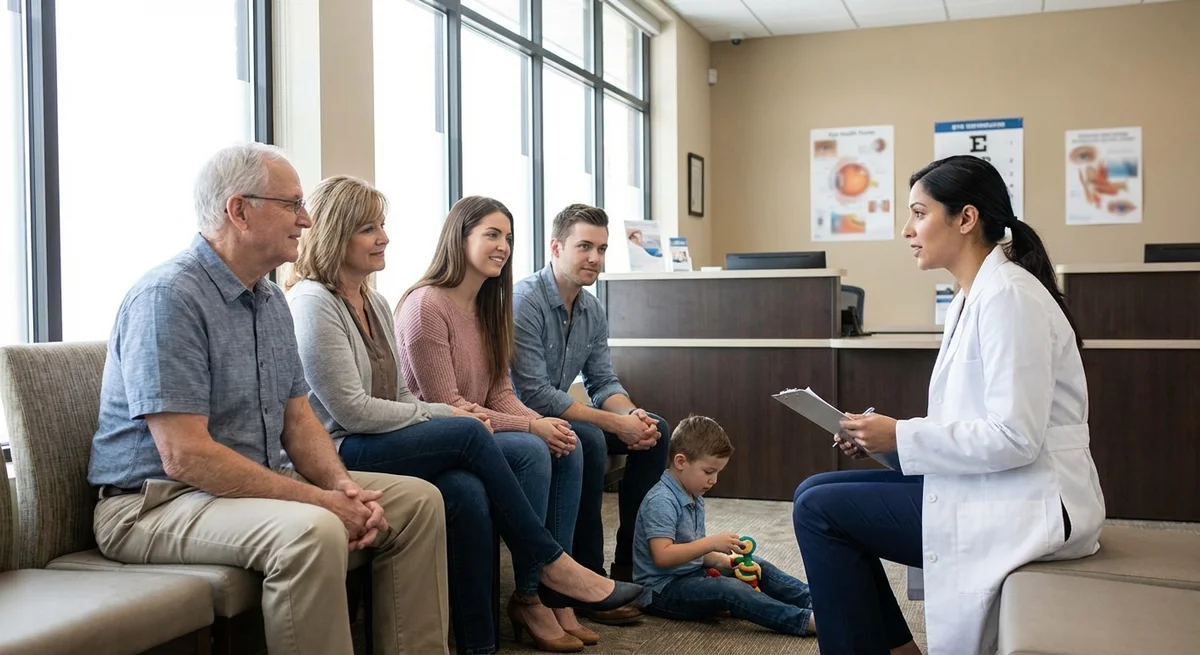
Why family history matters so much in glaucoma
Glaucoma is an eye condition that can quietly damage the optic nerve – the nerve that sends vision signals to the brain. Often there are no early symptoms, so people don’t notice any vision loss until late. Because of this, knowing your risk is very important. One big risk factor is family history. In fact, doctors say glaucoma often runs in families. Genetic studies suggest that more than half of glaucoma cases are due to inherited factors (glaucoma.org). That means if someone in your close family has glaucoma, your own risk goes up. An eye-care society notes that if a parent, brother, sister, or child (called an immediate family member) has glaucoma, you are about 10 times more likely to get glaucoma yourself (www.americanglaucomasociety.net).
Importantly, having a family history doesn’t guarantee you will get glaucoma, and not having a family history doesn’t guarantee you won’t. It’s a risk factor, not a certainty. For example, one review found that first-degree relatives of glaucoma patients had an estimated 22% lifetime risk of glaucoma, compared to only about 2% in people without any family history (journals.lww.com). In another screening study, about 15% of siblings of glaucoma patients had glaucoma, and 20% of parents did, while only 4% of children (often still young) were diagnosed (pmc.ncbi.nlm.nih.gov). These numbers show higher risk for close relatives, especially siblings and parents, but still a majority of relatives might not have it. Other factors also affect risk – for example, older age or certain ancestries can raise glaucoma risk too (www.americanglaucomasociety.net). In short, family history is important because it raises your chances, but it’s one of several factors.
What recent research shows about family risk
A report published in March 2026 summarized many studies on this topic. That review found that a large fraction of relatives of glaucoma patients show signs of the disease. For example, one study of family members found 8.3% of relatives already had glaucoma and another 19.2% were “glaucoma suspects” (meaning they had early warning signs) (pmc.ncbi.nlm.nih.gov). Altogether, that’s about 27% of relatives with disease or suspected disease. In another clinic study, 13.3% of screened relatives had confirmed glaucoma (pmc.ncbi.nlm.nih.gov). Putting these together, the review concluded that roughly one quarter to one third of close relatives may be affected or at high risk.
In practical terms, this means that if you learn a family member has glaucoma, doctors advise that other first-degree relatives – especially siblings – pay attention. The latest research underscores that checking relatives can find many cases early, because one in four or one in three is a much higher count than would be found by chance. Underlying this is the fact that glaucoma has up to 70% heritability (journals.lww.com), meaning much of the risk is passed along family lines.
Why screening family members is important
Glaucoma can slowly steal sight without you noticing. Many people call it a “silent thief of sight.” Surveys estimate nearly half of people with glaucoma don’t know they have it (glaucoma.org). The damage is permanent once it occurs, so the key is catching glaucoma early before vision is lost. Early treatment with prescription eye drops, laser or surgery can slow or stop the disease and protect vision (www.americanglaucomasociety.net). For this reason, screening family members of glaucoma patients is very helpful.
By telling your relatives about a glaucoma diagnosis, you give them a chance to get checked before any symptoms. The American Glaucoma Society reminds us that finding glaucoma early “can make a real difference” because treatment can prevent worse vision loss (glaucoma.org) (www.americanglaucomasociety.net). In short, family screening is important because it tends to catch high-risk people before they lose vision. If everyone waited for symptoms (like blurry vision or tunnel vision), it would often be too late to fully save their sight. Regular exams for at-risk relatives help catch problems when doctors can still protect the eyes.
The limits of current screening
It’s important to understand that glaucoma screening isn’t a single quick test. A doctor must do a comprehensive eye exam, which usually includes several parts. For example, your eye doctor will measure the pressure inside each eye, look closely at the optic nerve for damage, and check the side vision in each eye (www.americanglaucomasociety.net). They may also take special photos or scans of the optic nerve to track any changes over time. All these pieces together can find glaucoma early.
No single test is perfect. Eye pressure can be normal in some kinds of glaucoma, and optic nerve changes can be subtle at first. Because of this, screening often requires a combination of tests and sometimes repeating them over time. Even so, in practice, screening only close relatives will still miss some people. (Experts note that if we screened just family members, we’d still “miss over half” of all glaucoma cases, because many people with glaucoma have no known family history (journals.lww.com).) This means it’s wise not only to rely on family screening but also on general eye exams, especially as people age.
Who should be extra careful
If someone in your family has glaucoma, first-degree relatives should pay attention. First-degree relatives means your parents, full siblings, and children. These people share the most genes and have the highest risk. Research shows siblings with an affected brother or sister face the biggest jump in risk (glaucoma.org). In practice, this means:
- Siblings of a glaucoma patient should have regular eye checks, especially as they get older. (In one study, 15% of siblings screened already had glaucoma (pmc.ncbi.nlm.nih.gov).)
- Parents and children of a glaucoma patient also have higher risk, so they should be tested too. In that same study, 20% of parents had glaucoma (pmc.ncbi.nlm.nih.gov). (Children often are younger and may not develop it until later, but they should still be aware.)
If you’re a child or grandchild of a glaucoma patient, your risk is higher than average but often lower than siblings or parents. Doctors often recommend that adult children start getting screened by age 40 (or earlier if glaucoma appeared young in the family). Relatives who are over 60 or of certain ancestries (African American, Latino, etc.) should be especially vigilant (www.americanglaucomasociety.net).
Getting the right eye exam
When you talk to a doctor, be sure to ask for a glaucoma screening exam or comprehensive eye exam. A routine eye check for glasses may not include all the needed tests. A thorough exam should include:
- Eye pressure test (tonometry). A puff of air or a quick gentle touch measures the pressure inside your eyes.
- Optic nerve check. The doctor will put drops in your eyes to dilate (widen) your pupils and shine a light to view the optic nerve in the back of the eye. They look for any thinning or changes.
- Visual field test. This checks for any blind spots in side vision, which can show early loss from glaucoma.
- Imaging or photography. Many eye doctors take pictures or scans of the optic nerve (using tools like OCT) to compare over time.
You can say: “A close family member has glaucoma – can you do a full glaucoma check?” This tells the eye doctor to include all of the above. Usually an ophthalmologist (a medical eye doctor) does this kind of exam. The American Glaucoma Society advises people with risk to be tested by an ophthalmologist or a well-trained optometrist every 1–2 years. Early detection means a better chance to keep vision safe (www.americanglaucomasociety.net) (www.americanglaucomasociety.net).
What families should do now
If a family member has just been diagnosed with glaucoma, here are some practical steps for everyone:
- Talk about it. Let relatives know that glaucoma runs in families. When everyone is aware, they can take action. A family gathering is a good time to remind each other about eye health (glaucoma.org).
- Schedule eye exams. Encourage siblings, parents, and children to get a comprehensive eye exam soon. You might even help make appointments or look up programs for low-cost exams. The American Glaucoma Society and other groups can often guide you to free or affordable screenings if needed (www.americanglaucomasociety.net).
- Mention the family history. When a relative goes for an exam, have them say “I have a family history of glaucoma” so the doctor knows to check carefully.
- Keep regular check-ups. Even if the first screening is normal, future eye exams are still important. Glaucoma can develop slowly, so checking every 1–2 years is wise.
- Stay informed. Use trusted resources (like the American Academy of Ophthalmology or Glaucoma organizations) to learn about glaucoma.
These steps can help protect everyone’s eyesight. Early action can catch problems while they can still be treated. Working together as a family can make it easier: schedule exams together or remind each other of appointments, for example.
What patients can tell their relatives after a glaucoma diagnosis
After someone in your family is diagnosed, they can gently encourage others by saying things like:
- “I just found out I have glaucoma. It often runs in families, so I want you to get your eyes checked too.”
- “Doctors say each of you is at higher risk, even if you feel fine. We catch it early, the better your chances of keeping vision.”
- “I’m visiting the eye doctor on [date] for a full glaucoma screening exam. Would you come with me or make an appointment too?”
- “Glaucoma has no early warning signs. You might not know you have it unless you get tested.”
Keeping the tone positive and caring helps. Emphasize that you’re sharing this information to help them, not to worry them. You might point out that catching glaucoma early is the best way to save sight. Let them know they can mention your case at the eye doctor and that you’ll support them in getting checked. Every family member who is screened and treated if needed has a chance to maintain healthy vision.
What you say can literally be the “gift of sight” to your loved ones – helping them know they could be at risk and encouraging them to act before any vision is lost (glaucoma.org) (www.americanglaucomasociety.net).