
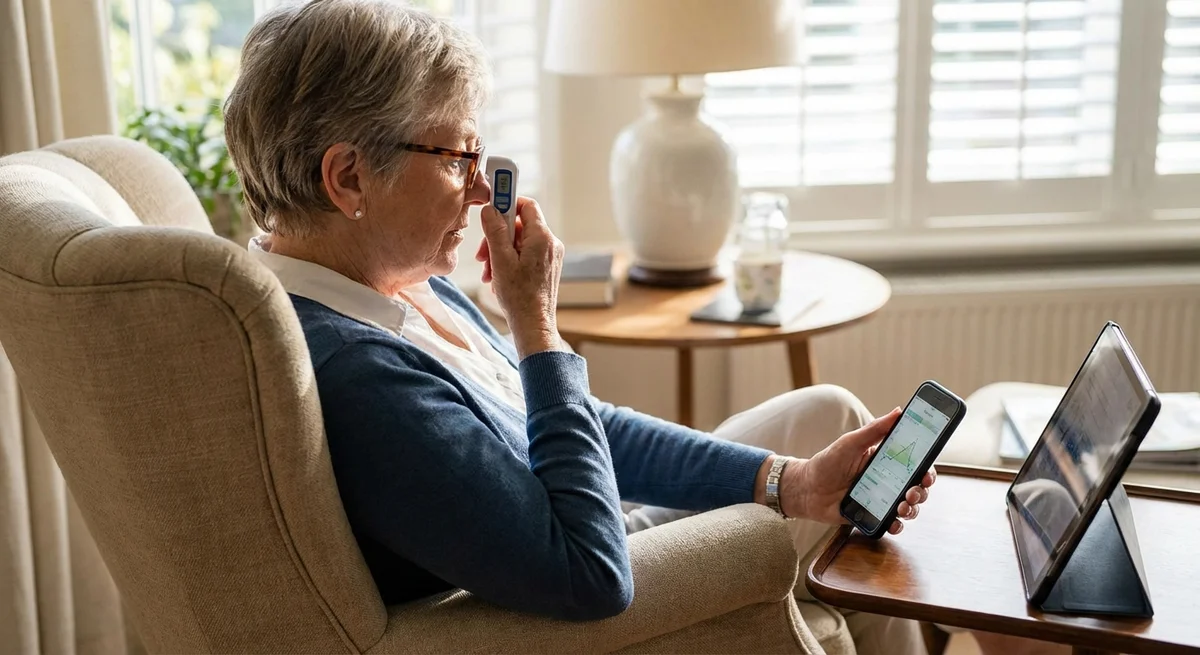
Home Tonometry and Remote Monitoring in Glaucoma – A Patient-Centered Investigation
Glaucoma care has traditionally relied on eye clinic visits every few months to check intraocular pressure (IOP). But IOP actually goes up and down over the day and night. In fact, studies show that a single office measurement misses the true peak pressure most of the time (pmc.ncbi.nlm.nih.gov). These hidden spikes may contribute to glaucoma progression. New handheld devices let patients measure their own IOP at home. For a patient, this could mean a more complete picture of their eye pressure, potentially catching worrisome rises early. In this article, we review how these home tonometry tools work, what it’s like to use one, and whether the extra data helps protect vision – as well as practical issues like cost, training, and the patient experience.
Home IOP Monitoring Devices on the Market
The main type of home tonometer approved for patients is the rebound tonometer. Instead of the clinic “puff” or a weighted cuff, a rebound tonometer uses a tiny probe that bounces off the cornea and measures the IOP from the rebound speed. Two examples are:
-
iCare HOME – This is a FDA-cleared, hand-held rebound tonometer approved for patient use. The device uses a disposable probe and magnetic launch system. When ready, it emits a short magnetic pulse sending the probe toward the eye. The probe touches the cornea and rebounds back. A built-in sensor calculates IOP from how fast the probe rebounds (pmc.ncbi.nlm.nih.gov). No numbing drops are needed (the probe impact is so quick it’s usually painless). The iCare HOME has adjustable forehead and cheek rests to help the patient hold it in the right position, and lights on the probe base that show green when alignment is correct (pmc.ncbi.nlm.nih.gov). The patient pushes a button when the device is aligned, which triggers six quick readings. The final IOP is the average of those readings (dropping the highest and lowest of the six) (pmc.ncbi.nlm.nih.gov).
-
Tono-Vera (Reichert Tono-Vera) – This is a newer clinically-approved tether-free rebound tonometer (about $800) that offers a live camera view of the eye to guide proper alignment. Like iCare, it uses a micro-probe and automatic measurements without anesthetic. It displays readings immediately and color-codes their reliability on the screen. This device is typically marketed to doctors, but its portable design could also allow home use with training.
Other approaches exist but are less common for home use. For example, Sensimed Triggerfish is a contact-lens sensor used in specialized settings. A soft lens embedded with strain gauges continuously records tiny eye shape changes over 24 hours, giving a pressure pattern rather than an absolute mmHg reading (www.sensimed.ch). It is FDA-cleared for research and some clinical use, but it is bulky (one-use, overnight device) and doesn’t show a straightforward pressure number. It is currently not something a patient buys for daily home checks, but it illustrates the push toward around-the-clock monitoring. (Similarly, experimental implantable sensors are under development.)
In practice today, if a doctor wants a patient’s home IOP, they usually prescribe or loan an iCare HOME tonometer (including its new-generation “HOME2” model). Companies like MyEyes sell or rent these devices to patients. The iCare HOME2 links to a smartphone app or cloud service (for uploading data), and even the original HOME requires docking at a clinic computer to download readings. Some clinicians buy one unit to loan to multiple patients short-term (say 1–2 weeks) when more pressure data is needed.
Using a Home Tonometer: The Patient Experience
Learning and Operating the Device
Before using a home tonometer unsupervised, patients must be trained. The iCare system requires a certified demonstration: the patient typically sits in the clinic, learns to hold the device, and performs a few self-readings under supervision. The exam room Goldmann tonometry is compared to the patient’s readings to ensure they match within a few mmHg (pmc.ncbi.nlm.nih.gov). Training includes sizing the adjustable headrests for that person’s forehead/cheek distance (pmc.ncbi.nlm.nih.gov) and coaching the hand movements. Many patients then practice for a day or two.
Real-world users report that with this hands-on learning, most people quickly become comfortable. In one small trial, patients reported needing only about 3 days of practice to reliably use the iCare HOME on their own (pmc.ncbi.nlm.nih.gov). By the third day, most could align and take the measurements in under 5 minutes. Interviews with patients found that 75% rated the device “moderately” or “very easy” to use (pmc.ncbi.nlm.nih.gov). About 88% of patients in that study could perform measurements completely independently (reading the lights and beeps properly without another person’s help) (pmc.ncbi.nlm.nih.gov). Most patients (94%) found it comfortable rather than painful (pmc.ncbi.nlm.nih.gov), and nearly everyone said they would be willing to use it again for ongoing monitoring (pmc.ncbi.nlm.nih.gov).
Some hurdles exist. Aligning the tonometer perfectly can take practice, especially for older patients or those with vision loss. Patients sometimes had trouble seeing the device’s tiny lights in dim rooms, or understanding its beeps when an error occurs (pmc.ncbi.nlm.nih.gov). (For example, different beep patterns mean “too close” or “too far” from the eye.) Early versions of the iCare HOME had no display showing the result; patients complained they were “highly curious” about their own IOP but couldn’t see the number (pmc.ncbi.nlm.nih.gov). The bright green LED on the probe and quick beeps did give feedback. (The latest HOME2 version now uses a smartphone app to show readings and can alert patients if their IOP goes above a preset limit (pmc.ncbi.nlm.nih.gov), addressing that concern.) In general, initial discomfort can happen if many attempts are needed – holding the device steady can be fatiguing. But in studies, by the end of training most people found the process “moderately” or even “very” comfortable (pmc.ncbi.nlm.nih.gov).
Patients measure their IOP at home more frequently than during a clinic day. In research, typical participants measured each eye about four times per day on average (pmc.ncbi.nlm.nih.gov). Patients chose a schedule (morning, midday, evening, etc.) often guided by medication timing. In practice, doctors may ask patients to measure before and after taking drops, or when bedtime, to map the diurnal curve. Patients record the date and time of each reading with the device (or in the app). Some doctors even have patients keep a diary of activities (like medication times, exercise, sleep) alongside the IOP logs (pmc.ncbi.nlm.nih.gov). This helps interpret the readings (for example, a spike after missing a dose).
How Accurate Are Home Readings?
The gold-standard in-clinic test for IOP is Goldmann applanation tonometry (GAT), done by a doctor. Every home device is compared to GAT to ensure it’s trustworthy. Overall, studies show that the iCare HOME readings are reasonably close to Goldmann measurements, though not identical. One systematic review found that on average the iCare HOME reads about 1 mmHg lower than a Goldmann tonometer (pmc.ncbi.nlm.nih.gov). In most normal pressure ranges (e.g. 10–18 mmHg), the readings agree very well. In hundreds of comparisons across patients, the median difference was only about 1 mmHg (with 95% of differences roughly between –2.7 and +2.1 mmHg) (pmc.ncbi.nlm.nih.gov). In other words, if the clinic reads 14 mmHg, the iCare might read 13 or 14 or 15 – usually within a couple mmHg.
Some situations can affect accuracy. Very low pressures (below ~10 mmHg) or very high pressures (above ~23 mmHg) can sometimes be off by several mmHg (pmc.ncbi.nlm.nih.gov). Thin or thick corneas can also skew results because rebound devices (like any tonometer) are influenced by corneal properties. In fact, manufacturers recommend iCare HOME only for corneal thickness between about 500–600 μm; outside this range the readings may be less reliable (pmc.ncbi.nlm.nih.gov). Complex eye conditions (like after certain surgeries) might also affect probe alignment and results.
Crucially, however, studies show home readings by patients are highly reproducible when done correctly. In one large trial of 61 patients, the iCare HOME was able to capture readings consistently 82.5% of the time (median success rate), with some patients getting usable readings almost every try (pmc.ncbi.nlm.nih.gov). With good training, even older patients can use it reliably. Some early research found similar results to clinic measurements for the same eye measured within minutes of each other by patient versus doctor. Bottom line: home IOP checks give a faithful estimate of real eye pressure if used properly, with only a slight average underestimation.
What Does the Extra Data Tell Doctors?
The main reason patients measure IOP at home is to see patterns the clinic visit missed. A growing number of studies suggest that knowing these patterns can be clinically useful:
-
Detecting hidden IOP peaks. Routine clinic checks are usually done during office hours. Yet many people’s IOP spikes at night or early morning. In one retrospective study of 107 eyes, home monitoring found that half the days had the daily maximum pressure occurring outside normal office hours (pmc.ncbi.nlm.nih.gov). In fact, roughly a quarter of days had the peak pressure between 4:30–8:00 AM, a time most patients are sleeping. Over the week of monitoring, about 44% of patients had a home-measured peak that was higher than any of the previous clinic readings, and 31% had peaks that exceeded their doctor’s target by at least 3 mmHg (pmc.ncbi.nlm.nih.gov). In other words, a significant number of patients have “spikes” that the doctor never saw in the clinic. Catching those spikes early could explain why some people still lose vision despite apparently fine clinic results.
-
Guiding treatment changes. If home monitoring reveals occult high pressures or unusually large fluctuations, it often prompts doctors to change therapy. For example, one group used the iCare HOME to check pressures over 3 days in patients with normal-tension glaucoma (glaucoma without high pressures). They found many spikes that were not seen at the office, and as a result changed treatment in 56% of patients (for example by adding drops or recommending surgery) based on the home readings (pmc.ncbi.nlm.nih.gov). In another case series, clinicians described 12 patients whose home IOP profiles before and after interventions (laser or surgery) gave a clearer picture of how effective the treatment was. In one patient, home monitoring showed a high early-morning spike every day that was missed in clinic; after surgery those spikes vanished, confirming success (pmc.ncbi.nlm.nih.gov). Conversely, one patient’s home chart showed only a slight drop in pressure after a procedure, suggesting the need for more aggressive therapy.
-
Confirming stable control or progression. A 2019 study taught 94 glaucoma patients to self-measure for 3 days and then looked at which eyes had worsened over years. Eyes that later progressed had higher average pressures, higher peaks, and a wider range of pressure during those home checks than eyes that stayed stable (pmc.ncbi.nlm.nih.gov). This suggests that frequent high readings and bigger swings could predict worsening disease. While this does not prove home monitoring prevents vision loss, it does show that home data can reveal risk factors missed by occasional clinic checks.
-
Improving patient-doctor discussions. Perhaps just as important, patients often use the data in conversation with their doctors. Many report they feel reassured that their doctor now “has all the facts.” Clinics that do home monitoring usually review the pressure log with the patient at follow-up. In practice, some ask the patient to note the time of each drop and activity so the doctor can see if, for example, a hike or missed medication corresponds to a pressure spike (pmc.ncbi.nlm.nih.gov). This shared review can make visits more data-driven. In one report, patients consistently voiced appreciation for having more data points to track their disease (pmc.ncbi.nlm.nih.gov).
-
Psychological benefit. Many patients simply feel safer and more involved with home measurements. In a feasibility study using iCare HOME and a virtual-reality visual field kit for at-home testing, 73.7% of patients said the iCare device was easy to use and 100% found it useful (www.sciencedirect.com). Interviewees in that study said home monitoring gave them “a heightened sense of security and insight” into their chronic eye disease (www.sciencedirect.com). In other words, they felt empowered rather than anxious by knowing their numbers.
On the flip side, no large clinical trial yet shows that home monitoring definitively reduces vision loss compared to standard care. Insurance policies note that “no studies are available… that compare progression rates” for tracked vs. untracked patients (www.anthem.com). In fact, an insurer’s policy in 2025 called home tonometry “investigational” and not proven to improve net outcomes (www.anthem.com). However, experts argue that for individual patients it can make a big difference – especially those who are still worsening despite “normal” clinic pressures. In summary, home IOP data often changes clinical decisions at the bedside, but strong proof of long-term benefit is still accumulating.
Practical Considerations
Cost and Access
A major question for patients is who can realistically use these devices. The iCare HOME tonometer carries a high price tag. Retail cost is on the order of $1,500–$2,000 for the handheld unit (www.thepricer.org) (dgital health sites report prices around $1,550–$1,850). Disposable single-use probes are needed for each shot; a pack of 24 probes might cost another $40–$60 (www.thepricer.org) and lasts for only a week or two of testing. So the initial investment is substantial.
Because of this, rental programs have emerged. In the U.S., for example, the company MyEyes offers iCare HOME devices for patients to rent. The Glaucoma Foundation partnered with Santen to fund grants that let qualifying low-income patients borrow an iCare HOME for about two weeks at a time (myeyes.net). MyEyes’ website shows that patients (with a doctor’s prescription) can upload payment online and have the device shipped. A typical rental period is 1–2 weeks, which includes enough probes for unlimited testing during that time (myeyes.net). (When finished, the patient mails it back and the company sends the IOP report to the patient’s doctor.) Some providers also loan their own clinic’s device to patients briefly, especially after surgery, so the patient can track healing pressures at home.
Insurance coverage for the device itself is generally not available. As of early 2023, major insurers like Medicare did not reimburse the purchase of a home tonometer (www.ophthalmologymanagement.com). Private policy documents (for example, Anthem BCBS in 2025) deem it experimental and say it is not covered (www.anthem.com). However, some tax-advantaged plans allow patients to pay with pre-tax dollars. iCare devices qualify as durable medical equipment (DME), so if you have a Flexible Spending Account (FSA) or Health Savings Account (HSA), you can often use those funds (www.ophthalmologymanagement.com). Patients have reportedly used FSA money or third-party financing ($100/month plans) to afford iCare units.
Training and Support
Effective use requires upfront training. Clinics typically provide a one-on-one session with a technician or specialist. After initial training in the office, patients “therefore become more proficient in about 3 days” of actual home use (pmc.ncbi.nlm.nih.gov). Written handouts and online videos further help. The MyEyes rental includes instructions and even offers optional video tutorials or phone help by eye-care “ambassadors” to coach patients remotely (www.ophthalmologymanagement.com). No anesthetic is needed, and the probes come sterile – so after training, patients can do the test themselves much like a home blood pressure check.
For both doctors and patients, a realistic plan is needed. Doctors usually tell patients not to stop glaucoma drops, and to measure under consistent conditions (standing upright, for instance, since lying down can raise IOP). To avoid confusion, some practices recommend measuring after drops, or at set times relative to doses, and recording the info.
Data Use and Telemedicine Integration
Once pressures are measured at home, the data must be reviewed. Early iCare models required patients to return the device to the clinic (or ship it back to the provider) so that the stored measurements could be downloaded via a computer program (pmc.ncbi.nlm.nih.gov). (Newer models like iCare HOME2 can sync in real time via Wi-Fi to a secure cloud or app.) Either way, doctors examine the log of times and IOP readings on their computer and discuss it with the patient. This can guide whether treatment should be intensified or is working.
Telemedicine platforms are starting to incorporate such data. Some vision clinics are setting up remote patient-monitoring (RPM) services for glaucoma. For example, ophthalmologists may bill Medicare using general remote monitoring codes when they review a patient’s home IOP chart outside a visit (www.ophthalmologymanagement.com). In the future, one can imagine home IOP data flowing into an app; integrated with virtual visits and alerts if pressures breach targets. Development is underway: the iCare HOME2’s new software allows providers to set upper limits and receive email alerts if a patient’s readings exceed those limits (pmc.ncbi.nlm.nih.gov).
When used together, home tonometry and telemedicine can help manage patients in between clinic visits. For example, if a patient’s pressure spikes unexpectedly, the eye doctor might adjust drops via a video call or phone, rather than waiting for the next scheduled appointment. This could speed up care and reassurance for the patient. We are still early in this process, but both technology and health systems are moving toward more remote glaucoma monitoring.
Psychological and Behavioral Impact
An important question for patients is how it feels to check your own eye pressure multiple times a day. Studies so far suggest most patients find it empowering. In surveys, glaucoma patients said they felt more in control and informed by doing home measurements. One small study reported that nearly everyone who tried home IOP checks mentioned feeling motivated and curious about the results (pmc.ncbi.nlm.nih.gov). A common sentiment was that having more data “allowed [patients] a heightened sense of security and insight” about their chronic disease (www.sciencedirect.com). Many patients were actually eager to see their pressure numbers and share them with doctors.
It is true that being able to view all your readings could worry some people. The manufacturers of iCare originally hid the numeric IOP from the patient (the device displays only lights and beeps) to prevent anxiety (pmc.ncbi.nlm.nih.gov). In practice, however, few studies have shown that patients get unduly distressed by knowing their own IOP. Patients in the 2017–19 era overwhelmingly said they would prefer to see some indication of their result rather than have no feedback. In fact, research participants in one study specifically suggested device improvements like a simple “normal/abnormal” display or a smartphone alert so they wouldn’t anxiously guess each time (pmc.ncbi.nlm.nih.gov). The newer iCare HOME2 addresses this by showing patients their trend on a phone app, while still protecting against sudden panic (for instance, doctors can pre-set an IOP threshold that will trigger an automatic alert if crossed (pmc.ncbi.nlm.nih.gov)).
Some patients might worry about performing the test “wrong” or misinterpreting an individual reading. Good training and doctor follow-up help prevent that. In practice, patients report that after a few tries they become confident at using the device and at understanding its limitations. Because doctors see the raw data too, the interpretation is shared: patients rarely make big treatment changes themselves, but rather discuss the graph with their eye doctor. This teamwork can build trust. Some patients feel more engaged in their care, taking ownership of a piece of the monitoring. Others appreciate reducing the burden of clinic trips or hospital stays for pressure phasing. A few say it makes them more diligent about taking drops, since they see immediately how medication lowers their home-measured IOP.
Overall, the behavioral effect seems positive. Patients are typically proud of adding to the dataset for their glaucoma and report that frequent monitoring does not increase fear; on the contrary, many find it reassuring. Of course, individual reactions vary. In counseling, doctors emphasize that day-to-day IOP can vary and one slightly high reading is not a disaster, which helps reduce anxiety. Very created "pressure paranoia" has not been reported in the literature; most patients use the tool as intended and resume daily life after each measurement.
Looking Ahead: Telemedicine, AI, and the Future of Glaucoma Care
Home tonometry is a glimpse into how glaucoma management is evolving. We are likely to see tighter integration of these devices with telehealth and smart software. For example, imagine a system where your iCare HOME connects to an app on your phone that logs pressures, sends reminders (“Time to check IOP!”), and uses simple graphics to indicate if your readings are within your normal range. Early versions of this are already here: recent software updates allow patients to see color-coded trend charts and even get push-notification alerts when pressure goes above a pre-set limit (pmc.ncbi.nlm.nih.gov) (pmc.ncbi.nlm.nih.gov). Doctors could then review those graphs remotely before a phone consultation, similar to how other chronic diseases (like diabetes) are monitored.
Artificial intelligence (AI) may play a future role. Large datasets of home IOP readings could be mined by algorithms to detect subtle patterns no human would catch. For example, machine learning might find that a certain fluctuation pattern predicts glaucoma worsening, and give automated advice. AI tools are already being developed in glaucoma for images and fields (pmc.ncbi.nlm.nih.gov); extending them to time-series IOP data seems like a natural next step. Patients might even interact with AI “chatbots” that coach them on medication adherence or alert them to repeat a measurement if an outlier value is spotted (pmc.ncbi.nlm.nih.gov).
Telemedicine clinics for glaucoma are rapidly expanding. As one expert notes, patients now expect to connect with their eye doctors between visits, and remote monitoring is becoming a standard element of chronic care (www.ophthalmologymanagement.com). Home tonometry will likely become one piece of a larger e-health strategy: combined with home visual fields, smart eye imaging that a patient can do at home, and internet-based counseling, the future may offer a more continuous, personalized glaucoma care.
Conclusion
In summary, home tonometry is an emerging tool that gives glaucoma patients the power to check their own eye pressures. Studies show that approved devices like the iCare HOME are generally easy for patients to learn, comfortable to use, and fairly accurate. Importantly, doing more frequent measurements often uncovers pressure highs and fluctuations that one short clinic visit would miss. This new information frequently influences care: doctors may adjust medications or surgeries based on home results, and patients feel more informed and active in their treatment.
However, challenges remain. These devices are expensive (often $1–2K) and not yet covered by insurance, so access depends on who can afford to buy, rent, or borrow them. Patients need some training and commitment to measure regularly. We do not yet have large controlled trials proving that home monitoring clearly saves vision in the long term – and insurers consider it investigational for now (www.anthem.com). But as more clinics and patients adopt these tools, real-world evidence is accumulating.
For a patient considering home IOP monitoring, the key questions are: Can I use it properly? Will the extra readings change my care? And do I feel better informed? If the answers are “yes,” then investing in a home tonometer (even renting one) could be worthwhile. Many patients report peace of mind from seeing their own data and participating in their care (www.sciencedirect.com) (pmc.ncbi.nlm.nih.gov). As technology advances, home tonometry is likely to become easier (smarter devices, better apps) and more integrated with telemedicine. In the long run, the goal is a glaucoma care model where patients and doctors together have a continuous view of eye pressure patterns, leading to earlier interventions and, hopefully, less vision loss.