
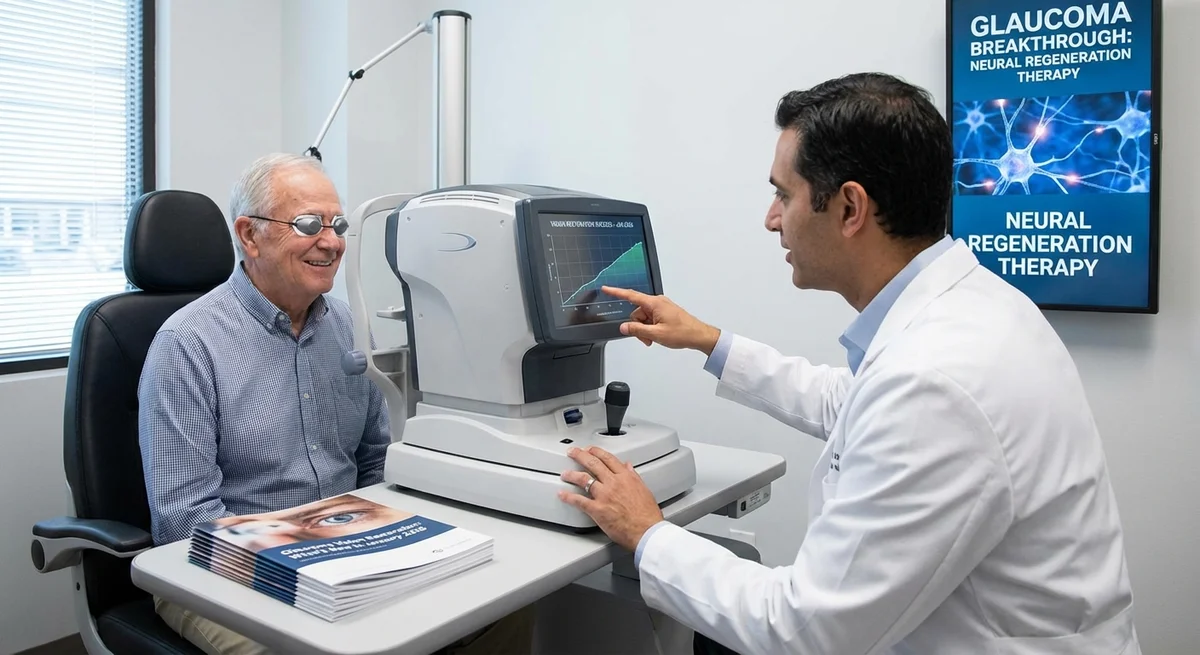
Glaucoma Vision Restoration: What’s New in January 2026
Glaucoma is often called the “silent thief of sight” – a group of eye diseases where damage to the optic nerve leads to permanent vision loss. Current treatments can only slow glaucoma by lowering eye pressure; they do not restore lost vision. But exciting research is now aiming to repair or replace the damaged retinal ganglion cells and optic nerve fibers. In the past few years, scientists have reported many breakthrough approaches. These include new neuroprotective therapies to shield surviving cells, gene therapies that could make nerve cells regenerate, stem-cell treatments to replace lost neurons, and even optogenetic or bionic-vision strategies to bypass damaged tissue. Although these ideas are mostly experimental, early news is encouraging. In late 2025, for example, a clinical trial kicked off to “rejuvenate” optic nerve cells with gene therapy (time.com) – sparking hope that glaucoma vision loss might one day be reversed. Other teams have reported partial vision returns in blind patients using implanted electronics or light-sensitive proteins (www.livescience.com) (time.com).
This article reviews the state of regenerative ophthalmology for glaucoma as of early 2026. We explain the new therapies under study, summarize any recent trial results or regulatory news, and give a realistic sense of how far these advances are from helping patients. (In short, there’s promise, but practical cures are still years away (time.com) (www.axios.com).) Read on for the latest on each approach.
Neuroprotective Therapies
One major strategy is neuroprotection, which means using drugs or treatments to keep surviving retinal ganglion cells (RGCs) alive and healthy longer. The idea is to slow or stop cell death so patients lose vision more slowly and perhaps maintain useful sight. Researchers are exploring many ways to do this:
-
Growth factors and cytokines. Delivering nerve-growth substances such as brain-derived neurotrophic factor (BDNF), ciliary neurotrophic factor (CNTF), or other supportive proteins into the eye. These molecules can help RGCs resist stress and avoid programmed cell death. For example, implantable devices have been tested that slowly release CNTF in the retina, with some evidence they protect retinal cells. (No neuroprotective drug for glaucoma is yet FDA-approved, but dozens of compounds are under study.)
-
Anti-inflammatory and antioxidant approaches. Chronic inflammation and oxidative stress contribute to glaucoma damage. Some experimental treatments aim to block those pathways – for example by shutting down inflammatory signals or scavenging free radicals in the optic nerve head. These too are still in research stages.
-
Pressure-independent medicines. Interestingly, some glaucoma drugs known to lower eye pressure may also have direct neuroprotective properties. For instance, the drug brimonidine (an eye-drop alpha-agonist) has been studied for neuroprotection, though results in trials have been mixed. Similarly, new Rho kinase inhibitors (like netarsudil) are being reviewed not only for pressure-lowering but also for possible nerve-protecting effects.
So far, neuroprotection remains a concept rather than a clinically proven therapy. As Dr. Joseph Rizzo (Harvard Ophthalmology) notes, one compelling idea is simply to “make the cell younger” so it becomes more resilient (time.com). In that vein, researchers are even testing gene-based methods to reprogram optic nerve cells into a more plastic, youthful state (see below). But no pill or injection has yet been shown to undo glaucoma damage in humans (time.com).
Gene Therapy for Retinal Ganglion Cell Regeneration
A hot area is gene therapy targeting the retina and optic nerve. Most current gene therapies in ophthalmology treat inherited retinal diseases, but scientists hope similar tools could apply to glaucoma. The basic idea is to use harmless viruses or gene-editing tools to modify cells in the eye so they survive or regrow their axons. Recent developments include:
-
“Rejuvenation” gene therapy (age rewind). A striking example is an experimental therapy coming from Harvard/Mass Eye & Ear. In this upcoming trial (starting in 2025), doctors will inject three genes into the optic nerve cells of patients with NAION (a kind of optic neuropathy) (time.com). These genes are designed to reprogram the cells into a more “youthful” state. The hope is that younger-like cells can better repair themselves from damage. If this works, the team envisions it could also apply to glaucoma by essentially pressing a “biological rewind button” for the aging nerve cells (time.com) (time.com). As Dr. Rizzo put it, the key is making the cell younger so it is more resilient to injury (time.com). This trial is very new, and even its researchers caution that it is only a first step – we’re still a long way from a proven therapy (time.com).
-
Regeneration gene editing. In laboratory studies, scientists have identified certain genes that control axon growth. For example, deleting the gene PTEN or SOCS3 in animal models can trigger retinal ganglion cells to regrow long optic axons after injury. Other experiments use CRISPR or RNA techniques to tweak nerve-cell growth pathways. While still in early animal testing, these approaches suggest it may eventually be possible to “unlock” RGCs and make them regenerate their connections. No human trials of these specific strategies have started yet, but they offer proof-of-concept.
-
Anti-aging metabolic genes. Some teams are targeting metabolic or aging pathways in neurons (for instance sirtuins or insulin signaling genes). The goal is similar: improve the health of RGCs at a molecular level.
In short, gene therapy trials for true optic nerve regeneration in humans are just beginning. The NAION study in late 2025 is one of the first to test any gene-based “rejuvenation” in the eye (time.com). It remains to be seen whether these results can translate to glaucoma patients. General headwinds include safely delivering genes into nerve cells and ensuring long-term effects. According to Vinson, current trials are “prehistoric” compared to where gene therapy is in other fields; vision-restoring therapies will likely evolve slowly (time.com) (www.axios.com).
Stem Cell–Based Approaches
Another major avenue is stem cell therapy. Researchers are exploring ways to use stem cells to replace damaged retinal or optic nerve tissue. Key ideas include:
-
Retinal ganglion cell replacement. In theory, stem cells (embryonic or induced pluripotent stem cells) could be coaxed to become RGC neurons and then transplanted into the retina. Those new neurons would have to survive, connect with the retinal circuitry, and send long axons through the optic nerve to the brain – a tremendous challenge. Thus far, full RGC replacement has only been tested in animals. However, related work offers encouragement: scientists have restored vision in blind rodents and primates by implanting layers of light-sensitive photoreceptor or retinal pigment cells grown from stem cells. (For example, in monkeys with retinal degeneration, patch transplants of human stem-cell–derived retina cells led to visual improvements.) These successes show that complex stem-cell–derived implants can integrate and function to some degree. In glaucoma, the focus would instead be on replacing ganglion cells or their support cells, possibly using similar “retina sheet” or cell-spray techniques.
-
Glial support cell transplantation. Transplanting non-neuronal support cells may also help. For example, olfactory ensheathing glia (OEG) from the nasal nerve have a special ability to promote CNS axon growth. Recent research engineered human OEG cell lines and showed they foster axonal regeneration when transplanted after spinal cord or optic nerve injury (arxiv.org). In one study, OEG cells grafted into damaged optic nerves in animals helped axons regrow. If such glial or stem-cell–derived cells could be safely injected into a human eye, they might create a more favorable environment for nerve repair.
-
Stem-cell secreted factors. Even without replacement, stem cells can secrete neuroprotective factors. Some trials are looking at injecting bone marrow–derived or mesenchymal stem cells into eyes to release growth factors in situ. This is another form of neuroprotection, where the implanted cells act like tiny drug pumps releasing helpful proteins. Early small studies of intravitreal stem cell injections are underway for optic neuropathies, though few results are public yet.
No stem-cell therapy for glaucoma vision restoration has gained approval yet. A few very early “Phase 1” trials (safety studies) are planned or recruiting, but results will take years. Overall, the field is inspired by successes in related diseases (like macular degeneration and retinitis pigmentosa) that have used stem cells. Those give a roadmap; the challenge in glaucoma is directing cells or factors specifically to the optic nerve pathway.
Optogenetics and Vision Prosthetics
Optogenetics and bionic implants offer a different kind of hope, especially for advanced blackouts of vision. These methods don’t try to regrow nerve cells. Instead, they give remaining eye cells new ways to sense or transmit light signals, effectively bypassing the damaged parts.
-
Opsin gene therapy. One approach is to genetically give other retinal neurons a light sensor protein (an “opsin”). For example, a landmark study used an adeno-associated virus (AAV) to deliver a red-shifted channelrhodopsin (ChrimsonR) into the eye of a blind patient with inherited retinal disease (time.com). After treatment and special light-filtering goggles, this patient regained the ability to detect objects and shapes. He could count crosswalk lines and recognize cups on a table (time.com). This shows that even after photoreceptors die, retinal or ganglion cells can be turned into “light sensors” to restore rudimentary vision. In glaucoma, a similar strategy could in principle be used: if enough RGCs or inner retinal cells remain, giving them an opsin could allow patients to perceive light. However, optogenetic vision is coarse (monochrome and requiring bright light and goggles) and best suited for people with only bare light perception. As one researcher noted, this kind of therapy is limited to those with very advanced loss, because it provides only basic shape/context sensing (time.com). Big challenges remain in improving resolution and light sensitivity.
-
Retinal implants and brain-computer interfaces. Other innovative devices are being tested. For example, scientists have implanted a tiny photodiode chip under the retina (the “PRIMA” system) that picks up light from a special camera in eyeglasses. In a recent European trial of patients blinded by age-related macular degeneration, about 80% could read letters a year after receiving the implant (www.livescience.com). While this is designed for central retinal disease, the idea of converting visual images into patterns of electrical impulses is applicable broadly. In theory, similar prosthetic systems could be developed to stimulate surviving retinal neurons in glaucoma or even directly interface with the visual cortex. Likewise, Neuralink- or DARPA-style brain implants are on the horizon that might deliver visual information straight to the brain. In fact, the U.S. ARPA-H is funding whole-eye transplantation research, which would involve reconnecting the optic nerve – essentially an ultimate BCI for vision (www.axios.com).
These approaches are extremely high-tech. To date, none are approved for glaucoma, and most have only been tried experimentally (often in other diseases). But they illustrate the creative strategies scientists are pursuing. A chip or optogenetic therapy might one day be an option when conventional cell regrowth isn’t possible.
Progress in Trials and Regulation
As of early 2026, no vision-restoring treatment is yet approved specifically for glaucoma. Regulatory progress has mainly involved closely related plans:
-
The NAION gene therapy trial (mentioned above) is at the Phase I/II stage, recruiting a few patients (time.com). Its success could open the door to similar optic nerve treatments. (If results are good, later phase trials will be needed.)
-
Several biotech companies have programs in this space. For example, GenSight Biologics in France has an optogenetic therapy (GS030) in clinical trials for retinitis pigmentosa. Its approval could set precedents for using gene-driven photosensitive therapies in other optic neuropathies. U.S. firms like Lineage Cell Therapeutics and regenerative ophthalmology labs worldwide are running or planning Phase I/II studies of stem-cell or support-cell implants for advanced eye disease.
-
There are no Phase III trials for glaucoma neuro-regeneration yet. All work is in early (preclinical or early clinical) stages. Scientists emphasize that even promising experimental trials are only “first steps” (time.com). In fact, one expert notes that truly reversing vision loss (regenerating an optic nerve) is still an unsolved problem (www.axios.com). Therefore, doctors caution that patients should not expect any approved restorative therapies within the next year or two. Most researchers privately estimate that if these approaches succeed, it will still be many years before they reach patients widely.
-
Meanwhile, eye institutes and funding agencies are investing heavily. A notable example is the $46 million ARPA-H grant to Colorado institutions to develop human eye transplantation techniques (www.axios.com). This is a “moonshot” that recognizes we currently lack the ability to regenerate the optic nerve. Crowdfunding and venture funding are also flowing into biotech startups focused on retinal regeneration.
In summary, the field of regenerative ophthalmology is rapidly evolving, but is still nascent. No “magic bullet” has emerged yet. The experimental therapies discussed are largely in animal studies or early human safety trials. If they continue to show promise, we might see mid-stage trials (Phase II/III) begin in the late 2020s. Most experts agree that a realistic timeline for having a widely available vision-restoring treatment in glaucoma is on the order of years to a decade, not months (time.com) (www.axios.com). That said, every year brings new laboratory findings and potential trial results. Patients and families watching this research can be hopeful that progress is being made – but should be prepared that these are long-term experimental efforts.
Conclusion
In recent months the “frontier” of glaucoma care has seen remarkable scientific ideas in the lab. From turning back the clock on optic nerve cells to transplanting stem-cell–derived tissues, researchers are pushing the boundaries of what medicine might someday achieve. Some of these approaches, like retinal implants and optogenetic gene therapy, have even restored partial vision in people with other blinding eye diseases (www.livescience.com) (time.com), offering a glimpse of what might be possible for advanced glaucoma. However, as highlighted by experts, we are only at the beginning of this journey (time.com) (www.axios.com). The coming years will tell which strategies can be safely translated to patients. For now, the best path for glaucoma patients is to continue proven pressure-lowering treatments and to enroll in clinical studies if eligible. In parallel, the neuroscience and ophthalmology communities will keep forging ahead, aiming to transform devastating vision loss into a condition that one day could be treated – or even cured.
Sources: Recent advances and trials are discussed in media and scientific reports (time.com) (time.com) (www.livescience.com) (www.axios.com) (time.com) (arxiv.org). These include a Time magazine report on an upcoming gene therapy trial (time.com) (time.com), a LiveScience summary of a landmark retinal chip study (www.livescience.com), an Axios news item on ARPA-H’s eye transplant funding (www.axios.com), and the Time and Nature Medicine account of the first human optogenetic vision restoration (time.com) (time.com). Each underscores both the promise and the long road ahead for regenerative glaucoma treatments.