
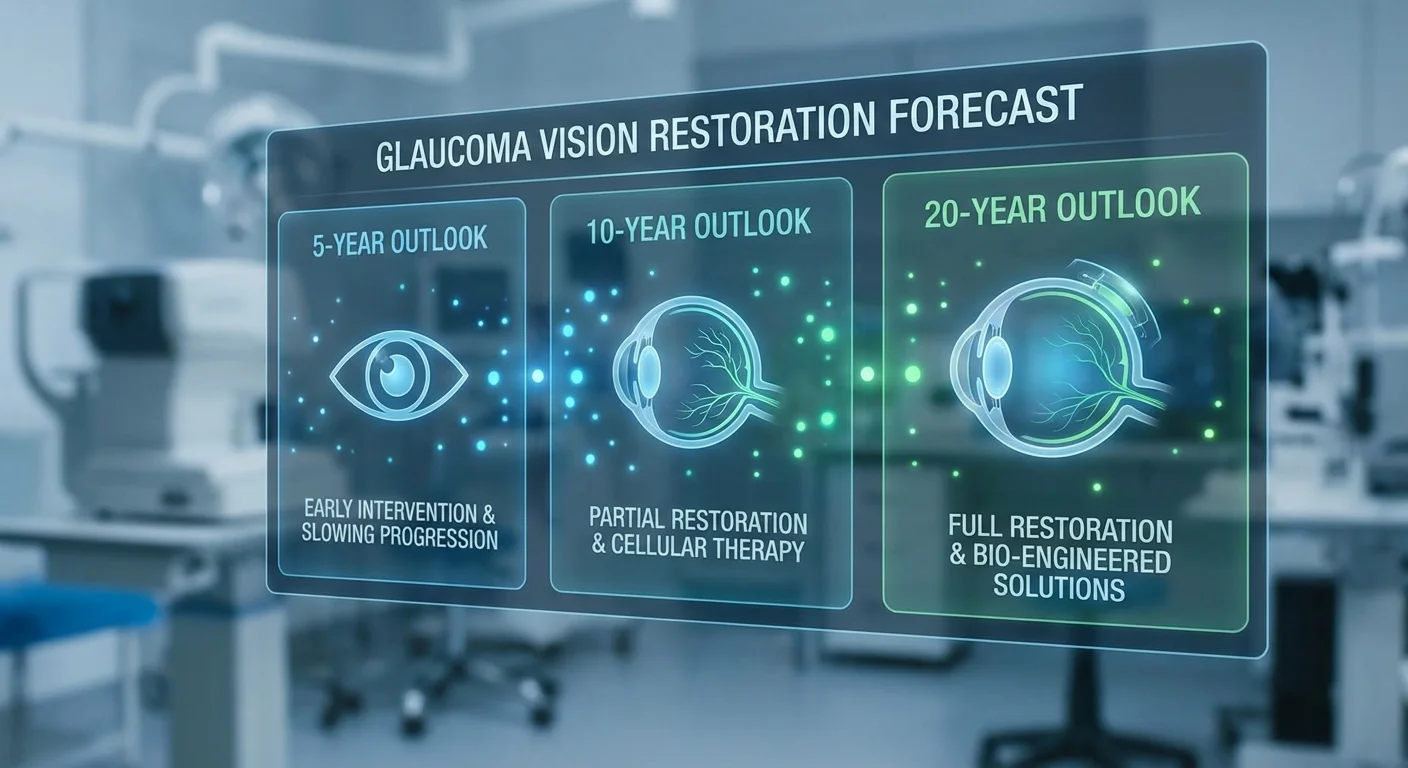
Forecasting Glaucoma Vision Restoration: 5-, 10-, and 20-Year Outlook
Glaucoma causes progressive loss of the retinal ganglion cells (RGCs) that send visual signals from the eye to the brain. Today’s treatments (medications, lasers or surgery) only lower eye pressure, which can slow vision loss but cannot restore lost nerve cells (pmc.ncbi.nlm.nih.gov). In fact, as one recent review notes, “controlling [eye pressure] in certain patients can be futile in slowing disease progression” (pmc.ncbi.nlm.nih.gov). New research is focused on three approaches: neurorescue to save or boost surviving RGCs; bioelectronic/cortical augmentation to bypass the damage; and true regeneration or replacement of damaged cells. These have very different timelines. Below, we explain what current trials and regulatory paths suggest for each category, using optimistic, base-case, and conservative scenarios.
Short-Term Outlook (Months–Years): Neurorescue and Neuroenhancement
In the next few years, the emphasis will be on neuroprotection/neuroenhancement – therapies that aim to preserve or slightly improve the function of existing RGCs rather than re-grow them. Studies have identified factors (like neurotrophins or gene signals) that help damaged RGCs survive. For example, gene therapy in mice has shown dramatic RGC protection: one Harvard team used three Yamanaka reprogramming factors in mice with glaucoma, and found that injured optic nerves regenerated and vision improved (www.brightfocus.org). This proof-of-concept is exciting, but still very early (in mice) and far from a human treatment.
More clinically, several early human trials are underway. For instance, a Phase-1 trial used eye drops containing nerve growth factor (rhNGF) in glaucoma patients (pmc.ncbi.nlm.nih.gov). The drops were safe and well-tolerated, but the small trial did not show a statistically significant vision improvement over placebo (though there were hints of benefit) (pmc.ncbi.nlm.nih.gov). In other words, no rescue drug has cleared trials yet. Reviews agree that most neuroprotective strategies (drugs, supplements or cells) that work in animals have “resulted in approved therapy [for glaucoma] clinically” only in rare cases and that the “road to glaucoma neuroprotection remains long” (pmc.ncbi.nlm.nih.gov). Some patients and doctors try over-the-counter supplements (like citicoline, gingko, or nicotinamide) or systemic medications (e.g. brimonidine eye drops) hoping for an effect (pmc.ncbi.nlm.nih.gov), but none of these are proven to restore vision.
A related idea is electrical stimulation of the optic nerve or retina. Small clinical studies have tested placing electrodes near the eye to deliver brief currents, with the goal of slowing degeneration. Encouragingly, one study of transorbital optic nerve stimulation (ONS) reported that after a course of noninvasive stimulation, about 63% of treated eyes showed no further visual-field loss over ~1 year (pmc.ncbi.nlm.nih.gov). In other words, most eyes’ vision stabilized after treatment. This suggests electrical neuromodulation may halt progression in some patients (pmc.ncbi.nlm.nih.gov). However, these were uncontrolled findings and need confirmation in larger trials. In fact, a large multicenter trial (the “VIRON” study) is now testing repetitive transorbital alternating current stimulation (rtACS) versus sham in glaucoma patients (pmc.ncbi.nlm.nih.gov). Early small trials hinted at modest visual field improvement from rtACS (pmc.ncbi.nlm.nih.gov), but the evidence is still limited. Results of the VIRON trial (expected in coming years) will be a key inflection point for this approach.
Timeline (Short Term): Over the next 3–5 years we can expect more Phase 1/2 trials of neuroprotective therapies (drugs, growth factors, gene vectors). If any are successful, they might lead to FDA fast-track or approval in the latter part of this decade. However, it’s realistic to expect only minor vision benefits at most. In the best case, a drug might slow vision loss or produce slight improvements. In the base-case, these therapies may show trends but fail to move the needle enough for approval. In a conservative scenario, they may stall (like the NGF drops) and require many more years of research (pmc.ncbi.nlm.nih.gov) (pmc.ncbi.nlm.nih.gov). Patients should not expect a cure in the next few years — most studies aim only to slow or modestly improve vision, not restore what’s already gone.
Mid-Term Outlook (5–10 Years): Electrical/Bioelectronic Augmentation
In the next 5–10 years, we may see more sophisticated bioelectronic devices and gene-based vision augmentation. These approaches attempt to bypass or compensate for lost RGC function:
-
Retinal/Cortical Prostheses: Devices like retinal implants (e.g. Argus II) and cortical implants aim to generate visual signals artificially. While Argus II (a wire-in-retina implant) was made for retinal diseases, similar ideas apply to glaucoma: if the optic nerve is dead, you can skip the eye altogether and stimulate the brain. In 2016, Second Sight (a medical device company) reported the first human activation of its Orion cortical implant in a patient blind from various causes (www.biospace.com). The implanted electrodes on the visual cortex produced spots of light (phosphenes) that the patient could perceive (www.biospace.com). More recently, efforts on this technology have continued: as of 2023, the new company Cortigent is funding the Orion brain implant with a $15M financing round targeted at vision restoration (spectrum.ieee.org). These implants remain experimental, but demonstrate that some visual perception can be achieved by directly stimulating the brain.
-
Optogenetics and Gene Auramen: Another mid-term strategy (mostly under research) is optogenetics: using gene therapy to make remaining retinal cells light-sensitive. For example, an experimental drug “MCO-010” is being tested in trials for patients (with retinal diseases like Stargardt’s) to express microbial opsins in retinal cells, enabling vision from simple light inputs. In principle, a similar technique could someday help late-stage glaucoma patients by giving light-sensitivity to any surviving inner retinal cells. However, this is still under study in retinal diseases, and no optogenetic therapy is near approval for glaucoma or other optic neuropathies yet.
-
Other Neural Interfaces: Beyond vision prostheses, future “bionic eye” research may involve implants that interface with the visual pathways in the brain or eye. For example, companies and labs are exploring wireless chips on the optic nerve or brainstem. These are very early-stage concepts.
Timeline (Mid Term): By 2030 (10-year mark), we may see prototypes or early clinical test results. For example, if the Orion project succeeds in small trials, a more robust brain implant could enter human studies. The above funding news (spectrum.ieee.org) suggests aggressive development. Optimistic scenario: By the early 2030s, one or two bioelectronic vision devices could be available to a few patients (with severely damaged eyes from glaucoma or other causes). They would offer crude vision (light/dark shapes), not high resolution, but enough for basic tasks. Base case: Devices may reach late human trials or conditional approvals by mid-2030s, still offering low-quality vision. Conservative: Technical and regulatory hurdles (safety of brain surgery, funding gaps) could delay these to 2040+.
Key inflection points: results of any new diverse retina or brain implant trials, FDA pre-submissions, and even animal studies showing improved resolution. Also watch for development of injectable electronics or nanotech (none yet in clinic, but something to watch).
Long-Term Outlook (10–20+ Years): True Regeneration and Transplantation
The boldest goal is to regenerate or replace lost RGCs and reconstruct the optic nerve. This is biologically the hardest. In principle, one would transplant new RGCs (from stem cells or reprogrammed cells) into the retina and guide their long axons back to the brain’s vision center. Practically, this faces two major hurdles: getting new cells to survive/integrate in the retina, and getting axons to grow through the optic nerve to the brain.
-
Cell and Gene Therapy for Regeneration: Researchers are working on ways to coax existing cells to regrow axons or to make new RGCs from stem cells (e.g. induced pluripotent stem cells). Animal experiments are encouraging: for example, Harvard scientists showed they could reprogram older RGCs with Yamanaka factors and trigger them to regenerate axons and restore vision in mice (www.brightfocus.org). Other teams have derived RGC-like cells from human stem cells and transplanted them into rodent eyes (with some short-term survival) (pubmed.ncbi.nlm.nih.gov) (pmc.ncbi.nlm.nih.gov). But none of these are close to human use yet.
-
Roadblocks: Experts agree that full RGC replacement is many years away. One review bluntly states that RGC transplantation “will optimistically require decades before clinical translation can reasonably be considered” (pmc.ncbi.nlm.nih.gov). Even if you could grow new RGCs, they must form the correct connections in the retina and central brain (a hugely complex task, since the visual system wiring is elaborate). Current stem-cell or gene approaches are still at lab-tests or early animal stages.
Timeline (Long Term): We are looking at the 15–30 year horizon (so well beyond 2035). Optimistic: In a best-case future, intensive research funding and breakthroughs (e.g. in neural scaffolds or gene editing) could lead to initial human trials of RGC transplants or regeneration within 10–20 years. Even so, full functional vision recovery would likely take longer. Base case: RGC regeneration remains experimental through 2040, with incremental successes along the way (partial wiring, organoids, etc.). Conservative: It may be several decades (2050s or beyond) before any true regenerative cure is ready, meaning current generations will likely need to rely on interim therapies.
A recent review summarizes this: only a few experimental therapies have reached actual human testing, and it concludes the road is long (pmc.ncbi.nlm.nih.gov) (pmc.ncbi.nlm.nih.gov). In the meantime, each small success (e.g. a gene therapy that slows glaucoma in primates, or a stem cell that makes a tiny new nerve fiber) will be an important milestone to watch.
Scenario Analysis and Inflection Points
-
Optimistic Scenario: Over the next 5–10 years, several new treatments clear Phase-2 trials. A neuroprotective drug or gene therapy showing positive visual outcomes could reach approval by ~2030. A first-generation visual prosthesis (cortical implant or retinal device) starts limited patient use. By 2040, combination therapies (e.g. gene therapy plus implant) give walkers new functional vision. Key inflection points: publication of successful trial results in 5–7 years, FDA breakthrough designations for at least one therapy, and demonstration of functional optic-nerve regeneration in a large animal model.
-
Base-Case Scenario: Progress is steady but slower. By 2030 we have some Phase-3 trials ongoing for neuroprotective agents and maybe conditional approval of an implant device. Vision improvements remain modest (e.g. slight field preservation, grayscale patterns from implants). RGC replacement is still experimental in labs. By 2040, a few clinics offer “last-resort” options (e.g. implant vision chips) for advanced cases. Patients should expect only incremental improvements year by year. Watch for moderate milestones: successful mid-stage trials, publications showing partial RGC wiring, and eventual regulatory guidance on gene therapies.
-
Conservative Scenario: Scientific and regulatory hurdles slow everything. Neuroprotective treatments show only minor benefit or fail trials; progress stalls. Implants remain tests with very limited effect and no market product by 2035. Regenerative therapies stay in animal research with unclear human translation. In this case, the 20-year horizon could bring zero truly restorative therapies, and glaucoma patients would still rely on pressure-lowering care only. Inflection points in this scenario would be negative trial outcomes (e.g. a major phase-3 trial meeting futility) or safety setbacks (device inflammation, gene therapy side effects).
In summary, patients and doctors should have realistic expectations. No cure is imminent, but multiple research paths offer hope. In the next few years, focus will remain on slowing damage. True restoration (especially sight improvement) will likely not happen overnight. It is reasonable to hope for some vision-preserving or slightly enhancing treatments over the next decade, but complete vision recovery in glaucoma will probably take well over 10 years – and perhaps decades – according to experts (pmc.ncbi.nlm.nih.gov) (pmc.ncbi.nlm.nih.gov). Clinicians should say this frankly: novel therapies (gene or electronic) are on the way, but they are not ready for routine use yet. Patients should stay engaged with new trials and consult specialists about emerging options, but also continue regular eye care to maximize the vision they have.