
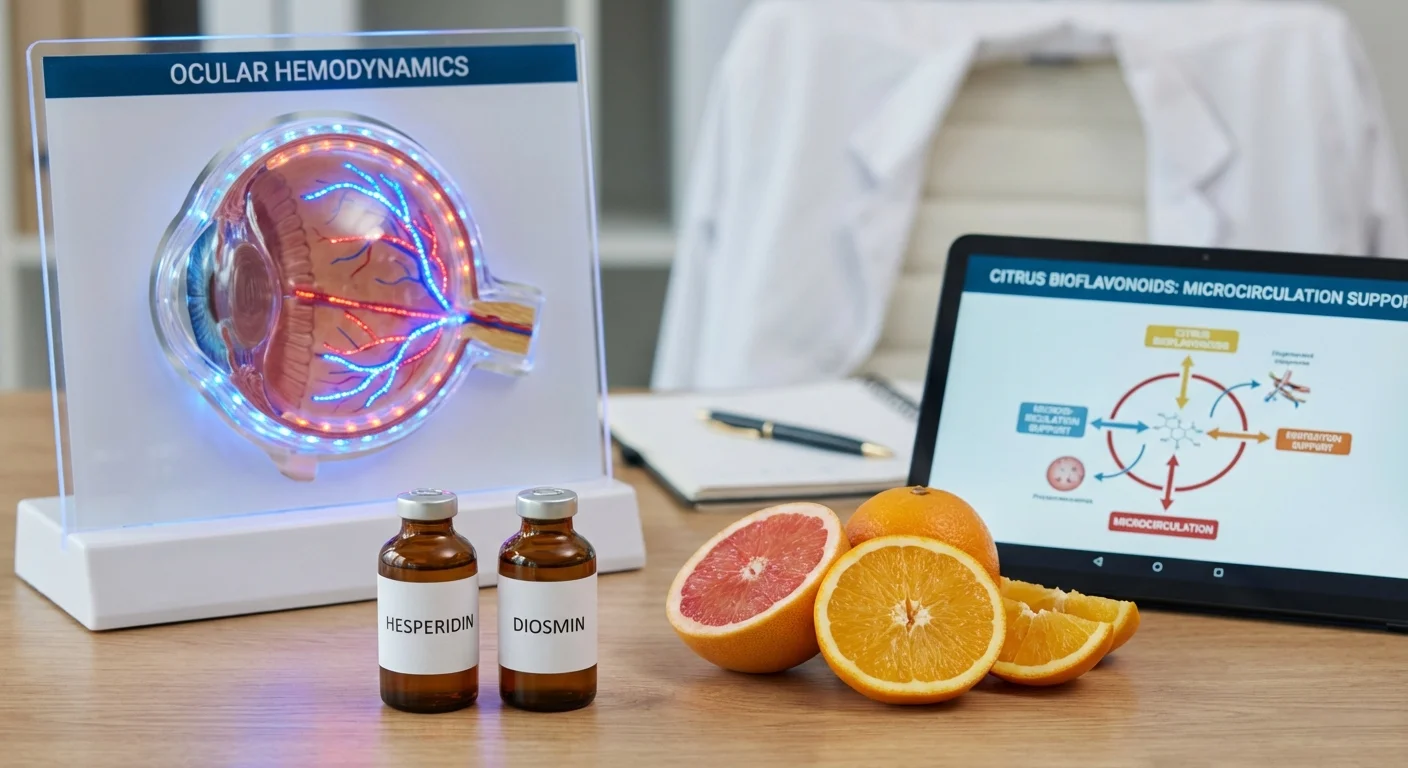
Citrus Bioflavonoids (Hesperidin, Diosmin) for Ocular Hemodynamics
The eye’s tiny blood vessels must work well to keep vision sharp. In glaucoma, reduced blood flow to the optic nerve may worsen damage. Citrus bioflavonoids like hesperidin and diosmin are plant compounds found in orange peels and other citrus fruits. These flavonoids are known to strengthen capillaries, reduce swelling, and improve circulation (pmc.ncbi.nlm.nih.gov). In this article we review how these compounds affect endothelial nitric oxide, venous tone, and microcirculation in the eye and body, and what clinical data suggest about blood flow and vision. We also look at their broader vascular benefits, dosing, standardization, and safety.
Effects on Endothelial Nitric Oxide
Blood vessels relax when their lining cells (endothelium) make the gas nitric oxide (NO). Hesperidin itself is a sugar-linked molecule that is broken down in the gut to hesperetin, its active form. Hesperetin strongly activates enzymes (AMPK, Akt) that turn on endothelial NO synthase (eNOS), boosting NO production (pmc.ncbi.nlm.nih.gov). In lab cells, hesperetin caused a rapid rise in eNOS phosphorylation and NO levels. In people with risk factors for heart disease (metabolic syndrome), a trial of 500 mg hesperidin daily for 3 weeks significantly improved flow-mediated dilation of the brachial artery (a measure of endothelial NO function) (pmc.ncbi.nlm.nih.gov) (pmc.ncbi.nlm.nih.gov). In that study, brachial FMD increased ~2.5% and blood markers of cholesterol (ApoB) and inflammation (hs-CRP) fell (pmc.ncbi.nlm.nih.gov). These findings suggest citrus flavonoids can improve vessel dilation in humans, likely via enhanced NO.
Diosmin, which comes from the herb Scrophularia initially and is also made from hesperidin, similarly has vascular effects. It scavenges free radicals and reduces inflammation, which may indirectly preserve NO signaling. In animal models where nitric oxide was blocked (using L-NAME), diosmin still lowered blood pressure and protected vessels (pmc.ncbi.nlm.nih.gov). This points to antioxidant actions of diosmin (removing superoxides) that help overall endothelial function (pmc.ncbi.nlm.nih.gov).
Venous Tone and Microcirculation
Beyond NO, hesperidin and diosmin are known as venoactive agents – meaning they make veins pump more effectively. Clinical and experimental evidence shows they increase venous tone, improve microcirculation, and reduce capillary leakage (pmc.ncbi.nlm.nih.gov) (pmc.ncbi.nlm.nih.gov). For example, diosmin has been shown to improve damaged microvessels, inhibit inflammatory adhesion molecules (ICAM-1, VCAM-1), and protect capillary tight junctions (pmc.ncbi.nlm.nih.gov) (pmc.ncbi.nlm.nih.gov). These actions help push blood out of swollen veins and strengthen the microvascular bed.
Used as a medicine (often combined), diosmin and hesperidin improve symptoms of chronic venous insufficiency (CVI) – such as leg swelling and varicose veins. The standard drug MPFF (Micronized Purified Flavonoid Fraction) contains about 90% diosmin and 10% hesperidin, with particles micronized for better absorption (pmc.ncbi.nlm.nih.gov). Meta-analyses indicate that ~1000 mg/day of MPFF (equivalent to ~900 mg diosmin + 100 mg hesperidin) significantly reduces leg heaviness, swelling, and pain over weeks (pmc.ncbi.nlm.nih.gov). In fact, one review found 600 mg/day of pure diosmin (without micronization) was almost as effective as 1000 mg/day MPFF for venous symptoms (pmc.ncbi.nlm.nih.gov).
In eye terms, stronger venous tone could help fluid outflow and reduce congestion. Diosmin’s capillary-stabilizing and anti-edema effects were seen in a rat study of retinal ischemia/reperfusion: rats given diosmin had less retinal swelling, preserved tight-junction proteins, and lower vascular permeability (pmc.ncbi.nlm.nih.gov). This suggests systemic diosmin can protect tiny blood vessels under stress.
Ocular Blood Flow and Glaucoma
Good circulation in the iris, ciliary bodies, choroid, and retina can support eye health. Laboratory studies in rabbits found that hesperetin (the non-sugar form of hesperidin) greatly increased blood flow in iris, ciliary body and choroid blood vessels (pmc.ncbi.nlm.nih.gov). In contrast, the glycoside hesperidin (with its sugar) had little effect unless converted to hesperetin (pmc.ncbi.nlm.nih.gov). This increase in flow was associated with better retinal recovery after induced lack of oxygen (pmc.ncbi.nlm.nih.gov). In another rabbit experiment, topical application of hesperetin raised blood flow in all eye tissues except the retina (pmc.ncbi.nlm.nih.gov), again highlighting that hesperetin (not hesperidin) is the active agent in the eye.
No large human trials have tested ocular blood flow directly, but these animal data suggest hesperidin (via hesperetin) could boost eye perfusion. Improved flow might help in glaucoma, where low perfusion of the optic nerve may contribute to damage. In fact, in glaucoma rat models, hesperidin supplementation lowered intraocular pressure comparably to acetazolamide (a glaucoma drug) (pmc.ncbi.nlm.nih.gov). While that study focused on pressure and optic nerve cell protection (showing higher ocular glutathione and lower glutamate), it underscores that citrus flavonoids have actions in the eye relevant to glaucoma (pmc.ncbi.nlm.nih.gov).
Retinal Microcirculation and Visual Function
Beyond flow, retinal function can benefit from flavonoids. In the rat ischemia/reperfusion injury study with diosmin, treated rats had stronger electroretinogram (ERG) responses (higher a- and b-wave amplitudes) compared to untreated rats (pmc.ncbi.nlm.nih.gov). They also had thinner (healthier) retinal layers after damage. This implies diosmin helped preserve retinal blood–retinal barrier integrity and neuron function (pmc.ncbi.nlm.nih.gov). While direct measures of human visual field or acuity with these supplements are lacking, the animal ERG results suggest potential for protecting vision in ischemic or glaucoma-like conditions.
Systemic Vascular and Metabolic Benefits
Citrus flavonoids also benefit overall vascular health. In metabolic syndrome (a cluster of heart-risk factors), hesperidin improved blood vessel function and metabolism. As noted, a trial of 500 mg/day hesperidin raised FMD and lowered cholesterol and C-reactive protein (pmc.ncbi.nlm.nih.gov). In that trial, total cholesterol dropped ~11 mg/dL, ApoB by ~4.8 mg/dL, and hs-CRP by 0.68 mg/L relative to placebo (pmc.ncbi.nlm.nih.gov). HDL cholesterol slightly increased. Over longer periods and higher doses (1000 mg daily), studies have reported reductions in blood sugar, triglycerides, blood pressure, and inflammatory markers (e.g. TNF-α) in people with metabolic syndrome or diabetes (pmc.ncbi.nlm.nih.gov).
Diosmin likewise has metabolic effects. It exhibits anti-hyperglycemic and lipid-lowering actions in preclinical studies (pmc.ncbi.nlm.nih.gov). It preserves endothelial health even under stress (e.g. in nitric-oxide-deficient hypertension models) and lowers blood pressure via antioxidant mechanisms (pmc.ncbi.nlm.nih.gov). Both flavonoids boast anti-inflammatory and antioxidant properties. By improving endothelial function and reducing oxidative stress, they may slow vascular aging – countering stiffening arteries and capillary damage that come with age (pmc.ncbi.nlm.nih.gov) (pmc.ncbi.nlm.nih.gov).
Taken together, hesperidin and diosmin support vascular health beyond the eye. They help normalize blood sugar and lipids, reduce blood pressure, and lower chronic inflammation. These systemic benefits are relevant since vascular factors can influence glaucoma progression and overall brain and heart health.
Dosing, Standardization, and Safety
Studies have generally used hundreds of milligrams per day of these flavonoids. In humans, hesperidin dosing is typically 500–1000 mg/day (often as a twice-daily split) (pmc.ncbi.nlm.nih.gov) (pmc.ncbi.nlm.nih.gov). Diosmin is usually dosed around 600–1000 mg/day. For example, Daflon® 500 mg tablets (a common venotonic drug) deliver a total of 1000 mg/day (two tablets), providing about 900 mg diosmin and 100 mg hesperidin (pmc.ncbi.nlm.nih.gov). This is in line with clinical trials that found 600 mg pure diosmin once daily was effective for venous symptoms (pmc.ncbi.nlm.nih.gov).
Product quality matters. High-quality extracts are standardized to specific flavonoid content. The micronized purified flavonoid fraction (MPFF) is formulated so it is 90% diosmin and 10% hesperidin, and micronized for better absorption (pmc.ncbi.nlm.nih.gov). Over-the-counter supplements vary greatly, so users should choose reputable brands that list active content (e.g. “hesperidin 500 mg”). Some products use aglycone forms or enhanced bioavailability (like glucosyl hesperidin) to improve uptake.
Both hesperidin and diosmin have excellent safety records. Large clinical trials reported no serious adverse events (pmc.ncbi.nlm.nih.gov). No toxic effects have emerged at the doses used for vascular health. (pmc.ncbi.nlm.nih.gov) Mild gastrointestinal upset or headaches are the most common complaints, but these are rare. As natural components of foods (e.g. oranges), they are generally well tolerated. However, as with any supplement, consumers should start at lower doses to assess tolerance and consult a healthcare provider if on medications.
Conclusion
Citrus flavonoids hesperidin and diosmin act on multiple fronts to support blood vessel health. They boost endothelial nitric oxide, strengthen capillary walls, and improve venous tone and microcirculation (pmc.ncbi.nlm.nih.gov) (pmc.ncbi.nlm.nih.gov). In animal models, these effects translated to better ocular blood flow and retinal protection – hesperetin increased flow in eye tissues and diosmin preserved retinal structure and ERG signals after injury (pmc.ncbi.nlm.nih.gov) (pmc.ncbi.nlm.nih.gov). Clinical studies in humans show improved vascular function (higher FMD) and better metabolic markers with hesperidin (pmc.ncbi.nlm.nih.gov). These benefits could be valuable in glaucoma, where eye perfusion is critical, and in slowing vascular aging systemically.
Typical doses in studies range from ~500–1000 mg/day of hesperidin or diosmin. Products like micronized diosmin/hesperidin (MPFF) are well studied (pmc.ncbi.nlm.nih.gov). Importantly, these flavonoids are generally safe at recommended doses (pmc.ncbi.nlm.nih.gov) (pmc.ncbi.nlm.nih.gov). Overall, while more human trials in glaucoma patients are needed, the existing evidence suggests citrus bioflavonoids may enhance ocular hemodynamics and visual function supportively, while also promoting healthier blood vessels throughout the body.