
Introduction
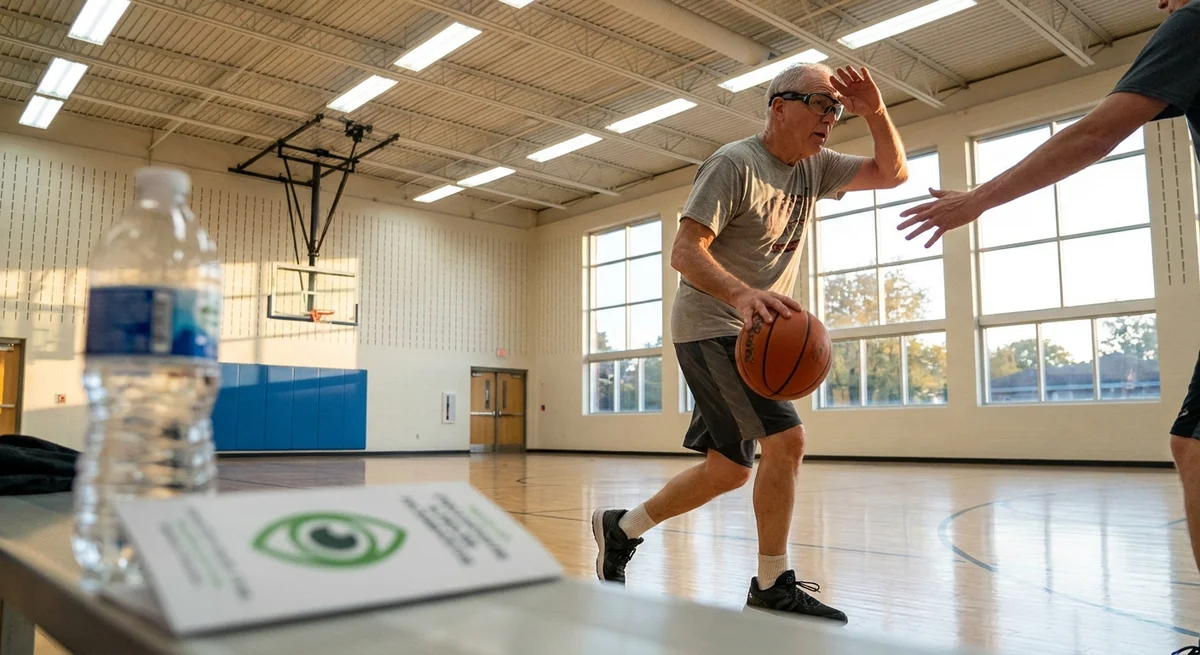
Glaucoma is a chronic eye disease in which high intraocular pressure (IOP) or other factors gradually damage the optic nerve, often leading to peripheral vision loss. Patients naturally worry whether vigorous sports like basketball are safe. In fact, moderate exercise is generally healthy – it boosts blood flow and slows vision loss – but basketball’s contact and bright lights pose special challenges. This article examines how basketball affects eye pressure during sprints and jumps, how field loss can make court play risky, and how players with glaucoma can balance the aerobic and social benefits of the game against the risks of injuries and glare. We’ll also offer practical strategies (goggles, modified play, hydration) and guidance on playing basketball according to disease severity, always citing evidence from eye health research and sports safety guidelines.
Exercise and Intraocular Pressure
Basketball is a dynamic sport combining aerobic running and short explosive movements. Studies of exercise and IOP show that aerobic activities tend to lower eye pressure in both healthy and glaucoma patients. For example, one large study found that after jogging, subjects’ IOP significantly decreased, even in glaucoma patients on medication (pmc.ncbi.nlm.nih.gov). In fact, that study concluded there was “no ocular restriction for simple glaucoma patients in performing aerobic physical activity” (pmc.ncbi.nlm.nih.gov). Similarly, the Glaucoma Research Foundation notes that moderate-to-vigorous exercise (like jogging or biking) improved cardiovascular health and significantly lowered IOP, slowing visual field loss by about 10% over time (glaucoma.org). These benefits likely apply to basketball since most of the game (running the court, defense, etc.) is aerobic.
However, intense bursts of effort and breath-holding can temporarily spike IOP. Basketball sprints and jumps are more anaerobic than jogging, and moments like panting hard or doing a Valsalva maneuver (like holding one’s breath on a big leap) can raise pressure. A review of exercise found that any movement involving heavy muscle exertion and increased breathing (especially with Valsalva) can elevate IOP (pmc.ncbi.nlm.nih.gov). In contrast, steady endurance exercise does not. For instance, a recent study comparing runners and weightlifters showed that after one hour of training, runners’ IOP actually fell slightly, whereas weightlifters’ IOP rose significantly (averaging ~19.3 mmHg post-workout) (pmc.ncbi.nlm.nih.gov). In other words, endurance running stabilizes or reduces eye pressure, but pure strength training causes spikes (pmc.ncbi.nlm.nih.gov). Basketball’s combination of activity means the net effect is usually pressure-lowering, provided players breathe normally. The key is to avoid holding your breath during jumps or lifts, and to use proper technique (for example, exhale while jumping up). Overall, most studies encourage moderate aerobic exercise in glaucoma but caution against intense strain and Valsalva stress (pmc.ncbi.nlm.nih.gov) (pmc.ncbi.nlm.nih.gov).
Visual Field Loss and Court Awareness
Glaucoma often first affects peripheral vision, shrinking the visual field (the area you can see around you). This can make fast-moving sports like basketball challenging. A person with glaucoma may have trouble noticing players or the ball approaching from the side. In everyday life, peripheral field loss is known to cause frequent collisions. For example, one mobility study found that patients with tunnel vision often bump into pedestrians and objects on their blind sides (pmc.ncbi.nlm.nih.gov). By analogy, a player with similar vision loss on the basketball court might not see an opponent cutting behind them or a loose ball rolling in from the corner. Indeed, driving studies show that glaucoma with severe field loss doubles crash risk (pmc.ncbi.nlm.nih.gov). On the court, this translates to a higher chance of accident or elbowing: a teammate or opponent might unintentionally collide with a player who can’t see them. These risks are greater during fast plays or with lots of players on the floor. It’s crucial for players with reduced fields to be aware of these blind spots. Communicating (“I’m on your left!”) and careful scanning are methods that can partly compensate, but avoidance of tight traffic is wise.
Benefits of Basketball (Aerobic and Social)
Despite these concerns, basketball offers real benefits for people with glaucoma. Firstly, the aerobic exercise is excellent for eye health. Physical activity improves blood circulation throughout the body and eye, which can help nourish the optic nerve. As noted above, research shows that regular aerobic exercise like running or swimming can reduce IOP and even slow glaucoma progression (glaucoma.org) (pmc.ncbi.nlm.nih.gov). For example, the Glaucoma Research Foundation cites a study in which moderate-to-intense exercise reduced the rate of vision loss by about 10% (glaucoma.org). In practice, playing basketball for 30–60 minutes several times a week can contribute to these benefits (improved fitness, lower resting IOP) while also strengthening muscles and heart health.
Basketball also provides important social and emotional benefits. Social sports help reduce stress, build confidence, and combat isolation. A systematic review of team sports found that participation usually improves mood, self-esteem, social bonding and overall mental well-being (pmc.ncbi.nlm.nih.gov). Working with teammates teaches cooperation and builds friendships; laughing over a game also relieves anxiety. Younger or older adults with vision loss can find strong community support on a team. In short, the camaraderie and enjoyment of basketball can boost quality of life. For many glaucoma patients – especially those wary of the disease – the positive feelings from exercise and team play counterbalance the worry.
Risks: Contact Injuries and Glare
On the flip side, basketball’s physical contact and environment can endanger an eye already compromised by glaucoma. Eye injuries are common in basketball. In the U.S., the American Academy of Ophthalmology (AAO) warns that sports cause over 40,000 eye injuries per year (www.newswise.com). Importantly, AAO specifically lists basketball alongside baseball and others as a sport where eye protection is warranted (www.newswise.com). In fact, studies have shown basketball is the leading cause of sports-related eye injury in the country: about one in ten college basketball players suffers some eye injury each year (pmc.ncbi.nlm.nih.gov). The majority of these injuries are minor (like a corneal abrasion from a poking finger or a black eye from an elbow) (pmc.ncbi.nlm.nih.gov), but even a seemingly light contact can cause trouble. One report noted that in high-school basketball injuries, almost all were caused by an elbow or finger jammed into the eye, and there was even a case of a retinal detachment after a ball rebounded into a player’s eye (pmc.ncbi.nlm.nih.gov). This reminds us that fingers, elbows, or the ball itself can injure a fragile eye. Court collisions – no matter how accidental – can scratch the cornea, pop out a contact lens, or worse. Given glaucoma already weakens the optic nerve, any blunt trauma could tip the balance toward vision loss.
Another hidden hazard is court lighting and glare. Basketball gyms often use very bright fluorescent or halogen lights. Glaucoma patients commonly suffer light sensitivity and glare. According to patient-oriented sources, many people with glaucoma find fluorescent lights painfully bright (www.cureglaucoma.org). Research confirms that the more advanced the glaucoma, the worse a patient’s vision gets in glare conditions (pmc.ncbi.nlm.nih.gov). For instance, Hamedani et al. (2020) found that patients with severe glaucoma had much larger drops in visual acuity from glare than those with mild disease (pmc.ncbi.nlm.nih.gov). In practice, this means a well-lit gym can create uncomfortable glare, halos or starbursts that momentarily blur vision. Scattered light off the shiny court or backboard can be disorienting. While not as injurious as a hit, glare can make it harder to track the ball or see sideline cues, which raises the chance of a collision.
Safety Strategies
To balance benefits and risks, glaucoma patients can take several precautions when playing basketball:
-
Wear Protective Sports Goggles. The single most important safety step is to always wear proper eye protection. Use sturdy sports goggles made of polycarbonate with wrap-around impact protection. The AAO emphasizes that “eyewear properly fitted and worn does not hinder performance… and can prevent most sports eye injuries” (www.newswise.com). Polycarbonate lenses can withstand high-speed impacts (up to 90 mph) (www.newswise.com). Importantly, regular glasses or contact lenses offer no protection against impacts (www.newswise.com). In fact, the AAO notes that 40,000 sports eye injuries per year could be greatly reduced if athletes wore ANSI- or ASTM-certified goggles (www.newswise.com) (www.newswise.com). Look for goggles that meet ASTM F803 standards (a U.S. safety standard being extended specifically to basketball as of 2025) (www.astm.org). Well-designed goggles have ventilation to reduce fog and fit comfortably over eyewear. By wearing them at all times on court, common injuries from fingers or elbows will be largely avoided.
-
Modify Playing Role and Style. Think about reducing collision risk through your role and format. For example, you might spend less time battling under the basket (with elbows flying) and more time on the perimeter catching and passing. Playing in non-contact or 3-on-3 half-court drills can cut down on rough scrambles. Some players find it safer to stick to a point-guard role, focusing on ball-handling and court vision, rather than a power forward or center role which involves more traffic in the paint. In general, communicate clearly with teammates (“I’ve got that guy at half court!”) to compensate for blind spots and be extra cautious of players approaching from your weak side. Scheduling breaks during the game to rest eyes and re-hydrate can also help. These adaptations of “where, how hard, and how long” you play basketball can greatly reduce the chance of accidental pokes or collisions.
-
Maintain Proper Hydration. Staying well-hydrated is good for overall health and circulation, but be mindful of timing. In theory, drinking very large volumes of water all at once can transiently raise IOP (this is actually used as a test by eye doctors). One review of exercise notes that factors like fluid intake and Valsalva maneuvers during exercise can elevate IOP (pmc.ncbi.nlm.nih.gov). In practice, drink water consistently before and after exercise rather than gulping a huge amount at game time. Sipping fluids throughout the half-time is wise. If you have salt or electrolyte drinks, use them in moderation according to your doctor’s advice. In short, avoid extreme dehydration (which is unhealthy) or extreme over-hydration; aim for a steady fluid balance. Proper hydration keeps blood pressure stable and may help the eye’s fluid dynamics.
-
Check Glare and Lighting. If glare is a problem in your gym, consider tinted sports eyewear (as a replacement for sunglass indoors) or anti-reflective coatings on glasses under your goggles. Some glaucoma patients use subtle yellow/amber tints to soften fluorescent light (www.cureglaucoma.org). Simple measures like wearing a cap or picking a side of the court with slightly dimmer light can help. After dark, ensure outdoor courts are well-lit. While no published studies specifiy goggles for glare in sports, make sure any protective goggles do not overly darken or distort vision. In very bright situations, brief rests facing away from lights can help reset your eyes.
-
Regular Checkups and Communication. Finally, always keep your eye doctor informed about sports. If you sustain any eye injury (even a scratch), seek prompt care: delays can worsen outcomes. Likewise, if you notice more glare sensitivity or new blind spots, let your doctor know. They may advise additional protective drops or adjust treatment. Remember, the goal is to enjoy basketball safely, not to ignore vision problems.
Balancing Play and Disease Severity
How aggressively you should play depends on your glaucoma stage and doctor’s advice. For early or mild glaucoma (open-angle with good field remaining), you can often continue playing basketball as long as you use safety precautions. Studies have reassuringly reported that aerobic exercise causes no lasting harm in such patients (pmc.ncbi.nlm.nih.gov). In fact, if your pressures are under control and fields are stable, playing pick-up or even some competitive games is reasonable. Always wear certified sports goggles (www.newswise.com) (www.astm.org).
For moderate glaucoma (some field loss or fluctuations in IOP), consider limiting full-intensity play. Stick to rec leagues or shooting drills where contact is minimized. It may be wise to avoid short-term anaerobic strains: avoid Valsalva (like roaring hard when leaping) and use goggles as above. Discuss with your ophthalmologist whether shorter shifts, half-court games, or other modifications are best. Many patients in this category successfully continue sports by emphasizing safety and monitoring their eye pressure before and after exercise.
For advanced glaucoma or very narrow fields, caution ramps up significantly. Patients with severely restricted vision may find any fast-moving team sport risky. Here, major guidelines even list basketball among activities to consider avoiding due to impact hazard (glaucoma.org). If your glaucoma has progressed far, shifting focus to safer aerobic exercises (walking, cycling, swimming) might be advised. If you still want to play, strict protective measures are essential: legal-action–grade goggles at all times, playing only under supervision, or limiting to purely non-contact “shootaround” sessions. In all cases, follow standard sports eye-safety rules: use ASTM/ANSI-certified eyewear (www.newswise.com) (www.astm.org) and do not play when extremely tired or if vision worsens. By matching your activity level to your disease severity and protective standards, you can enjoy the benefits of sport while minimizing added glaucoma risk.
In summary: Basketball can be part of a healthy lifestyle for many glaucoma patients. The aerobic exercise often lowers IOP (pmc.ncbi.nlm.nih.gov) (glaucoma.org) and the social engagement builds well-being (pmc.ncbi.nlm.nih.gov). However, the disease’s visual field loss and the sport’s impact hazards mean caution is needed. Use polycarbonate sports goggles, adapt your play style, and stay well-hydrated. If vision loss is mild and controlled, you may play more freely; if glaucoma is severe, you should largely avoid contact play. Always follow eye-protection standards (such as ASTM F803 goggles for basketball) (www.newswise.com) (www.astm.org) and heed your doctor’s guidance. By combining these precautions with regular exercise, patients can maintain fitness and camaraderie without unduly risking their sight.