
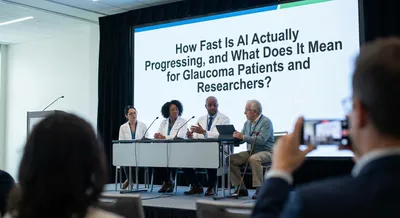
How Fast Is AI Actually Progressing, and What Does It Mean for Glaucoma Patients and Researchers?
Researchers measure AI progress by performance on challenging tasks (benchmarks) and by tracking improvements in model design, data, and compute. In...
Deep research and expert guides on maintaining your visual health.
Researchers measure AI progress by performance on challenging tasks (benchmarks) and by tracking improvements in model design, data, and compute. In...

Commercial and research groups are already developing such systems. For instance, the Medios AI-Glaucoma system (Remidio, India/ Singapore)...
Our visual field test is inspired by the perimetry methods eye care professionals use. Check for blind spots and track changes over time.
Test Your VisionMedical imaging refers to the variety of tools and techniques that create pictures of the inside of the body to help diagnose, monitor, and guide treatment. Common types include X-rays, ultrasound, CT scans, MRI scans, and specialized cameras that show organs or tissues; each method uses different physics to reveal different kinds of detail. These images let doctors see bones, organs, blood flow, and abnormalities without major surgery, making it easier to identify problems like fractures, tumors, infections, or blockages. Images are used not only to make an initial diagnosis but also to track how a condition is responding to treatment and to plan operations or other procedures. While these technologies are powerful, they have trade-offs: some expose patients to small amounts of radiation, others can be expensive or require time and special facilities. Interpreting images requires trained professionals because subtle details can change the meaning of a scan. Improvements in digital imaging and computing have made pictures clearer and easier to share among care teams. Because accurate, timely images speed diagnosis and reduce guesswork, they play a central role in modern healthcare. For patients, medical imaging often means faster answers and more targeted care, which can improve outcomes and reduce unnecessary procedures.