
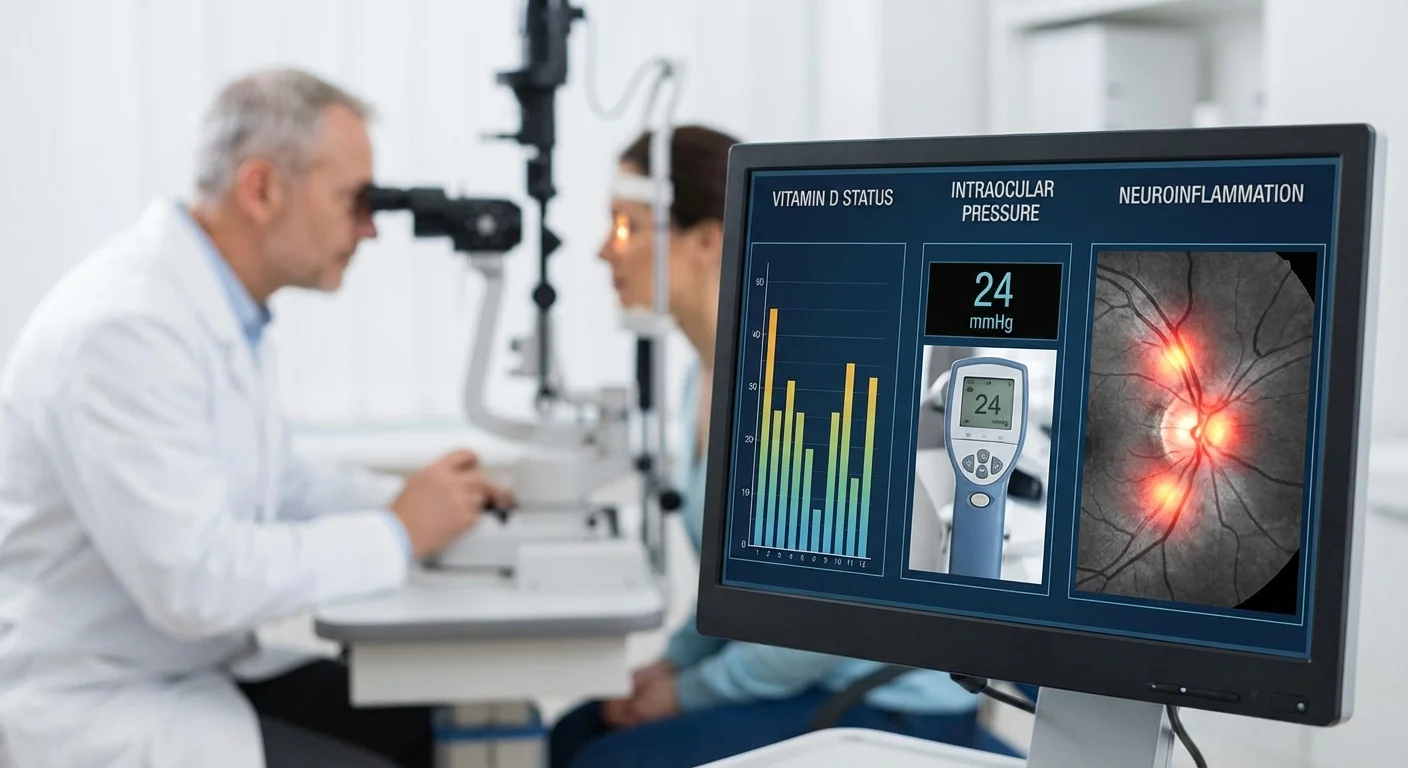
Vitamin D Status, Intraocular Pressure, and Neuroinflammation
Glaucoma is a chronic optic neuropathy leading to irreversible vision loss (pmc.ncbi.nlm.nih.gov). Elevated intraocular pressure (IOP) is the main modifiable risk factor, but glaucoma is multifactorial, involving optic nerve damage, blood flow, and neuroinflammation. Vitamin D (measured as serum 25-hydroxyvitamin D) plays roles in bone metabolism, cell regulation, and immune signaling (pmc.ncbi.nlm.nih.gov). Experimental data suggest vitamin D is neuroprotective; low levels are linked to neurodegeneration (pmc.ncbi.nlm.nih.gov). Since deficiency is common, researchers have studied whether vitamin D status influences IOP, optic nerve health, or inflammation in glaucoma. We review human and animal studies, and also examine evidence linking vitamin D to lifespan and mortality. We also discuss how sun exposure, skin pigmentation, and health conditions confound vitamin D measurements, define deficiency thresholds, and summarize supplementation advice.
Vitamin D and Glaucoma: IOP and Optic Nerve
Observational and Case-Control Studies
Several large surveys have tested if vitamin D levels correlate with glaucoma. For example, a Korean health-screening study of over 120,000 adults found no overall difference in glaucoma prevalence across vitamin D quintiles. However, women in the fourth quintile (moderately high 25(OH)D) had a significantly lower glaucoma risk than women in the lowest quintile (OR ≈0.71) (pmc.ncbi.nlm.nih.gov). Another Korean analysis of national survey data found a striking “reverse J-shaped” association: people in the lowest vitamin D quintile had a much higher risk of open-angle glaucoma than those with moderate levels (pmc.ncbi.nlm.nih.gov). In essence, very low vitamin D was linked to higher glaucoma prevalence.
Smaller case-control studies echo this general trend. Investigations in France, Croatia, the U.S., and Turkey reported that glaucoma patients often have lower serum vitamin D than similarly-aged control subjects (pmc.ncbi.nlm.nih.gov). (Not all were significant; one Turkish study found no difference (pmc.ncbi.nlm.nih.gov).) However, these cross-sectional snapshots cannot prove causation. In sum, many observational surveys note an association between low vitamin D and glaucoma, but some large analyses (e.g. from U.S. national data) found no significant link after adjusting for other factors (pmc.ncbi.nlm.nih.gov). Ethnicity and geography may partly explain inconsistent results (pmc.ncbi.nlm.nih.gov).
Interventional Trials and IOP
Very few clinical trials have tested vitamin D supplementation in relation to IOP or glaucoma. One well-controlled trial enrolled healthy adults with low vitamin D levels and randomized them to high-dose vitamin D3 (20,000 IU twice weekly) or placebo for six months. The study found no difference: intraocular pressure did not change significantly in the vitamin D group versus placebo (pubmed.ncbi.nlm.nih.gov) (pmc.ncbi.nlm.nih.gov). In other words, raising 25(OH)D in vitamin-D-deficient people did not lower IOP. Likewise, baseline comparisons showed no association between serum 25(OH)D and IOP in this population (pubmed.ncbi.nlm.nih.gov) (pmc.ncbi.nlm.nih.gov). Thus, at least in healthy subjects, vitamin D supplementation did not appear to affect IOP.
On the other hand, a very large Korean cross-sectional study (15,338 adults) found that higher vitamin D levels were linked to lower odds of having elevated IOP (pmc.ncbi.nlm.nih.gov) (pmc.ncbi.nlm.nih.gov). In fully adjusted models, each incremental rise in 25(OH)D was associated with about a 3% reduction in the odds of IOP ≥22 mmHg. Compared to people with vitamin D deficiency, those with insufficiency (20–29 ng/mL or 50–72 nmol/L) had 28% lower odds of high IOP, and those with sufficiency (≥30 ng/mL) had about 50% lower odds (pmc.ncbi.nlm.nih.gov). Since this was cross‐sectional, it only shows an association (vitamin D may mark other health factors) rather than proving causation.
Optic Nerve Health and Neuroinflammation
Beyond IOP, vitamin D might influence the optic nerve itself. One way to assess this is by glaucoma progression: do patients with low vitamin D lose vision or nerve fiber thickness faster? A recent cohort study of 536 glaucoma patients (followed ~5 years) measured blood vitamin D and tracked visual field (MD) and retinal nerve fiber layer (RNFL) thinning. After adjusting for age, IOP, and other factors, vitamin D levels were not significantly associated with the rate of field loss or RNFL loss (pmc.ncbi.nlm.nih.gov). In other words, among people already diagnosed with glaucoma or suspicion, those with lower 25(OH)D did not deteriorate faster.
Laboratory and animal studies point to possible neuroinflammatory mechanisms. In a mouse model of inherited glaucoma (DBA/2J mice), daily treatment with active vitamin D (calcitriol, 1,25-(OH)_2D_3) for five weeks had remarkable protective effects (pmc.ncbi.nlm.nih.gov). Treated mice showed less retinal ganglion cell death and better retinal function (measured by electroretinography) than controls. Importantly, calcitriol greatly reduced activation of microglia and astrocytes (immune cells of the retina) and lowered expression of pro-inflammatory molecules (cytokines, NF-κB) (pmc.ncbi.nlm.nih.gov). It also increased neuroprotective growth factors like BDNF. In short, high-dose vitamin D suppressed retinal inflammation and oxidative stress, preserving the optic nerve in glaucoma-prone mice (pmc.ncbi.nlm.nih.gov).
This preclinical evidence suggests vitamin D can modulate inflammatory markers implicated in glaucoma (e.g. TNF-α, interleukins). Another study found calcitriol reversed oxidative injury in retinal cells and altered gene expression to lower inflammation and improve fluid outflow genes (pmc.ncbi.nlm.nih.gov) (pmc.ncbi.nlm.nih.gov). However, these findings come from animal models and cell studies. Human data on vitamin D and ocular inflammatory markers are very limited. Overall, the picture is mixed: observational data hint at a vitamin D–glaucoma link, an RCT found no IOP effect, and mechanistic studies show possible benefits in dampening neuroinflammation (pmc.ncbi.nlm.nih.gov) (pmc.ncbi.nlm.nih.gov). More clinical trials (e.g. vitamin D vs placebo in early glaucoma) are needed.
Vitamin D, Longevity, and Mortality
Besides glaucoma, vitamin D status has been studied extensively in relation to lifespan and death rates. Observationally, low 25(OH)D often tracks with higher mortality in cohort studies. A landmark pooled analysis of about 26,000 adults (age 50–79) from Europe and the U.S. found that the lowest vitamin D quintile had a 1.57-fold higher risk of death than the highest quintile (pmc.ncbi.nlm.nih.gov). This was true for both cardiovascular and non-cardiovascular mortality. The dose-response was curvilinear: risk fell as vitamin D rose, with most benefit up to roughly the middle ranges (pmc.ncbi.nlm.nih.gov).
However, observational links can be confounded by health status, sun habits, and other factors. To address causality, Mendelian randomization (MR) studies have tested whether genetically lower vitamin D levels predict life expectancy. One early MR (n ≈3,300) found that common SNPs affecting vitamin D did not predict higher mortality over ~10 years (pubmed.ncbi.nlm.nih.gov). The authors concluded that low vitamin D may be a marker rather than a direct cause of mortality. In contrast, a larger MR analysis of ~96,000 Danes (followed ~7–19 years) reported that people with genetically lower 25(OH)D had higher all-cause and cancer mortality (pubmed.ncbi.nlm.nih.gov). The odds of death were about 1.30 times higher per 20 nmol/L lower genetically-predicted 25(OH)D (pubmed.ncbi.nlm.nih.gov). These MR results suggest vitamin D deficiency might causally affect cancer and other deaths, though the link with cardiovascular death may be confounded (pubmed.ncbi.nlm.nih.gov).
A very recent MR using UK Biobank data (n ≈307,000 Europeans) found a nonlinear causal effect (pubmed.ncbi.nlm.nih.gov). Genetically-predicted 25(OH)D was inversely related to death risk up to ~50 nmol/L (20 ng/mL). Comparing 25 vs. 50 nmol/L levels, the odds of all-cause death were ~25% higher at 25 nmol/L (pubmed.ncbi.nlm.nih.gov). Similar trends were seen for cancer and cardiovascular deaths. Above ~50 nmol/L, higher vitamin D gave little further benefit. The authors interpreted this as evidence that vitamin D deficiency (below ~50 nmol/L) likely causes higher mortality, but achieving much above that threshold may not yield extra longevity (pubmed.ncbi.nlm.nih.gov).
Interestingly, genetic studies of longevity have challenged the idea that high vitamin D promotes long life. In the Leiden Longevity Study, researchers compared the adult children of long-lived siblings (median age ~66) to their similar-aged partners. The long-lived families had a 41% lower mortality risk, but paradoxically the offspring had lower mean 25(OH)D than controls (64.3 vs 68.4 nmol/L) (pmc.ncbi.nlm.nih.gov). They also had fewer DNA variants that raise vitamin D levels. This suggests that high vitamin D is not necessary for longevity and that low levels may be a consequence rather than cause of health differences (pmc.ncbi.nlm.nih.gov).
In summary, prospective cohorts generally show that people with low vitamin D have higher death rates (pmc.ncbi.nlm.nih.gov). Mendelian studies give mixed signals: some find no causal effect (pubmed.ncbi.nlm.nih.gov), others implicate deficiency in increased mortality (pubmed.ncbi.nlm.nih.gov) (pubmed.ncbi.nlm.nih.gov). Overall the evidence hints that vitamin D deficiency (as opposed to merely low-normal levels) might shorten lifespan, but the exact causal role remains unsettled.
Confounding Factors and Deficiency Thresholds
Vitamin D status is influenced by many non-ocular factors, which can confound studies. The main source of vitamin D is skin synthesis under UVB sunlight. Thus sun exposure and geography are critical: levels vary strongly by season and latitude (pmc.ncbi.nlm.nih.gov). For example, typical recommendations suggest that fair-skinned adults get 5–30 minutes of midday sun exposure on most days to maintain sufficiency (pmc.ncbi.nlm.nih.gov). People closer to the equator or who routinely expose large skin areas need less time (pmc.ncbi.nlm.nih.gov). Conversely, in high-latitude or winter months, sun rays may be too weak for adequate vitamin D.
Skin pigmentation is another key factor. Melanin absorbs UVB, so darker-skinned individuals require more sunlight to produce the same vitamin D. In modern studies, African Americans and other heavily pigmented groups have much higher rates of deficiency than Caucasians in the same country (pmc.ncbi.nlm.nih.gov). (One analysis noted a 15–20-fold greater prevalence of low vitamin D in African Americans versus European Americans (pmc.ncbi.nlm.nih.gov).) Evolutionarily, this disparity arose because darker skin was adapted to high sun, but when many dark-skinned people life at northern latitudes, they often become deficient without supplementation. Other factors – clothing, indoor lifestyles, air pollution and sunscreen – also reduce UV exposure.
Chronic diseases and lifestyle can both lower vitamin D and increase disease risk, causing confounding. For instance, obesity sequesters vitamin D in fat tissue, and obese people typically have lower 25(OH)D. Metabolic disorders like diabetes, hypertension, heart disease or kidney disease may be associated with both low vitamin D and with glaucoma or mortality. In glaucoma studies, researchers adjust for these: one Korean analysis noted that vitamin D status can affect diabetes, hypertension and dyslipidemia – all risk factors for raised IOP and poor ocular blood flow (pmc.ncbi.nlm.nih.gov). Thus, an observed link between low vitamin D and glaucoma could partly reflect overall health differences. Careful adjustment and randomized trials are needed to untangle whether vitamin D itself has an independent effect.
The definition of “deficiency” also varies. Experts often use serum 25(OH)D below 12 ng/mL (30 nmol/L) as frank deficiency, 12–20 ng/mL (30–50 nmol/L) as insufficiency, and 20–100 ng/mL (50–250 nmol/L) as sufficient (pmc.ncbi.nlm.nih.gov). According to these, many people worldwide (>30%) have levels in the deficiency range. The UK Biobank MR suggests that risks fall off until about 50 nmol/L (20 ng/mL) (pubmed.ncbi.nlm.nih.gov), supporting a goal above that line. Clinically, some guidelines target ≥20 ng/mL or even ≥30 ng/mL, especially in older adults or high-risk groups. Importantly, very high levels (>100 ng/mL or 250 nmol/L) can be toxic (pmc.ncbi.nlm.nih.gov), so supplementation should be monitored.
Supplementation and Safety
For patients with low vitamin D, supplementation is common. A typical maintenance dose in adults is 400–800 IU per day, which often keeps levels in a sufficient range (pmc.ncbi.nlm.nih.gov). Some authorities recommend up to 1000–2000 IU daily for those at high risk of deficiency. In clinical trials, short-term high-dose regimens (e.g. 50,000 IU weekly) are used to correct deficiency, but these should be medically supervised. Since vitamin D is fat-soluble, excessive dosing can cause hypercalcemia and other issues. Toxicity usually occurs only at very high serum 25(OH)D (e.g. >100 ng/mL) (pmc.ncbi.nlm.nih.gov), but caution is advised.
It is prudent to measure serum 25(OH)D levels when treating deficiency. Follow-up blood tests (every 3–6 months) can guide dosage and avoid overshoot. Kidney function matters too: since the kidney activates vitamin D, patients with chronic kidney disease often require special management. In general, moderate supplementation (<4,000 IU/d for most adults) is safe for the vast majority (pmc.ncbi.nlm.nih.gov). Very few studies have directly linked vitamin D supplements to worsening of glaucoma or iatrogenic ocular harm; instead, safety concerns center on calcium metabolism and fall risk in the elderly. As always, patients should consult their physician for personalized dose and have periodic monitoring of blood calcium and vitamin D levels.
In summary, maintaining vitamin D sufficiency (above ~20–30 ng/mL) is generally considered safe and potentially beneficial for overall health. Zoo asserts from available evidence: routine sun exposure and modest supplementation can correct low levels. There is not yet proof that doing so prevents glaucoma or prolongs life, but avoiding deficiency is reasonable. Careful monitoring ensures safety, since super-high levels confer no known extra benefit and carry risk (pmc.ncbi.nlm.nih.gov).
Conclusion
Vitamin D status appears to be associated with several aspects of glaucoma biology, but causality is unproven. Observational data often show lower vitamin D in glaucoma patients and a link between low 25(OH)D and higher IOP or disease risk in some studies (pmc.ncbi.nlm.nih.gov) (pmc.ncbi.nlm.nih.gov). Mechanistic research and animal models reveal vitamin D’s anti-inflammatory and neuroprotective effects on retinal ganglion cells (pmc.ncbi.nlm.nih.gov). However, clinical trials in humans have not yet demonstrated that correcting vitamin D deficiency can reduce IOP or glaucoma progression. Non-glaucoma outcomes are similarly mixed: large cohorts link deficiency to higher mortality (pmc.ncbi.nlm.nih.gov), and some genetic analyses suggest causality (pubmed.ncbi.nlm.nih.gov) (pubmed.ncbi.nlm.nih.gov), yet other evidence (e.g. longevity studies) implies confounding.
Importantly, vitamin D levels are strongly influenced by sun exposure, skin color, diet and illness, so much of the observed risk may reflect overall health or lifestyle. At a minimum, avoiding deficiency is advised for general health – elderly and dark-skinned people in temperate climates often need supplementation. Target 25(OH)D levels of at least 20–30 ng/mL (50–75 nmol/L) to ensure sufficiency. Physicians should tailor vitamin D intake to individual risk factors, and monitor levels and calcium periodically. Future randomized trials in glaucoma patients are needed to decide if vitamin D can become part of the strategy to protect optic nerve health. For now, vitamin D sufficiency can be considered a component of overall health maintenance, with a benign safety profile when used appropriately.