
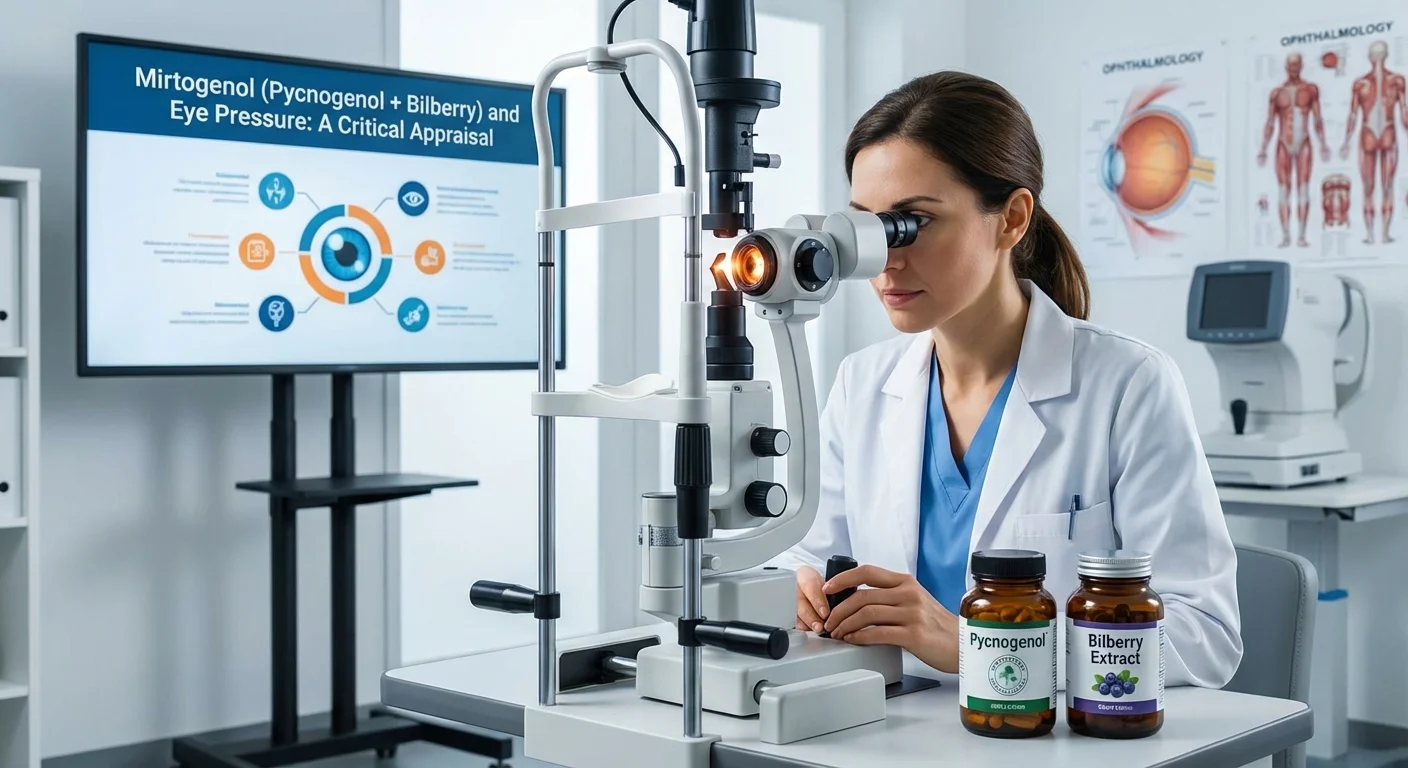
Introduction
Glaucoma – a leading cause of irreversible blindness – is primarily driven by elevated intraocular pressure (IOP) in the eye. Lowering IOP delays or prevents optic nerve damage (pmc.ncbi.nlm.nih.gov). In recent years, interest has grown in natural supplements for eye health. Mirtogenol is one such supplement, a combination of bilberry extract (rich in anthocyanins) and French maritime pine bark extract (Pycnogenol). It is marketed to improve circulation and lower IOP. We critically review the clinical evidence on Mirtogenol and its components (bilberry anthocyanins and Pycnogenol) for reducing IOP and improving ocular blood flow. We examine study designs, results (effect sizes), and mechanisms (e.g. blood vessel function, nitric oxide) – as well as author conflicts, reproducibility, safety, and practical cost-effectiveness.
What Is Mirtogenol?
Mirtogenol® is a proprietary supplement blend containing two main ingredients: Mirtoselect®, a standardized bilberry fruit extract (Vaccinium myrtillus) with ~36% anthocyanins, and Pycnogenol®, a French maritime pine bark extract rich in procyanidins (pmc.ncbi.nlm.nih.gov). Typical “Mirtogenol” doses in clinical studies are about 80 mg bilberry + 40 mg pine bark taken twice daily (total ~240 mg daily) (pmc.ncbi.nlm.nih.gov), though some trials used lower dosing (e.g. 90 mg/40 mg once daily (pmc.ncbi.nlm.nih.gov)). Bilberry anthocyanins are thought to strengthen capillaries and improve microcirculation, while Pycnogenol has known antioxidant and vascular effects. Both ingredients have been used individually for diabetic retinopathy and circulatory disorders. Mirtogenol is sold over-the-counter (not regulated as a drug) for ocular health and lowering “ocular hypertension,” but its clinical utility needs close scrutiny.
Clinical Trials: IOP and Blood Flow
Several small clinical trials have tested Mirtogenol’s effects on IOP and eye blood flow. Key trials include Steigerwalt et al. (2008, 2010), Gizzi et al. (2017), and Manabe et al. (2020). Across studies, the sample sizes were relatively modest (tens of patients), and study quality varied (often open-label or registry-based rather than placebo-controlled). Results generally suggest some IOP reduction and improved ocular circulation, but with caveats.
-
Steigerwalt et al. 2008 (Mol Vis) was a six-month open-label trial in 38 healthy adults with ocular hypertension (IOP 22–26 mmHg). Twenty subjects took Mirtogenol (80 mg Pycnogenol + 160 mg bilberry per day) and 18 were untreated controls (pmc.ncbi.nlm.nih.gov). By 3 months, the Mirtogenol group’s mean IOP dropped from about 25.2 to 22.0 mmHg – a reduction of ~3.2 mmHg (≈13%) (pmc.ncbi.nlm.nih.gov). In contrast, untreated controls’ pressure changed very little. Nineteen of 20 treated patients had lowered IOP at 3 months, versus only 1 of 18 controls (pmc.ncbi.nlm.nih.gov). Color-Doppler imaging showed significant increases in blood flow (both systolic and diastolic velocities) in key eye arteries after 3–6 months on Mirtogenol (pmc.ncbi.nlm.nih.gov). No side effects were reported. This study suggests Mirtogenol can modestly reduce elevated IOP and improve ocular perfusion over a few months (pmc.ncbi.nlm.nih.gov) (pmc.ncbi.nlm.nih.gov).
-
Steigerwalt et al. 2010 (Clin Ophthalmol) was a randomized trial in 79 patients with very high ocular hypertension (baseline IOP ≈37–38 mmHg, no glaucoma). Patients were assigned to three groups: Mirtogenol alone (one tablet daily, containing 40 mg pine + 80 mg bilberry), latanoprost eye drops alone, or both combined (pmc.ncbi.nlm.nih.gov) (pmc.ncbi.nlm.nih.gov). After 16–24 weeks, all groups showed large IOP drops. Mirtogenol alone reduced mean IOP from ~38.1 to 29.0 mmHg after 16 weeks (a drop of ~9 mmHg) (pmc.ncbi.nlm.nih.gov). For comparison, latanoprost alone dropped IOP from 37.7 to 27.2 mmHg within 4 weeks (pmc.ncbi.nlm.nih.gov). The combination of Mirtogenol + latanoprost lowered IOP most: to 23.0 mmHg after 24 weeks (versus 27.2 mmHg with latanoprost alone) (pmc.ncbi.nlm.nih.gov). In other words, adding Mirtogenol yielded a few extra mmHg improvement. All groups improved ocular blood flow over time, but combination therapy showed higher diastolic flow after 12+ weeks (pmc.ncbi.nlm.nih.gov) (pmc.ncbi.nlm.nih.gov). The authors concluded Mirtogenol worked “almost as effectively” as latanoprost on IOP (though it took longer: months vs weeks) and that combined therapy was most effective (pmc.ncbi.nlm.nih.gov) (pmc.ncbi.nlm.nih.gov). There were no serious side effects beyond what latanoprost causes (pmc.ncbi.nlm.nih.gov). This suggests a potentially additive effect, but again in a small trial (23–29 patients per arm) with unblinded design.
-
Gizzi et al. 2017 (Europe Rev Med Pharmacol Sci; cited in reviews) reported a 12-week registry study of 88 patients with ocular hypertension. Three groups were compared: (a) latanoprost + Mirtogenol, (b) latanoprost alone, (c) dorzolamide/timolol + Mirtogenol. All groups had significant IOP reductions and improved retinal microcirculation over 12 weeks, with the latanoprost+Mirtogenol group showing a slightly greater effect on IOP and blood flow (pmc.ncbi.nlm.nih.gov). For example, patients receiving supplements showed better perfusion in the circle of Zinn-Haller (optic nerve circulation) than those on latanoprost alone (pmc.ncbi.nlm.nih.gov). This study’s abstract notes that oxidative stress markers improved only in the supplemented groups, not in eye-drop–only patients (pmc.ncbi.nlm.nih.gov). However, the full data are not easily accessible (published as a brief report) and the study was not placebo-controlled. It does reinforce the earlier finding: Mirtogenol as adjunct may marginally enhance IOP lowering and ocular blood flow (pmc.ncbi.nlm.nih.gov).
-
Manabe et al. 2020 (J Clin Biochem Nutr) tested supplements of French pine bark (40 mg) and bilberry (90 mg) once daily in 18 Japanese patients (29 eyes) with primary open-angle glaucoma already on 1–3 medications (baseline IOP ≥15 mmHg). Over 4 weeks, mean office IOP fell from 17.2 to 15.7 mmHg (an 8.7% reduction, p=0.0046) (pmc.ncbi.nlm.nih.gov). Home measurements likewise showed a 5.7% drop in morning IOP (p=0.029). About half the patients were “non-responders” with no IOP change (pmc.ncbi.nlm.nih.gov). No significant changes occurred in systemic oxidative stress tests (pmc.ncbi.nlm.nih.gov). This small open-label study (short duration, no control group) suggests even a moderate-dose bilberry+pine supplement might lower IOP modestly (~1–2 mmHg) in medicated glaucoma patients (pmc.ncbi.nlm.nih.gov).
Other Evidence on Components: Pure bilberry or Pycnogenol formulations have also been studied. For example, black currant anthocyanins (similar to bilberry) 50 mg/day in a double-blind trial lowered mean IOP by ~1–2 mmHg over 2–4 weeks in healthy subjects, significantly more than placebo (pubmed.ncbi.nlm.nih.gov). Over 2 years in glaucoma patients, those on black currant anthos had better-preserved visual fields and increased optic nerve head blood flow, compared to non-supplemented patients (pmc.ncbi.nlm.nih.gov) (pubmed.ncbi.nlm.nih.gov). Conversely, one small Japanese trial adding bilberry+ginkgo extracts showed improved visual function in normal-tension glaucoma but did not significantly change IOP (pmc.ncbi.nlm.nih.gov). There is little direct data on Pycnogenol alone for IOP, but its known vascular effects (see below) inform the combination rationale.
Effect Sizes: In sums, the reported IOP drops with Mirtogenol were modest: about 3 mmHg (13%) in one 2008 trial (pmc.ncbi.nlm.nih.gov), and 9–14 mmHg (20–30%) in trials of very high-IOP patients (pmc.ncbi.nlm.nih.gov). The percentage reductions are similar to typical glaucoma eye drops, but Mirtogenol’s effects usually took longer (several months) than drugs like latanoprost. Importantly, most studies lacked a placebo group, and the patient numbers were small. One should interpret the effect sizes with caution, as the magnitude could be overstated in open-label settings.
Proposed Mechanisms
How might Mirtogenol affect eye pressure or flow? The components’ biological actions provide clues:
-
Endothelial Function & Nitric Oxide: Vascular dysfunction (narrowed capillaries) can contribute to glaucoma. Pycnogenol is known to improve endothelial function and increase nitric oxide (NO) production in blood vessels (pmc.ncbi.nlm.nih.gov). For example, human trials show daily Pycnogenol can augment endothelium-dependent vasodilation (pmc.ncbi.nlm.nih.gov). Increased NO causes blood-vessel relaxation and may improve blood supply in the optic nerve. Generate more NO could also lower resistance in the trabecular meshwork (outflow channels), although direct evidence is lacking. In the Mirtogenol studies, improved ocular arterial flow suggests better microvascular perfusion over time (pmc.ncbi.nlm.nih.gov).
-
Ciliary Capillary Permeability: The ciliary body in the eye produces aqueous humor. Bilberry anthocyanins (Mirtoselect) were shown in animal models to reduce hyperpermeability of ciliary capillaries – i.e. they “tighten” the blood–aqueous barrier (pmc.ncbi.nlm.nih.gov). In other words, bilberry extract prevented leakage of dye into the eye fluid after surgical insult. If human ciliary capillary permeability is lowered, it could reduce the amount of aqueous making it into the eye, thus lowering IOP. This is one hypothesized reason Mirtogenol might lower fluid formation (pmc.ncbi.nlm.nih.gov).
-
Antioxidant and Anti-Inflammatory Effects: Both bilberry anthocyanins and Pycnogenol are powerful antioxidants. Oxidative stress and inflammation are implicated in trabecular meshwork dysfunction and optic nerve damage. By scavenging free radicals and inhibiting inflammatory mediators, Mirtogenol may preserve ocular cells. In one study, Mirtogenol supplementation reduced systemic oxidative stress markers compared to controls (pmc.ncbi.nlm.nih.gov). This might protect the optic nerve or improve overall ocular circulation indirectly.
-
Additive/“Synergistic” Action: The clinical studies with added glaucoma drugs hint at complementary mechanisms. Prostaglandin analog drops (like latanoprost) mainly increase outflow of fluid. Mirtogenol may primarily act by reducing fluid production (via ciliary capillary effects) and improving blood flow (via NO). Together, they yield better results than either alone (pmc.ncbi.nlm.nih.gov) (pmc.ncbi.nlm.nih.gov).
In summary, Mirtogenol is thought to work by improving endothelial (vascular) function, boosting nitric oxide, reducing capillary leakiness, and providing antioxidant protection (pmc.ncbi.nlm.nih.gov) (pmc.ncbi.nlm.nih.gov). However, these mechanisms come largely from animal or indirect studies; direct proof in the eye is limited. Some evidence (e.g. increased retinal artery flow) is consistent with enhanced circulation (pmc.ncbi.nlm.nih.gov).
Study Design & Quality
Most Mirtogenol studies were small and open-label. Their designs often had key limitations:
-
Controls: The 2008 Mol Vis trial used an untreated control group rather than a placebo pill (pmc.ncbi.nlm.nih.gov). The 2010 trial was randomized but not placebo-masked. The observational 2017 study had no randomization or blinding. Only the black-currant anthocyanin studies mentioned above were clearly double-blind, place-controlled. Without placebo controls, patient expectations could influence outcomes (placebo effect can lower IOP slightly).
-
Sample Size: These studies had tens of subjects (e.g. 20 treated vs 18 controls (pmc.ncbi.nlm.nih.gov), 79 total in the 2010 RCT). While these sizes can detect large changes, smaller benefits might be missed or overestimated. The Japan 2020 study had just 18 subjects (29 eyes) and 4-week duration (pmc.ncbi.nlm.nih.gov) – effectively a small pilot trial.
-
Duration: Most trials ran 3–6 months; one was just 4 weeks (pmc.ncbi.nlm.nih.gov). Glaucoma is a chronic disease, so ideally long-term studies are needed. It’s not known whether Mirtogenol’s benefits persist or require continuous use.
-
Outcomes: All studies measured IOP with standard tonometry (Goldmann device) and often repeated measures to reduce variability. Many also measured ocular blood flow via Doppler imaging. Reported p-values show most IOP changes were statistically significant (p<0.05) (pmc.ncbi.nlm.nih.gov) (pmc.ncbi.nlm.nih.gov) (pmc.ncbi.nlm.nih.gov). However, without independent replication, statistical significance can be misleading.
Given these issues, the quality of evidence is low to moderate by medical standards. None of the trials qualifies as a large-scale, double-blind, placebo-controlled trial – the gold standard. Thus the findings should be seen as preliminary.
Conflicts of Interest & Reproducibility
Many of the Mirtogenol studies involve authors affiliated with the supplement’s manufacturers. For example, the combination Mirtogenol is a registered trademark of Indena (Italy) and Horphag Research (UK) (pmc.ncbi.nlm.nih.gov) – companies that produce bilberry and pine extracts. Key authors on the 2008 and 2010 Steigerwalt papers are Indena researchers or Horphag-associated (Paolo Morazzoni and Ezio Bombardelli are Indena co-founders, for instance). These studies did not clearly declare conflicts of interest, raising concern about bias. In the Japanese trial (pmc.ncbi.nlm.nih.gov), three authors disclosed ties to Santen Pharmaceutical (who markets a related supplement); two were company employees (pmc.ncbi.nlm.nih.gov).
In contrast, independent confirmation of the results is limited. Apart from Indena/Horphag-linked teams and a notable Asian research group, peer-reviewed independent trials are scarce. To our knowledge, no large multicenter RCT has replicated the findings. There are no published negative trials. The positive results, often from a single research group, may reflect publication bias or selective reporting. A recent herbal-glaucoma review notes that all Mirtogenol studies show benefit, but it also calls for further studies (pmc.ncbi.nlm.nih.gov). In summary, while the reported effects are promising, they rely on a few small, company-linked trials. This situation merits caution about reproducibility.
Safety Profile
Across published trials, Mirtogenol was well tolerated. Steigerwalt et al. reported no adverse effects or dropouts in their 6-month trial (pmc.ncbi.nlm.nih.gov). The 2010 trial likewise noted “no serious side effects”, only the typical latanoprost effects (for the eye-drop groups) (pmc.ncbi.nlm.nih.gov). In the 2017 supplement registry, “all managements were well-tolerated [with] no side effects” (pubmed.ncbi.nlm.nih.gov). The Japanese 4-week trial did not note any issues with the bilberry/pine supplement (pmc.ncbi.nlm.nih.gov).
These findings are not surprising, as both bilberry extracts and Pycnogenol have long records of use. Reported common side effects of Pycnogenol (from other contexts) include mild gastrointestinal upset or headache, but these were not observed in the eye pressure trials. Because regulatory oversight of supplements is limited, precise safety data are scant, but no red flags have emerged from the small studies. Importantly, no eye-drop or medication was replaced – Mirtogenol was added on. Therefore, any safety issues have to do only with the supplement itself.
However, caution is sensible: pregnant or breastfeeding women were excluded from all trials (pmc.ncbi.nlm.nih.gov), and product labels often advise against use in pregnancy. Pycnogenol can affect blood clotting slightly and might interact with anticoagulant drugs. Anyone on medications or with chronic illness should consult a doctor before adding supplements. Overall, though, the safety profile in eye-related studies appears favorable.
Clinical Relevance & Cost-Effectiveness
The critical question is whether Mirtogenol’s modest benefits justify its use in practice. The available evidence suggests only a small to moderate effect on IOP (on the order of a few mmHg reduction) over months, achieved in research settings with motivated patients. This is not trivial, but it is far from a cure. Conventional glaucoma medications (eye drops, laser, surgery) remain far more potent and well-proven in lowering IOP. Mirtogenol is not a substitute for prescription treatment when needed.
As an adjunct – say, for someone with mild ocular hypertension or as extra support – Mirtogenol might be considered. The Japanese study showed a further 8–9% IOP reduction even in patients already on drops (pmc.ncbi.nlm.nih.gov), similar to other add-on strategies. If future studies confirm synergy (as the 2010 trial and registry hinted), Mirtogenol could have a role alongside medications. But this is speculative until larger trials in commercial populations are done. The American Academy of Ophthalmology does not list any supplement as standard glaucoma therapy; Mirtogenol is not part of any treatment guidelines.
Cost is also a factor. Mirtogenol is sold as a dietary supplement, out-of-pocket. In the US, a 30-day supply of Life Extension’s “Eye Pressure Support with Mirtogenol” costs about $30 on discount (www.lifeextension.asia). Many people take two tablets per day, which would double that cost (about $720 per year). Insurance won’t cover supplements. By comparison, a generic timolol eye drop might cost under $5–10 per month. For such a price, you'd expect a clear benefit; but for Mirtogenol, the effect is borderline. A cost-effectiveness analysis specifically for Mirtogenol has not been done. Based on current data, any potential reduction in glaucoma risk must be weighed against the substantial cost of long-term supplementation.
Conclusion
In summary, Mirtogenol (bilberry+Pycnogenol) has shown some ability to lower elevated eye pressure and improve ocular blood flow in small studies (pmc.ncbi.nlm.nih.gov) (pmc.ncbi.nlm.nih.gov). Proposed mechanisms (better blood vessel function, more nitric oxide, less capillary leak) are biologically plausible (pmc.ncbi.nlm.nih.gov) (pmc.ncbi.nlm.nih.gov). Importantly, the supplement appears safe in the short term (pmc.ncbi.nlm.nih.gov) (pubmed.ncbi.nlm.nih.gov).
However, major caveats apply. The trials to date are few, small, and often linked to the supplement’s makers. None are large, placebo-controlled trials. Effect sizes, while statistically significant in these studies, are modest and come from non-independent research. It remains unclear whether the IOP reductions seen would persist long-term or translate into less glaucoma progression. The supplementation is expensive and not covered by insurance.
Verdict: Mirtogenol might offer a slight adjunct benefit in lowering eye pressure and improving ocular circulation, but current evidence is not robust enough to recommend it as a primary therapy. Patients interested in supplements should discuss with their ophthalmologist. Traditional glaucoma treatments (drops, lasers, surgery) have far stronger evidence. If Mirtogenol is tried, it should be in addition to – not instead of – proven treatments. More rigorous, independent clinical trials are needed to confirm its effects and value in eye pressure management.