
Introduction
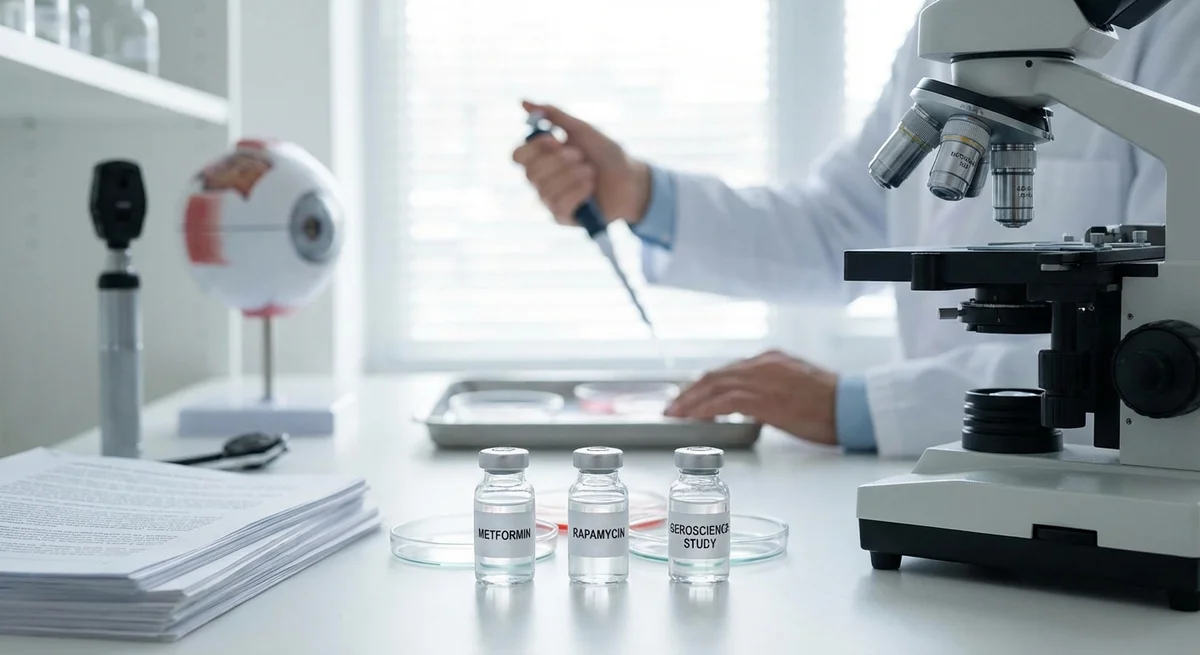
Age-related vision loss from macular degeneration (AMD), glaucoma, and diabetic retinopathy (DR) is often tied to the biology of aging. Researchers are now exploring whether drugs known to affect aging – dubbed geroprotectors – might also protect the eye. In particular, medications like metformin, rapamycin (and related “rapalogs”), SGLT2 inhibitors, acarbose, and new senolytics have drawn attention. These agents influence key aging pathways such as the mTOR signaling network, autophagy, mitochondrial health, and cellular senescence. Here we review what is known about these geroscience drugs and their impact on AMD, glaucoma, and DR – summarizing population studies, laboratory experiments, and early trials. We then contrast observational signals with intervention data and suggest priorities for future eye-focused trials.
Metformin and Eye Health
Metformin is a widely used diabetes medication that also activates AMP-activated kinase (AMPK), mimics calorie restriction, and can reduce cellular stress. It influences autophagy (the cell’s cleanup process), improves mitochondrial function, lowers inflammation, and even affects senescent cells (pmc.ncbi.nlm.nih.gov) (pmc.ncbi.nlm.nih.gov). These actions suggest potential benefit for age-related eye diseases.
Metformin and AMD
Observational studies suggest metformin users have lower AMD rates. A recent meta-analysis of over 2.6 million people found metformin use was associated with about a 14% reduced odds of developing AMD (pmc.ncbi.nlm.nih.gov). The benefit appeared in both diabetic and non-diabetic individuals. For example, a large Chinese retrospective study found only 15.8% of long-term diabetic metformin users had AMD versus 45.2% of non-users (pmc.ncbi.nlm.nih.gov). In mice with AMD-like retina damage, diabetes treatment with metformin slowed retinal degeneration (similar to rapamycin in OXYS rats) (pubmed.ncbi.nlm.nih.gov).
However, a randomized trial-like follow-up of a diabetes prevention study found no difference in AMD rates between metformin-treated and control groups after 16 years (pmc.ncbi.nlm.nih.gov). This shows observational signals can be misleading: biases in who gets metformin (e.g. younger, healthier diabetics) might explain part of the apparent benefit. Thus, despite many studies hinting at protection, the only long-term trial data do not confirm a metformin effect on AMD.
Metformin and Glaucoma
Several large studies have associated metformin with lower glaucoma risk. In a Dutch population study, diabetic patients on metformin had far lower open-angle glaucoma incidence than diabetics untreated (lifetime risk ~1.5% vs. 7.2% in non-diabetic peers) (pmc.ncbi.nlm.nih.gov). In a U.S. cohort of 18,000 diabetics, metformin users had about one-third the odds of developing glaucoma as non-users (pmc.ncbi.nlm.nih.gov). Mechanistic research supports this: in mice with retinal injury, metformin preserved retinal ganglion cells (which form the optic nerve) by stimulating autophagy and mitochondrial quality control (pmc.ncbi.nlm.nih.gov) (pmc.ncbi.nlm.nih.gov). Clinically, diabetics with glaucoma on metformin showed no visual-field decline over 6 months, whereas those on insulin did deteriorate (pmc.ncbi.nlm.nih.gov).
Yet not all studies agree. A six-year follow-up of an Indian eye cohort saw no difference in glaucoma incidence between diabetic metformin users and non-users (pmc.ncbi.nlm.nih.gov). Differences in populations, diabetes control, and glaucoma definition may explain the mixed results. In summary, metformin’s neuroprotective actions (via AMPK and autophagy) make it an appealing glaucoma therapy, but clinical proof is still lacking.
Metformin and Diabetic Retinopathy
Metformin’s glucose-lowering and anti-inflammatory effects could slow diabetic retinopathy. Preclinical work suggests it reduces retinal inflammation and oxidative stress. Observationally, some studies have found metformin use is associated with less retinopathy among diabetics, though the evidence is not as strong as for AMD or glaucoma. A recent umbrella review found no clear relationship between metformin and reduced DR risk in diabetes (pmc.ncbi.nlm.nih.gov). However, basic research shows metformin can blunt high-glucose damage in retinal cells. For example, in diabetic mice, metformin partially prevented blood-retina barrier leakage (pubmed.ncbi.nlm.nih.gov). Overall, metformin remains a candidate worth testing in DR trials, but high-quality clinical data are sparse.
Rapamycin (Rapalogs) and Eye Aging
Rapamycin and related drugs (everolimus, sirolimus) directly block mTOR, a key nutrient-sensing kinase. Inhibition of mTOR is a classic longevity mechanism: rapamycin extends lifespan in many animals and suppresses cellular senescence (pubmed.ncbi.nlm.nih.gov) (pmc.ncbi.nlm.nih.gov). In the eye, mTOR activity tends to rise with age and in disease states (pmc.ncbi.nlm.nih.gov). Blocking mTOR with rapalogs boosts autophagy, lowers oxidative stress, and can reduce inflammatory senescence signals (pubmed.ncbi.nlm.nih.gov) (pmc.ncbi.nlm.nih.gov).
Rapamycin and AMD
Animal studies suggest rapamycin protects against AMD-like changes. In senescence-accelerated rats (a model of dry AMD), oral rapamycin greatly reduced the development and severity of retinal lesions (pubmed.ncbi.nlm.nih.gov). It cleared abnormal cells in the retinal pigment epithelium (RPE), preserved photoreceptors, and prevented neuron shrinkage (pubmed.ncbi.nlm.nih.gov). In cultured human RPE cells stressed by high glucose, mTOR inhibition reduced oxidative damage (pmc.ncbi.nlm.nih.gov).
However, human trials of rapalogs in AMD have not yet shown benefit. A Phase I/II trial testing subconjunctival sirolimus injections in geographic atrophy (dry AMD) found that the drug was safe but produced no slowing of lesion growth or visual loss (pmc.ncbi.nlm.nih.gov). Ongoing trials are evaluating rapamycin-like drugs for AMD, but as of now there is no clinical proof of benefit. It might be that blocking mTOR alone is not enough, or that different delivery/time is needed.
Rapamycin and Glaucoma
Glaucoma shares features with neurodegenerative disease and involves RGC death partly driven by oxidative stress. Experimental work suggests rapamycin could protect RGCs. In diabetic or ischemic retinal injury models, mTOR blockade reduced apoptosis and inflammation in the retina (pmc.ncbi.nlm.nih.gov). Rapamycin also inhibits angiogenic factors, which might help certain secondary glaucoma (like neovascular glaucoma), though this is unproven. No glaucoma clinical trial of rapamycin exists to date, but the idea of mTOR inhibitors as neuroprotectants in glaucoma is under discussion.
Rapamycin and Diabetic Retinopathy
Since DR involves chronic hyperglycemia and inflammation, mTOR is implicated in its pathology. In diabetic animals, mTOR inhibitors reduce retinal vascular leakage and neuronal loss (pmc.ncbi.nlm.nih.gov). A small clinical trial gave oral rapamycin to patients with diabetic macular edema (swelling) and found it was safe but with uncertain efficacy (pmc.ncbi.nlm.nih.gov). Overall, evidence here is very preliminary. The biggest hurdle for rapalogs is their immune-suppressive effects; for example, some rapamycin-treated patients develop mouth sores or risk infection, which limits dose. Future studies might look at eye-selective delivery or newer agents that fine-tune mTOR.
SGLT2 Inhibitors and Eye Diseases
SGLT2 inhibitors (such as empagliflozin, canagliflozin, dapagliflozin) are diabetes drugs that act on the kidney to lower blood sugar and blood pressure. They also reduce heart and kidney complications of diabetes. Recent work suggests SGLT2 inhibitors may benefit the eye as well.
SGLT2 Inhibitors and Diabetic Retinopathy
Large observational studies show that SGLT2 inhibitor use is linked to less DR. In a nationwide Taiwanese cohort (3.5 million people), patients on SGLT2 inhibitors had significantly lower rates of sight-threatening DR than those on other diabetes drugs (pmc.ncbi.nlm.nih.gov). Meta-analyses of real-world studies also found up to ~30% reduction in DR progression and vision-threatening DR with SGLT2 therapy (pubmed.ncbi.nlm.nih.gov). However, randomized trials of SGLT2 effects on DR have been inconclusive so far (pubmed.ncbi.nlm.nih.gov), partly because existing diabetes trials did not focus on the eyes.
Importantly, laboratory research shows SGLT2 inhibitors may protect the retina directly. In diabetic mice, dapagliflozin reduced capillary damage and neuron loss in the retina (pubmed.ncbi.nlm.nih.gov). Dapagliflozin also raised levels of FGF21, a factor known for anti-aging effects, in the eye (pubmed.ncbi.nlm.nih.gov). Another study found that SGLT2 is present in retinal pericytes (cells that support blood vessels), and that blocking SGLT2 reduced oxidative stress and inflammation in retinal vessels (pmc.ncbi.nlm.nih.gov). In various animal models of DR, SGLT2 inhibitors decreased VEGF production and vascular leakage (pmc.ncbi.nlm.nih.gov). These findings suggest SGLT2 drugs work beyond sugar control – by improving retinal blood flow, reducing stress signals, and stabilizing capillaries.
A small clinical trial (ongoing in Egypt) is now randomizing diabetic patients with early DR to add an SGLT2 inhibitor (dapagliflozin 10 mg) versus standard care (clinicaltrials.gov). If positive, such trials could demonstrate that SGLT2i slow DR progression, making them truly “retinoprotective” drugs.
SGLT2 Inhibitors and AMD
Some studies have looked at SGLT2 inhibitors for AMD. In the same Taiwanese database, new SGLT2 users had about a 30% lower risk of developing AMD than similar patients not on SGLT2i (pubmed.ncbi.nlm.nih.gov). A multinational cohort study also reported that diabetic patients on SGLT2 inhibitors had significantly lower hazard of AMD than those on DPP-4 inhibitors (pmc.ncbi.nlm.nih.gov). The protective effect seemed strongest for dry AMD (odds ~40% lower). The reason is unclear, but it might relate to overall metabolic improvements (less glycemic flux and inflammation), or to better blood pressure and vascular health.
No clinical trial has specifically tested SGLT2 inhibitors for AMD prevention. However, the accumulating observational evidence is intriguing. Given SGLT2 drugs are generally safe and U.S. guidelines increasingly recommend them for diabetics, their potential AMD protection is an added motivator for doctors and patients.
SGLT2 Inhibitors and Glaucoma
There is little data on SGLT2i for glaucoma. One could speculate that their blood pressure–lowering and diuretic effects might modestly reduce intraocular pressure, but no study has confirmed this. Research has focused on DR and AMD rather than glaucoma for SGLT2 drugs, so this area remains open.
Acarbose and Diabetic Eye Aging
Acarbose is an older diabetes drug that slows carbohydrate absorption in the gut. It effectively blunts post-meal blood sugar spikes, which in theory should reduce advanced glycation endproducts (AGEs) and oxidative stress on blood vessels. Acarbose has been linked to life extension in some mouse studies (thought to be a calorie restriction mimetic), but human data are limited.
In the retina, acarbose’s primary effect would be to reduce glucose exposure. In diabetic rat experiments, acarbose prevented the hallmark thickening of the retinal capillary basement membrane (pubmed.ncbi.nlm.nih.gov), a structural change that leads to leakage and damage. Another rat study found acarbose largely reversed the abnormal blood flow seen in early diabetic retinopathy (pubmed.ncbi.nlm.nih.gov). These findings show that lowering sugar surges can protect the tiny vessels of the eye.
However, there are no large clinical studies in humans connecting acarbose with eye outcomes. Because acarbose works only in the digestive tract and is usually less potent than newer drugs, its eye effects have not been a research priority. It may still be worthwhile to study acarbose in high-risk diabetic patients (for example, combining it with other agents) to see if microvascular damage can be delayed. For now, acarbose is a plausible geroadjuvant for the retina mainly via its anti-hyperglycemic action.
Senolytics and Ocular Aging
Senescent cells are aged cells that no longer divide and that secrete inflammatory signals (SASP factors). They accumulate in aged tissues, including the eye, and contribute to disease. Senolytic drugs selectively kill senescent cells, reducing that toxic inflammatory milieu.
Research shows senescent cells appear in the retinal pigment epithelium (RPE) and neural retina in AMD, glaucoma, and DR. For instance, aged human RPE and primate retina contain markers of senescence (pmc.ncbi.nlm.nih.gov). In X-ray–accelerated AMD mice, senescent RPE cells drive degeneration. In a breakthrough study, clearing those senescent RPE cells with a targeted senolytic (an MDM2–p53 inhibitor) allowed retinal regeneration and halted vision loss in AMD-model mice (pmc.ncbi.nlm.nih.gov). This provides strong proof-of-concept: removing senescent cells in the retina can slow or partially reverse degeneration.
In diabetic eye disease, senescence also plays a role. Hyperglycemia and stress in DR can trigger premature senescence in retinal vascular cells (pmc.ncbi.nlm.nih.gov). A review of DR models noted that eliminating senescent retinal cells (with senolytics like dasatinib+quercetin or navitoclax) might prevent capillary damage and abnormal neovascularization (pmc.ncbi.nlm.nih.gov). Indeed, a novel agent UBX-1325, specifically targeting senescent cells, is being tested: early data in diabetic macular edema and wet AMD showed improved vision after UBX-1325 injection (pmc.ncbi.nlm.nih.gov). In laboratory models, UBX-1325 removed senescent cells, reduced retinal neovascularization and leakage, and enhanced response to VEGF blockers (pmc.ncbi.nlm.nih.gov).
Glaucoma has also been linked to senescence. High intraocular pressure can induce stress and senescence in retinal ganglion cells and glia. In a mouse glaucoma model, killing senescent retinal cells with dasatinib preserved the remaining ganglion cells and visual function (pmc.ncbi.nlm.nih.gov). In humans, a small retrospective study of glaucoma patients who happened to take senolytic drugs (for other reasons) found no harm: their vision and eye pressure stayed stable, and visual field loss did not accelerate compared to controls (pmc.ncbi.nlm.nih.gov). This work suggests senolytics are safe for the eye and might even be protective.
Several senolytic compounds are of interest. Besides UBX-1325, others include dasatinib (a cancer drug) with quercetin (a plant flavonoid), fisetin, navitoclax, and others (pmc.ncbi.nlm.nih.gov). Some (like fisetin) are being tested in human trials for various age-related conditions. None are yet approved for eye diseases. But because senolytics target a root cause of multiple aging pathologies, there is growing enthusiasm for testing them in AMD, DR, and glaucoma – using anatomical and functional endpoints.
Observational vs. Interventional Evidence
Overall, observational studies often hint that geroprotective drugs might slow eye disease, but clinical trials have so far been equivocal. For example:
-
Metformin: Many large cohort studies suggest lower AMD and glaucoma risk with metformin use (pmc.ncbi.nlm.nih.gov) (pmc.ncbi.nlm.nih.gov). But the only trial-like data in a diabetes prevention study showed no AMD benefit (pmc.ncbi.nlm.nih.gov).
-
SGLT2 inhibitors: Meta-analysis of trials found no significant DR reduction (pubmed.ncbi.nlm.nih.gov), yet large “real world” cohorts find significant protection (pubmed.ncbi.nlm.nih.gov) (pmc.ncbi.nlm.nih.gov). A neutral or weak trial result alongside strong observational benefit is similar to metformin in AMD.
-
Rapamycin: Animal data are strong, but human trials in AMD and DR have not yet been favorable (pmc.ncbi.nlm.nih.gov) (pmc.ncbi.nlm.nih.gov). Rapalogs’ toxicity also complicates interpretation.
-
Acarbose: To our knowledge there are no human trials for eye outcomes, only animal data.
-
Senolytics: Only very early human data exist (like the UBX-1325 reports and the glaucoma retrospective), but the preclinical results are promising (pmc.ncbi.nlm.nih.gov) (pmc.ncbi.nlm.nih.gov).
In sum, the signals are mixed. Observational data can be confounded (healthier patients receive metformin, or those on SGLT2i might have other advantages). Rigorous trials with ocular endpoints are needed to confirm if any of these drugs truly slow eye aging.
Future Trials and Priorities
To rigorously test the “geroprotective” hypothesis in the eye, well-designed trials are needed. Here are priority ideas:
-
Metformin trials: Randomize older adults (with or without diabetes) to metformin vs. placebo, and follow them for eye outcomes. For example, a trial in people with early AMD could measure progression to late AMD or visual acuity decline. Similarly, a trial in glaucoma suspects could assess whether metformin slows optic nerve damage (e.g. nerve fiber layer thinning by OCT or visual field loss). The Diabetes Prevention Program follow-up suggests metformin does not reduce AMD over ~15 years (pmc.ncbi.nlm.nih.gov), but shorter focused trials in high-risk patients are still of interest.
-
Rapamycin/Rapalogs trials: Small Phase II studies of oral or injectable rapalogs in dry AMD or glaucoma could measure anatomical changes or visual field progression. For example, a trial of low-dose oral rapamycin in progressing AMD (early or intermediate) might track drusen size or GA growth on OCT. Or a glaucoma trial might add rapamycin to standard pressure-lowering therapy and monitor visual field. Delivery to the eye (intravitreal, subconjunctival) is also possible – future drug delivery systems (e.g. encapsulated rapalogs) might enable long-term release.
-
SGLT2 inhibitor trials: Building on the Egyptian dapagliflozin trial (clinicaltrials.gov), more studies should use DR endpoints. Multi-center RCTs could compare SGLT2i vs. another diabetes drug (or placebo on top of background therapy) and measure DR by fundus grading or OCT. Since SGLT2i are already standard for diabetes heart/kidney protection, adding eye exams to those trials (or conducting eye-specific trials) would clarify their ocular benefit.
-
Acarbose and other glycemic modifiers: Given the animal data, one could test acarbose or other glucose-slowing drugs in diabetic patients for microvascular endpoints. For instance, a study in Type 2 diabetics with early retinopathy could evaluate whether adding acarbose to their regimen slows lesion progression (using fundus photography) over 1–2 years.
-
Senolytic trials: These are the most novel. UBX-1325 (now in phase 2) is moving forward, but other senolytics like dasatinib+quercetin could be tried. A possible trial design is to use ocular injections or systemic dosing of a known senolytic in patients with moderate DR or AMD, then track retinal structure (OCT, vascular leakage) and function (vision). Another approach is to leverage existing senolytic trials: for example, trialing fisetin or dasatinib for other aging conditions but also measuring eye exams. The key is selecting appropriate endpoints: early outcomes like reduction of retinal inflammation markers or small vascular changes might foot the path to longer-term trials on vision.
Across all these trials, outcomes should include both anatomic measures (OCT imaging of retina, fluorescein angiography, optic nerve scans) and functional tests (visual acuity, visual fields, contrast sensitivity). Retinal biomarkers of aging (e.g. accumulation of drusen proteins, retinal vessel caliber changes) and quality-of-life assessments can strengthen the case. Importantly, trial designs must account for the slow nature of these diseases – many years may be needed to see clear differences, so surrogate markers will be crucial.
Conclusion
Geroscience drugs like metformin, rapamycin, SGLT2 inhibitors, acarbose, and emerging senolytics show intriguing promise for eye aging. Laboratory studies reveal that these agents can boost autophagy, improve mitochondrial health, and clear senescent cells in the retina and optic nerve (pmc.ncbi.nlm.nih.gov) (pmc.ncbi.nlm.nih.gov). Large patient studies hint that metformin and SGLT2 inhibitors are linked to lower rates of AMD and retinopathy (pmc.ncbi.nlm.nih.gov) (pubmed.ncbi.nlm.nih.gov). However, “signal” is not proof: clinical trial data are just beginning to appear, and so far do not fully confirm the benefits suggested by observational work. For now, we can say these drugs are hypothesis-generators: they target the same aging pathways that affect ocular cells, but we need dedicated randomized trials to know if they really slow vision loss.
The highest priority is to incorporate eye endpoints into trials of these drugs. Some are already underway (e.g. dapagliflozin for retinopathy, UBX-1325 for DME/AMD). Other ideas include testing metformin in AMD or glaucoma, rapamycin analogues in early AMD, and new senolytics in diabetic eye disease. Given aging is a major risk factor for these blinding conditions, finding drugs that safely “turn back the clock” on the retina or optic nerve could transform eye care in the elderly. For now, patients and doctors should view these therapeutic avenues as promising but still unproven. In the coming years, well-designed trials using visual outcomes will be essential to know whether geroprotectors can truly protect our vision as we age.
References: Recent clinical and preclinical studies have examined these links (pmc.ncbi.nlm.nih.gov) (pmc.ncbi.nlm.nih.gov) (pmc.ncbi.nlm.nih.gov) (pmc.ncbi.nlm.nih.gov) (pmc.ncbi.nlm.nih.gov) (pmc.ncbi.nlm.nih.gov) (pmc.ncbi.nlm.nih.gov) (pmc.ncbi.nlm.nih.gov) (pmc.ncbi.nlm.nih.gov). Ongoing trials are testing several hypotheses mentioned above.