
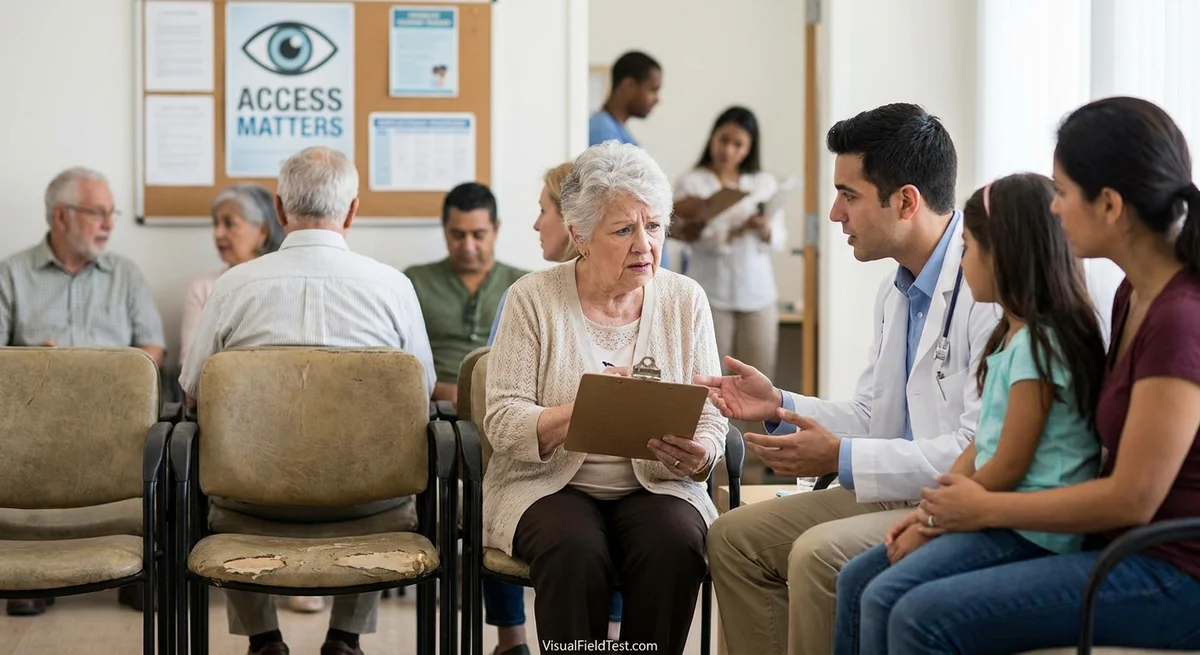
Inequities in Access to Visual Field Testing and Their Consequences
Visual field testing (also called perimetry) is a key tool eye doctors use to catch vision-threatening diseases like glaucoma early. In glaucoma, for example, people usually feel no symptoms until serious vision loss has occurred, so doctors rely on tests to measure the full field of a person’s vision (pmc.ncbi.nlm.nih.gov). Routine visual field tests help detect early damage to the optic nerve before it causes blindness. However, not everyone has equal access to these tests. In many parts of the country, people – especially those in rural areas or with low income – face barriers to getting regular eye exams and visual field tests. This article maps out how geography and socioeconomic factors affect who gets tested, how late disease is caught, and what can be done to close these gaps.
Uneven Access Across Communities
Geographic Barriers
Living far from an eye clinic can make testing hard. A recent large study found glaucoma patients in isolated rural areas were far less likely to get the recommended follow-up eye exams than those in cities (pmc.ncbi.nlm.nih.gov). In fact, rural patients’ odds of receiving a needed optic nerve evaluation were 56% lower than urban patients (pmc.ncbi.nlm.nih.gov). Similarly, research of insured patients across the U.S. found wide variation by community in whether newly diagnosed glaucoma patients get any visual field test: in some places as few as 51% got tested within two years of diagnosis, while in others 95% did (pmc.ncbi.nlm.nih.gov). Some communities had over 25% of new glaucoma patients receive no visual field testing at all in the first two years after diagnosis (pmc.ncbi.nlm.nih.gov). These findings show that where a person lives – and the resources of that community – can make a big difference in whether they get basic vision testing.
Socioeconomic and Insurance Factors
Money matters too. Patients with lower income or without good insurance often get tested less. For example, one study showed that people on Medicaid (public insurance for low-income individuals) with glaucoma were much less likely to get visual field tests compared to patients with commercial insurance (pubmed.ncbi.nlm.nih.gov). Only about 35% of Medicaid patients received a visual field test within 15 months of diagnosis, versus 63% of privately insured patients (pubmed.ncbi.nlm.nih.gov). This means Medicaid patients were over three times as likely to get no glaucoma testing at all after diagnosis (pubmed.ncbi.nlm.nih.gov). Because Medicaid patients are disproportionately low-income and include many racial minorities, these insurance disparities contribute greatly to unequal care.
Racial and Ethnic Disparities
Race and ethnicity intersect with income and location. Studies have found that Black, Hispanic, and Asian patients with glaucoma often receive fewer visual field tests than White patients, even after accounting for age and severity (pmc.ncbi.nlm.nih.gov) (pmc.ncbi.nlm.nih.gov). For instance, Black and Asian glaucoma patients in one clinic-based study underwent about 3–5% fewer tests per visit than White patients, despite having more advanced disease at baseline (pmc.ncbi.nlm.nih.gov). Another analysis showed Black patients had a 17% lower chance of getting the recommended optic nerve exams than White patients, and Hispanic patients also lagged in follow-up visits (pmc.ncbi.nlm.nih.gov). These differences may reflect factors like lower insurance coverage, less access to specialists, or other social determinants of health that vary by race.
Consequences: Later Diagnosis and Faster Progression
When visual field testing is infrequent, vision loss can slip by unnoticed. Late-stage diagnosis is a common result in underserved populations. Since glaucoma causes no early symptoms, patients who lack regular testing often first notice vision problems only after significant damage. A 2015 review warned that without “careful monitoring with diagnostic testing such as perimetry,” patients risk “potentially preventable disease progression and irreversible vision loss” (pmc.ncbi.nlm.nih.gov). In other words, skipping tests can mean missing the window to preserve healthy vision. This is especially worrying because both older age and certain risk factors make disease progress more quickly if not caught early. Studies show that glaucoma not caught in time can advance at rates that make everyday tasks impossible over a patient’s remaining lifetime.
Moreover, lack of consistent testing may lead to faster measured progression. Experts recommend frequent visual field exams (often multiple times per year) for patients with glaucoma to catch any worsening. Research suggests that detecting change in a visual field takes more time if tests are sparse (pubmed.ncbi.nlm.nih.gov). In practice, patients who are monitored only once a year instead of quarterly, for example, might not have a serious worsening noticed until it has become severe. In rural or low-income communities, these delays can translate to higher rates of blindness. One study of hundreds of U.S. glaucoma patients found that only 57% got the recommended exams within three years of diagnosis; many in the remaining 43% likely lost vision needlessly (news.northwestern.edu) (pmc.ncbi.nlm.nih.gov).
In short, when people can’t get regular eye exams and visual field tests, glaucoma and other eye diseases are more often diagnosed late and progress unchecked. This disproportionately impacts disadvantaged groups who already have higher rates of severe glaucoma and vision loss.
Bridging the Gap with Technology and Outreach
Health systems are exploring several approaches to bring visual field testing to underserved communities.
Tele-Perimetry and Remote Testing
Advancements in technology now allow some types of visual field tests to be done outside the doctor’s office. One example is tablet-based perimeters: apps like the Melbourne Rapid Fields (MRF) allow patients to test their visual field on an iPad or similar device. Another is virtual reality (VR) headsets that perform visual field exams in a portable form. Research comparing these new tools to standard ophthalmology equipment has been encouraging. A 2023 study found that tablet-based and VR headset perimeters produced overall results similar to the gold-standard Humphrey Field Analyzer, suggesting they could safely track glaucoma at home or in remote clinics (pubmed.ncbi.nlm.nih.gov) (pubmed.ncbi.nlm.nih.gov). Early trials in telemedicine programs support this: the AL-SIGHT tele-glaucoma project in Alabama found moderate agreement between the tablet test and traditional tests in rural patients (pmc.ncbi.nlm.nih.gov). Tablet perimetry was even described by researchers as a “promising solution to democratize access” to vision screening in rural areas (pmc.ncbi.nlm.nih.gov).
Virtual reality field tests offer additional advantages. Recent reviews highlight that VR-based testing can be more comfortable and engaging for patients, and its digital nature allows results to be uploaded automatically to the cloud (pmc.ncbi.nlm.nih.gov). This means eye doctors can remotely monitor patients’ fields over time. VR systems work with smartphones or simple headsets, removing the need for bulky clinic machines (pmc.ncbi.nlm.nih.gov). In short, tele-perimetry can reduce travel barriers and allow more frequent monitoring. If patients can do some exams at home or at a local clinic, early signals of vision loss will not be missed just because travel or cost was hard.
Mobile Clinics and Community Screenings
When telemedicine isn’t enough, bringing care to the community is another strategy. Mobile eye clinics—vans or buses equipped with eye testing equipment—have been used to reach isolated or inner-city areas. These eye units provide screenings, eye pressure checks, imaging, and often visual field testing on site. A narrative review of U.S. and Canadian mobile eye units highlighted their success: they “directly address persistent barriers” (like lack of transportation and local eye-care providers) and serve high-risk groups (pmc.ncbi.nlm.nih.gov). By parking at community centers, churches, or health fairs, these units catch vision problems in people who otherwise might forego care. For example, mobile units serving diabetic and elderly populations often add glaucoma screening to identify those who need follow-up. Studies show these programs can be scaled up and effective: communities with eye vans or roving equipment see more testing and earlier referrals than similar areas without them. In practice, the presence of a mobile clinic means a low-income neighborhood can get high-quality eye exams (including perimetry) without a hospital trip.
Reimbursement and Policy Reforms
New technology and mobile programs help, but patients will only get tested if providers are paid for it. Unfortunately, current U.S. reimbursement rules often discourage innovation. For instance, Medicare will cover teleglaucoma exams only under strict conditions: the patient must be in a rural area and be physically at a qualifying clinic when tested . There has been no coverage for at-home perimetry. This gap means a doctor who wants to monitor a low-income patient remotely may lose money on the visit, discouraging telemedicine. By contrast, countries like Canada and Australia have broadened coverage. In Australia, Medicare began allowing billing to pay the office doctor for conducting shared tele-eye exams, which led their teleglaucoma program to triple in use within a year (www.ophthalmologytimes.com).
Experts argue that in the U.S., shifting to models that reward keeping patients healthy (such as capitated payments or bundled care) could remove barriers. Under a capitated system, one eye clinic might cover the cost of remote monitoring because preventing blindness saves money long-term (www.ophthalmologytimes.com). Other ideas include reimbursements for community health workers who do initial vision screenings or pay-for-performance for providers serving underserved areas. For example, expanding Medicaid coverage to explicitly include annual visual field tests for at-risk seniors—and paying optometrists for each telehealth retinal/photo consultation—could dramatically boost testing rates.
The U.S. Office of Disease Prevention and Health Promotion (Healthy People 2030) and the CDC’s Vision Health Initiative are already recognizing these needs. The CDC now funds glaucoma screening programs in high-risk regions and supports statewide vision health partnerships (www.cdc.gov). In practice, this means resources for mobile vans, outreach at community clinics, and telemedicine research. Advocates suggest policies like loan-repayment programs to send more ophthalmologists to rural areas, grants for rural health centers to buy testing equipment, and requiring private insurers to cover annual optic nerve checks for glaucoma patients, similar to what Medicare partially does.
Conclusion
Access to visual field testing is not equal. Geographic, financial, and social factors leave many patients – especially the rural poor and marginalized groups – without needed glaucoma monitoring. This leads to glaucoma being caught later and allowed to progress unchecked, costing some people their sight. However, promising solutions exist. Portable testing devices, telemedicine programs, and mobile eye clinics can bring vision exams to the patient rather than the other way around (pubmed.ncbi.nlm.nih.gov) (pmc.ncbi.nlm.nih.gov). At the same time, policy changes such as insurance reforms and provider incentives are needed to make these services sustainable (www.ophthalmologytimes.com) (www.cdc.gov). By combining technology and smart health policies, we can ensure regular visual field testing for all, catching eye disease early and protecting vision in every community.