
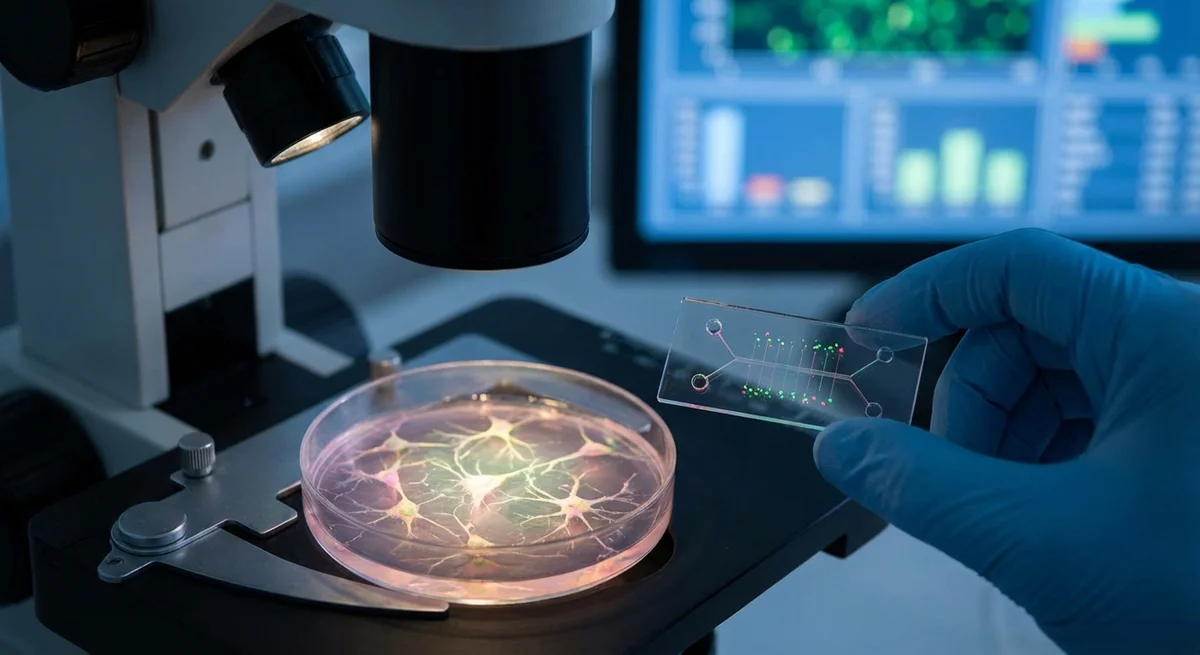
Helping New Cells Survive: How Tiny Drug Carriers May Support Future Vision Repair in Glaucoma
Glaucoma is a leading cause of permanent blindness worldwide. In glaucoma, a type of nerve cell in the eye called a retinal ganglion cell (RGC) gradually dies, leading to loss of vision (pubmed.ncbi.nlm.nih.gov) (pmc.ncbi.nlm.nih.gov). These cells normally carry visual information from the eye to the brain, so when they go, peripheral vision fades and darkness creeps in. Today’s treatments for glaucoma focus on lowering eye pressure (for example with eye drops) to slow damage, but they cannot bring back lost RGCs or recover eyesight (pubmed.ncbi.nlm.nih.gov) (pmc.ncbi.nlm.nih.gov).
Researchers are exploring new ways to one day fix this problem by replacing or protecting those lost nerve cells. One exciting idea is to transplant healthy RGCs (grown from stem cells) into the eye. In principle, these new cells could reconnect the retina to the brain. But there’s a catch: simply planting new cells into a diseased eye is not enough. New transplanted RGCs often do not survive very long. In experiments, many new cells were found trapped in the eye’s fluid without the support they need, and they quickly died (pmc.ncbi.nlm.nih.gov). Because of this, scientists are looking for tricks to help the transplanted cells live and grow.
What scientists are trying to fix
The goal is to fix the damage that glaucoma causes – namely, the loss of RGCs that carry vision signals. Since human RGCs cannot simply regenerate on their own, one approach is to replace them. Scientists can create RGC-like cells from stem cells and transplant them into the retina (pmc.ncbi.nlm.nih.gov). Another goal is to protect the remaining RGCs from dying in the first place, to save patients’ vision.
However, both strategies face big challenges. Any new RGCs (either transplanted or surviving ones) must grow axons (“wires” of the cell that carry signals) all the way to the brain. They need a friendly environment (with nutrients and supporting signals) to survive. The eye tissue in glaucoma is often stressed by high pressure and inflammation, which makes it a harsh place. For example, transplanted cells in rodent eyes were found mostly stuck in the eye fluid (the vitreous) where they lacked life–support signals (pmc.ncbi.nlm.nih.gov). As a result, most died soon after transplant. This low survival rate means simply adding new cells “is not enough to compensate for what glaucomatous retina needs to see again” – it remains an unsolved problem (pmc.ncbi.nlm.nih.gov) (pmc.ncbi.nlm.nih.gov).
What do scientists want to fix? In short, they want to replace or rejuvenate the lost RGCs and restore the optic nerve pathway. This could mean transplanting healthy RGCs (from embryonic or induced stem cells) and helping them integrate, or finding ways to rescue the patient’s own remaining cells with drugs or other therapy. But so far, no method in the clinic can truly restore the lost cells or reconnection in glaucoma (pmc.ncbi.nlm.nih.gov). That’s why researchers are looking at creative new tools – including nanomedicine – to give these transplanted cells a fighting chance.
Why simply adding new cells may not be enough
Picture a garden bed (the retina) where plants (RGCs) have died out. You might think replanting new seedlings should work, but if the soil is poor and the climate harsh, the new plants won’t thrive. The same goes for RGCs. The eye of a glaucoma patient has high pressure, reduced blood flow, and chronic stress on the nerves. A transplanted cell suddenly finds itself in an unfriendly “soil” without enough growth factors. In experiments, even when carefully inserting many healthy RGCs into a mouse retina, most did not survive (pmc.ncbi.nlm.nih.gov).
Research has shown that the transplanted cells not only need nutrients, but also protective signals (like growth factors and anti-death signals) to stay alive and extend their nerve branches (neurites). In one study, scientists found that co-transplanting supportive stem cells (called iPSCs) along with RGCs dramatically improved the survival of the grafted RGCs (pmc.ncbi.nlm.nih.gov). The stem cells secreted helpful factors that kept the RGCs alive and even promoted their nerve growth (pmc.ncbi.nlm.nih.gov). This underlines the need for a supportive environment. Simply dropping replacement cells in the eye, without protection or help, often fails.
What is nanomedicine?
Nanomedicine might sound like science fiction, but it’s essentially medicine at a super tiny scale. A “nano” particle is about one billionth of a meter in size – much smaller than a human cell. Imagine very tiny delivery trucks that can carry medicine directly to where it’s needed. In nanomedicine, scientists design microscopic particles (often made of biodegradable polymers or lipids) to hold drugs or growth factors. These nanoparticles can travel through the eye and release their cargo slowly over time. They can be engineered to target specific cells by surface “labels,” much like adding an address label to a package.
This approach can overcome some eye barriers. For example, eye drops often wash away quickly; injections need repeating. Nanoparticles can stay in the eye longer and protect the drug until it reaches the retina. In glaucoma research, such particles could carry neuroprotective compounds that save RGCs from stress. A recent review notes that nanocarriers are a “promising approach” to address the challenges of delivering neuroprotective drugs to RGCs (pubmed.ncbi.nlm.nih.gov). In short, nanomedicine means using engineered, microscopic drug carriers to deliver therapy precisely and safely in the eye.
How tiny drug carriers may help transplanted cells
Now, how could these tiny carriers help new transplanted RGCs? The idea is to pack each nanoparticle with molecules that protect cells from dying and promote growth. For instance, scientists might use anti-apoptotic agents (which block cell suicide) and growth factors that stimulate nerve extension. When transplanted cells are introduced into the eye, the nanocarriers can release these helpful substances around them. It’s like giving each new cell its own supply of life-preserving medicine.
In practical terms, researchers might inject these nanocarriers into the eye along with the cells. The particles can be designed to stick around the retinal layer where the cells reside. As they slowly break down, they flood the area with protective molecules. This creates a local micro-environment – a safer “soil” – for the fragile grafted cells.
There’s some evidence this strategy can work. For example, an earlier study in mice used targeted nanoparticles carrying a natural protective steroid (DHEA) directly to RGCs. Those nanoparticles accumulated in the RGC layer and significantly prevented ganglion cell death under stress (pmc.ncbi.nlm.nih.gov). In that work, the special particles (guided by a molecule called CTB) preserved RGCs for at least two weeks, whereas particles without targeting did not help (pmc.ncbi.nlm.nih.gov). This shows that if you give the right drug to RGCs via nanoparticles, you can help them survive damage.
The new research on glaucoma takes this further by combining transplanted RGCs with such nanomedicine support. In the latest study, scientists loaded tiny carriers with a mix of molecules designed to block apoptosis and encourage neurite growth. They then transplanted stem-cell-derived RGCs in a glaucoma model (in lab animals). The results were promising: the grafted RGCs lived longer and extended more neural projections when the nanocarriers were present. In other words, the tiny drug packages helped “nurse” the new nerve cells through the stressful early period after transplant.
Importantly, this is not a magic bullet yet. The work was done in the lab (animal models, not people). It showed that more transplanted cells survived with the nanomedicine treatment, but we must be clear: it did not restore vision in these animals. It only demonstrated improved cell survival and neurite growth under laboratory conditions. The researchers measured how many cells remained and how well they grew, but they did not test actual vision outcomes. Still, this proof-of-concept result is an important step, showing the strategy “has potential to augment RGC grafts” without harming the cells.
How far away could this be from real treatment?
It is very important to be realistic: this research is at an early, experimental stage. The positive results so far come from controlled lab studies, not studies in humans. There have never been clinical trials showing that transplanting RGCs can restore vision in glaucoma patients. In fact, experts note that currently there are no therapies that truly restore lost RGCs or rebuild the optic nerve pathway in glaucoma (pmc.ncbi.nlm.nih.gov).
What this new work shows is promise in principle, but there are many hurdles ahead. Scientists will need to repeat and verify the findings, check that this is safe, and test it in more advanced models. Only when a therapy consistently works in animals might it move toward human trials, and that process can take many years. During this time, researchers must also ensure the method is safe and does not cause unwanted effects (for example, immune reactions or other damage).
So far, no vision improvement in people has been demonstrated. The study did not show that vision was restored in the animals – only that more transplanted cells survived with the help of nanomedicine. It’s similar to seeing seedlings sprout in the lab; there’s hope, but it’s not a planted crop yet. We cannot assume this will work the same way in people.
In summary, scientists are far from having a new glaucoma cure based on this idea. This nanomedicine approach is still a proof of concept. It highlights a clever solution to a tough problem, but it will take many more experiments and tests before patients could ever benefit. As one review bluntly puts it, there are currently “no translatable techniques to replace lost RGCs” (pmc.ncbi.nlm.nih.gov). The road from a lab finding to a medical treatment is long.
Conclusion
In plain terms, this research shows a creative way to give new retinal cells a boost. Tiny drug-delivery particles – a kind of nanomedicine – were used to protect transplanted nerve cells in a glaucoma model. The cells fared better with this help, surviving longer and growing more connections. It’s an encouraging laboratory result, but it’s only an early step on a long journey. Right now, it does not restore vision in eyes; it only shows that transplanted cells can be made to survive under tough conditions.
For now, glaucoma patients and families should know that this is promising basic science, not a treatment. It’s a glimpse of a future approach: one day, we might use nanotechnology to help nerve-cell grafts repair an eye. But for the time being, it remains in the realm of experimental research.