
Economics of High-Frequency Home Monitoring vs Clinic-Based Perimetry
Glaucoma is a chronic eye condition that gradually shrinks side (peripheral) vision. It requires ongoing visual field testing (perimetry) to track disease progression and prevent vision loss. Traditionally, these tests are done in the clinic about every 6–12 months (www.sciencedirect.com). However, new home perimetry technologies (tablet apps or headsets) allow patients to test more often at home (journals.lww.com) (www.sciencedirect.com). Home testing could be much more convenient – saving travel and wait time – and might catch changes earlier. For example, in a remote-care model for glaucoma, patients saved an average of 61 travel hours compared to in-person exams (pmc.ncbi.nlm.nih.gov). Yet home tests also have costs (devices and data review) and performance uncertainties. Early reviews point out that while many home and portable perimeters are promising, their real-world accuracy and value still need validation (journals.lww.com).
Clinic-Based vs Home Perimetry
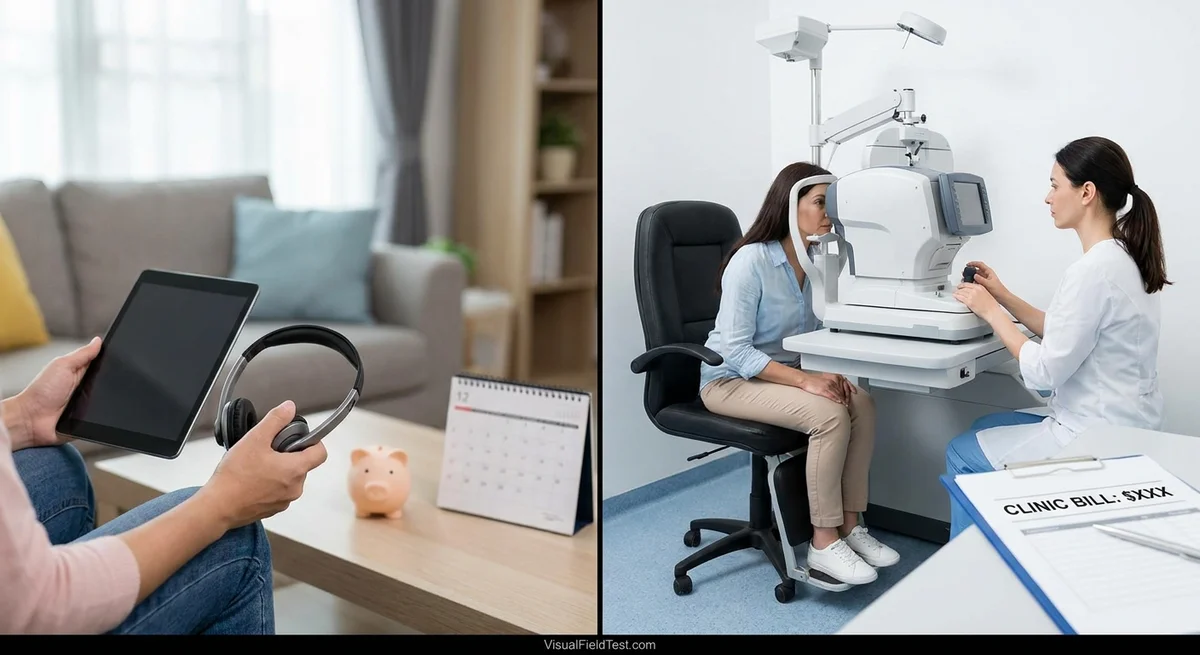
Clinic perimetry is very reliable but requires specialized equipment (like a Humphrey Field Analyzer) and trained staff. It can be costly and burdensome – patients must take time off and possibly travel far for tests. In contrast, home monitoring offers comfort and flexibility. Patients can test on a personal tablet at home, often with simple apps that guide the procedure (www.sciencedirect.com). Users and eye doctors alike are optimistic: one UK study found patients and clinicians were cautiously positive about home glaucoma checks, citing potential convenience and cost-savings (pmc.ncbi.nlm.nih.gov) (pmc.ncbi.nlm.nih.gov). In that study, most patients were able to use home devices regularly – 95% completed follow-up visits and 55% maintained ~80% or better adherence over 3 months (pmc.ncbi.nlm.nih.gov).
However, home tests can be less controlled. For example, one trial of an iPad perimeter found about 44% of the unsupervised tests were flagged as unreliable (often due to distraction or fatigue), versus only 18% in the clinic (www.sciencedirect.com). Nevertheless, well-designed home tests have shown results closely matching clinic tests when done correctly. In fact, home testing had similar false-positive error rates to the clinic test (~14% in both cases) (www.sciencedirect.com). The bottom line is that home perimetry can free patients from some clinic visits (and save on travel and wait time) (pmc.ncbi.nlm.nih.gov), but it also depends on patient tech skills and diligence.
Building Economic Models: Costs and Outcomes
To compare home monitoring with clinic testing, researchers use decision-analytic models (often Markov models) that simulate patient health over many years (openaccess.city.ac.uk) (pmc.ncbi.nlm.nih.gov). These models assign patients to vision states (no vision loss, moderate loss, severe loss) and simulate transitions between them each year. They tally up all costs (device, staff, clinic visits, treatments) and all health outcomes (measured in quality-adjusted life years or QALYs – a combination of length and quality of life).
A QALY of 1 equals one year in perfect vision-health. For example, if home monitoring helps preserve vision and adds 0.1 QALY per patient (about 1.2 extra vision-quality months), and it costs an extra $1,000 per patient, then the cost per QALY is $10,000. Interventions below a country’s cost-effectiveness threshold (often $50,000/QALY in the US or ~£20–30k in the UK) are generally considered good value (jamanetwork.com) (jamanetwork.com).
Key Factors in the Models
Several real-world factors hugely affect the cost-effectiveness of home testing:
-
Frequency and Early Detection: The main gain from home tests is catching vision loss earlier. In a simulation, weekly home tests (with about 63% average compliance) detected disease progression in roughly 11 months on average, compared with 2.5 years under the usual 6-month checks (www.sciencedirect.com). This earlier catch means faster treatment, which can slow vision loss and add QALYs. Models show that ramping up test frequency (like three clinic tests per year instead of one) can be cost-effective in early disease (openaccess.city.ac.uk), but not worth it in very advanced cases. A UK study found that intensive monitoring in patients with already severe glaucoma cost over £60,000/QALY (above the usual NHS threshold) (openaccess.city.ac.uk), whereas in younger or moderate cases it was about £21,000/QALY (below the threshold) (openaccess.city.ac.uk).
-
Patient Adherence: The benefits only materialize if patients actually do the tests. Trial data are encouraging but not perfect. One large study gave glaucoma patients a loaned tablet and asked for weekly tests: 88% did at least one home test and 69% completed all six weekly tests (www.sciencedirect.com). However, over the longer term adherence may fall. In that UK feasibility study, only 55% of patients managed ≥80% of weekly tests (pmc.ncbi.nlm.nih.gov). In modeling, lower adherence means fewer early detections and reduced benefits. (For instance, if patients do tests half as often as expected, you’d need to double the monitoring time to catch the same number of events.)
-
Accuracy and False Alarms: No test is perfect. Some home tests can give false alarms (warning of vision change when none exists). In one trial, about 14% of home test checks gave a false-positive result (www.sciencedirect.com). In practice, this could translate into extra clinic visits. For example, a related telemonitoring model for macular degeneration assumed about 0.24 false alarm-triggered office visits per patient each year (roughly one extra visit every 4 years) (jamanetwork.com). Each false alarm creates needless cost and patient anxiety, and models must include that overhead. Conversely, false negatives (missed progression) would make home monitoring less effective but are harder to quantify.
-
Device and Program Costs: Implementing home monitoring has up-front and running costs. Devices and software may need to be purchased or leased. For instance, a home tonometer (for eye pressure, not visual field) can cost $1,200–$2,300 per unit (pv-gp-staging.hbrsd.com). A home perimetry setup (tablet plus app) might cost in the low thousands per patient, depending on whether it’s reused or leased. There are also training and data-management costs. In one economic analysis for macular monitoring, the total program cost was estimated at $2,645 per patient (jamanetwork.com). If device prices rise too much, it can break cost-effectiveness. (That AMD study found increasing monitoring costs by 50% would push the cost-effectiveness ratio above $50,000/QALY (jamanetwork.com).)
-
Healthcare Perspective: Costs look different to a government insurer vs society as a whole. A payer perspective (like Medicare or an insurance plan) counts only medical bills. A societal perspective adds patient out-of-pocket travel expenses, lost work time, and long-term disability costs. In the AMD monitoring example, home testing incurred about $907 net cost to society per patient (almost cost-neutral) but increased Medicare spending by $1,312 per patient over 10 years (jamanetwork.com). In other words, society saved on travel and vision-loss costs, but the health system paid more to provide the new service. Models often report both views – policymakers may care more about the payer budget.
-
Patient Risk Group: Not all patients benefit equally. Monitoring is most cost-effective for those likely to progress quickly. In the AMD analysis, home testing was worthwhile for those at high risk of severe disease (existing CNV) but not for low-risk patients (jamanetwork.com). For glaucoma, models analogously suggest focusing on early or moderate glaucoma (especially younger patients), where catching change changes management. For very stable or very advanced cases, the extra testing adds cost but little extra benefit (openaccess.city.ac.uk).
Modeling Results from Analogous Studies
Because formal studies of home perimetry are just emerging, we look to related analyses for insight. In glaucoma screening (teleglaucoma) for at-risk rural patients, one Canadian model found tele-screening cost only $872 per patient screened – 80% less than in-person exams (pmc.ncbi.nlm.nih.gov). It also slightly improved outcomes (0.12 QALY gain), making tele-screening cost-saving: the incremental cost-effectiveness ratio was about –$27,460/QALY (negative means less cost and better outcome) (pmc.ncbi.nlm.nih.gov). This suggests remote testing can cut costs by reducing travel and unnecessary clinic visits.
In age-related macular degeneration, a US simulation of adding home vision tests found it cost $35,663 per QALY for high-risk patients (jamanetwork.com), which is under the typical $50,000/QALY benchmark. From a societal view the program cost only $907 per patient while saving on vision loss costs (jamanetwork.com). These models highlight parallels: more frequent monitoring can be cost-effective if targeted at those who stand to lose vision.
For glaucoma specifically, a UK model examined simply doing three visual field tests a year in early glaucoma (versus one per year). It found an ICER of ~£21,400/QALY (openaccess.city.ac.uk) (cost-effective by UK standards). Including the cost savings from avoided severe vision loss made it even better (around £11,400/QALY) (openaccess.city.ac.uk). These results imply that if home testing can safely increase test frequency, it can add life quality at acceptable cost.
Payer vs Societal Perspectives
When comparing costs, it’s important whose shoes you are in. A patient or society gains from every trip not taken and every hour of vision preserved, while a healthcare payer only tallies its own bills. For example, the AMD analysis above concluded: “Pharmacy coverage of home monitoring is expected to increase net federal payments by $1,312 per patient over 10 years” (jamanetwork.com), even though society’s lifetime expenditures barely changed ($907 net). In glaucoma terms, insurers might see new device or monitoring fees, whereas patients would save on travel, parking, and time.
Different countries also use different cost-effectiveness thresholds. In the US, a common rule-of-thumb is about $50,000–100,000 per QALY. In the UK, NICE guidelines typically use about £20,000–30,000 per QALY. (One British analysis noted that a £21,000/QALY result was robust under NHS thresholds (openaccess.city.ac.uk).) In low- and middle-income countries, budgets are tighter, so even lower-cost strategies might not be affordable. Models must be adapted: for instance, device rental may be practical in rich settings but not where clinics are scarce or patients pay out-of-pocket.
Cost-Effectiveness “Thresholds”
Under what conditions does home perimetry “pay off”? Key thresholds include:
-
Device/Program Cost: If the per-patient cost of home testing stays moderate (e.g. a few thousand dollars), it can be below common willingness-to-pay cutoffs. In one model, spending about $2,645 per patient still kept the ICER under $50K/QALY (jamanetwork.com). But if costs rise 50% above that, the ICER climbed past $50K/QALY (jamanetwork.com). So programs likely need efficient pricing (e.g. shared devices or leases) to stay cost-effective.
-
Adherence Rate: The more patients actually use the home test, the faster progression is found. If adherence is high (e.g. most patients do weekly tests), the benefit is large. If adherence falls below, say, 60–70%, models predict a sharp drop in benefit. A useful rule of thumb from simulation: about 60–70% compliance was enough for home testing to detect change in ~1 year vs ~2.5 years with standard care (www.sciencedirect.com). There isn’t a single “cutoff”, but clearly, near-zero adherence would nullify any cost-effectiveness.
-
False-Alarm Tolerance: Excessive false alarms cut value. If home tests trigger a false clinic visit too often, costs mount. For context, one analysis treated ~0.24 false alarm visits per patient-year (AMD monitoring). If glaucoma home tests had, say, one false alarm per year on average, the added follow-up costs could push the ICER far higher. Acceptable rates depend on local cost structures, but lower is better.
-
Patient Risk Group: Everyone agrees: home monitoring is most cost-effective for high-risk patients. For example, if a patient has rapidly progressing glaucoma (younger, high pressure, or early field loss), extra monitoring is likely worth it. Conversely, if a patient’s glaucoma is stable for years, home tests may cost more than any extra vision saved.
-
Healthcare Context: In settings where clinic visits are very expensive or hard to get (e.g. rural areas, or overloaded systems), telemonitoring gives bigger savings, shifting the threshold favorably. In a public health system with fixed budgets, they might accept a higher ICER if it frees up clinic appointments. In a private insurance system, the payer might push back on new costs unless patient co-pays compensate.
In summary, home visual field monitoring tends to be cost-effective under targeted scenarios: when devices are not too pricey, patients use them regularly, the false alarm rate is reasonable, and especially when patients are at appreciable risk of vision loss. Outside those scenarios, sticking with traditional clinic visits may remain the best economic choice.
Conclusion
Introducing high-frequency home visual field testing for glaucoma has the potential to save vision and reduce patient burden. Economic models adapted from glaucoma and other eye diseases generally suggest that if used in the right patients, home monitoring can be worth the cost. For example, one analysis (in macular degeneration) found an added cost of ~$35,600 per QALY – well below the usual $50,000 threshold (jamanetwork.com). Another model of more frequent eye exams showed favorable results (around £21,000/QALY) for early glaucoma cases (openaccess.city.ac.uk). These gains depend on early detection (catching change in ~1 year instead of 2–3 years (www.sciencedirect.com)) and offsetting costs like travel time (pmc.ncbi.nlm.nih.gov).
However, the economics hinge on adoption and costs. If many patients skip the home test or if devices cost thousands per person, the extra tests might not be worth the price. In those cases, the insurer’s bill piles up without much health return. Ultimately, home perimetry programs look most advantageous when focused on patients at real risk of progression, when technical reliability is high, and when cost-sharing (or leasing models) keep prices in check. In such cases, both patients and the healthcare system may benefit: patients avoid trips to the clinic, and society gains more healthy vision years for each dollar spent (jamanetwork.com) (openaccess.city.ac.uk).