
Understanding Light, the Body Clock, and Glaucoma
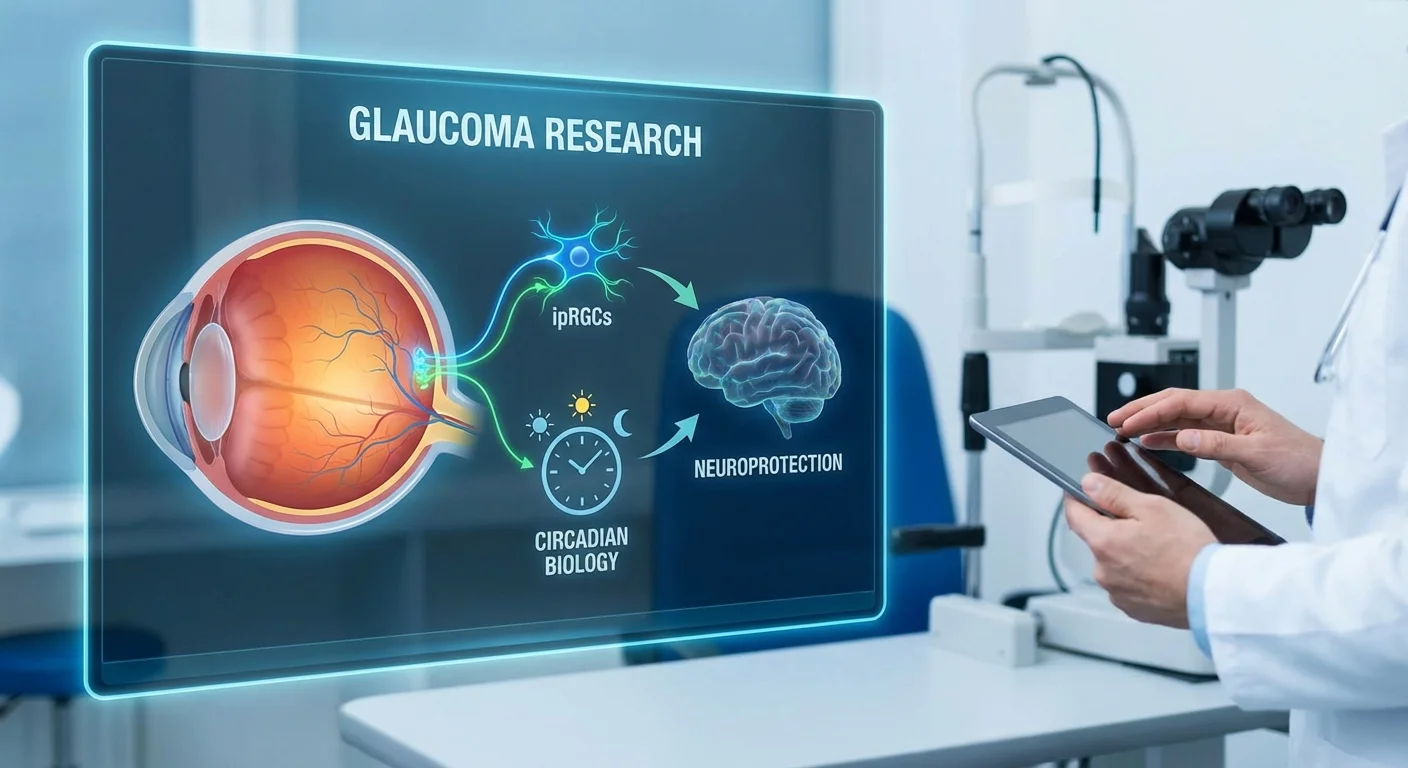
Our eyes do more than just see. Tiny retinal cells called intrinsically photosensitive retinal ganglion cells (ipRGCs) use a special pigment (melanopsin) to detect light – especially blue daylight – and send signals to the brain’s “master clock” (the suprachiasmatic nucleus). This alignment keeps our circadian rhythms on track, regulating sleep, hormone release, and other daily cycles (pmc.ncbi.nlm.nih.gov) (pmc.ncbi.nlm.nih.gov). In glaucoma, these retinal ganglion cells are damaged. As they die off, the clock’s light signals weaken, often leading to circadian disruption and poor sleep (for example, glaucoma patients commonly report daytime sleepiness and fragmented nights) (pmc.ncbi.nlm.nih.gov) (pmc.ncbi.nlm.nih.gov).
In simple terms: because glaucoma hurts the very cells that tell our body when to wake and sleep, a vicious cycle can start where bad sleep and disrupted rhythms may further stress eye health. This article explores how ipRGC loss and circadian problems intertwine with glaucoma, and looks at emerging strategies – melatonin supplements, bright light therapy, and timing treatments – to protect vision and improve sleep. We’ll also discuss tools like sleep trackers and pupil tests researchers use, and what studies are still needed to prove these ideas.
How ipRGCs Connect Light and the Body Clock
Most light-sensing in the eye happens in rods and cones, which form images. But ipRGCs are a unique group of retinal ganglion cells that look for daily light signals, not detailed pictures. They contain melanopsin, which maximally absorbs blue wavelengths (~480 nm) (pmc.ncbi.nlm.nih.gov) (pmc.ncbi.nlm.nih.gov). When ipRGCs detect brightness (especially morning light), they send a steady signal to the brain’s clock. That signal resets and aligns the circadian rhythm (our internal 24-hour cycle) with the outside world (pmc.ncbi.nlm.nih.gov) (pmc.ncbi.nlm.nih.gov).
Because ipRGCs also help control the pupil reflex and mood, they link the eyes and brain in non-visual ways. In glaucoma, ipRGCs are not immune to damage. Studies have shown people with glaucoma have fewer or less healthy ipRGCs (pmc.ncbi.nlm.nih.gov), which means light cues to the clock weaken. Indeed, one research review noted that even early glaucoma causes ipRGC dysfunction, reducing light input to the circadian clock (pmc.ncbi.nlm.nih.gov). As these cells decline, patients often experience sleep and mood changes that go beyond aging alone.
Glaucoma’s Impact on Sleep and Circadian Rhythms
Glaucoma doesn’t just steal vision; it can steal restful nights. Several studies find that glaucoma patients report more sleep problems than peers without glaucoma. For example, one study found glaucoma patients scored higher on daytime sleepiness scales, and this sleepiness was linked to abnormal pupil light responses (a sign of ipRGC loss) (pmc.ncbi.nlm.nih.gov). Other reports show glaucoma patients tend to have shorter or more fragmented sleep at night and feel unusually sleepy by day compared to healthy people (pmc.ncbi.nlm.nih.gov) (pmc.ncbi.nlm.nih.gov).
In large surveys, people with glaucoma were more likely to report insomnia and reduced sleep quality. For instance, a cross-sectional study of over 6,700 individuals found glaucoma was associated with very long or disrupted sleep durations (pmc.ncbi.nlm.nih.gov). Another found glaucoma patients went to bed later, woke up earlier or more often, and had worse overall sleep efficiency than those without eye disease (pmc.ncbi.nlm.nih.gov).
Why? Normally, bright daytime light (especially blue light) suppresses melatonin (our “sleep hormone”) and strengthens the clock signals. But with ipRGC damage, loud light cues aren’t registered properly. Laboratory tests reveal that in early glaucoma models, blue light fails to lower nighttime melatonin as it should (pmc.ncbi.nlm.nih.gov). Similarly, advanced glaucoma patients make less melatonin at night, and even bright light may fail to suppress the small amount they do produce (pmc.ncbi.nlm.nih.gov). In short, the feedback loop between retina, brain clock, and melatonin breaks down, leading to sleep disturbances.
These sleep and circadian issues may worsen general health. Poor sleep is known to affect mood, alertness, and metabolic health. It can also indirectly harm the eye: for example, chronically bad sleep can raise nighttime eye pressure or inflammation, potentially accelerating optic nerve damage (pmc.ncbi.nlm.nih.gov) (pmc.ncbi.nlm.nih.gov).
Melatonin: A Natural Ally for Eye Health?
Melatonin is the hormone that tells our body it’s nighttime. It is normally high in the blood when it gets dark and drops when it’s light (pmc.ncbi.nlm.nih.gov). It also influences eye pressure and retinal function. In glaucoma, research shows melatonin’s usual nighttime rise and day suppression become blunted. Advanced glaucoma patients have delayed melatonin peak times and a lower overall melatonin level (pmc.ncbi.nlm.nih.gov).
Fortunately, supplementing melatonin may help. In one clinical study, glaucoma patients took a small dose of melatonin each night for three months. Researchers found their body night-day temperature cycle aligned better, and crucially their 24-hour eye pressure became more stable (the average IOP dropped and the day-night swings shrank) (pmc.ncbi.nlm.nih.gov). Even on an eye exam test (pattern electroretinogram) that reflects retinal ganglion cell function, the patients showed improvement after melatonin (pmc.ncbi.nlm.nih.gov). Notably, people with more advanced glaucoma (and heavier ipRGC loss) saw the biggest sleep and retinal function gains (pmc.ncbi.nlm.nih.gov). These changes suggest melatonin helped restore some normal circadian control and even protect the remaining retinal cells.
Lab studies back this up: melatonin is a powerful antioxidant and anti-inflammatory molecule in the eye. It guards retinal ganglion cells by neutralizing harmful free radicals, ensuring healthy mitochondria, and blocking cell-death signals (pmc.ncbi.nlm.nih.gov). In other words, melatonin could slow down the neurodegeneration of glaucoma, beyond just improving sleep. While these findings are exciting, more research is needed. We still don’t have large clinical trials confirming the best melatonin dose and timing, or its longterm safety in glaucoma (pmc.ncbi.nlm.nih.gov) (pmc.ncbi.nlm.nih.gov).
Bright Light Therapy: Resetting the Clock
If missing light cues are a problem, can extra light help? In other fields, bright light therapy (like using a 10,000-lux light box in the morning) is known to recalibrate the circadian clock. A small pilot study tried this with glaucoma patients (pmc.ncbi.nlm.nih.gov). Over one month, participants sat in front of a bright light box (10,000 lux for 30 minutes each morning).
The results were promising: after the light therapy period, patients had stronger post-illumination pupil responses. This means their pupils stayed constricted longer after a blue flash of light – a sign of healthier ipRGC signaling (pmc.ncbi.nlm.nih.gov). Patients also reported better sleep quality. Objective measures (wrist actigraphy) didn’t change dramatically, but those who had the biggest pupil improvements tended to show more stable daily activity rhythms (pmc.ncbi.nlm.nih.gov). In short, simple daytime bright light exposure seemed to engage the melanopsin system and improve how rested patients felt (pmc.ncbi.nlm.nih.gov).
While this trial was small, it suggests an easy lifestyle tweak might help some glaucoma patients. Given that ipRGC count falls in glaucoma, giving extra light the eye can see (especially blue light) might strengthen what signals remain. Future larger studies could test longer or more intense light therapy.
Timing Treatments with Your Clock: Chronotherapy
Another idea is chronotherapy – aligning medication timing with the body’s 24-hour cycle. In glaucoma, eye pressure naturally fluctuates over the day-night cycle (often higher at night). Some studies ask: should IOP medications be given in the morning or evening? The answer depends on the drug’s action.
For example, one recent clinical trial compared giving a fixed combination eye drop (latanoprost/timolol) in the morning vs. the evening (pmc.ncbi.nlm.nih.gov). Both schedules lowered pressure, but the morning dose was better at smoothing out the daytime pressure peaks (pmc.ncbi.nlm.nih.gov). The morning group had a greater overall drop in pressure fluctuations than those dosing at night (pmc.ncbi.nlm.nih.gov). This suggests, at least for this medication, that morning timing kept 24-hour eye pressure more stable. Other studies have tested various glaucoma drugs this way, with some differences seen. For instance, beta-blockers work mostly during the day, whereas prostaglandins act throughout 24 hours.
This area is still being explored. For now, patients should follow their doctor’s advice on drop timing. But it’s wise to know that researchers are looking closely at the clock: when we dose medicines could one day become a simple tool to optimize treatment and protect retinal cells.
Monitoring Effects: Sleep Trackers and Pupil Tests
To study these ideas, scientists need ways to measure circadian and ipRGC function in glaucoma patients. Two key tools are actigraphy and pupillometry.
-
Actigraphy – a wrist-worn sensor (like a sleep activity tracker) – can record rest-activity patterns over days. In studies of glaucoma, patients have used actiwatches to document their sleep efficiency and daily rhythm stability (pmc.ncbi.nlm.nih.gov). These data can show if interventions (like light therapy or melatonin) actually make rest-activity cycles more regular.
-
Pupillometry – measuring the pupil’s reaction to light – is used as a window into ipRGC health. In practice, doctors (or researchers) shine a bright blue light flash into one eye and record how the pupil constricts and then dilates over the next several seconds. A strong, sustained constriction (post-illumination pupil response) indicates healthy ipRGC signaling. In glaucoma studies, a reduced pupil response to blue light has been linked with poorer sleep quality and more nerve damage (pmc.ncbi.nlm.nih.gov) (pmc.ncbi.nlm.nih.gov). After an intervention like bright light therapy or melatonin, researchers see if the pupil response improves. Thus, pupillometry serves as a non-invasive biomarker of how well the circadian photoreceptors are working.
By combining actigraphy and pupillometry, doctors could one day stratify patients (e.g. identify who has significant circadian dysfunction) and track if treatments are helping. For instance, a glaucoma patient with very blunted pupil responses and erratic actigraphy might be flagged for circadian-focused therapy.
Gaps and Future Research
The field of circadian neuroprotection in glaucoma is new and intriguing, but many questions remain. Most currently available studies are small or preliminary. For example, the bright light trial had only twenty patients (pmc.ncbi.nlm.nih.gov), and the melatonin study was not randomized (pmc.ncbi.nlm.nih.gov) (pmc.ncbi.nlm.nih.gov). We need larger, rigorous clinical trials to prove that these interventions truly slow glaucoma or improve vision. Key gaps include:
-
Melatonin Studies: Optimal dose and timing are unclear. Studies hint benefits, but we lack long-term placebo-controlled trials (pmc.ncbi.nlm.nih.gov) (pmc.ncbi.nlm.nih.gov). We also need to ensure supplements are safe, especially since melatonin is unregulated as an “over-the-counter” product.
-
Light Therapy Trials: No large trials have tested regular bright light exposure in glaucoma patients. As one review points out, evidence on morning light or outdoor light in glaucoma is virtually absent (pmc.ncbi.nlm.nih.gov). Since people with glaucoma may avoid bright light (due to poor vision), structured therapy could help, but this needs proof.
-
Medication Timing: Beyond one trial for morning vs. evening dosing of one drug (pmc.ncbi.nlm.nih.gov), we need more studies on timing glaucoma drops or laser/surgery relative to circadian patterns. Also, how does altered body clock (like shift work) affect glaucoma risk?
-
Biomarkers as Endpoints: We must validate if changes in actigraphy or pupil tests truly predict vision outcomes. Will an improved PIPR lead to slower vision loss? Or are they just interesting signals? Large trials should incorporate these measures.
In summary, researchers believe that aligning glaucoma care with the body’s clock could offer new protection for the optic nerve. But for now, these ideas are on the horizon. In the clinic, the proven strategies remain: control eye pressure, protect the visual field, and encourage good sleep habits. Habits like strong daytime light exposure and consistent sleep schedules are generally healthy and low-risk, so they can be recommended even while studies continue.
Conclusion
Glaucoma is more than an eye pressure disease – it affects the whole body’s rhythms. Damage to ipRGCs in glaucoma patients can disrupt sleep and hormone cycles, and poor sleep in turn may worsen eye health. Evidence is growing that we might help break this cycle with circadian-friendly treatments. Melatonin supplements have shown promise in lowering eye pressure and boosting retinal signals (pmc.ncbi.nlm.nih.gov) (pmc.ncbi.nlm.nih.gov). Light therapy (especially morning bright light) may awaken the disrupted melanopsin system and improve sleep quality (pmc.ncbi.nlm.nih.gov). Even simply fine-tuning when patients take their eye drops could make 24-hour pressure control tighter (pmc.ncbi.nlm.nih.gov).
Doctors and patients should be aware of these connections. If a glaucoma patient complains of insomnia or daytime sleepiness, it’s worth exploring whether circadian factors play a role. Clinicians can consider sleep hygiene advice, morning light exposure, and careful scheduling of medications – while we await stronger trial evidence.
In the future, tools like actigraphy watches and pupil light response tests might help ophthalmologists personalize care. Imagine a time when a simple pupil exam and sleep diary tell your doctor exactly how to sync your glaucoma treatment with your body clock. Before that, more research is needed. For now, keeping a regular sleep schedule, getting ample daylight, and discussing any sleep issues with your doctor can be beneficial steps. Science is just beginning to unlock the “around-the-clock” care of glaucoma, and ongoing studies will determine which of these natural interventions truly protect vision and improve life for patients.