
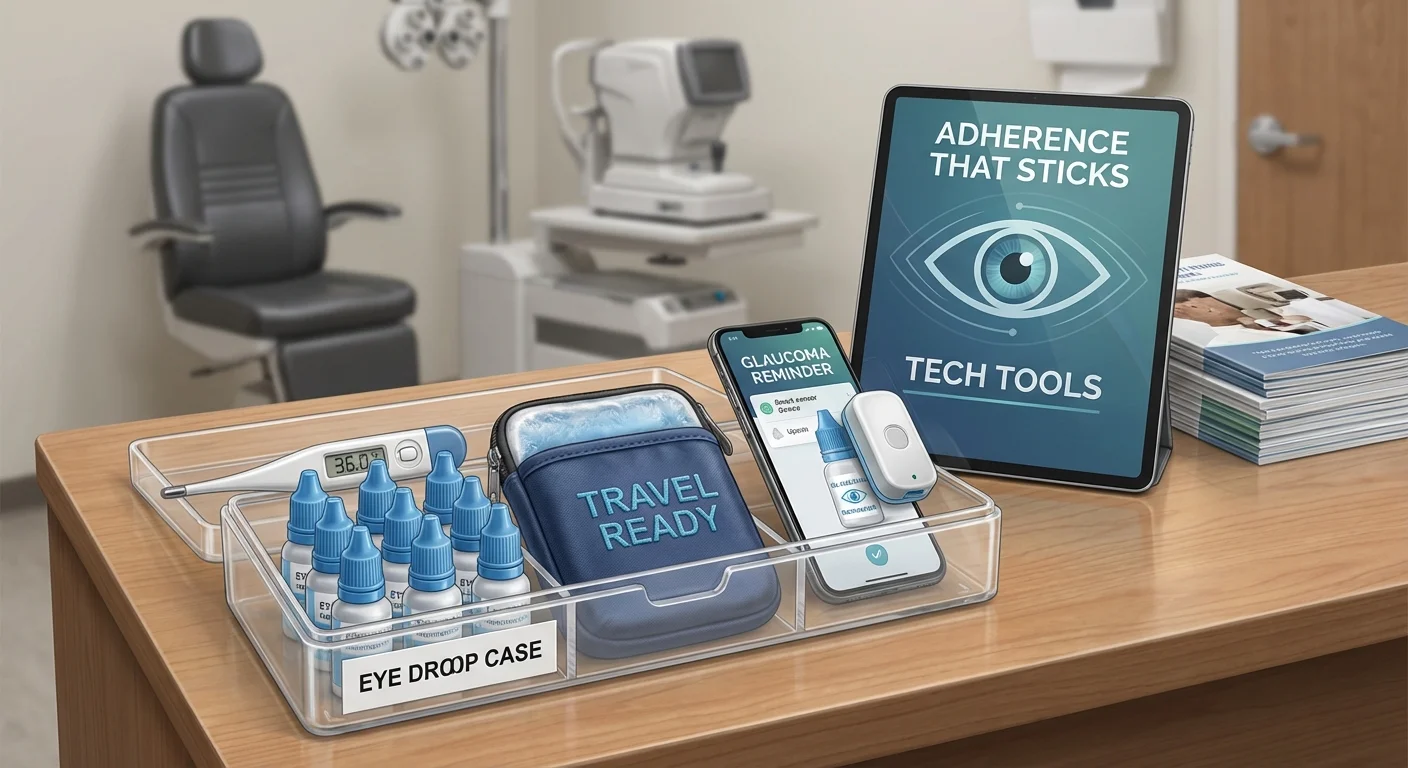
Adherence That Sticks: Storage, Travel, and Tech Tools for Glaucoma Drops
Consistent use of glaucoma eye drops is vital for controlling eye pressure and protecting your vision. Many patients find it hard to remember or manage their drops every day. The good news is that simple habits, reminders, and technology can help. Below, we explore practical strategies to make taking your eye drops a seamless part of your life, plus tips on storing and carrying them safely.
Building a Daily Drop Routine
The key to taking glaucoma drops regularly is tying them to habits you already do. For example, put your eye drops next to your toothbrush or coffee maker so you use them when you brush your teeth or have your morning coffee. This technique is often called habit stacking: linking a new task (your eye drops) to an established routine (like breakfast) to make it almost automatic (pmc.ncbi.nlm.nih.gov).
-
Anchor drops to daily routines. Choose regular cues – such as meals, waking up, or going to bed – and take your drops at that time. Studies show that anchoring medication to stable routines helps overcome forgetfulness (pmc.ncbi.nlm.nih.gov). For instance, if you brush your teeth every night, make it a rule to instill your drop right after you brush.
-
Use visible reminders. Physical cues can help too. Keep your drops on the kitchen counter, next to your nightstand lamp, or any place you cannot miss. A note on the bathroom mirror or a sticker on your pillbox can prompt you when it’s time for your drops.
-
Set alarms or calendar alerts. Many patients find phone alarms, calendar reminders, or smart watch notifications very helpful. You can set a repeating alarm on your phone with a label like “Eye Drop Time.” According to experts, external reminders – like alarms, text notifications, or visual alerts – are proven ways to improve medication adherence (pmc.ncbi.nlm.nih.gov). There are even free smartphone apps designed for eye drop reminders. These apps (for example, the EyeDropAlarm app) send alerts at scheduled times so you won’t forget (link.springer.com). You do not need any special device; a plain phone alarm, calendar event, or tablet notification works just as well.
-
Consider smart caps and devices. Technology has come a long way. Special “smart” bottle caps with timers exist: they attach to the medicine bottle and beep or flash when it’s time for your dose (pmc.ncbi.nlm.nih.gov). Some can alert you with lights or sounds exactly at the right interval. For example, one electronic cap system was designed to beep and flash when each dose was due, and it even shows a countdown timer between doses (pmc.ncbi.nlm.nih.gov). (These smart caps are not yet widely used for eye drops, but they illustrate how technology can help.) There are also electronic dosing aids and sensor-enabled bottles in development that work with smartphones to track when you use a drop (link.springer.com) (pmc.ncbi.nlm.nih.gov). For now, the simplest tech is a reminder app or alarm, but keep an eye out as new devices come to market for medication reminders.
Proper Storage of Glaucoma Drops
How you store your eye drops can affect their strength. Always check the label or leaflet that comes with your drops, because different medications can have different storage rules. Here are general tips:
-
Refrigeration vs. Room Temperature: Some glaucoma drops must be kept cold until opened, while others live safely on a shelf. For instance, latanoprost drops (brands like Xalatan) must be refrigerated (around 36–46°F) before you open them (www.dailymed.nlm.nih.gov). During shipping or travel, temps up to 104°F for a short time are usually allowed (www.dailymed.nlm.nih.gov). Once opened, latanoprost can be kept at room temperature (up to about 77°F) for about 6 weeks (www.dailymed.nlm.nih.gov). In contrast, travoprost (Travatan Z) and timolol drops can be stored at normal room temperature without refrigeration (dailymed.nlm.nih.gov) (dailymed.nlm.nih.gov). For example, travoprost simply says “store at 36–77°F,” and timolol says “store at 59–86°F, protect from freezing” (dailymed.nlm.nih.gov) (dailymed.nlm.nih.gov). In practice, this means that travoprost and timolol bottles are fine on a bathroom shelf or bedside table. Always look at the “Storage” section of your eye drop’s label or ask the pharmacist if you’re unsure.
-
Protect from light and heat: Even for drops that do not require cold storage, avoid extreme conditions. Keep bottles away from direct sunlight, heaters, or very warm cars, as heat and light can weaken the medicine. Likewise, do not let them freeze. A frozen drop solution may not work the same. If you do accidentally freeze a bottle, mention it to your doctor or pharmacist — they may recommend replacing it.
-
Check expiration and discard in time: After you open a drop bottle, it usually has a limited use period. Many drops are good for 4–6 weeks after opening (check the label). Write the open date on the bottle. If your pharmacy gave you a “discard after X days” sticker, adhere to that timeline. Using an old, expired drop may reduce its effectiveness or even risk eye irritation. In short, keep an eye on dates and replace bottles as needed.
Travel Tips for Glaucoma Drops
Going on a trip doesn’t mean you have to miss a dose. Plan ahead with these travel strategies:
-
Pack enough drops (and extras!). Count how many days you’ll be away, and bring a little more than required in case your return is delayed. Keep your eye drops in their original, labeled bottles if possible. Even though TSA (airport security) does not require it, having your prescription name on the bottle is helpful (glaucoma.org). Label information and a doctor’s letter (especially for international travel) can ensure you face no issues.
-
Air Travel: According to the TSA, all prescription medications are allowed in carry-on luggage, even liquids beyond the usual 3-ounce limit (glaucoma.org) (glaucoma.org). When you go through security, let the officer know you have medically necessary liquids. You don’t have to pack them in a clear bag – just present them separately for inspection. They may be X-rayed or visually checked for proof. It’s a good idea to bring your drops in your hand luggage (not checked baggage) so you always have them with you (glaucoma.org).
-
At Security: If you’re carrying eye drops, tell the screener at the start of the check. They will inspect them carefully (they might ask you to open the container). This is routine for any medicine. TSA specifically notes there is no volume limit for essential meds in your carry-on (glaucoma.org). Some travelers find it helpful to have a note from their doctor saying they have glaucoma and need daily drops, but usually the prescription label is enough.
-
-
Keep drops accessible: During traveling, routine can get disrupted. Set your phone’s clock to the local time at your destination and set your reminders accordingly. For example, if you take a drop at bedtime back home but now you are in a different time zone, decide what “bedtime” means locally (or consult your doctor for a plan). In general, do not skip doses because of time change. If you cross only a few hours, you can often continue your usual schedule without harm. If the time change is large, a common approach is to take your drops at an appropriate local time as soon as possible. If in doubt, just continue taking them with the same interval (e.g. every 12 hours) and talk to your doctor if the schedule is confusing.
-
Carry-ons versus checked bags: Always put your medications and eyedrops in your carry-on. This way if your checked luggage is lost or delayed, you still have your medicine (glaucoma.org). Also, cabin temperatures are more controlled. If your drops need refrigeration, consider a small insulated travel bag or a chilled pack that meets air travel rules (you can buy little gel packs that stay cool without freezing). But remember not to freeze the drops (even refrigerated ones should not be frozen solid).
-
During the flight: Airplane cabins are usually quite dry. That doesn’t mean your drops need protection from drying out (they are sealed), but it does mean your eyes can become dry. Carry artificial tears if recommended. Stick to your drop schedule; having an alarm on the flight can help. Also drink water to stay hydrated.
Troubleshooting Doses
Even with routines, sometimes things slip. Here is what to do in common situations:
-
If you miss a dose: Stay calm. If you realize you forgot and it’s not yet close to your next scheduled dose, go ahead and put the drop in as soon as you remember (www.glaucomapatients.org). If you only notice when it’s almost time for the next dose, skip the missed one and stick to your normal schedule. For instance, if you give one drop in the morning and evening and you forgot the evening dose until late at night, it’s usually better to wait until the next morning’s dose and keep going (rather than doubling up that night). Never try to “double” eye drops—one drop is all that You should use per dose, and taking more can cause extra side effects.
The Glaucoma Patients Society advises that if a regular dose is missed but it’s long before the next dose, you should use it right away (www.glaucomapatients.org). However, if the next dose is due within a few hours, just continue with your regular timing and skip what you forgot (www.glaucomapatients.org). In summary: “Soon after you remember: use it. If almost time for the next drop: skip it.” If you are ever unsure (for example, if you missed multiple doses or aren’t sure how to space out your doses), call your doctor or pharmacist for advice.
-
If you run out of drops early: First, know that this is a common issue. Sometimes drops miss the eye and are wasted, and insurers historically restricted refill timing. The Glaucoma Research Foundation notes that many patients go through a bottle before the insurance refill schedule allows (glaucoma.org). Here’s how to handle it:
-
Track your usage: Keep a log of when you start and finish bottles. If you find you always run out early, talk with your pharmacist or doctor. They know roughly how many drops should come in a bottle, and can help you plan.
-
Talk to your doctor/pharmacist: Explain the situation. The American Academy of Ophthalmology (AAO) and American Glaucoma Society have worked with insurers to allow early refills for glaucoma drops when needed (glaucoma.org). Tell your doctor that you may need more frequent refills. Sometimes doctors can note on the prescription that you get 30 drops per eye and there’s normal waste, prompting the pharmacy to give more. Pharmacies may also call insurance companies to get approval to override refill limits.
-
Keep extras in hand: If you get a refill early one month, you might have leftovers. You could temporarily store an extra, but be mindful of expiration dates and storage conditions. Use extras first if you get new ones (first in, first out).
-
Never mix drops: If you run completely out unexpectedly, do not start substituting with over-the-counter drops (unless specifically advised by your doctor). Stick with your prescription medication.
-
Conclusion
Managing glaucoma medication can feel challenging, but small changes in routine and using available tools can make it much easier. Anchor your drops to daily activities, use alarms or apps for reminders, and consider technology like smart caps or apps when available (pmc.ncbi.nlm.nih.gov) (link.springer.com). Store your bottles as directed (some need refrigeration, others don’t) (www.dailymed.nlm.nih.gov) (dailymed.nlm.nih.gov) and always carry extras with you when traveling (glaucoma.org) (glaucoma.org).
Being prepared (packing extra, knowing TSA rules, adjusting for time zones) and having a plan for missed doses or early refill issues will keep your treatment on track. If problems persist, talk openly with your eye doctor or pharmacist—they deal with these questions every day. Following these tips can help you stick with your glaucoma drops, preserve your vision, and give you peace of mind.