
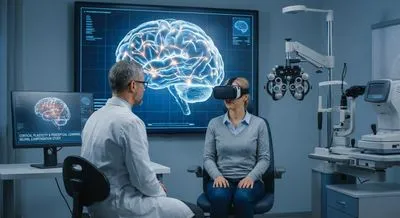
Cortical Plasticity and Perceptual Learning: Can the Brain Compensate for Optic Nerve Damage?
Interestingly, many glaucoma patients have little awareness of their blind spots. This perceptual filling-in – where the brain “fills” missing...
Deep research and expert guides on maintaining your visual health.
Interestingly, many glaucoma patients have little awareness of their blind spots. This perceptual filling-in – where the brain “fills” missing...
Our visual field test is inspired by the perimetry methods eye care professionals use. Check for blind spots and track changes over time.
Test Your VisionCortical plasticity is the brain’s ability to change the structure and function of its outer layer, the cerebral cortex, in response to experience, learning, or injury. It means that connections between brain cells can strengthen, weaken, be pruned away, or form anew, allowing the brain to reorganize how it processes information. These changes can happen quickly, within minutes or hours, and also over long periods of weeks, months, or years. Plasticity is strongest during early development but continues in adulthood, giving adults the ability to learn new skills and recover some function after damage. The underlying mechanisms include changes in the strength of synapses, growth of new branches on neurons, and unmasking of existing pathways that were previously less active. Scientists measure cortical plasticity with brain imaging, electrical recordings, and by observing improvements in behavior and skills. It matters because this flexibility is the biological basis for learning, memory, and adaptation to changing environments. Cortical plasticity also underlies recovery after injury, making it a key concept for rehabilitation strategies following stroke, sensory loss, or brain trauma. However, plasticity has limits: it may not fully restore lost abilities after severe damage and is generally greater in younger brains. Sometimes plastic changes can be harmful, contributing to chronic pain or persistent tinnitus when brain circuits reorganize in maladaptive ways. Understanding cortical plasticity helps researchers and clinicians design training programs, therapies, and technologies that support beneficial brain change while minimizing negative outcomes.