
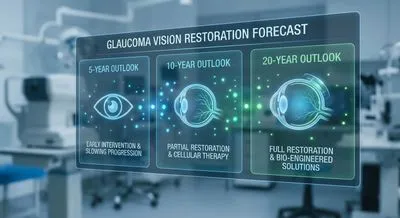
Forecasting Glaucoma Vision Restoration: 5-, 10-, and 20-Year Outlook
In the next few years, the emphasis will be on neuroprotection/neuroenhancement – therapies that aim to preserve or slightly improve the function of...
Deep research and expert guides on maintaining your visual health.
In the next few years, the emphasis will be on neuroprotection/neuroenhancement – therapies that aim to preserve or slightly improve the function of...
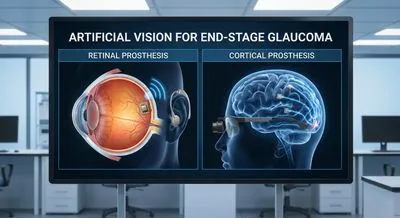
In conditions like retinitis pigmentosa or macular degeneration, the photoreceptors die but RGCs and optic nerve remain intact () (). Retinal...
Track peripheral vision changes between eye doctor visits. Start your free trial and get results in under 5 minutes.
A cortical prosthesis is an implanted device that stimulates neurons in the visual cortex—the part of the brain that processes visual information—to create perceptions of light or shapes in people who are blind. Instead of working through the eye and optic nerve, this approach bypasses damaged ocular structures by directly interfacing with brain tissue. The system generally includes an external camera or sensor, a processor to translate images into stimulation patterns, and an electrode array placed on or within the visual cortex to deliver those patterns. When the brain receives these electrical signals, users may perceive spots, lines, or forms that can be trained into useful visual cues. Because the device targets the brain’s processing center, it can help people whose eyes or optic nerves are not functional. Cortical prostheses matter because they expand the possibility of restoring vision to people who cannot benefit from eye-based devices. They could potentially offer broader applicability across different causes of blindness, but they also bring unique challenges such as complex surgery, the need for precise placement and calibration, long-term stability of neural interfaces, and careful rehabilitation. Ethical and safety considerations are important, and successful outcomes depend on both engineering advances and the brain’s ability to adapt to new kinds of input. Ongoing work aims to improve resolution, reduce invasiveness, and create stimulation strategies that produce clearer, more naturalistic perceptions.