
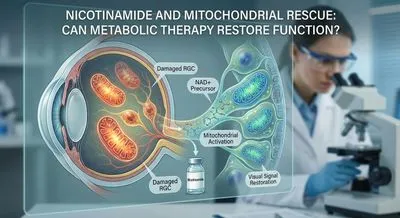
Nicotinamide and Mitochondrial Rescue: Can Metabolic Therapy Restore Function?
RGCs have extremely high metabolic demands and rely on robust mitochondrial function. In glaucoma, aging and chronic stress trigger progressive NAD+...
Deep research and expert guides on maintaining your visual health.
RGCs have extremely high metabolic demands and rely on robust mitochondrial function. In glaucoma, aging and chronic stress trigger progressive NAD+...
Visual field loss from conditions like glaucoma can go unnoticed. Start a free trial and screen for potential blind spots in minutes.
Retinal ganglion cells (RGCs) are neurons located at the back of the eye that collect processed visual signals from other retinal cells and send them to the brain. They sit in a layer called the ganglion cell layer, and their long fibers bundle together to form the optic nerve. Each RGC responds to specific features of the visual scene—such as light intensity, contrast, motion, or edges—and converts those signals into electrical impulses called action potentials. There are multiple types of these cells with distinct roles: some convey fine detail and color, others detect movement, and a special subset senses overall light levels to help control the pupil and daily biological rhythms. Because they are the final output cells of the retina, RGCs are essential for forming the visual messages that reach the brain for recognition and awareness. Damage to these cells causes permanent vision loss in many cases because they do not regenerate well, so diseases that harm RGCs can have serious and lasting effects. Glaucoma is the best-known condition that slowly kills RGCs, but they can also be injured by reduced blood flow, inflammation, inherited disorders, or problems with cellular energy. Researchers study these cells to understand why vision fails and to develop treatments that protect them or restore function, using approaches like lowering stress on the nerve, improving blood and nutrient supply, or supporting cell metabolism. Measuring RGC health is also useful for early diagnosis of eye disease and for tracking whether a therapy is working. In short, retinal ganglion cells are the critical link between the eye and the brain, and keeping them healthy is central to preserving sight and many light-driven bodily functions.