
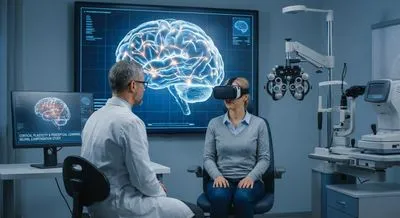
Cortical Plasticity and Perceptual Learning: Can the Brain Compensate for Optic Nerve Damage?
Interestingly, many glaucoma patients have little awareness of their blind spots. This perceptual filling-in – where the brain “fills” missing...
Deep research and expert guides on maintaining your visual health.
Interestingly, many glaucoma patients have little awareness of their blind spots. This perceptual filling-in – where the brain “fills” missing...
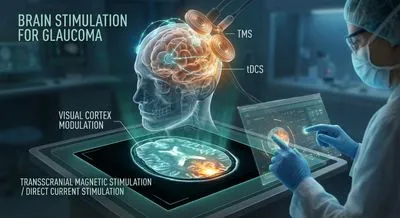
Vision outcomes: Measured outcomes have included visual field indices (e.g. detection accuracy or mean defect in perimetry) and sometimes contrast...
Screen your peripheral vision from home — no downloads, no waiting rooms. Sign up for a free trial and test in under 5 minutes.
Neuroplasticity is the brain’s ability to change its structure and function in response to experience, learning, or injury. It means that neurons and their connections can strengthen, weaken, form new links, or even reroute tasks to different areas when needed. These changes happen at many levels, from tiny shifts in how chemical signals pass between cells to larger rewiring over months or years. Neuroplasticity allows you to learn a new language, improve at a musical instrument, or get better at a skill with practice. It also underlies recovery after brain injury: undamaged regions can sometimes take over functions lost by damaged areas. Plasticity is strongest in early life but continues throughout adulthood, which is why people can keep learning and adapting. The process can be helped or hindered by things like sleep, nutrition, stress, and targeted training. Not all plastic changes are helpful — some lead to chronic pain or persistent bad habits when the brain reinforces unhelpful patterns. Understanding neuroplasticity matters because it gives a scientific basis for rehabilitation, education, and therapies that aim to reshape how the brain works for better outcomes.