
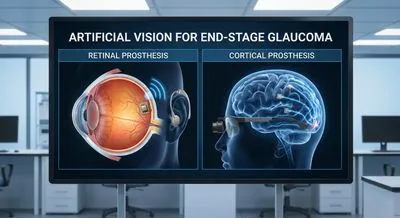
Artificial Vision for End-Stage Glaucoma: Retinal vs. Cortical Prostheses
In conditions like retinitis pigmentosa or macular degeneration, the photoreceptors die but RGCs and optic nerve remain intact () (). Retinal...
Deep research and expert guides on maintaining your visual health.
In conditions like retinitis pigmentosa or macular degeneration, the photoreceptors die but RGCs and optic nerve remain intact () (). Retinal...
Blind spots often develop gradually without symptoms. Start a free trial and take a quick visual field test to spot changes early.
Find Out NowORION is the name given to a type of cortical visual prosthesis designed to restore some degree of sight by directly stimulating the visual part of the brain. Instead of relying on a working eye or retina, the system captures images with a camera, processes those images, and sends electrical signals to a small array of electrodes placed on the visual cortex. When the brain receives these pulses, people perceive small flashes or points of light called phosphenes, and with training those flashes can be interpreted as basic shapes, movement, or contrast. The goal is not to recreate normal vision but to provide useful visual cues that help with orientation, object detection, and mobility for people who are otherwise blind because the eye or optic nerve can no longer transfer information. ORION matters because it offers a route to vision for people whose retinal cells or optic pathways are too damaged for retinal implants to help. By bypassing the eye entirely, it can be useful in conditions where damage is deeper in the visual system. The approach also highlights important trade-offs: the surgery to place electrodes on the brain is more invasive than eye surgery, and the amount of detail delivered is limited by electrode number and the brain’s response. Users need rehabilitation and practice to learn how to interpret artificial visual signals, and researchers are working on better electrode designs, wireless systems, and smarter image processing to improve outcomes. As a research and clinical effort, ORION represents an important step toward practical devices that can increase independence and quality of life for people with severe vision loss.